
 Worksheets
Quarter 2 Test Review
Total questions: 85
Worksheet time: 1hrs 15mins
Name
Class
Date
1.
If a material absorbs all frequencies of light waves EXCEPT green, what color will be perceived by the observer?
a)
Green
b)
White
c)
Black
d)
Yellow
2.
If all light waves are absorbed by a medium, then what color will be perceived?
a)
White
b)
Black
c)
Red
d)
Green
3.

What property of the wave is represented by the letter "B"?
a)
amplitude
b)
crest
c)
trough
d)
wavelength
4.

What property of this wave is represented by the letter "A"
a)
amplitude
b)
crest
c)
trough
d)
wavelength
5.
The highest point on a wave is:
a)
the crest
b)
the trough
c)
the top
d)
the coast
6.
The lowest point on a wave is the:
a)
Amplitude
b)
Crest
c)
Trough
d)
Wavelength
7.
The number of wavelengths that pass a point each per second is:
a)
frequency
b)
period
c)
longitudinal
d)
transverse wave
8.
When the frequency of a wave increases, what happens to the wavelength?
a)
The wavelength is not directly affected by the frequency of a wave.
b)
The wavelength increases.
c)
The wavelength decreases.
d)
More specific information is needed to form a conclusion about the wavelength.
9.
A mechanical wave cannot travel through...
a)
a vacuum(empty space).
b)
water.
c)
air.
d)
glass.
10.
regular disturbances that carry energy through matter or space
a)
crest
b)
energy
c)
wave
d)
trough
11.

What kind of wave is this?
a)
Transverse
b)
Longitudinal
12.

What kind of wave is this?
a)
Transverse
b)
Longitudinal
13.
Select the correct order of waves on the Electromagnetic Spectrum
a)
Radio, Micro, Infra, Visible, Ultra, X-ray, Gamma
b)
Gamma, X-ray, Ultra, Vis, Infra, Micro, Radio
c)
Vis, Micro, Infra, Ultra, X-ray, Gamma, Radio
d)
Micro, Radio, Vis, Infra, Ultra, X-ray, Gamma
14.

Which of the following represents refraction?
a)
A
b)
B
c)
C
d)
D
15.
how is the electromagnetic spectrum organized?
a)
crest
b)
amplitude
c)
trough
d)
wavelength
16.
Objects can do which of the following?
a)
Reflect light
b)
Absorb Light
c)
Transmit light
d)
All of the above
17.
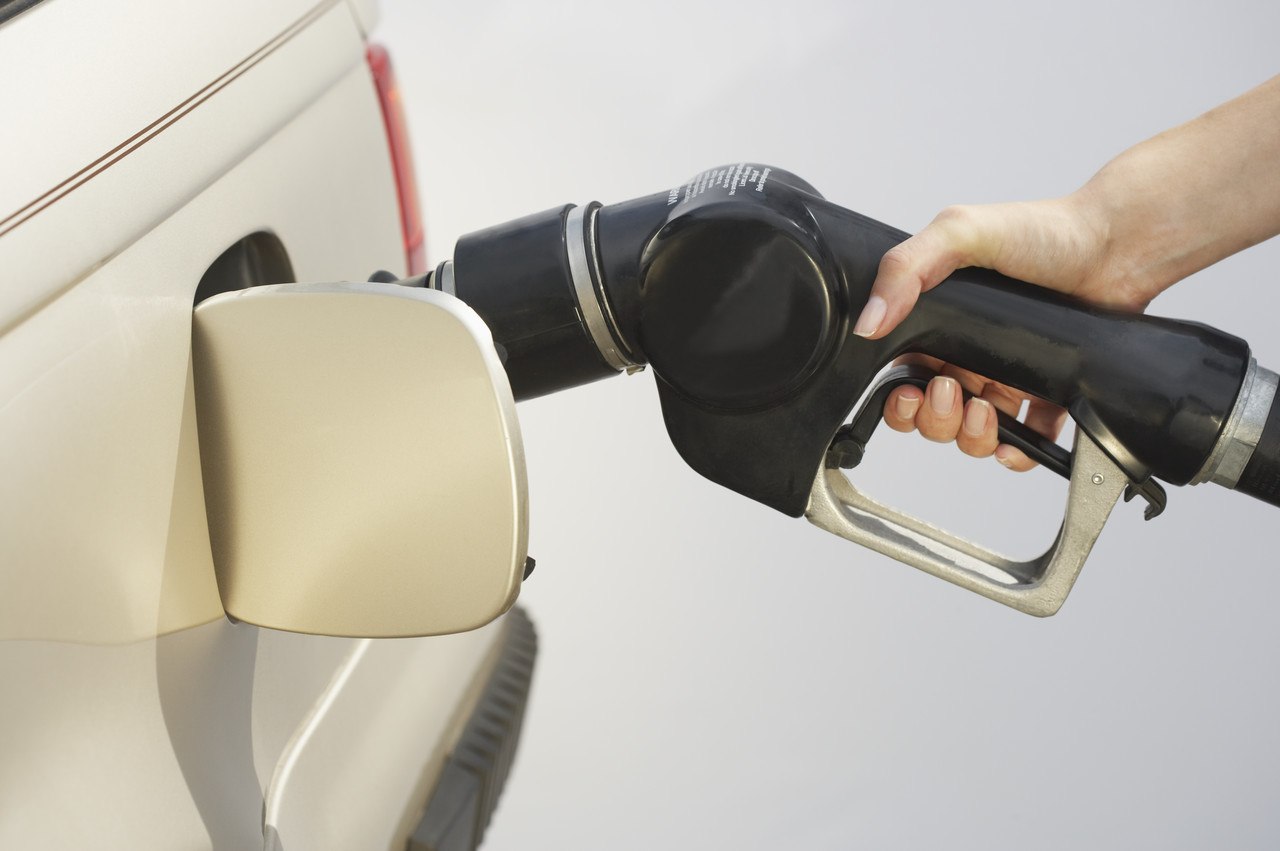
Which energy conversion is taking place when you put gasoline in a car?
a)
thermal -> electrical
b)
mechanical -> electrical
c)
chemical -> mechanical
d)
mechanical -> electromagnetic
18.

Electrical Energy is transferred to _____ Energy.
a)
Thermal
b)
Solar
c)
Electrical
d)
None
19.
According to the Law of Conservation of Energy, energy cannot be _________ or ____________.
a)
destroyed, destroyed
b)
created, saved
c)
created, destroyed
d)
lost, found
20.

A battery converts what type of energy to another?
a)
sound to kinetic
b)
light to heat
c)
mechanical to electrical
d)
chemical to electrical
21.
Energy transformations occur when...
a)
energy is created through conduction
b)
energy changes from one form to another
c)
two forces slide together that are touching
d)
a chemical reaction takes place
22.
What is energy changing from one form to another?
a)
energy conservation
b)
energy transformation
c)
energy creation
d)
mechanical energy
23.
Which of the following contains forms of Kinetic energy ONLY?
a)
Chemical, thermal, gravitational, electric
b)
radiant, electrical, thermal, sound
c)
sound, chemical, thermal, gravitational
d)
radiant, thermal , chemical, sound
24.
Which of the following contains forms of Potential energy, ONLY?
a)
chemical, sound, thermal, nuclear, sound
b)
radiant, thermal, sound
c)
chemical, gravitational, stored mechanical
d)
stored mechanical, thermal, sound
25.

A student listens to music with a digital music player, similar to the one shown below. Which best describes the energy transformations that take place in the music player?
a)
Mechanical to chemical to electrical
b)
Chemical to sound to electrical
c)
Chemical to electrical to sound
d)
Electrical to heat to sound
26.

If you drop a basketball, it will bounce, and then roll, and finally stop.
Why won't a basketball bounce forever?
Why won't a basketball bounce forever?
a)
The ball weighs too much, and that makes it stop.
b)
Gravity pulls the ball down more than the ball can bounce.
c)
It's Potential Energy gets destroyed as it bounces.
d)
It's energy is transformed into other types of energy.
27.

The diagram shows a circuit with the bulb glowing. How does the energy change as it moves from inside the battery, along the wires, and through the light bulb?
a)
electrical → light → chemical
b)
light → electrical → chemical
c)
chemical → electrical → light
d)
chemical → light → electrical
28.

What does this graph represent?
a)
Constant Speed
b)
Acceleration
c)
Deacceleration
d)
Not moving
29.

According to the graph how far does the person travel in the first 5 seconds?
a)
2 m
b)
10 m
c)
0 m
d)
5 m
30.

What is the person doing from 5 seconds to 10 seconds?
a)
Walking
b)
Running
c)
Standing Still
d)
Walking Fast
31.

What is happening at E?
a)
Stationary
b)
Accelerating
c)
Fast steady speed; moving away from the starting position
d)
Steady speed; returning to start position
32.

Alan travels 100 km in 5hrs. Find his average speed in km/h
a)
5km/hr
b)
10km/hr
c)
50km/hr
d)
20km/hr
33.

What does this graph represent?
a)
Constant speed
b)
Acceleration
c)
Not moving
d)
Constant
34.

What is the total distance the object moved at 13 hours?
a)
.92 km
b)
0 km
c)
12 km
d)
1.92 km
35.
What force is acting on all objects?
a)
gravity
b)
balanced force
c)
unbalanced force
d)
mass
36.

A ____________ is a push or a pull on an object.
a)
friction
b)
force
c)
magnet
d)
gravity
37.
What will cause an object to move?
a)
Applied forces
b)
Balanced forces
c)
Unbalanced forces
38.

If an object is not moving the forces acting upon it are _____________
a)
unbalanced
b)
weak
c)
balanced
d)
Hulk Smash!
39.
According to the Law of Conservation of energy, the amount of energy before and after a reaction must be the same. Which statement below is true?
a)
The total amount of energy is conserved
b)
The total amount of energy is less after a reaction
c)
The total amount of energy is more after a reaction
40.

Where does the most potential energy exist on a roller coaster?
a)
The top of the coaster
b)
The bottom of the coaster
c)
The middle of the coaster
d)
It is the same anywhere on the coaster
41.

________ is the energy possessed by an object because of its motion.
a)
Power
b)
Force
c)
energy
d)
kinetic energy
42.
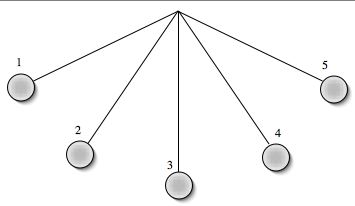
When a pendulum swings, at which point is kinetic energy highest?
a)
1
b)
2
c)
3
d)
4
43.
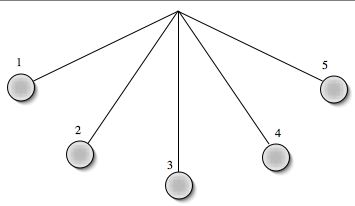
When a pendulum swings, at which point is potential energy at its greatest?
a)
1
b)
2
c)
3
d)
4
44.
The two factors that determine kinetic energy are ____________________________ & ____________________________.
a)
mass and height
b)
height and gravity
c)
gravity and velocity
d)
mass and velocity
45.
What size resistor would produce a 3 Amp current flow with a 12 Volt battery
a)
1 Ohm
b)
3 Ohms
c)
4 Ohms
d)
12 Ohms
46.
What is Ohm's Law?
a)
V=W/Q
b)
1-800-HOTLINEBLING
c)
V=IR
d)
dy/dx
47.

This is an example of a _______ circuit
a)
open
b)
series
c)
parallel
d)
square
48.
The movement of electrons from atom to atom in a line results in a flow of _____.
a)
amperage.
b)
electric current.
c)
electromagnetic connectors.
49.

This is an example of a ______ circuit
a)
Series
b)
Parallel
c)
Open
d)
Dihexihedral
50.
How does flipping a switch turn a light on?
a)
It steps up the voltage
b)
It generates an electromagnetic field
c)
It opens a circuit
d)
It closes a circuit
51.
If you decrease the voltage of a circuit, what happens?
a)
Current decreases
b)
Current increases
c)
Electrons disappear
d)
Bulbs get brighter
52.
If you increase the voltage of a circuit, what happens?
a)
Current decreases
b)
Current increases
c)
Electrons disappear
d)
Bulbs get dimmer
53.
If you decreases the resistance of a circuit, what happens?
a)
Current decreases
b)
Current increases
c)
Electrons disappear
d)
Bulbs get brighter
54.
If you increase the resistance of a circuit, what happens?
a)
Current decreases
b)
Current increases
c)
Electrons disappear
d)
Bulbs get brighter
55.
What 'flows' in a wire?
a)
Protons
b)
Neutrons
c)
Atoms
d)
Electrons
56.
Insulation is used in the walls of a building to ____.
a)
trap solar energy
b)
keep thermal energy from moving through the walls
c)
conduct thermal energy
d)
keep cold air from moving through the walls
57.
When a popsicle melts, the particles _____.
a)
gain thermal energy and speed up
b)
there are no particles in popsicles
c)
lose thermal energy and slow down
d)
stay the same
58.
Identify and explain the different types of heat transfer (convection, conduction, radiation) occurring in the following scenario. Chris went on a camping trip. During the day it was so hot that he got sunburn. When it was time to go to his campsite, he noticed smoke in the air. His father had started a fire and he felt the heat as he walked by. In the morning while his mother was cooking breakfast he accidentally touched a hot pan and got burned. Although this was the case he still had a lot of fun on the trip.
a)
Sunburn = radiation;
Smoke rising = convection;
Feeling fire = radiation;
Touching hot pan = convection
Smoke rising = convection;
Feeling fire = radiation;
Touching hot pan = convection
b)
Sunburn = radiation;
Smoke rising = conduction;
Feeling fire = radiation;
Touching hot pan = conduction
Smoke rising = conduction;
Feeling fire = radiation;
Touching hot pan = conduction
c)
Sunburn = radiation;
Smoke rising = convection;
Feeling fire = radiation;
Touching hot pan = conduction
Smoke rising = convection;
Feeling fire = radiation;
Touching hot pan = conduction
59.

The average kinetic energy in an object.
a)
convection
b)
temperature
c)
Heat
d)
radiation
60.

Two cups of water, one at 100oC and the other at 50oC are poured into a larger container. What would be the final temperature of the water?
a)
Less than 50oC.
b)
Greaterr than 100oC.
c)
Between 50oC and 100oC.
d)
The water temperature will rise and fall continually.
61.

An ice cube feels cold in your hand because:
a)
your hand is an insulator
b)
heat flows from your hand to the ice cube
c)
cold flows from the ice cube to your hand
d)
there is friction between your hand and the ice cube
62.

What is the definition of CONVECTION?
a)
When heat transfers through the heater or AC in your house.
b)
When heat transfers from objects that are touching.
c)
A hot liquid or air that expands, becomes less dense, and rises or becomes more dense, and sinks.
63.

The chocolate bunny and the iron is an example of:
a)
conduction
b)
convection
c)
radiation
d)
chlorination
64.

The chocolate bunny and the blow dryer is an example of:
a)
conduction
b)
convection
c)
radiation
d)
florination
65.

The chocolate bunny and the lamp is an example of:
a)
conduction
b)
convection
c)
radiation
d)
radicalization
66.

What would be the effect on the particles if more heat is supplied to the system?
a)
They would slow down
b)
They would stop moving
c)
They would speed up
d)
There would be no effect
67.

You can't hear sounds in outer space because there is no
a)
matter
b)
light
c)
energy
d)
heat
68.

Which of the following is NOT a mechanical wave?
a)
sound
b)
light
c)
ocean
d)
seismic
69.

Leaves are green because green is reflected and all the other colors are _____.
a)
transmitted
b)
refracted
c)
absorbed
70.
A force exerted over a distance to move an object is ______________________.
a)
power
b)
work
c)
momentum
d)
Watt
71.
A 5000N block is lifted 10 m. How much work was done?
a)
50000 J
b)
5000 J
c)
500 J
d)
50 J
72.
The amount of work done in a certain amount of time is known as
a)
work
b)
effort force
c)
resistance force
d)
power
73.
If a group of workers can apply a force of 1,000 Newtons to move a crate 20 meters, what amount of work will they have accomplished?
a)
20,000 J
b)
200 J
c)
2,000 J
d)
20 J
74.
How much time is needed to produce 720 Joules of work if 90 watts of power is used?
a)
0.125 s
b)
8 s
c)
64800 s
d)
80 s
75.
What is the equation for power?
a)
P = Work/time
b)
P = Force/time
c)
P = time/distance
d)
P = Work * time
76.
Power is defined as the quantity that measures the rate at which _____ is done or energy is transformed.
a)
energy
b)
time
c)
work
d)
elasticity
77.
What is the equation for work?
a)
W = mass * acceleration
b)
W = force * distance
c)
W = force/distance
d)
W = speed/time
78.
If 68 Joules were necessary to move a 4 Newton crate, how far was the crate moved?
a)
272 m
b)
17 m
c)
4.05 m
d)
272 cm
79.

Bro A bench presses 145-lbs five times in 20 seconds.
Bro B bench presses 145-lbs five times in 10 seconds.
Bro B bench presses 145-lbs five times in 10 seconds.
a)
Bro A has more power
b)
Bro B has more power
c)
Both Bros have the same power
d)
Bro
80.

Bro A bench presses 145-lbs five times in 20 seconds.
Bro B bench presses 145-lbs five times in 10 seconds.
Bro B bench presses 145-lbs five times in 10 seconds.
a)
Bro A did more work.
b)
Bro B did more work.
c)
Both Bros did the same amount of work.
d)
Bro
81.

The
graph shows an example of
a)
Positive acceleration
b)
Negative acceleration
c)
Constant speed
d)
At rest
82.

In
which graph is negative acceleration
shown?
a)
A
b)
B
c)
C
d)
D
83.

A box attains a velocity of 27 m/s in 3 seconds from 0m/s. Find the acceleration.
a)
30 m/s
b)
24 m/s2
c)
9 m/s2
d)
81 km/hr
84.
The slope of a position vs time graph is:
a)
acceleration
b)
speed
c)
distance
d)
time
85.

Which line represents the constant acceleration?
a)
A
b)
B and D
c)
C
d)
A, B, and D
100 %

