
 Worksheets
Finals Review Fall 2017 APBio
Total questions: 152
Worksheet time: 2hrs 15mins
Name
Class
Date
1.

Using the cladogram: a common ancestor of amphibians and ray-finned fish would have
a)
a bony skeleton
b)
four limbs
c)
scaly skin
d)
eggs with shells
2.
Which of the following is a true statement about natural selection?
a)
it is goal directed
b)
individuals evolve
c)
variation exists in a population
d)
acquired characteristics
3.
The condition in which there are barriers to successful interbreeding between individuals of different species in the same community is referred to as
a)
sexual dependency
b)
reproductive isolation
c)
geographic isolation
d)
adaptive radiation
4.
The wing of a bat and a humans' arm have different functions and appear very different. Yet, the underlying anatomy is basically the same. therefore, these structures are examples of
a)
geographic isolation
b)
analogous structures
c)
homology
d)
reproductive isolation
5.
In a population that is in Hardy-Weinberg equilibrium, the frequency of a particular recessive allele a is .4. What is the percentage of the population heterozygous for this allele?
a)
4 percent
b)
16 percent
c)
32 percent
d)
48 percent
6.
The population of peppered moths in England changed from white to black in 50 years
a)
stabilizing selection
b)
sexual selection
c)
directional selection
d)
disruptive selection
7.
The differences in sparrow songs among sympatric species of sparrows are examples of
a)
geographic isolation
b)
convergent evolution
c)
behavioral isolation
d)
mechanical isolation
8.
Two allopatric species of sparrows have very similar niches when compared to two sympatric species of sparrows. What would be a good explanation for this?
a)
The allopatric species have no competition with one another so therefore can occupy similar niches
b)
The sympatric species are usually mechanically isolated from one another
c)
The sympatric species diverged from a common ancestor
d)
The allopatric species are behaviorally isolated from one another
9.
Darwin's finches are an example of
a)
adaptive radiation
b)
divergent evolution
c)
founder effect
d)
convergent evolution
10.
which of the following is NOT a requirement for Hardy-Weinberg equilibrium?
a)
small population
b)
no gene flow
c)
no mutations
d)
no selection
11.
which of the following is not involved in natural selection?
a)
competition for resources
b)
differences in reproductive success
c)
inheritable variation in populations
d)
breeder selects traits
12.

a bird that can easily outcompete other birds for food and that can produce many eggs has a high
a)
sexuality
b)
mutation rate
c)
fitness
d)
adaptability
13.

If an organism has a vestigial structure, that structure likely once had a function in a(n)
a)
close relative
b)
early ancestor
c)
unrelated organism
d)
embryological stage
14.

Which of the following statements is correct based on the information shown in this cladogram?
a)
the turtle and the frog are more similar to each other than the turtle and the bass
b)
frogs have existed for a longer time that bass
c)
the frog is more closely related to the bass than to the leopard
d)
the bass is exinct
15.
A mutation occurs in a particular animal and quickly begins to increase in frequency throughout the population. Which of the following are you most likely to conclude?
a)
The mutation makes the animal grow larger
b)
The mutation does not confer any benefit or harm to the animal
c)
The mutation makes the animal more susceptible to predators
d)
The mutation increase the probability that the animal will reproduce.
16.
Which of the following is an example of gene flow?
a)
A subordinate wolf successfully challenges the alpha male and mates with pack females
b)
A deer picks up spores from a plant as it grazes and deposits them next to that plant.
c)
A young stallion is driven out of its herd by the alpha stallion and begins its own herd in another location
d)
All of these answers
17.
All of the following should be used to construct evolutionary trees EXCEPT
a)
DNA sequencing comparison
b)
morphological similarities and differences
c)
physical relationsips
d)
fossil records
18.
A migratory bird unknowingly accumulates a few seeds of the hwagha plant in her feathers and drops them in an area where those plants did not live before. This is an example of
a)
Founder Effect
b)
Predation
c)
Bottleneck Effect
d)
Migration
19.

A common ancestor for both C and E could be at position __.
a)
1
b)
2
c)
3
d)
4
20.
In the early 2000s, White Nose fungus caused a mass die-off of native American bat species. Those bats that survived will continue the population with their own allele frequencies. What type of genetic drift is this?
a)
Founder Effect
b)
Bottlenose Effect
c)
Bottleneck Effect
d)
Migration Effect
21.
Which statement correctly explains how resistance to penicillin appeared after a few years of its widespread use to fight bacterial infection?
a)
in order to survive exposure to penicillin, bacteria developed a resistance to the drug
b)
a few bacteria became resistant to penicillin, and through sexual reproduction , most bacteria acquired the resistance
c)
penicillin never really successfully wiped out populations of bacteria, scientist did not use proper controls in their studies
d)
some bacteria were resistant to penicillin and their population spread rapidly, without competition from bacteria that were killed by penicillin
22.
The condition in which there are barriers to successful interbreeding between individuals of different species in the same community is referred to as
a)
sexual dependency
b)
reproductive isolation
c)
geographic isolation
d)
adaptive radiation
23.
What evidence of evolution? humans can be made temporarily immune to various human diseases by receiving antibodies against those diseases from horses.
a)
comparative biochemistry
b)
comparative anatomy
c)
comparative embryology
d)
geographic distribution
24.
The wing of a bat and a humans' arm have different functions and appear very different. Yet, the underlying anatomy is basically the same. therefore, these structures are examples of
a)
geographic isolation
b)
analogous structures
c)
homology
d)
reproductive isolation
25.
Which of the following statements is correct based on the information shown in this cladogram?
a)
the turtle and the frog are more similar to each other than the turtle and the bass
b)
frogs have existed for a longer time that bass
c)
the frog is more closely related to the bass than to the leopard
d)
the bass is exinct
26.
Which of the following is not in Hardy-Weinberg equation?
a)
a population with non-random mating
b)
a population in which the allele frequencies do not change over time
c)
p2+2pq+q2=1
d)
a population undergoing natural selection
27.
____________ & _________________ are organelles that definitely arose from endosymbiosis.
a)
Rough ER & Smooth ER
b)
Mitochondria & Flagellum
c)
Chloroplast & Mitochondria
d)
Chloroplast and Golgi apparatus
28.
The theory of Endosymbiosis explains
a)
The origin of eukaryotes
b)
How species develop
c)
How bacteria live
d)
Why cells rely on one another
29.
The emergence of many diverse species from a common ancestor is called
a)
allopatric speciation
b)
gradualism
c)
adaptive radiation
d)
hybridization
30.
The emergence of a new plant species over a brief period of time, followed by a long period of little change, is consistent with which of the following?
a)
allopatric speciation
b)
the gradual model of speciation
c)
punctuated equilibrium
d)
adaptive radiation
31.
Which of the following types of reproductive barriers separates a pair of insect species that could interbreed except that one lives on goldenrod plants and the other on autumn daisies in the same general area?
a)
behavioral
b)
geographic
c)
temporal
d)
gametic
32.
Which of the following types of reproductive barriers separate a pair of species that could interbreed except that one mates at dusk and the other at dawn?
a)
behavioral isolation
b)
mechanical isolation
c)
habitat isolation
d)
temporal isolation
33.
A migratory bird unknowingly accumulates a few seeds of the hwagha plant in her feathers and drops them in an area where those plants did not live before. This is an example of
a)
Founder Effect
b)
Predation
c)
Bottleneck Effect
d)
Migration
34.
About 60 million years ago, an asteroid impact caused mass extinction of all non-avian dinosaur species. The avian lineage survived, however, leading to today's modern birds. What type of genetic drift is this?
a)
Founder Effect
b)
Bottleneck Effect
c)
Darwinian Effect
d)
Migration Effect
35.
A herd of zebras would be considered a
a)
community
b)
species
c)
ecosystem
d)
population
36.
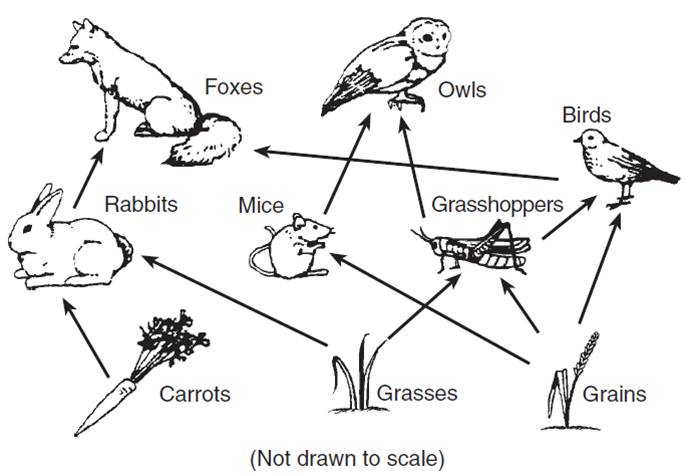
Which of the following is a primary consumer in this food web?
a)
Foxes
b)
Carrots
c)
Mice
d)
Owls
37.

Which organism contains the most energy?
a)
Rabbit
b)
Grains
c)
Birds
d)
Mice
38.
All of the following are density-dependent factors that limit animal populations EXCEPT.
a)
weather
b)
predation
c)
food competition
d)
birthrate
39.
Two organisms of different species exist in a relationship in which each individual benefits from the activity of the other:
a)
commensalism
b)
parasitism
c)
herbivory
d)
mutualism
40.
Why is only 10% of the energy passed along to the next trophic level?
a)
90% is lost through heat, reproduction, and movement
b)
90% is gained
c)
90% is lost in light energy
d)
because only 10% is lost
41.
All of the following statements concerning characteristics of predator-prey relationship are correct EXCEPT:
a)
Camouflage is an adaptation that protects prey.
b)
A rise in the population of predators is followed by a decreased in the population of prey.
c)
A rise in the population of prey is often followed by a rise in the population of predators.
d)
The population of predators most often eliminates the population of prey
42.
Which of the following best explains why there are seldom more than five trophic levels in a food chain?
a)
Most carnivores function at more than one trophic level
b)
Trophic levels about this numbers contain too many individuals
c)
Energy is lost from each trophic level
d)
The ecosystem contains too much biomass
43.
Which of the following represents the combination of all relevant environmental variables in which a species or population lives?
a)
clade
b)
hybrid zone
c)
phylogeny
d)
ecological niche
44.

Refer to the diagram of the survivorship curve.
Which curve best describes an organism that invests a lot of energy in parenting?
Which curve best describes an organism that invests a lot of energy in parenting?
a)
A
b)
B
c)
C
d)
this is not a survivorship curve
45.
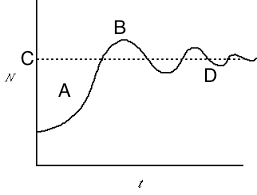
Which letter shows the the exponential growth of a population?
a)
A
b)
B
c)
C
d)
D
46.
There are 200 bears in an area. 10 emigrate, 15 immigrate, 10 are born and 20 die. How many are left?
a)
195
b)
205
c)
200
d)
260
47.
The maximum population size for a species based on the environmental factors is called
a)
ecological footprint
b)
carrying capacity
c)
population growth
d)
environmental capacity
48.
A group of interbreeding individuals occupying the same area is best called
a)
community
b)
population
c)
ecosystem
d)
symbiotic relationship
49.
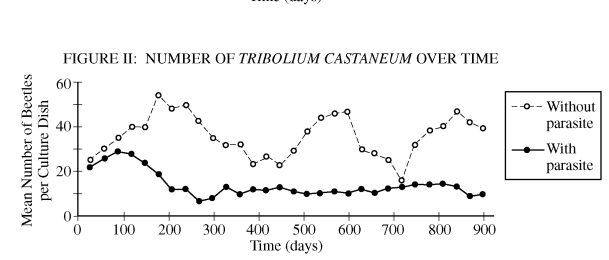
Which of the following correctly describes the interactions between T. castaneum and the parasite.
a)
The parasite decreases the population density of beetles in each culture dish.
b)
The parasite increases the population density of beetles in each culture dish.
c)
The parasite has no effect on the population density of the beetles.
50.
Primary consumer's energy is 54,000 joules. How much energy was provided to secondary consumers?
a)
53,460 J
b)
540 J
c)
5,400 J
d)
54 J
51.

A team of ecologists observed feeding patterns of several populations in the desert. The energy pyramid shown below depicts the feeding patterns the ecologists observed. Which of the following best explains the difference in the amount of available energy in the trophic levels of the desert ecosystem?
a)
There is less energy available in the producers because their tissues are less dense than those at higher trophic levels.
b)
There is more energy available in the second trophic level because less energy is needed for hunting compared to the higher trophic levels.
c)
There is less available energy in the fourth trophic level because of the loss of energy through metabolism in each of the lower trophic levels.
d)
There is more available energy in the birds of prey because they have greater muscle mass for storing energy than organisms in lower trophic levels have.
52.
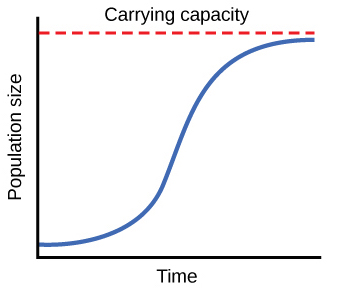
__________ growth shows growth of a population under environmental constraints (carrying capacity-K) that sets a maximum population size
a)
logistic
b)
exponential
c)
niche
d)
uniform
53.
________ grow slowly over time, cares for its young over a long period of time and is usually near the carrying capacity of its ecosystem.
a)
K-strategists
b)
R-strategists
c)
Uniform strategists
d)
environmentalists
54.
A measure of the number of different species living in an ecosystem is referred to as the
a)
ecological census
b)
species richness
c)
population density
d)
biomass
55.
A species that exerts a large, positive impaction on its ecosystem is known as a:
a)
Keystone species
b)
Invasive species
c)
Indicator species
d)
Poached species
56.
All organic compounds contain the element
a)
carbon
b)
nitrogen
c)
phosphorus
d)
sulfur
57.
Which property makes water molecules stick to other water molecules?
a)
adhesion
b)
cohesion
c)
capillary action
d)
polarity
58.

Which macromolecule is shown?
a)
lipid
b)
protein
c)
nucleic acid
d)
carbohydrate
59.
Which of the following is NOT a function of lipids?
a)
long term energy
b)
provides flavor in food
c)
used to make hormones
d)
building of muscles
60.

The diagram shows a bond forming between two amino acids. What is the name of this reciprocation?
a)
Dehydration Synthesis
b)
Hydrolysis
c)
Pepysis
d)
Oxidation
61.
___________ are some functions of lipids.
a)
storing energy and cell membrane structure
b)
providing actin & providing myosin
c)
cellulose structure and digestive assistance
d)
storing & transferring genetic info
62.
Which is not a use or function of protein?
a)
forms enzymes and hormones
b)
forms transport channel in cell membrane
c)
forms structural proteins in the body
d)
quick energy
63.
Where do substrates bind on an enzyme?
a)
voltage-gated channels
b)
surface receptor
c)
calcium channels
d)
active site
64.
What is a substance called if it speeds up a chemical reaction?
a)
reusable
b)
catalyst
c)
specific
d)
fragile
65.

Combines with 3 fatty acid chains to make up a triglyceride; part of the monomer of lipids
a)
Amino Acid
b)
Fatty Acid
c)
Glycerol
d)
Nucleotide
66.

The process/reaction used to link compounds/monomers together. Releases water.
a)
Dehydration
b)
Hydrolysis
c)
Enzomatic
d)
Tetratonic
67.
Which of the following is correct about the molecule cholesterol?
a)
it is a polar molecule
b)
it is a protein
c)
it stores energy as a charbohydrate
d)
it is hydrophobic
68.

What molecule is this?
a)
this is a monosaccharide
b)
this is a polysaccharide
c)
this is a protein
d)
this is a lipid
69.

Which of the following conclusions can be drawn from this graph?
a)
The optimum pH of the enzyme is 6.6.
b)
The optimum pH of the enzyme is 5.8
c)
The enzyme’s activity increases as pH increases 5.0 to 9.0
d)
The enzyme’s activity is greater around pH of 8.0 .
70.
What are the building blocks of a lipid?
a)
3 gylcerols and 1 fatty acid
b)
1 glycerol and 3 fatty acids
c)
3 amino acids
d)
3 simple sugars
71.
Which structure is common to plant and animal cells?
a)
central vacuole
b)
chloroplast
c)
wall made of cellulose
d)
mitochondrion
72.
Which of the following is major cause of the size limits for certain types of cells?
a)
evolutionary progression in cell size; more primitive cells have smaller sizes.
b)
the need for sufficient surface area to support the cell's metabolic needs.
c)
limitation on the strength and integrity of the plasma membrane as cell size increases
d)
the difference in plasma membranes between prokaryotes and eukaryotes
73.
A chemical reaction that has a positive ΔG (free energy) is best described as
a)
entropic
b)
spontaneous
c)
endergonic
d)
exergonic
74.
Which of the following would likely move through the lipid bilayer of a plasma membrane most rapidly?
a)
CO2
b)
an amino acid
c)
starch
d)
glucose
75.
Which statement is correct about diffusion?
a)
It's very rapid over long distances.
b)
It's a passive process which molecules move from a region of higher to lower concentration.
c)
It requires an energy expenditure by the cell.
d)
It's an active process where molecules move from a region of lower to higher concentration.
76.
A biologist ground up some plant leaf cells and then centrifuged the mixture to fractionate the organelles. Organelles in one of the heavier fractions could produce ATP in the light, whereas organelles in the lighter fraction could produce ATP in the dark. The heavier and lighter fractions are most likely to contain, respectively,
a)
mitochondria and chloroplasts.
b)
peroxisomes and chloroplasts.
c)
chloroplasts and peroxisomes.
d)
chloroplasts and mitochondria.
77.

Metabolism is best described as______
a)
synthesis of macromolecules
b)
breakdown of macromolecules
c)
control of enzyme activity
d)
control of enzyme activity in the synthesis and breakdown of macromolecules
78.
Which process takes place in the presence of oxygen and produces nearly 20 times as much as ATP as glycolysis alone?
a)
photosynthesis
b)
lactic acid fermentation
c)
aerobic respiration
d)
alcoholic fermentation
79.
What are the reactants in the equation for cellular respiration?
a)
oxygen and lactic acid
b)
carbon dioxide and water
c)
glucose and oxygen
d)
water and glucose
80.
Where does glycolysis occur?
a)
Inner mitochondrial membrane
b)
Mitochondrial Matrix
c)
Cytosol
d)
At a ribosome
81.
Glycolysis is a _______ process
a)
Anabolic
b)
Catabolic
c)
Single Step
d)
Strictly Eukaryotic
82.
NADH is a ______ form of NAD+.
a)
Reduced
b)
Oxidized
c)
Catabolized
d)
Hydrolized
83.
How many ATP are gained through glycolysis?
a)
0
b)
2
c)
4
d)
30-38
84.
Which of the following is not an end product of the Kreb's cycle?
a)
FADH2
b)
CO2
c)
pyruvate
d)
ATP
85.
During chemiosmosis
a)
H+ ions serve as the final electron acceptor
b)
a concentration gradient is generated when H+ ions are passively transported from the matrix to the intermembrane space of the mitochondrion
c)
energy is released as H+ ions move freely across the mitochondrial membrane
d)
ATP is synthesized when H+ ions move through a channel in ATP synthase
86.
In yeast cells
a)
alcohol is produced during the citric acid cycle
b)
lactic acid is produced during the citric acid cycle
c)
alcohol is produced after glycolysis
d)
lactic acid is produced after glycolysis
87.

Use the diagram to answer the question. Between which parts of the molecule must the bonds be broken to form an ADP molecule?
a)
A and B
b)
A and C
c)
B and C
d)
C and D
88.
The main purpose of anaerobic respiration is to
a)
produce oxygen
b)
replenish NAD+ for glycolysis
c)
replenish oxaloacetic acid for the Krebs cycle
d)
produce ATP
89.
Where do the light-dependent reactions occur?
a)
thylakoid membrane
b)
stroma
c)
mesophyll
d)
mitochondria
90.
What is the primary function of the light reactions of photosynthesis?
a)
To produce glucose
b)
To produce NADPH and ATP
c)
To use ATP
d)
To produce RuBP
91.
What does ATP synthase do?
a)
Create ATP in chemiosmosis.
b)
Break down ATP in chemiosmosis.
c)
Break down NADPH.
d)
Create NADPH.
92.

The enzyme responsible for Carbon Fixation in C3 Photosynthesis is
a)
RuBisCo
b)
PEP Carboxylase
c)
Hexokinase
d)
Pyruvate DeHydrogenase
93.

The loss of H2O through stomata is referred to as:
a)
Transpiration
b)
Respiration
c)
Evaporation
d)
Photorespiration
94.

Carbon fixation in CAM plants occurs during the:
a)
Day
b)
Night
95.

The main problem encountered by C3 plants in hot conditions is:
a)
Transpiration
b)
PhotoRespiration
c)
Dehydration
d)
Starvation
96.
Green plants reflect ________ light.
a)
Red
b)
Green
c)
All
d)
Red and Violet
97.
Where is glucose synthesized
a)
Photosystem II
b)
Photosystem I
c)
Calvin Cycle
d)
Glycolysis
98.
When oxygen is released as a result of photosynthesis, it is a direct by-product of
a)
reducing NADP+
b)
splitting water molecules
c)
chemiosmosis
d)
electron transfer in photosystem II and I
99.
What is the primary function of the Calvin cycle?
a)
regenerate
ATP for use in the light reactions of photosynthesis
b)
produce carbon dioxide for use in the light
reactions of photosynthesis
c)
produce oxygen by oxidizing water
d)
produce simple sugars from carbon dioxide
100.
CAM plants keep stomata closed in daytime, thus reducing loss of water. They can do this because they
a)
fix CO2 into
organic acids during the night when temperatures are cooler.
b)
fix CO2 into by
combining it with RuBP in the Calvin cycle.
c)
obtain CO2 through their roots during the day.
d)
fix
CO2 into organic acids in the mesophyll cells,
which do not rely on stomata.
101.
Which of the following is the correct equation for PHOTOSYNTHESIS?
a)
6CO2 + 6H2O --> 6O2 + C6H12O6
b)
6CO2 + C6H12O6 + 6H2O --> O2
c)
6O2 + 6H2O --> 6CO2 + C6H12O6
d)
C6H12O6 + 6O2 ---> 6H2O + 6CO2
102.
Most plants appear green because chlorophyll
a)
absorbs green light.
b)
absorbs violet light.
c)
does not absorb green light.
d)
does not absorb violet light.
103.
What gas is released by plants during photosynthesis?
a)
sulfur
b)
carbon dioxide
c)
oxygen
d)
hydrogen
104.
Which gas is removed from the atmosphere during photosynthesis?
a)
hydrogen
b)
oxygen
c)
nitrogen
d)
carbon dioxide
105.
In peas, the trait for tall plants is dominant (T) and the trait for short plants is recessive (t). The trait for yellow seeds is dominant (Y) and the trait for green seeds is recessive (y).
A cross between two plants results in 292 tall, yellow plants and 103 short, green plants. What are the most likely genotypes of the parents?
A cross between two plants results in 292 tall, yellow plants and 103 short, green plants. What are the most likely genotypes of the parents?
a)
TtYY x Ttyy
b)
TTYy x TTYy
c)
TTyy x TTYy
d)
TtYy x TtYy
106.
Red x white = pink
a)
codominance
b)
multiple alleles
c)
incomplete dominance
d)
epistasis
107.
Suppose that in sheep, a dominant allele (B) produce black hair and a recessive allele (b) produce white hair. If you saw a black sheep, you would be able to identify
a)
its phenotype for hair color
b)
its genotype for hair color
c)
the genotype of only one of its parents
d)
the phenotype of both of its parents
108.
One of the main reasons genes assort independent of one another is that
a)
they produce unrelated traits
b)
they produce related traits
c)
they are on the same chromosome
d)
they are on different chromosomes.
109.
A single gene has 3 or more alternative forms. These are called
a)
heterozygotes
b)
multiple alleles
c)
epistatic
d)
polygenic
110.
A child has type O blood, if mother has type A blood, what would the fathers blood type be
a)
A,B, or O
b)
AB or A
c)
AB or B
d)
O only
111.
In mice, the homozygous mice are black and white. The heterozygous mice are gray. What pattern of inheritance is expressed in fur color in mice?
a)
complete dominance and recessiveness
b)
co-dominance
c)
incomplete dominance
d)
pleiotropy
112.
If the parents of a cross are AaBcCc x aaBBcc. What is the probability of an offspring that is homozygous recessive for all 3 traits?
a)
1/64
b)
1/32
c)
1/8
d)
O
113.
Which of the following statements best describes what a Barr body is and its significance?
a)
it is an inactivated Y chromosome and results in a man being sterile
b)
It is an inactivated Y chromosome, and the person who has it appears female
c)
It is an inactivated X chromosome and results in females with half their cells have one X inactivated and in the other half of their cells have the other X inactivated
d)
it is an inactivated X chromosome and results in females who are sterile
114.
A man who has a sex-linked allele will pass it on to
a)
all his daughters
b)
all his sons
c)
1/2 of his daughters
d)
1/2 of his sons
115.
In humans, hemophilia is an X-linked recessive trait. If a man and a woman have a son who is affected with hemophilia, which of the following is definitely true?
a)
The mother carries an allele for hemophilia
b)
The father carries an allele for hemophilia
c)
The father is afflicted with hemophilia
d)
both parents carry an allele for hemophilia
116.

When an area of a chromatid is exchanged with the matching area on a chromatid of its homologous chromosome, _________________ occurs
a)
crossing over
b)
mutagenesis
c)
hybridization
d)
fertilization
117.
If a stem cell has 24 chromosomes, how many will it have at the end of meiosis?
a)
24
b)
12
c)
6
d)
the number varies per species
118.
During meiosis I, what happens?
a)
Sister chromatids are split
b)
Homologous chromosomes are split
c)
Four cells are created
d)
None of the other choices are correct
119.
When does crossing over occur?
a)
Interphase
b)
Prophase 1
c)
Prophase 2
d)
Metaphase 1
120.
The two ways to increase genetic variation during meiosis are crossing over and _____
a)
Synapsis
b)
Tetrad
c)
Independent assortment
d)
Gameiosis
121.
Trisomy is a genetic disorder that ________
a)
has three sets of chromosomes
b)
has three copies of a particular chromosome
c)
that is curable
d)
none of the above
122.
Meiosis results in ______.
a)
4 genetically distinct haploid gametes
b)
2 genetically distinct cells
c)
2 genetically identical cells
d)
4 genetically identical cells
123.
Crossing over helps promote
a)
male genotype
b)
genetic variation
c)
DNA replication
d)
mitosis
124.

What phase is shown in the picture?
a)
anaphase 1
b)
anaphase 2
c)
metaphase 1
d)
telophase 1
125.
Chiasmata are most closely related to which of the following?
a)
crossing over
b)
fertilization
c)
cytokinesis
d)
mitosis
126.
Human eggs and sperm are _____, and each has ____ chromosomes.
a)
diploid, 23
b)
diploid, 46
c)
haploid, 23
d)
haploid, 46
127.
Which of the following statements best describes the termination of transcription in prokaryotes?
a)
RNA polymerase transcribes through the polyadenylation signal, causing proteins to associate with the transcript and cut it free from the polymerase
b)
RNA polymerase transcribes through the terminator sequence, causing the polymerase to separate from the DNA and release the transcript.
c)
RNA polymerase transcribes through an intron, and the snRNPs cause the polymerase to let go of the transcript.
d)
Once transcription has initiated, RNA polymerase transcribes until it reaches the end of the chromosome.
128.
Cytosine makes up 42% of the nucleotides in a sample of DNA from an organism. Approximately what percentage of the nucleotides in this sample will be thymine?
a)
8%
b)
16%
c)
31%
d)
42%
129.
An Okazaki fragment has which of the following arrangements?
a)
primase, polymerase, ligase
b)
3' RNA nucleotides, DNA nucleotides 5'
c)
5' RNA nucleotides, DNA nucleotides 3'
d)
DNA polymerase I, DNA polymerase III
130.
Which enzyme catalyzes the elongation of a DNA strand in the 5' → 3' direction?
a)
primase
b)
DNA ligase
c)
DNA polymerase III
d)
topoisomerase
131.
What is meant by the description "antiparallel" regarding the strands that make up DNA?
a)
The twisting nature of DNA creates nonparallel strands.
b)
The 5' to 3' direction of one strand runs counter to the 5' to 3' direction of the other strand.
c)
Base pairings create unequal spacing between the two DNA strands.
d)
One strand is positively charged and the other is negatively charged.
132.

The entire curve moves in one direction or the other.
a)
Stabilizing selection
b)
Disruptive selection
c)
Directional selection
133.
What does Vestigial mean?
a)
change in the heritable traits of biological populations over successive generations.
b)
(an organ or part of the body) degenerate, rudimentary, or atrophied, having become functionless in the course of evolution.
c)
is the differential survival and reproduction of individuals due to differences in phenotype
d)
things that animals eat
134.
The idea that evolution seems to occur in spurts of time.
a)
stabilizing selection
b)
directional selection
c)
disruptive selection
d)
puntuated equilibrium
135.

Favors the middle of the population.
a)
Disruptive selection
b)
Stabilizing selection
c)
Directional selection
136.
2 energy rich molecules created by Light Dependent Reactions of Photosynthesis are:
a)
ATP and ADP
b)
ATP and NADPH
c)
ADP and FADH
d)
ADP and NADP
137.
During chemiosmosis
a)
Carbon is fixed.
b)
ATP is synthesized from ADP
c)
NADPH is synthesized from NADP+
d)
Electrons are removed from chlorophyll molecules.
138.
C double bonded to O and single bonded to OH group; acts as acids
a)
hydroxyl
b)
carbonyl
c)
carboxyl
d)
phosphate
139.

What type of transport is shown in the picture?
a)
Osmosis
b)
Diffusion
c)
Endocytosis
d)
Exocytosis
140.

The cell below is in a _________ solution.
a)
Hypotonic
b)
Hypertonic
c)
Isotonic
141.
A horse and a donkey can successfully mate to produce offspring known as a mule. Mules are sterile . Would mules be classified as a species?
a)
Yes, mules have enough of their own traits to be considered a species.
b)
Yes, the fact that have different number of chromosomes makes them a different species
c)
No, mules are too similar to the parent species
d)
No, due to their inability to reproduce successfully.
142.
repetitive sequences of DNA on the ends of chromosomes (TTAGGG)
a)
telomeres
b)
telomerase
c)
Okazaki fragments
d)
primer
143.
synthesizes a short fragment of RNA that allows DNA polymerase III to bind
a)
ligase
b)
DNA polymerase I
c)
primase
d)
helicase
144.
Which of the following is not a part of interphase?
a)
G2
b)
M
c)
G1
d)
S
145.

Place these cells in order of mitosis.
a)
A, B, C, D, E
b)
B, E, D, A, C
c)
C, E, A, D, B
d)
B, D, A, E, C
146.
In which type of cells will mitosis occur?
a)
egg cells
b)
sperm cells
c)
jail cells
d)
Body cells except the sperm and egg cells
147.

Which phrase best describes a common characteristic of all cancers?
a)
absence of cyclins
b)
damaged DNA
c)
uncontrolled cell growth
d)
inherited from parents
148.
Which of these may be assessed by various proteins during a "checkpoint"?
a)
Ensure that all chromosomes have lined up in the center of the cell before sister chromatids separate
b)
Ensure that spindle fibers have attached to all centromeres before cell division
c)
Ensure that DNA has been replicated properly
d)
All of these
149.

The graph represents the amount of DNA in the nucleus of each cell during the cell cycle.
Which region represents the G2 phase?
Which region represents the G2 phase?
a)
I
b)
II
c)
III
d)
IV
150.
The normal function of a tumor suppressor gene is
a)
to produce growth signals
b)
to code for proteins that inhibit, or slow, cell division
c)
to cause the cell to move faster through the cell cycle
d)
to attack cancer cells in the body
151.
Oncogenes
a)
are mutated forms of tumor suppressor genes
b)
are mutated genes that result in apoptosis
c)
are mutated genes the inhibit the cell cycle
d)
are mutated genes that code for proteins which activate cell division at the improper time
152.
Which description is true about cell cycle regulation?
a)
Changing concentrations of Cdk result in binding to cyclin
b)
Changing concentrations of cyclin result in binding to Cdk
c)
MPF complex formation decreases with increased Cdk levels
d)
MPF complex formation decreases with increased cyclin levels
100 %

