
 Worksheets
Bio Exam Ch. 10, 11 - YL
Total questions: 153
Worksheet time: 38hrs 15mins
Which of the following statements is the most consistent with the process of meiosis?
The cells that result from meiosis I are diploid, and each chromosome consists of 1 chromatid.
The cells that result from meiosis I are haploid, and each chromosome consists of 2 chromatids.
The cells that result from meiosis I are haploid, and each chromosome consists of 1 chromatid.
The cells that result from meiosis I are diploid, and each chromosome consists of 2 chromatids.
The cells that result from meiosis II are haploid, and each chromosome consists of 2 chromatids.
Next
You are comparing the events of meiosis I in cells from several different organisms. You come across one species in which you do not observe any chiasmata. The best conclusion to make is
chiasmata will form during meiosis II.
the chromosome pairs will not assort independently.
kinetochores of sister chromatids do not fuse.
there is no crossing over between nonsister chromatids.
PreviousNext
Which stage of mitosis is characterized by the disassembly of spindle apparatus, the reestablishment of the nuclear membrane, and the decondensation of the chromosomes?
Metaphase
Telophase
Anaphase
Prometaphase
What happens during Anaphase B?
The APC/C gets activated for the first time.
Kinetochores are pulled toward the poles.
The spindle poles move apart.
The spindle apparatus disassembles.
The nuclear envelope reforms.
A person whose cells all contain a chromosome number of 2n+1 most likely has what type of condition?
None, this is the normal chromosome number for humans.
Monosomy
Cancer
Trisomy
Obesity
The Rec8 protein holds sister chromatids together during meiosis. If an individual has a mutation that prevents degradation of Rec8, this would most likely prevent
crossing over during prophase I.
synapsis of homologous chromosomes.
normal segregation during meiosis I.
normal segregation during meiosis II.
The pairing of homologous chromosomes is called
syngamy
synapsis
alignment
crossing over
independent assortment
If there are 32 sister chromatids in a normal somatic cell, how many chromosomes are there?
8
16
32
64
The stage of the cell cycle during which the cytoplasm divides to form two cells is called __________.
G2
G1
mitosis
cytokinesis
S
During which stage of mitosis do the chromosomes become attached to the spindle at their kinetochores?
Anaphase
Prometaphase
Metaphase
Prophase
Telophase
In life cycles that alternate between haploid and diploid stages, fertilization doubles the number of chromosomes per cell while the number of chromosomes is reduced by half by which process?
Mitosis
Meiosis
Syngamy
Binary fission
If a germ-line cell from an owl contains 8 picograms of DNA during G1 of interphase, how many picograms of DNA would be present in each cell during prophase I of meiosis? (Enter the number only, not the units.)
16
24
If a somatic cell from a cat contains 40 picograms of DNA during G2 of interphase, how many picograms of DNA would be present in each cell during metaphase II of meiosis? (Enter the number only, not the units.)
20
0
If there are 32 sister chromatids in a normal somatic cell, what is the haploid number for that cell?
8
16
32
64
In animals, the cells that will eventually undergo meiosis to produce gametes are set aside early in development. These are called
reproductive cells
germ-line cells
somatic cells
gametophytes
sex cells
Why does sexual reproduction require both meiosis and syngamy?
The process of meiosis results in the production of gametes in which the number of chromosomes is reduced by half. During syngamy, two gametes fuse to form a new cell, and the number of chromosomes is restored to the full amount. Therefore, by coupling meiosis and syngamy, the organism ensures that the proper number of chromosomes will be maintained.
The process of meiosis results in the production of gametes in which the number of chromosomes is doubled. During syngamy, gametes are reduced by half, and the number of chromosomes is restored to the full amount. Therefore, by coupling meiosis and syngamy, the organism ensures that the proper number of chromosomes will be maintained.
The process of meiosis results in the production of gametes in which the number of chromosomes remains the same. During syngamy, two gametes fuse to form a new cell, and the number of chromosomes is restored to the full amount. Therefore, by coupling meiosis and syngamy, the organism ensures that the proper number of chromosomes will be maintained.
A cell in G2 before meiosis begins, compared with one of the four cells produced at the end of meiosis II, has
twice as much DNA and half as many chromosomes.
four times as much DNA and twice as many chromosomes.
twice as much DNA and twice as many chromosomes.
twice as much DNA but the same number of chromosomes.
four times as much DNA and four times as many chromosomes.
You are studying meiosis in an organism where 2n = 24. How many chromosomes will each nucleus have after meiosis II is complete?
24
6
12
48
During what stages of the cell cycle are sister chromatids bound together by cohesin?
G1, S
G1, S, G2
S, G2
S, G2, prophase, metaphase
S, G2, prophase, metaphase, anaphase, telophase
What is the sequence of events in a typical eukaryotic cell cycle?
G1 to S to G2 to mitosis to cytokinesis
G1 to G2 to S to mitosis to cytokinesis
G1 to G2 to mitosis to S to cytokinesis
G1 to S to G2 to cytokinesis to mitosis
S to G1 to G2 to mitosis to cytokinesis
In bacteria, DNA replication is initiated at the __________.
3' end
origin of replication
5' end
nucleoid
terminus
The portion of the cell cycle when the cell is growing and does not contain a replicated genome is referred to as __________.
G1
mitosis
S
cytokinesis
G2
Crossing over between homologous chromosomes takes place during
prophase II
prophase I
metaphase II
interphase I
interphase II
A cell biologist examines a diploid cell from a particular species of Ragoletis during metaphase of mitosis and determines that 8 centromeres are present. Based on this finding, how many centromeres should be present in a single cell from this species during anaphase II of meiosis?
4
0
A somatic cell from a garden pea normally contains 14 chromosomes. How many sister chromatids would that cell contain during G1 of the cell cycle?
28
14
7
0
In later chapters, you will learn more about the regulation of gene expression. One way to regulate gene expression is to make changes to the histone proteins to alter how tightly the DNA is coiled and wrapped. The more tightly coiled and wrapped a particular region of DNA is, the less likely it is that the genes in that region will be expressed. Bearing this in mind, how tightly do you think regions of heterochromatin are compacted?
Not at all
Very tightly
Moderately
Loosely
Animal cells typically achieve cytokinesis by __________.
forming a cleavage furrow that pinches the cell into two
chromosome elongation
forming a cell plate across the middle of the cell
binary fission
chromosome condensation
During anaphase I, which best represents segregation of the chromatids that make up one pair of homologues? (M represents a maternal chromatid and P represents a paternal chromatid. Assume no crossing over occurs.)
The segregation of these chromatids is completely random.
Half of M and half of P to each pole
M and M to one pole; P and P to the other pole
M and P to one pole; M and P to the other pole
M to one pole; P to the other pole
PreviousNext
Which protein or protein complex functions in the cell to stop cell division if the cell has experienced extensive DNA damage?
FtsZ
p53
Condensin
APC/C
If there were no suppression of DNA replication between meiotic divisions but cytokinesis proceeded normally, what is the most likely outcome of meiosis?
2 haploid cells
2 diploid cells and 2 haploid cells
4 diploid cells
2 diploid cells
4 haploid cells
A duplicate copy of all of the hereditary information contained in the nucleus of eukaryotic cells is made during what stage of the cell cycle?
Mitosis
G1
S
G2
Cytokinesis
The process that produces new cells that are genetically identical to the original cell is _____.
independent assortment
mitosis
fertilization
meiosis
crossing over
Interphase is made up of what stages of the cell cycle?
S + cytokinesis
Cytokinesis + mitosis
Prophase + metaphase + anaphase + telophase
G1 + G2 + S
G0 + G1 + G2
A scientist wants to study histones. Histones are __________.
proteins that serve as the spindle fiber to pull sister chromatids apart during anaphase
proteins that double-stranded DNA molecules wrap around in prokaryotes and eukaryotes
proteins that double-stranded DNA molecules wrap around in eukaryotes
proteins that required for the activity of Cdk enzymes
proteins that regulate checkpoints in the mitotic cell cycle
PreviousNext
A geneticist examines a somatic cell from a fly during metaphase of mitosis and determines that 16 chromatids are present. If a germ-line cell from this species divides by meiosis, then at the end of meiosis I (including the first cytokinesis) each cell will contain
4 chromosomes with 8 DNA molecules.
4 chromosomes with 4 DNA molecules.
8 chromosomes with 8 DNA molecules.
8 chromosomes with 16 DNA molecules.
Nondisjunction is the failure of homologous chromosomes to separate during meiosis I, or the failure of sister chromatids to separate during meiosis II or mitosis. As a result, both homologous chromosomes or both sister chromatids migrate to the same pole of the cell. This produces daughter cells with an imbalance of chromosomes. A cell biologist examines the final products of meiosis in an earthworm (2n = 36) and finds 2 cells with 20 chromosomes, and 2 cells with 16 chromosomes. Most likely this was because
2 pairs of homologous chromosomes failed to separate during meiosis I.
1 pair of homologous chromosomes failed to separate during meiosis I.
1 pair of sister chromatids failed to separate during meiosis II.
2 pairs of sister chromatids failed to separate during meiosis II.
At the end of meiosis II, each of the four resulting cells contains
two full sets of chromosomes, each with 2 molecules of DNA.
one full set of chromosomes, each with 1 molecule of DNA.
two full sets of chromosomes, each with 1 molecule of DNA.
one full set of chromosomes, each with 2 molecules of DNA.
Which stage of mitosis is characterized by the alignment of the chromosomes in a ring along the inner circumference of the cell?
Prophase
Metaphase
Telophase
Interphase
At what checkpoint(s) does the cell arrest in response to DNA damage?
G2/M and spindle
Spindle
G2/M
G1/S
G1/S and G2/M
The Indian Elephant has 56 chromosomes in its somatic cells. How many chromosome will its haploid cells have?
28
16
112
56
Which process leads to increased genetic variation in a population?
Sexual Reproduction (Meiosis)
Vegetative reproduction
Parthenogenesis
Asexual Reproduction (Mitosis)
Chromosomes are pulled apart into chromatids during which phase of meiosis?
Anaphase II
Telophase I
Telophase II
Anaphase I
A cell undergoing interphase made a mistake by skipping the 1st step of interphase. What didn't the cell do and what phase would it go into next?
The cell did not check to see if it doubled in size or if the DNA replicated and it will go into Prophase
The cell did not check to see if it doubled in size or if the DNA replicated and it will go into Go
The cell did not double in size and it will go into G0
The cell did not double in size and it will go into S phase
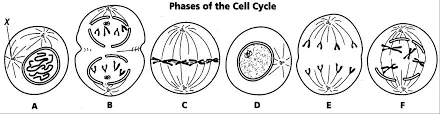
Match the LETTER to the correct phase: A
Telophase
Prophase
Metaphase
Interphase
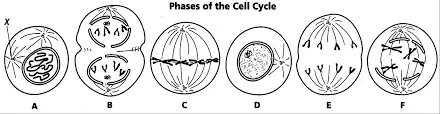
Match the LETTER to the correct phase: B
Prophase
Anaphase
Interphase
Telophase
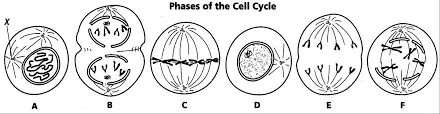
Match the LETTER to the correct phase: C
Prophase
Telophase
Metaphase
Interphase
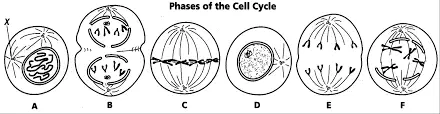
Match the LETTER to the correct phase: D
Interphase
Anaphase
Metaphase
Telophase
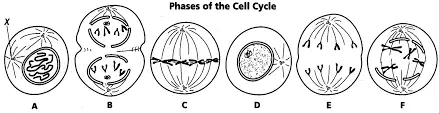
Match the LETTER to the correct phase: E
Interphase
Anaphase
Telophase
Prophase

The diagram below shows a comparison of the chromosomes during the prophase of mitosis, meiosis I, and meiosis II. Which of the following correctly describes the process of meiosis I?
Mutation in which the DNA content of the gene is altered?
Segregation of sister chromatid
Crossing-over in which genes are exchanged
Condensation and segregation of genes
A scientist wants to increase the chance of pregnancy in mice. He gives the mice a hormone that causes them to produce more gametes. Which of the following statements justifies which process the cells went through after the hormone injections?
The mouse did meiosis to create 2 somatic cells
The mouse did mitosis to create 4 haploid cells
The mouse did meiosis to create 4 haploid gamete cells
The mouse did meiosis to create 2 diploid cells
Which of the following is NOT a contribution of Henrietta Lacks (mentioned in class or in your notes)?
Chemotherapy treatments
Radiation treatments
Vaccines
HIV treatments
During which phase does DNA replicate (make a copy of itself)?
G2
Mitosis
Cytokinesis
G1
S
Embryonic cell cycles allow the rapid division of cells in the early embryo. These complete mitotic cell cycles are much shorter in length than the mitotic cell cycles of cells in a mature organism. The specific phase of mitosis, however, takes approximately the same amount of time during the embryonic cell cycles as it does in the cell cycles of mature cells. What do you think is a result of the embryonic cycle?
Resulting daughter cells do not contain the same genetic information as the mother cell in the embryonic cell cycles
Mother cells in the embryonic cell cycle spend the majority of their time in G0
Resulting daughter cells are smaller than the mother cell in the embryonic cell cycles
Resulting daughter cells cannot form a mitotic spindle in the embryonic cell cycle
The progress of the eukaryotic cell cycle is regulated primarily by what proteins?
Cyclins
Condensins
Histone proteins
FtsZ
Chromosomes exchange genetic information by
fertilization
syngamy
DNA replication
crossing over
mitosis
In prophase, ribosomal RNA synthesis stops when the chromosomes condense, and as a result _____.
the chromosomes line up at the equator of the cell
the nuclear envelope reforms
the chromosomes lengthen
the nucleolus disappears
Plant cells typically achieve cytokinesis by ______.
forming a cell plate across the middle of the cell
forming a cleavage furrow that pinches the cell into two
chromosome elongation
binary fission
chromosome condensation
If a chromosome contains a mutation such that it cannot bind to the kinetochore complex, what would be the consequence?
That chromosome would not be able to be replicated
That chromosome would not be able to condense
That chromosome would not be able to bind to the mitotic spindle
That chromosomes would not be able to interact with histone proteins
In bacterial cell division, the cell divides into two nearly equal halves. This process is referred to as ______.
binary fission
mitosis
meiosis
cytokinesis
fusion
If a cell was capable of bypassing metaphase and going directly from prometaphase to anaphase, what is the most likely consequence?
The resulting daughter cells would not have a nuclear envelope
The resulting daughter cells would have significantly different quantities of cytoplasmic materials
The resulting daughter cells would have different numbers of chromosomes
The resulting daughter cells would be completely normal
If a cell has 32 chromosomes prior to 5 phase and undergoes mitosis followed by cytokinesis, each new daughter cell will have how many chromosomes
32
16
8
64
Why is it so important that all of the chromosomes align on the metaphase plate during metaphase?
This allows sister chromatids to form
This is the only place in the cell where the cyclins and Cdks are located
This allows asters to form
If they cannot, it suggests that they aren't properly attached to the spindle microtubules, thus won't separate properly during anaphase
This is the location where the chromosomes can become attached to the spindle microtubules
The synaptonemal complex is
a cluster of microtubules at each pole of the cell
the area where microtubules attach to the centromere of each chromosome
a network of microtubules that forms the spindle apparatus
a region of highly coiled DNA
a network of proteins that holds homologues together
Which best describes the process of independent assortment
The way one pair of homologues line up along the metaphase plate does not affect how any other pair lines up
Crossing over along one pair of chromosomes is independent of crossing over along the other pairs
During synapsis, homologues pair independently of each other.
Segregation of chromosomes during meiosis I is independent of their segregation during meiosis II
If a cell contained a mutation in the gene that encodes FtsZ, which process would be affected?
DNA Synthesis
Cytokinesis
Cohesin cleavage
Prophase
Septation
During which stage of mitosis does the nuclear envelope begin to break down and the spindle begins to form?
Metaphase
Prometaphase
Prophase
Anaphase
Telophase
If it were possible to prevent crossing over, what would be the result of inhibiting this event?
Sister chromatids would not segregate properly during mitosis
Homologous chromosomes would not align properly during metaphase I
Homologous chromosomes would not segregate properly during mitosis
Sister chromatids would not have cohesion during metaphase I
Homologous chromosomes pair along their length during prophase I of meiosis. While two homologues are paired, genetic exchange may occur between them in a process called ________.
synapsis
crossing over
independent assortment
syngamy
You are conducting a genetic screen using Caenorhabditis elegans embryos to isolate mutations affecting anaphase (A). Therefore, you need to look for embryos in which ______.
sister chromatids are mismatched and therefore fail to separate
the poles do not move apart
the spindle apparatus does not disassemble
the centromeres do not move toward the poles
Which cells never divide by meiosis? (Check all that apply)
Diploid cells
Zygotes
Somatic cells
Haploid cells
Germ-line cells
The division of a bacterial cell occurs as the ____.
new membrane and cell wall materials begin to grow and form a septum
actin and microtubules constrict the cytoplasm
chromosomes are pulled toward the ends of the cell
cell wall develops cracks around the equator of the cell
Which structures indicate where crossing over has occurred?
Centrioles
Spindle fibers
Kinetochores
Chiasmata
Centromeres
If a germ-line cell from a salamander contains 10 picograms of DNA during G1 of interphase, how many picograms of DNA would be present in each gamete produced by this species? (Enter the number only, not the units.)
5
0
The process of nuclear division that reduces the number of chromosomes per cell from 2 sets to 1 set is called _____.
syngamy
meiosis
mitosis
binary fission
Meiosis results in a reassortment of maternal chromosomes (inherited from the mother) and paternal chromosomes (inherited from the father). If n = 4 for a given species, and ignoring the effects of crossing over, what is the probability that a gamete will receive only paternal chromosomes?
1/4
1/16
1/8
1/2
You are examining the effect of maturation-promoting factor (MPF) in sea urchin cells, which have a diploid number of 36. If you fuse a dividing sea urchin cell with a G1 arrested oocyte, what would be the outcome?
The G1 cell would first go through S phase and then mitosis. Its daughter cells would have 36 chromosomes.
The G1 cell would undergo mitosis and its daughter cells would each have 36 chromosomes.
The G1 cell would undergo mitosis and its daughter cells would each have 18 chromosomes.
The G1 cell would enter mitosis, but would likely arrest at the spindle checkpoint because the chromosomes have not been properly replicated.
You are leading a team of researchers at a pharmaceutical company. Your goal is to design drugs that help fight cancer. Specifically, you want to focus on drugs that bind to and inactivate certain proteins, thereby halting cell cycle progression. One of your team members suggests targeting the retinoblastoma (Rb) protein and inhibiting this protein. Will this approach be successful? Why or why not?
This approach will be successful. Rb is an oncogene and functions to activate a number of cell cycle regulatory proteins. A drug designed to inactivate the Rb protein would halt the cell cycle in cells that contain an active Rb. As a result, cancer cells expressing a constitutively active Rb protein would be good targets for this type of therapeutic
This approach will not be successful. Rb is tumor-suppressor protein and functions to inhibit the action of a number of cell cycle regulatory proteins. A drug designed to inactivate the Rb protein would essentially create the same situation as in as a cell that lacks both copies of the Rb gene. Lack of Rb activity would release the inhibition of cell cycle regulatory proteins, thereby promoting cell cycle progression, rather than halting it
This approach will be successful. Rb is tumor-suppressor protein and functions to inhibit the action of a number of cell cycle regulatory proteins. A drug designed to inactivate the Rb protein would activate cell cycle inhibition. Lack of Rb activity would therefore inhibit the cell cycle regulatory proteins
This approach will not be successful. Rb is an oncogene and functions to activate a number of cell cycle regulatory proteins. A drug designed to inactivate the Rb protein would actually activate cell cycle progression. As a result, this drug would likely make this situation worse for patients whose cancer cells contain mutant Rb.
The point of connection between two sister chromatids, before anaphase II of meiosis separates them, is called the
centrosome
centromere
kinetochore
centriole
spindle apparatus
Meiosis and mitosis have different stages that share some similarities and differences. What distinguishes Prophase during mitosis from Prophase I during meiosis?
Chromosomes turn into chromatin during Prophase I of Meiosis but not Mitosis
Spindle Fibers line homologous chromosomes in the middle of Meiosis but not Mitosis during Prophase
Homologous Chromosomes separate in Meiosis but sister chromatids separate in Mitosis of prophase
Crossing over occurs in Meiosis but not Mitosis during Prophase
During interphase of the cell cycle, a muscle cell was determined to contain less mitochondria than needed. What would most likely happen to this cell?
The defective cell (not correct) will be fixed during S phase
The defective (not correct) cell will go into G0 and not be allowed to divide
The defective cell wall continue to divide incorrectly
The defective (not correct) cell will go through interphase and mitosis, but will be removed before cytokinesis
Which of the following phrases best describes cancer?
Uncontrolled cell growth caused by mutations in genes that control the cell cycle
Presence of a hereditary disorder
Multiple gene mutations on a chromosomes of DNA
Absence of cyclins in the DNA
A cell has 30 chromosomes. Which means, there are ______ centromeres and _____ chromatids.
30 ; 30
30 ; 60
60 ; 30
60 ; 60
A cell biologist produces a karyotype of mouse somatic cells arrested in mitosis. She sees 40 chromosomes, which is completely normal for mice. Based on this information, what is the haploid number of chromosomes for mice?
80
20
10
40
It cannot be determined from the information provided
You are studying cell cycle progression in yeast cells. If you could prevent cdc2 from associating with the mitotic cyclin, the cells would __________.
arrest in S
arrest in G1
arrest in metaphase
arrest in prometaphase
arrest in G2
If you were to think of the cell as a car, and mitosis as a process that drives that car to go, what would be a good analogy for a cell that has a mutation in both copies of a tumor-suppressor gene?
The brake pedal of a car does not work at all.
The gas pedal of a car does not work at all.
The gas pedal of a car gets stuck while pushed down.
The brake pedal of a car gets stuck while pushed down.
The two copies of each type of chromosome found in normal somatic (body) cells in an organism, throughout the cell cycle, are called __________.
kinetochores
sister chromatids
homologous chromosomes
daughter chromosomes
In G2, there are typically high levels of the mitotic cyclin. Why is cdc2 not active during G2 if the mitotic cyclin is present?
Cdc2 is also regulated by phosphorylation.
Cdc2 does not bind to the mitotic cyclin.
Cdc2 also has to bind to cohesin to be activated.
Cdc2 requires ubiquitination to be activated.
Eukaryotic chromosomes are composed of a complex of 60% protein and 40% DNA. This complex is referred to as __________.
cohesin
chromatin
the kinetochore
the histone complex
The most common form of gene therapy involves inserting a normal gene into cells that contain a defective version of the gene. In order to use gene therapy to prevent a man from passing a defective gene on to future generations, you should try to insert normal copies of the gene into
germ-line cells
somatic cells in the testes
bone marrow cells
blood cells
In meiosis, sister kinetochores are attached to the same pole of the cell during meiosis I, and sister chromatid cohesion is released during anaphase II. What would be the likely result if sister kinetochores were attached to different poles of the cell during meiosis I and sister chromatid cohesion was released during anaphase I?
Sister chromatids would migrate to the same pole during anaphase II.
Sister chromatids would migrate to the same pole during anaphase I.
Sister chromatids would migrate to opposite poles during anaphase I.
Sister chromatids would migrate to opposite poles during anaphase II.
One of a pair of chromosomes with similar genetic information and from different sources like the sperm and egg is called a(n)
synaptonemal
synapsis
chiasma
homologue
kinetochore
A cell biologist examines a diploid cell from a particular species of butterfly during prometaphase of mitosis and determines that 10 centromeres are present. Based on this finding, how many chromatids should be present in a single cell from this species in metaphase I of meiosis?
20
10
The point of constriction on chromosomes that contains certain repeated DNA sequences that bind specific proteins is called __________.
the centromere
the centrosome
the cohesin complex
the kinetochore
the centriole
You are studying meiosis in an organism where 2n = 28. How many chromosomes will be present in each cell after meiosis I is complete but before meiosis II begins?
7
14
28
56
A cell biologist examines a skin cell from a lizard during metaphase of mitosis and determines that 20 chromatids are present. The role of meiosis in this species is to (Check all that apply)
reduce the number of chromosomes per cell from 20 to 10.
reduce the number of chromosomes per cell from 10 to 5.
produce 4 daughter cells that are genetically different from each other.
produce 4 daughter cells that are genetically different from the original parental cell.
Animal cells that are haploid are called
somatic cells
muscle cells
germ-line cells
nerve cells
gametes
How does the organization of the bacterial genome differ from the organization of the eukaryotic genome?
Bacterial chromosomes are made up of RNA and eukaryotic chromosomes are made up of DNA.
Eukaryotic chromosomes have to be tightly packed to fit into the nucleus, and bacterial chromosomes do not require tight packing to fit into the cell.
The eukaryotic genome is found on chromosomes and there are no chromosomes in bacterial cells.
The compaction of the eukaryotic genome involves structural maintenance of chromosome (SMC) proteins, and the compaction of the bacterial genome does not.
Most bacterial chromosomes are circular and the eukaryotic chromosomes contained in the nucleus are not.
Consider the cell cycle of a human cell. During G2, what is the state of the homologous chromosomes?
The homologous chromosomes are now in the haploid or n condition.
The homologous chromosomes have not been replicated yet.
The homologous chromosomes have been pulled to their respective poles by the spindle apparatus.
The homologous chromosomes have all been copied through DNA replication and are beginning to condense.
The homologous chromosomes are lined up on the equator of the cell.
During meiosis, sister chromatids are held together by
the kinetochores and a cohesin protein complex.
a common centromere and a cohesin protein complex.
a common centromere and kinetochore microtubules.
a common centromere and chiasmata.
a common centromere and polar microtubules.
Following S phase, a human cell would have how many pairs of sister chromatids and individual DNA molecules?
46 pairs of sister chromatids and 92 individual DNA molecules
46 pairs of sister chromatids and 184 individual DNA molecules
23 pairs of sister chromatids and 46 individual DNA molecules
23 pairs of sister chromatids and 92 individual DNA molecules
46 pairs of sister chromatids and 46 individual DNA molecules
A cell biologist examines a leaf cell from an alfalfa plant during metaphase of mitosis and determines that 32 chromatids are present. The role of fertilization in this species is to (Check all that apply)
combine the chromosomes from 2 haploid cells into a single diploid cell.
increase the number of chromosomes per cell from 16 to 32.
produce a new cell that has a combination of chromosomes from 2 different parents.
increase the number of chromosomes per cell from 8 to 16.
You are assembling a model of a chromosome, but begin having some trouble when you get to the step of forming chromatin loops. If you are unable to resolve this problem, what step of chromosome structure would you be unable to achieve?
Rosettes
Solenoid
Histone/DNA complex
Nucleosome
Cancer is the uncontrolled growth of cells. Which of the following would be most likely to cause cancer?
Cancer is contagious
Bacterial infection
Mutations (changes to the DNA)
Crossing Over
During interphase of the cell cycle, a muscle cell was determined to contain less mitochondria than needed. What would most likely happen to this cell?
The defective (not correct) cell will go into G0 and not be allowed to divide
The defective (not correct) cell will go through Interphase and Mitosis, but will be removed before Cytokinesis
The defective cell will continue to divide incorrectly
The defective cell (not correct) will be fixed during S phase
True or False: Cells will generally divide when they're too large
True
False
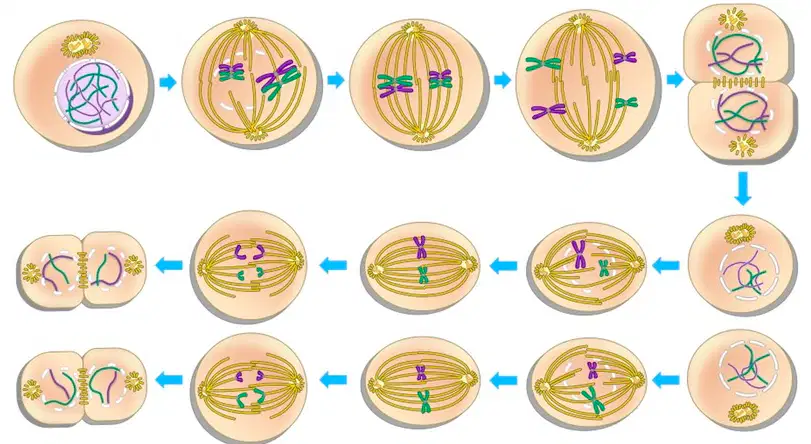
The diagram below illustrates which process?
Endocytosis
Meiosis
Phagocytosis
Mitosis
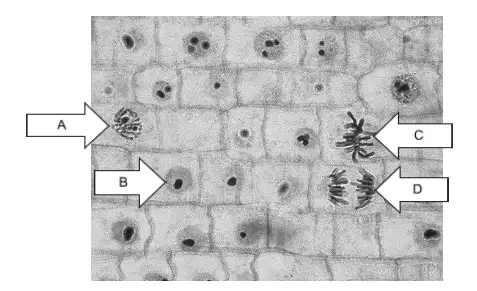
The image below shows a microscopic image of plant cells going through different stages of mitosis. Which stage identification is correctly justified?
The condensed chromatin indicates that A is prophase
The missing nuclear envelope indicates that C is interphase
The separation of sister chromatids indicates that D is telophase
The presence of a nucleus indicates that B is prophase
How are sexual reproduction and asexual reproduction different from each other?
Mutation rates are lower in sexual reproduction than in asexual reproduction
Asexual reproduction occurs only in multicellular organisms
Sexual reproduction requires two parents and asexual reproduction requires only one parent
Asexual reproduction requires 2 parents and sexual reproduction requires only one parent
A cell going through meiosis changes as it divides. Which statement describes how meiosis creates haploid cells?
During S phase of Interphase, the chromosomes reduce by half
During Crossing Over, the chromosomes reduce by half
Independent Assortment causes chromosomes to reduce by half
During the 2nd round of PMAT, chromosomes reduce by half
Some organisms, such as bacteria, reproduce asexually; whereas, other organisms reproduce sexually. Which statement correctly states why one type of reproduction is beneficial over the other?
Sexual reproduction can produce a large number of body cells
Asexually reproduced offspring are more genetically diverse.
Sexual reproduction produces organisms that are genetically diverse
Asexual reproduction produces gametes
A somatic cell from a corn plant normally contains 20 chromosomes. How many sister chromatids would that cell contain during G2 of the cell cycle?
10
40
0
20
Which structure holds two homologous chromosomes together?
Synaptonemal complex
Spindle apparatus
Kinetochore
Centromere
Polar microtubules
The drug taxol, or paclitaxel, is used to treat patients with a variety of cancers, including breast, lung and ovarian cancers. The drug works by stabilizing microtubules, and preventing their disassembly. The goal of the drug is to prevent dividing cells from being able to complete mitosis. As a result, cancerous cells can no longer divide. In a cell treated with taxol, at what stage of mitosis will the cells arrest?
Telophase
Anaphase
Prior to metaphase
Cytokinesis
Which one of these structures is held together by cohesin?
Homologous chromosomes
Solenoids
Sister chromatids
Nucleosomes
The fusion of a male gamete with a female gamete is called
mitosis
recombination
meiosis
syngamy
synapsis
What immediately follows meiosis I?
Crossing over of homologues
Metaphase II
DNA replication
Synapsis of homologues
Prophase II
Edouard van Beneden proposed that an egg and a sperm, each containing half the complement of chromosomes found in somatic cells, fuse to produce a single cell called a(n) ______.
embryo
zygote
oocyte
karyotype
If a cell has 32 chromosomes prior to S phase and undergoes mitosis followed by cytokinesis, each new daughter cell will have how many chromosomes?
32
64
16
8
If a drug that inhibited transport from the trans face of the Golgi was applied to plant cells, which stage of the cell cycle would be directly affected?
Cytokinesis
G2
Metaphase
S
Anaphase
When do homologous chromosomes separate from each other during meiosis?
Metaphase I
Anaphase II
Anaphase I
Prophase I
Metaphase II
Which best describes the process of independent assortment?
During synapsis, homologues pair independently of each other.
The way one pair of homologues lines up along the metaphase plate does not affect how any other pair lines up.
During synapsis, chromosomes pair up at random.
Segregation of chromosomes during meiosis I is independent of their segregation during meiosis II.
Crossing over along one pair of chromosomes is independent of crossing over along the other pairs.
Which event normally contributes to genetic variation?
Independent assortment of homologous chromosomes during mitosis.
Cytokinesis during mitosis.
Crossing over during meiosis II.
Fusion of a random egg and sperm to generate a zygote.
The zygote has
chromosomes identical to those of an egg cell.
chromosomes identical to those of a sperm cell.
two copies of each chromosome.
one copy of each chromosome.
one full haploid complement of chromosomes.
Before cell division of somatic cells, each chromosome must be replicated. After replication, the resulting two parts of each chromosome are held together by cohesin at the centromere. These two parts are referred to as __________.
kinetochores
homologous chromosomes
daughter chromosomes
sister chromatids
genes
What is one of the roles of the APC/C during anaphase?
To directly target microtubules for destruction
To directly target separase for destruction
To directly target cohesin for destruction
To directly target the mitotic cyclins for destruction
A cell undergoing interphase made a mistake by skipping the 1st step of interphase. What didn't the cell do and what phase would it go into next?
The cell did not check to see if it doubled in size or if the DNA replicated and it will go into Prophase
The cell did not double in size and it will go into S phase
The cell did not check to see if it doubled in size or if the DNA replicated and it will go into Go
The cell did not double in size and it will go into G0
Mitosis and meiosis are processes involved in cellular reproduction. Which of the following describes an event that results from mitosis but NOT meiosis?
2 stages of cell division
2 Identical cells
4 different cells
replicating DNA
Creating sperm cells is slightly different than creating egg cells. Which answer correctly summarizes the difference?
In females, only 1 egg cell is saved but in males, 4 sperm cells are created at the end of meiosis
None of options mentioned are correct
In females, 4 eggs are created but males only create 1 viable (usable) sperm cell at the end of meiosis
How is cytokinesis in plant cells different from cytokinesis in animal cells?
Cytokinesis in plant cell results in one large cell with two nuclei; cytokinesis in animal cells results in two cells, each with one nucleus.
Cytokinesis in plant cells requires formation of a cell plate; cytokinesis in animal cells requires formation of a ring of actin.
Cytokinesis in plant cells results in haploid cells; cytokinesis in animal cells results in diploid cells.
Cytokinesis in plant cells occurs during G2; cytokinesis in animal cells occurs in the M phase of the cell cycle.
The number of chromosomes characteristic of diploid eukaryotic cells, in general __________.
can be predicted by the size of the organism
is 46
varies considerably from 2 to over 1000 in different species
changes as each organism grows and ages
The stage of mitosis characterized by the physical separation of sister chromatids is called __________.
anaphase
metaphase
telophase
prometaphase
How many tetrads are present in a single elephant cell (2n = 56) during metaphase I of meiosis?
28
56
Diploid organisms use meiosis to produce haploid cells. Meiosis consists of ____ round(s) of nuclear division.
three
one
None of the answer choices are correct.
four
two
Which stage of the cell cycle is characterized by growth and contains a checkpoint to verify that all of the DNA has been replicated prior to mitosis?
S
G1
G2
Cytokinesis
Mitosis
The pairing of chromosomes along their lengths, which is essential for crossing over, is referred to as
recombination
syngamy
synapsis
centromere
prophase
Sister chromatids move to opposite poles of the cell during (Check all that apply.)
Metaphase I of meiosis.
Anaphase I of meiosis.
Anaphase II of meiosis.
Anaphase of mitosis.
A cell with 10 chromosomes undergoes mitosis. ________ daughter cells are created. Each cell will have _______ chromosomes
2 ; 10
2 ; 5
4 ; 5
4 ; 10
What type of cells contain only one set of chromosomes?
Diploid
Haploid
Germ-line
Somatic
The cell produced by the fusion of an egg and a sperm is the
germ line cell
zygote
somatic cell
oocyte
gamete
Which of the following describe changes in how scientists understand the genetics of cancer as a result of new data collected? Select all that apply.
Most cancer gene mutations found in solid tumors are single-base substitutions.
Tens of thousands of cancer genomes have been analyzed and the data are publicly available to help identify mutations that drive cancer development.
Cancer is the result of interactions between biological processes such as gene mutations, metabolic pathways, genomic stability, and patterns of transcription.
Cancer may or may not include over proliferation of cells in various tissues/organs.
Mutations that confer growth advantages to cells (i.e. cause cancer) can occur in oncogenes or tumor suppressor genes.
The accommodation of the very long DNA strands that are part of a chromosome into the limited space of the nucleus is achieved by coiling the DNA around beads of histones into repeating subunits. These DNA-wrapped histones are called __________.
rosettes
solenoids
chromatin loops
nucleosomes
What would you expect to happen if the anaphase-promoting complex/cyclosome (APC/C) failed to ubiquitinate securin?
Separase will be marked for degradation by securin, preventing the cell from entering anaphase.
Securin will remain intact and therefore will degrade cohesin, allowing the cell to enter anaphase.
The cohesin complex will be destroyed, and the cell will remain in metaphase.
The cohesin complex will persist, preventing the cell from entering anaphase.
Some organisms have a life cycle that is not an alternation between haploid and diploid stages. What is an example of an organism that has a life cycle that is not an alternation between diploid and haploid chromosome numbers?
The mold N. crassa
The bacterium E. coli
Alfalfa plants
Dogs
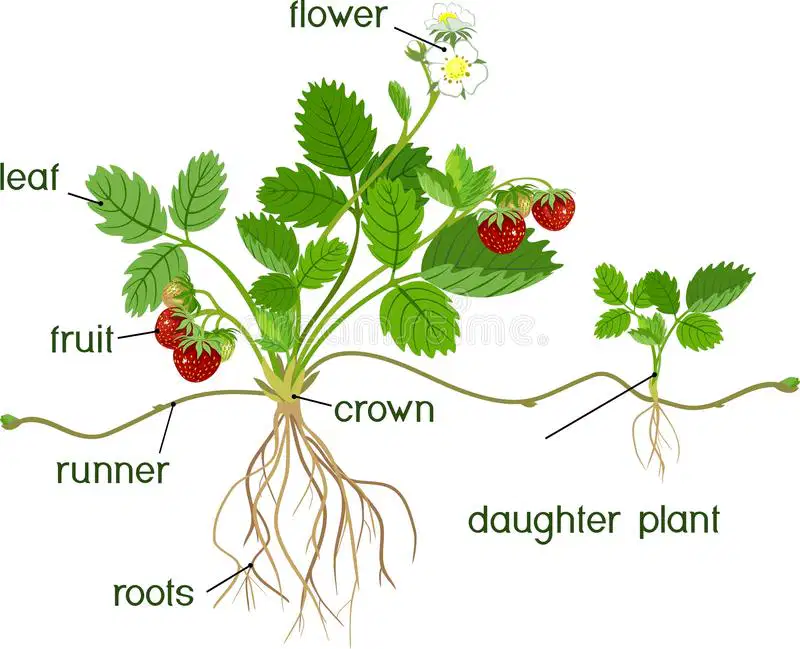
The diagram below shows two strawberry plants. Plant 2 is produced asexually from plant 1. If the leaf of Plant 1 has 56 chromosomes, how many chromosomes will be found in the leaf cells of Plant 2?
56
14
28
112
Compared to asexual reproduction, the main advantage of sexual reproduction is that it
can produce more complex offspring
can produce a greater number of offspring
requires less energy
increases the genetic diversity of the offspring
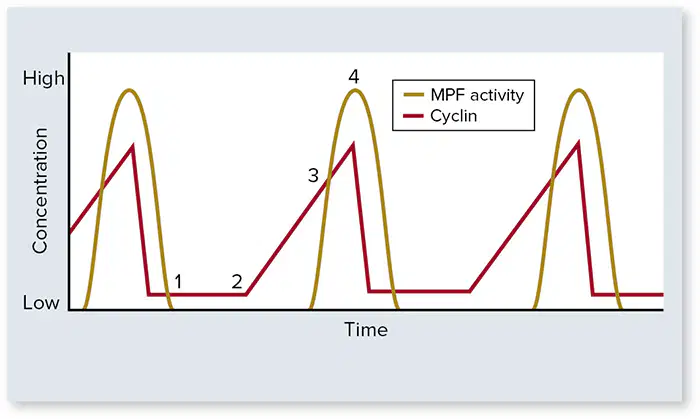
What time point represents G2?
1
2
4
3
What stage of mitosis is essentially the reverse of prophase?
Anaphase
Cytokinesis
Telophase
Prometaphase
Metaphase
In 95% of cases of Down's syndrome, there is one extra chromosome (number 21) in every cell. This aneuploid condition is most likely the result of
failure of 2 homologous pairs to segregate during meiosis.
failure of 1 homologous pair to segregate during meiosis.
failure to suppress DNA replication between meiosis I and meiosis II.
failure of the chromosomes to assort independently during meiosis.
failure of the cytoplasm to divide at the end of meiosis II.
In plants and animals, the zygote develops into an embryo by _____.
syngamy
synapsis
mitosis
reduction division
meiosis
Place the steps of Mitosis in the correct order (1st=1 , Last=4th).
METAPHASE
TELOPHASE
PROPHASE
ANAPHASE
2, 4, 1, 3
3, 2, 1, 4
4, 1, 2, 3
1, 4, 2, 3
Match the description to the correct stage:
Cells physically split their cytoplasm and they are no longer touching
Chromosomes line up in the middle with the help of centrioles and their spindle fibers
Nuclear envelope disappears, chromatid join into chromosomes, centrioles start to spread out with spindle fibers
Two nuclear envelopes reform with chromatids inside. Centrioles dissolve their spindle fibers. Two cells form but are still connected
Chromosomes are pulled apart by spindle fibers towards chromatids. Chromatids are pulled towards opposite sides of the cell
Metaphase
Anaphase
Cytokinesis
Prophase
Telophase
Cytokinesis
Metaphase
Prophase
Telophase
Anaphase
Telophase
Prophase
Cytokinesis
Metaphase
Anaphase
Which of the following is likely to occur if you were to prevent cyclin B from associating with its cyclin-dependent kinase near the end of meiosis I?
Failure to maintain sister chromatid cohesion at the centromere
Activation of DNA replication
Suppression of DNA replication
Failure to form initiation complexes necessary for DNA replication to proceed
What is separase?
A protein that is part of the cohesin complex
A protein that destroys cohesin through its protease activity
A protein that marks a protein called securin for destruction
A protein that targets the mitotic cyclin for degradation

