wayground logo

Free Printable Worksheets

NEW

Font size

S
M
L
XL
Worksheets

Biology Mid Year Exam Review (Units 1-4)

Total questions: 64

Worksheet time: 1hrs 1mins

Name
Class
Date
1.
What is the main difference between prokaryotic and eukaryotic cells?
a)
Prokaryotic cells have a nucleus and Eukaryotic cells do not
b)
Prokaryotic cells are unicellular and Eukaryotic cells are multicellular.
c)
Prokaryotic cells do not have a nucleus, Eukaryotic cells do have a nucleus.
d)
Prokaryotic cells are plant cells and Eukaryotic cells are animal cells.
2.
The main function of chloroplasts is:
a)
To control what enters and leaves the cell.
b)
To break down food to release energy for the cell.
c)
To control all activities of the cell.
d)
To produce food for the cell using the sun's energy.
3.
Ribosomes are the cell organelle that
a)
Break down food to produce energy for the cell.
b)
Produce proteins for the cell.
c)
Break down broken cell parts.
d)
Make food for the cell using the sun's energy.
4.
Organisms composed of many cells are called
a)
Prokaryotic
b)
Eukaryotic
c)
Unicellular
d)
Multicellular
5.
Which types of organisms are Prokaryotes?
a)
Animals
b)
Plants
c)
Fungi
d)
Bacteria
6.
This is referred to as the energy currency of the cell
a)
ADP
b)
ATP
c)
Mitochondria
d)
Nucleus
7.
Stores genetic information and carries out protein synthesis
a)
Carbohydrates
b)
Lipids
c)
Proteins
d)
Nucleic Acids
8.
Which of the following is the correct equation for aerobic cellular respiration?
a)
6CO2 + 6H2O     --->   C6H12O6 + 6O+ ATP
b)
6O2 + C6H12O6  ---> 6H2O + 6CO+ ATP
c)
C6H12O+ 6H2O ---> 6CO2 + 6O+ ATP
d)
6O2 + 6H2O ---> C6H12O6 + 6CO+ ATP
9.
Which of the following is the correct equation for PHOTOSYNTHESIS?
a)
6CO2 + 6H2O --> 6O+ C6H12O6
b)
6CO+ C6H12O6 + 6H2O --> O
c)
6O2 + 6H2O --> 6CO+ C6H12O6
d)
C6H12O6 + 6O2 ---> 6H2O + 6CO2 
10.
What is the purpose of cellular respiration?
a)
to break down food
b)
to create energy in the body
c)
to release energy from food
d)
there is none; it's a waste of time
11.
Made of monomers of amino acids
a)
Carbohydrates 
b)
Lipids
c)
Proteins 
d)
Nucleic Acids
12.
Made of monomers of monosaccharides
a)
Carbohydrates
b)
Lipids
c)
Proteins
d)
Nucleic Acids
13.
Made of monomers of nucleotides
a)
Carbohydrates
b)
Lipids
c)
Proteins
d)
Nucleic Acids
14.
Made of glycerol and fatty acids
a)
Carbohydrates
b)
Lipids
c)
Proteins
d)
Nucleic Acids
15.
Include sugars (ex. glucose) and starches
a)
Carbohydrates
b)
Lipids
c)
Proteins
d)
Nucleic Acids
16.
Include waxes, oils, steroids (hormones)
a)
Carbohydrates
b)
Lipids
c)
Proteins
d)
Nucleic Acids
17.
Includes DNA and RNA
a)
Carbohydrates
b)
Lipids
c)
Proteins
d)
Nucleic Acids
18.
Provide quick energy and serve as structural components of plant cells
a)
Carbohydrates
b)
Lipids
c)
Proteins
d)
Nucleic Acids
19.
Waterproofs, insulates, and stores energy long-term
a)
Carbohydrates
b)
Lipids
c)
Proteins
d)
Nucleic Acids
20.
What are the reactants (what's needed) for photosynthesis?
a)
glucose and oxygen
b)
light, water, and carbon dioxide
21.
What is the purpose of photosynthesis?
a)
make glucose
b)
make ATP
c)
make light
d)
release carbon dioxide
22.
In which organelle (part of the cell) does photosynthesis take place?
a)
mitochondria
b)
chloroplast
c)
nucleus
d)
cell membrane
23.
What is the gas we breath out that plants use for photosynthesis?
a)
sulfur
b)
carbon dioxide
c)
oxygen
d)
hydrogen
24.
How can photosynthesis be related to cellular respiration?
a)
What's produced (made) by one is needed (the reactants) for the other
b)
They both produce the same products
c)
They both have the same reactants (need the same things)
d)
These 2 processes have nothing in common
25.
Another term for equilibrium is...
a)
Not enough
b)
Too little
c)
Homeostasis
d)
Too much
26.
The cell membrane is selectively permeable, which means...
a)
All materials can enter and leave the cell
b)
Certain things can enter while others cannot
c)
The cell manually sorts through all materials
d)
Only certain cells can interact with the cell.
27.
Against the concentration gradient
low to high
uses energy/ATP
a)
facilitated diffusion
b)
osmosis
c)
active transport
d)
simple diffusion
28.
A molecule that diffuses down a concentration gradient goes from an area of ______ concentration into an area of ______ concentration.
a)
high, low
b)
low, high
c)
passive, active
d)
active, passive
29.
Structure A refers to the _____.
a)
chromatid
b)
chromosome
c)
centromere
30.
Before cells can divide, what must be copied?
a)
mitochondria
b)
cytoplasm
c)
DNA
d)
Cell Wall
31.
Which of the following is NOT occuring during interphase?
a)
Cell growth
b)
DNA being copied
c)
DNA condensing
d)
Two new cells are made
32.
The process by which the nuclear material is divided equally between two new cells
a)
mitosis
b)
cancer
c)
spindle
d)
centromere
33.
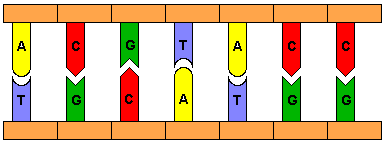
Which sequence of DNA bases would pair with this partial strand
ATG TGA CAG
a)
ATG TGA CAG
b)
TAC ACT GTC
c)
GTA AGT GAC
d)
CAT TCA CTG
34.
Which 2 molecules form the sides (backbone) of the DNA ladder?
a)
deoxyribose sugar and adenine
b)
deoxyribose sugar and a hydrogen bond
c)
deoxyribose sugar and the nucleus
d)
deoxyribose sugar and phosphate
35.

A process in which DNA has the unique ability to make an exact copy of itself.

a)

Replication

b)

Translation

c)

Transcription

d)

Mitosis

36.
What are the three components of a nucleotide?
a)
sugar, hydrogen, nitrogen base
b)
sugar, oxygen, nitrogen base
c)
sugar, phosphate, nitrogen base
d)
sugar, phosphate, protein
37.
In DNA, Adenine pairs with ___________. 
a)
Guanine
b)
Cytosine
c)
Thymine
d)
Uracil
38.
What process does a multi-cellular organism use to replace its damaged body cells?
a)
mitosis
b)
meiosis
c)
replication
d)
transcription
39.
breaks down glucose to release energy for the cell
a)
nucleus
b)
lysosomes
c)
mitochondria
d)
vacuole
40.

What is the cell organelle that contains digestive enzymes to break down unwanted material?

a)

The cytoplasm

b)

The lysosomes

c)

The vacuole

d)

The mitochondria

41.
Identify which of these is NOT a major difference between plant and animal cells.
a)
Only plant cells have a cell wall.
b)
Only animal cells have mitochondria.
c)
Animal cells do NOT contain chloroplasts.
d)
Plant cells have a large central vacuole.
42.
___________ form the two layers of the cell membrane. 
a)
Carbohydrates 
b)
Proteins 
c)
Phospholipids 
d)
Cholesterol
43.
The process of mitosis and cellular division allows multicellular organisms to do which of the following? 
a)
metabolize nutrients
b)
perform photosynthesis 
c)
grow larger
d)
repair mutations 
44.
Most of the life cycle of a cell is spent in in what phase of the cell cycle? 
a)
Mitosis 
b)
Interphase
c)
Cytokinesis
d)
Sythesis 
45.
During interphase, the DNA is replicated to create two complete sets of DNA.  The DNA is copied during which stage of the cell cycle? 
a)
G1
b)
S
c)
G2
d)
M
46.
Before DNA can be replicated, the DNA must separate-- 
a)
between the phosphate groups
b)
behind the deoxyribose sugars
c)
from the sugar-phosphate backbone
d)
between the nitrogen bases
47.
This is a picture of
a)
Cell wall
b)
Cell membrane
c)
chloroplast
d)
mitochondria
48.
Where does cellular respiration occur?
a)
Nucleus
b)
Mitochondria
c)
Vacuole
d)
Chloroplast
49.
Arteries carry blood.... 
a)
Away from the heart 
b)
To the heart 
c)
In any direction of the body
50.
Veins carry blood.... 
a)
away from the heart 
b)
To the heart 
c)
In any direction 
51.

Red blood cells deliver __________ to your body cells.

a)

water

b)

oxygen

c)

proteins

d)

carbon dioxide

52.

Within the lungs, the exchange of oxygen and carbon dioxide occurs between the ___ and the capillaries.

a)

trachea

b)

bronchi

c)

alveoli

d)

diaphragm

53.
Which of the sequence best describe how a piece of chicken nugget is digested in the human body?
a)
mouth, esophagus, small intestine, large intestine, stomach
b)
mouth, stomach, small intestine, large intestine, esophagus
c)
mouth, esophagus, stomach, small intestine, large intestine
54.

The large intestine's major role is to _________________.

a)

absorb water from undigested food

b)

exhale carbon dioxide

c)

break down food

d)

absorb nutrients from food

55.
The movement of oxygen from the alveoli to the blood and from the blood to the tissues is due to the process of... 
a)
osmosis
b)
diffusion
c)
cytokinesis
d)
phagocytosis
56.

What is the main function of the kidney?

a)

Store and remove urine from the body

b)

To add salt and nitrogen to the blood

c)

Maintain water balance of the body and remove nitrogenous wastes

d)

To break down proteins and deliver amino acids to cells

57.

In _______________, the control center uses information from the sensors to increase the rate of change away from a set point.

a)

Negative Feedback

b)

Homeostasis

c)

Mitochondria

d)

Positive Feedback

58.
a body system that controls and coordinates all body activities through electric impulses/messages between brain, spinal cord and nerves.
a)
endocrine system 
b)
nervous system
c)
nerve
d)
neuron
59.

Which term most accurately describes your body's response to temperature changes?

a)

Positive Feedback

b)

Negative Feedback

c)

Control Center

d)

Condensation

60.

Which of the following statements about viruses is true?

a)

They contain ribosomes

b)

They do not contain genetic material

c)

They need a host cell to reproduce

d)

They have a cell membrane

61.

How many chromosomes are in this cell?

a)

12

b)

3

c)

6

62.

After mitosis, how many cells will be produced, and how many chromosomes will be in each cell?

a)

1 cell, 4 chromosomes

b)

2 cells, 2 chromosomes

c)

1 cell, 2 chromosomes

d)

2 cells, 4 chromosomes

63.

How should you set up your axes in a graph?

a)

Independent variable on x-axis; dependent variable on y-axis

b)

Independent variable on y-axis; dependent variable on x-axis

64.

Jim measures his heart rate before, during, and after exercise. Which of the following correctly describes the variables?

a)

IV - exercise; DV - heart rate

b)

IV - heart rate; DV - exercise

c)

control - exercise; contstant - heart rate

d)

control - heart rate; constant - exercise