
 Worksheets
midterm
Total questions: 98
Worksheet time: 4hrs 4mins
Name
Class
Date
1.
Which particle has a positive charge?
a)
electron
b)
orbital
c)
proton
d)
neutron
2.
This particle determines what element you have - the elements identity.
a)
electron
b)
proton
c)
neutron
d)
valence shell
3.
Choose the particle that has no charge.
a)
nucleus
b)
neutron
c)
proton
d)
electron
4.
An electron has a _____ charge.
a)
negative
b)
positive
c)
neutral
5.
Describe an Electron Cloud?
a)
the mist outside of an atom
b)
home of the protons
c)
where electrons are located
d)
nucleus
6.
What are the maximum number of electrons that go on the first 3 energy levels?
a)
2,4,16
b)
2,8,18
c)
4,8,12
d)
3,4,6
7.
What are valence electrons?
a)
electrons on the first orbital always
b)
nucleus
c)
the outermost shell
d)
the number of electrons on the outermost orbital
8.
Which particles make up the nucleus of an atom?
a)
protons and neutrons
b)
electrons and protons
c)
electrons, protons, and neutrons
d)
electrons and neutrons
9.
What is the mass number and name of an element with 8 protons and 8 neutrons?
a)
16 - Carbon
b)
16 - Oxygen
c)
24 - Oxygen
d)
8 - Neon
10.
An element with a mass number of 10 and an atomic number of 6 has how many protons?
a)
5
b)
8
c)
6
d)
10
11.
An atom has 10 protons, 15 neutrons and 10 electrons what is its mass number.
a)
20
b)
10
c)
5
d)
25
12.
An atom has 13 protons, 15 neutrons and ___ electrons what is its mass number?
a)
13
b)
26
c)
28
d)
15
13.

What is an ion?
a)
A Charged Atom
b)
A Large Atom
c)
A Small Atom
d)
A Cute Atom
14.

Barium atoms want to form...
a)
an anion
b)
a cation
c)
an onion
d)
a cuddly kitten friend
15.

An Arsenic atom wants to form...
a)
An anion
b)
A cation
c)
An onion
d)
A cuddly kitten friend
16.

Why are ions formed?
a)
To make our lives difficult
b)
Because atoms want 8 valence electrons
c)
Because atoms have the same number of protons and electrons
d)
Because atoms gained neutrons
17.

Cations are...
a)
Positive
b)
Negative
c)
Neutral
d)
Purring
18.

Anions are...
a)
Positive
b)
Negative
c)
Neutral
d)
Crying
19.

An atom becomes _________ when it gains electrons.
a)
Positive
b)
Negative
c)
Neutral
d)
Invinsible
20.

An atom becomes _______ when it loses electrons.
a)
Positive
b)
Negative
c)
Neutral
d)
Invinsible
21.

What is a Rubidium ion's symbol?
a)
Rb-
b)
Rb+
c)
Rb-2
d)
Rb+2
22.

What is the ionic symbol for a phosphorus atom?
a)
P-3
b)
P+3
c)
P-2
d)
P+2
23.
Which atom has the largest atomic radius?
a)
potassium
b)
rubidium
c)
francium
d)
cesium
24.
As you move down the periodic table atoms get bigger. This is because ____________.
a)
The atoms have more mass.
b)
The atoms have more protons.
c)
The atoms have more energy levels
d)
The atoms have more nuetrons
25.
As you move across the periodic table atoms tend to get smaller because, ______________.
a)
the atoms have more mass.
b)
the atoms have less mass
c)
the atoms have more protons.
d)
the atoms have less electrons.
26.
Electronegativity is...
a)
how good an atom is at attracting electrons
b)
the ability of an atom to lose electrons
c)
the energy required to remove an electron from a specific atom
d)
how easy it is to make friends.
27.
Ionization energy is...
a)
the energy required to add an electron to a specific atom
b)
how much energy it takes to remove an electron from an atom
c)
the energy required to shield the outer electrons from the nucleus
d)
a measure of the ability of an atom to attract electrons
28.
Atomic radius generally increases as we move __________.
a)
down a group and from right to left across a period
b)
up a group and from left to right across a period
c)
down a group and from left to right across a period
d)
up a group and from right to left across a period
29.
Electronegativity __________ from left to right within a period and __________ from top to bottom within a group.
a)
decreases, increases
b)
increases, increases
c)
increases, decreases
d)
stays the same, increases
30.
A helium nucleus with two protons and two neutrons is called a(n) ____.
a)
alpha particle
b)
electroscope
c)
beta particle
d)
gamma ray
31.

What particle completes this reaction?
a)
alpha particle
b)
beta particle
c)
gamma particle
d)
neutron
32.
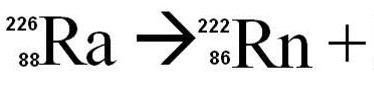
Complete the nuclear equation and determine the type of decay that is occurring in this reaction.
a)
alpha
b)
beta
c)
gamma
d)
none
33.
Solve this equation for alpha decay.
20985At = ___ + 42He
20985At = ___ + 42He
a)
20583Bi
b)
20986Rn
c)
20781Tl
d)
20885At
34.
Solve this equation for alpha decay.
22688Ra = ___ + 42He
22688Ra = ___ + 42He
a)
22286Rn
b)
22689Ac
c)
22484Po
d)
22588Ra
35.
Solve this equation for beta decay.
6027Co = ___ + 0-1e
6027Co = ___ + 0-1e
a)
5625Mn
b)
6028Ni
c)
5823V
d)
5927Co
36.
Solve this equation for beta decay.
146C = ___ + 0-1e
146C = ___ + 0-1e
a)
104Be
b)
147N
c)
102He
d)
136C
37.
The following is an example of what type of reaction?
24395Am → 23993Np + 42He
24395Am → 23993Np + 42He
a)
alpha decay
b)
beta decay
c)
gamma decay
38.
What is the missing isotope that will balance the following nuclear equation?
94Be + 11H → _____ + 42He
94Be + 11H → _____ + 42He
a)
105B
b)
105Ne
c)
63Li
d)
63C
39.
If we start off with element 5024X after an alpha decay we get another element Y that looks like
a)
5022Y
b)
4622Y
c)
4820Y
d)
5426Y
40.
Fusion produces ____ nuclei.
a)
same-sized
b)
smaller
c)
larger
d)
all of the above
41.
Fission produces ____ nuclei.
a)
same-sized
b)
smaller
c)
larger
d)
all of the above
42.
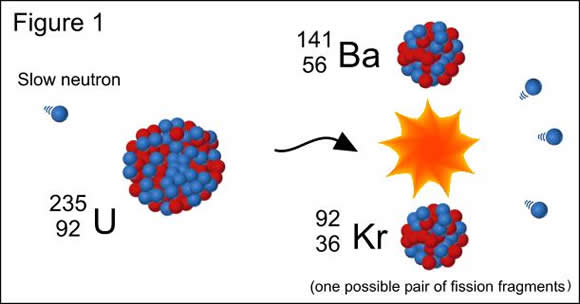
Which nuclear process is shown in the picture?
a)
fission
b)
fusion
c)
alpha decay
d)
beta decay
43.
The amount of material left after TWO half lives is ____ of the original amount.
a)
1/2
b)
1/4
c)
1/8
d)
1/16
44.

Which type of radioactive decay is occurring in this equation?
a)
Alpha decay
b)
beta decay
c)
gamma decay
d)
positron emission
45.
The half-life of strontium-91 is 30 years. How much strontium-91 will remain after 120 years if the initial amount is 4.0 g?
a)
3.0g
b)
0.25mg
c)
0.3g
d)
0.25g
46.
What is Half-life?
a)
The amount of time it takes for some of the nuclei in a sample of the isotope to decay
b)
The amount of time it takes for half the electrons in a sample of the isotope to decay
c)
The amount of time it takes for half the nuclei in a sample of the isotope to decay
d)
the amount of time it takes to double the nuclei in a sample of the isotope to decay
47.
Which is the correct order of the electromagnetic spectrum from highest frequency to lowest frequency?
a)
Gamma, X-ray, Ultraviolet, Visible, Infrared, Microwave, Radio
b)
Gamma, Ultraviolet, Visible, Infrared, X-ray, Microwave, Radio
c)
Ultraviolet, Microwave, Radio, Visible, X-ray, Gamma, Infrared
d)
Radio, Microwave, Infrared, Gamma, X-ray, Ultraviolet, Visible
48.
Which class of electromagnetic radiation has the longest wavelengths?
a)
Radio
b)
Gamma
c)
Infrared
d)
Visible
49.
Which class of electromagnetic radiation has the least energy?
a)
Radio
b)
Gamma
c)
Infrared
d)
Visible
50.
Which color light has the longest wavelength?
a)
Red
b)
Orange
c)
Green
d)
Violet
51.
Which color light has the most energy?
a)
Red
b)
Blue
c)
Green
d)
Violet
52.

Wavelengths on the right side of the Electromagnetic spectrum are ______________.
a)
short
b)
long
c)
average
53.

_______ carry the greatest amount of energy.
a)
x-rays
b)
gamma rays
c)
infrared rays
d)
visible light
54.

The higher the frequency the ______ the energy.
a)
higher
b)
lower
c)
neither, stays the same
55.
Put the visible light colors in order from longest wavelength to shortest wavelength
a)
Violet, Indigo, Blue, Green, Orange, Yellow, Red
b)
Red, Yellow, Green, Orange, Violet, Blue, Indigo
c)
Red, Orange, Yellow, Green, Blue, Indigo, Violet
d)
Yellow, Blue, Orange, Violet, Red
56.

This wave has the second highest frequency on the spectrum.
a)
microwaves
b)
visible light
c)
x-rays
d)
gamma ray
57.
The part of the electromagnetic spectrum that we can see
a)
microwaves
b)
visible light
c)
gamma rays
d)
infrared
58.

Short, high energy rays used to see through things
a)
gamma rays
b)
X rays
c)
microwaves
d)
infrared
59.

Wavelength in between visible light and microwaves; night vision goggles
a)
radio waves
b)
infrared
c)
microwaves
d)
trough
60.
Which is the electron configuration for an oxygen atom?
a)
1s22s22p63s23p64s2
b)
1s22s22p4
c)
1s22s22p6
d)
1s22s22p63s23p6
62.
What is the maximum number of electrons that an orbital can have?
a)
1 electron
b)
2 electrons
c)
3 electrons
d)
4 electrons
62.
What is the maximum number of electrons that an orbital can have?
a)
1 electron
b)
2 electrons
c)
3 electrons
d)
4 electrons
63.

How many valence electrons are represented here?
a)
7
b)
5
c)
2
d)
8
64.
How many electrons can the d sublevel hold?
a)
8
b)
10
c)
2
d)
4
66.
What is this element?
1s22s22p63s23p6
4s23d104p6
1s22s22p63s23p6
4s23d104p6
a)
Argon
b)
Krypton
c)
Selenium
d)
Bromide
66.
What is this element?
1s22s22p63s23p6
4s23d104p6
1s22s22p63s23p6
4s23d104p6
a)
Argon
b)
Krypton
c)
Selenium
d)
Bromide
67.
How many valence electrons does Chlorine have?
a)
5
b)
2
c)
7
d)
5
68.
How many valence electrons does phosphorus have?
a)
5
b)
2
c)
8
d)
15
69.

Which element is pictured?
a)
neon
b)
fluorine
c)
magnesium
d)
argon
70.
What atom matches this electron configuration?
1s2 2s2 2p6 3s2
1s2 2s2 2p6 3s2
a)
Neon
b)
Magnesium
c)
Aluminum
d)
Potassium
71.
What atom matches this electron configuration?
[Xe] 6s2 4f14 5d9
[Xe] 6s2 4f14 5d9
a)
Mercury
b)
Gold
c)
Platinum
d)
Thallium
72.
How many neutrons in C-14?
a)
6
b)
7
c)
14
d)
8
74.
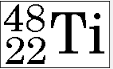
How many protons does this isotope of titanium have?
a)
48
b)
22
c)
26
d)
70
74.
How many protons does this isotope of titanium have?
a)
48
b)
22
c)
26
d)
70
75.

How many neutrons does the isotope of lithium have?
a)
8
b)
3
c)
4
d)
5
76.

What do these isotopes of carbon all have in common?
a)
neutrons & mass number
b)
atomic number and neutrons
c)
atomic number and electrons
d)
protons, atomic number, and mass number
77.
The rows in the period table are called ______
a)
periods
b)
groups
c)
families
d)
series
78.
The region around the nucleus of the atom where the electrons are likely to be found is the...
a)
isotope
b)
orbital paths
c)
electron cloud
d)
ions
79.
The center of the atom with protons and neutrons is the...
a)
nucleus
b)
ion
c)
electron
d)
isotope
80.

How many ELECTRONS are an atom of Lithium?
a)
6.941
b)
4
c)
3
d)
7
81.

What is the ATOMIC NUMBER of Cobalt?
a)
58.933
b)
4
c)
27
d)
32
82.
What is at the center of every atom?
a)
An electron
b)
A compound
c)
A molecule
d)
A nucleus
83.
Which two particles make up the nucleus of an atom?
a)
Protons and Electrons
b)
Protons and Neutrons
c)
Molecules and Compounds
d)
Neutrons and Electrons
84.
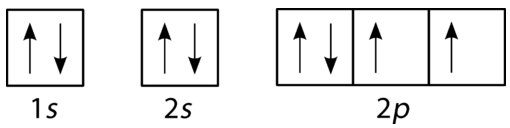
This orbital diagram represents:
a)
C
b)
B
c)
N
d)
O
85.

This orbital diagram represents:
a)
C
b)
B
c)
N
d)
O
86.

What is incorrect about this orbital diagram?
a)
Both arrows in the 2p box should be pointing up
b)
There is nothing incorrect with this diagram
c)
In the there should only be 1 orbital in the first 2p box and one in the 2nd 2p box
d)
All the arrows should be pointing up.
87.
What is incorrect about this orbital diagram?
a)
Both arrows in the 2p box should be pointing up
b)
There is nothing incorrect with this diagram
c)
In the 2p box there should only be 1 electron in the first 2p box and one in the 2nd 2p box
d)
All the arrows should be pointing up.
88.
For an electron to change from ground state to an excited stated it must...
a)
Absorb energy
b)
Release energy
89.
As light emitted from an element is passed through a prism, which of the following is created?
a)
light prism effect
b)
electron absorption chart
c)
quantum diagram
d)
line emission spectrum
90.
If an electron moves from n=2 to n=4 ...
a)
it absorbs light
b)
it releases light
91.

_____________________light is the only type of EM wave detected by the human eye.
a)
Red
b)
Gamma
c)
Microwave
d)
Visible
92.

_____ have the longest wavelengths and lowest frequencies of all electromagnetic waves.
a)
microwaves
b)
radio waves
c)
gamma rays
d)
ultraviolet
93.

Emission of light from an atom occurs when an electron
a)
drops from a higher to a lower energy level.
b)
jumps from a lower to a higher energy level.
c)
moves within its atomic orbital.
d)
falls into the nucleus.
94.

How do we solve for number of neutrons?
a)
Mass + Atomic Number= Neutrons
b)
Mass x Atomic Number = Neutrons
c)
Mass - Atomic Number = Neutrons
d)
Mass + Number of Protons = Neutron
95.
If 10 mg of iodine 131 is given to a patient, how much is left after 24 days? The half-life of iodine-131 is 8 days.
a)
1.25mg
b)
1.25g
c)
10g
d)
10mg
96.
If the half-life of uranium-232 is 70 years, how many half-lives will it take for 10 g of it to be reduced to 1.25 g?
a)
1 half-life
b)
2 half-lives
c)
3 half-lives
d)
4 half-lives
97.
The half-life of Zn-71 is 2.4 minutes. If one had 100.0 g at the beginning, how many grams would be left after 7.2 minutes has elapsed?
a)
100.0g
b)
50.0g
c)
12.5g
d)
8.5g
98.
An atom's _________ is its number of protons.
a)
atomic number
b)
mass number
c)
weight number
d)
football number
100 %

