
 Worksheets
Chemistry
Total questions: 100
Worksheet time: 2hrs 30mins
Name
Class
Date
1.
The positive particles of an atom are
a)
electrons
b)
positrons
c)
neutrons
d)
protons
2.
the central region of an atom where its neutrons and protons are is its
a)
nucleus
b)
electron cloud
c)
core
d)
center
3.
an atom with atomic number 6 would have how many protons
a)
6
b)
12
c)
3
d)
cannot be determined
4.
Particles in an atom that are neutral and have no charge are
a)
negatrons
b)
electrons
c)
neutrons
d)
protons
5.
True or False? Neutrons have a negative charge
a)
True
b)
False
6.
What is the atomic number for an element with three protons?
a)
2
b)
1
c)
3
d)
6
7.
A particle that moves around the nucleus is a(n)...
a)
Proton
b)
Neutron
c)
Electron
d)
Quark
8.

What does the 1.00794 stand for?
a)
Hydrogen
b)
atomic number
c)
atomic mass
d)
atomic explosion
9.
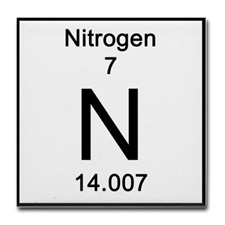
What is the number of protons that the element in this image contain?
a)
14
b)
7
c)
15
d)
18
10.
The first energy level can hold up to how many electrons?
a)
8
b)
4
c)
2
d)
5
11.

What is the atomic mass of "F"
a)
9
b)
18
c)
17
d)
19
12.
What is the atomic symbol for sodium?
a)
Na
b)
So
c)
NaCl
d)
S
13.

What is the atomic mass of Neon?
a)
10
b)
21
c)
10.18
d)
20.18
14.

How many protons are in Beryllium?
a)
4
b)
9
c)
5
d)
2
15.

What element is represented in this Bohr Model?
a)
Carbon
b)
Hydrogen
c)
Aluminum
d)
Lithium
16.

What's a valence electron?
a)
electrons in the second energy level
b)
electrons in the outermost energy level
c)
the atomic number
d)
electrons in the first level
17.
Which of the following has a full valence shell?
a)
Oxygen
b)
Neon
c)
Barium
d)
Carbon
18.
Which group of the periodic table is composed of inert (not reactive) gases?
a)
alkali metals
b)
alkaline earth metals
c)
halogens
d)
noble gases
19.
Elements which are shiny, conduct electricity and heat are called
a)
metal
b)
nonmetal
c)
metalloid
d)
nonexistent
20.
Which element is not a metal?
a)
Ca
b)
Re
c)
Al
d)
B
21.

The atoms along the staircase are called
a)
metals
b)
nonmetals
c)
metalloids
d)
noble gases
22.

The period for Bromine is ___________.
a)
3
b)
2
c)
4
23.
How many Valance electrons does Iodine Have?
a)
6
b)
16
c)
7
d)
17
24.
What is the name of the group that never reacts--ever ever they are stable with a full outermost ring!!!
a)
noble gases
b)
transition
c)
halogens
d)
borons
25.

Beryllium is in group number______.
a)
Group 2
b)
Group 3
c)
Group 4
d)
Group 7
26.
Which of the following is not a property of metals?
a)
brittle
b)
malleable
c)
lustrous
d)
conductive
27.

The blue atoms are called
a)
metals
b)
nonmetals
c)
metalloids
d)
noble gases
28.
The noble gases have how many valence electrons?
a)
1
b)
2
c)
7
d)
8
29.
Calcium is most like which of the following?
a)
Barium
b)
Potassium
c)
Cesium
d)
Nitrogen
30.
A atom has 20 protons, 20 neutrons and 20 electrons; what is the charge of the ATOM (Look at protons and electrons)
a)
Neutral
b)
Negative
c)
Positive
31.
A atom has 20 protons, 20 neutrons and 20 electrons; what is the charge of the NUCLEUS (think about the only particle that has a charge)
a)
+40
b)
+20
c)
20
d)
-20
32.
Name that element!
Period 2
Group 14
Period 2
Group 14
a)
Boron
b)
Oxygen
c)
Carbon
d)
Nitrogen
33.
True or false
Atomic Mass= Protons + Neutrons
Atomic Mass= Protons + Neutrons
a)
True
b)
False
34.
True or false: Chlorine, Bromine and Iodine are highly reactive and have similar chemical properties
a)
True
b)
False
35.
Name that element!
7 Protons
5 valence electrons
7 Protons
5 valence electrons
a)
Boron
b)
Calcium
c)
Nitrogen
d)
odine
36.
Elements in the same group have the same number of valence electrons sharing similar chemical properties.
a)
True
b)
False
37.
This element has 17 protons; what is it's name and how many valence electrons does it have?
a)
F; 5
b)
Cl; 7
c)
Br; 7
d)
Cl; 6
38.
How do you calculate the number of neutrons?
a)
N=AM-AN
b)
N= Protons + Electrons
c)
N= AN x AN
d)
N= AN-Valence electrons
39.
Why are elements in groups 1 and 17 highly reactive?
a)
Because they don't bond with other elements
b)
Because they have 8 valence electrons and are stable
c)
Because they loose/gain 1 valence electron
d)
None of the above
40.

The yellow atoms are called
a)
metals
b)
nonmetals
c)
metalloids
d)
noble gases
41.
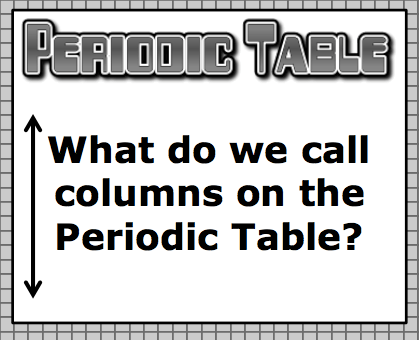
a)
Periods
b)
Groups
42.
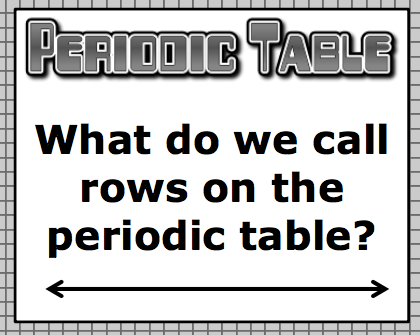
a)
Periods
b)
Groups
43.
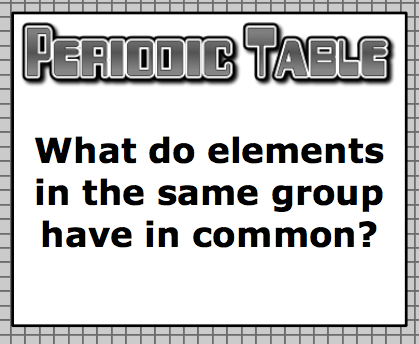
a)
energy levels
b)
valence electrons
c)
protons
d)
neutrons
44.

a)
energy levels
b)
valence electrons
c)
protons
d)
neutrons
45.
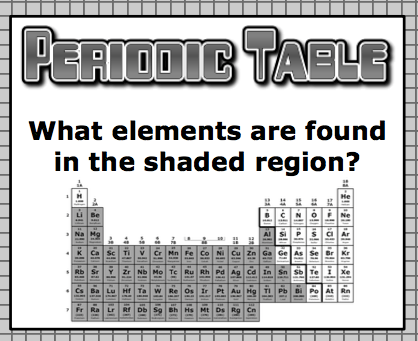
a)
Metals
b)
Nonmetals
c)
Metalloids
46.
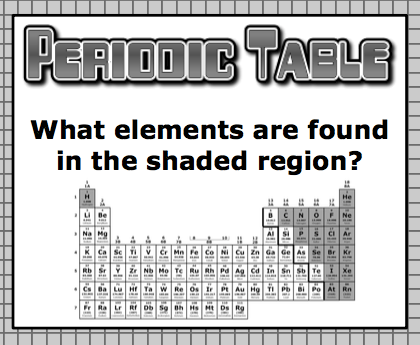
a)
Metals
b)
Nonmetals
c)
Metalloids
47.
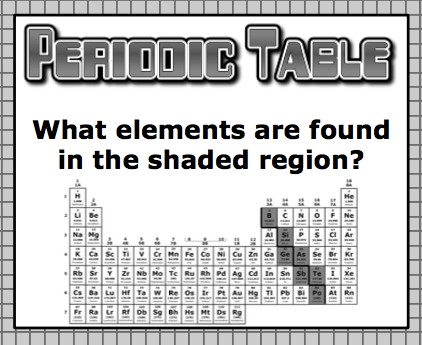
a)
Metals
b)
Nonmetals
c)
Metalloids
48.
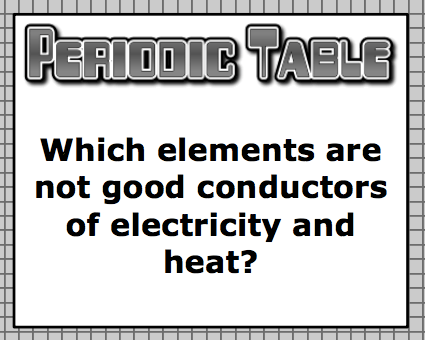
a)
Metals
b)
Nonmetals
c)
Metalloids
49.
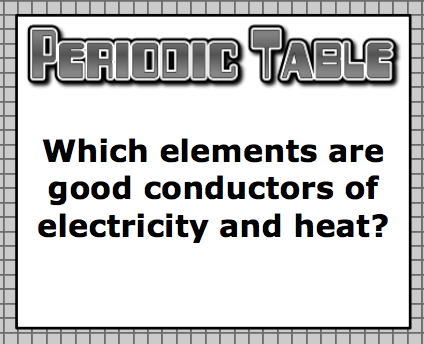
a)
Metals
b)
Nonmetals
c)
Metalloids
50.
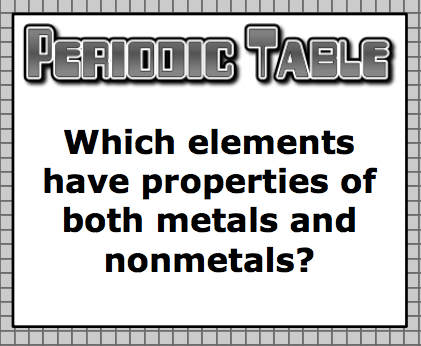
a)
Metals
b)
Nonmetals
c)
Metalloids
51.
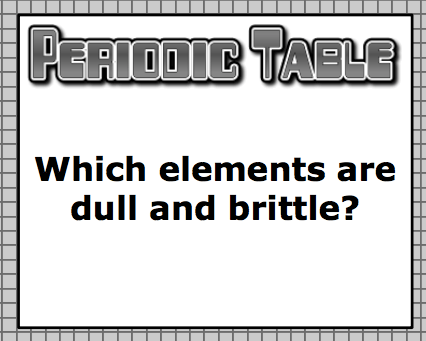
a)
Metals
b)
Nonmetals
c)
Metalloids
52.
How many elements are in C6H12O6?
a)
1
b)
2
c)
3
d)
4
53.
How many atoms of carbon (C) are in C6H12O6?
a)
3
b)
6
c)
12
d)
24
54.
Element or compound?
H2O
H2O
a)
element
b)
compound
55.
Element or compound?
O2
O2
a)
Element
b)
Compound
56.
Which of the following is a compound?
a)
Co
b)
O2
c)
C
d)
CO2
57.
Which is the correct formula for:
three hydrogen (H)
one sulfur (S)
four oxygen (O)
three hydrogen (H)
one sulfur (S)
four oxygen (O)
a)
H3SO4
b)
HSO4
c)
H4S3O
d)
H2O
58.
Which is the correct formula for:
one carbon (C)
two oxygen (O)
one carbon (C)
two oxygen (O)
a)
CO2
b)
CO
c)
C2O
d)
2CO
59.
How many elements are in H2O?
a)
1
b)
2
c)
3
d)
4
60.
Which of the following is NOT an element?
a)
H2O
b)
H2
c)
O2
d)
Au
61.
How many atoms are there TOTAL in:
H2SO4
H2SO4
a)
6
b)
5
c)
7
d)
3
62.
How many atoms are there TOTAL in:
H2SO4
H2SO4
a)
6
b)
5
c)
7
d)
3
63.
How many Aluminum are in Al2O3?
a)
3
b)
2
c)
5
64.
How many O's are in Al₂(SO₄)₃
a)
4
b)
12
c)
7
d)
24
65.
How many atoms of Nitrogen are in this formula (NH₄)₂CrO₄?
a)
1
b)
2
c)
8
d)
16
66.
The most important subatomic particle when determining an elements REACTIVITY is what?
a)
protons
b)
neutrons
c)
valence electrons
d)
electrons
67.

How many neutrons are contained in a neutral atom of:
a)
7
b)
14
c)
8
d)
9
68.

**
a)
CO
b)
H2O
c)
CO2
d)
H2
69.

**
a)
1
b)
2
c)
3
d)
4
70.
When trying to identify an unknown element, a scientist determines what other elements the unknown element reacts with chemically. Which property of the unknown element determines the other elements it reacts with?
a)
The total number of neutrons in the unknown element
b)
The total number of particles in the nucleus of the unknown element
c)
The number of protons in the nucleus of the unknown element
d)
The number of valence electrons in the unknown element
71.
Hay is made up of organic compounds. What are the main elements in many organic compounds?
a)
Helium, Carbon, Sodium
b)
Sodium, Hydrogen, Nitrogen
c)
Carbon, Hydrogen, Oxygen
d)
Radon, Oxygen, Helium
72.

Which of these formulas contain equal numbers of nitrogen atoms?
a)
Formulas I and III
b)
Formulas I and IV
c)
Formulas II and III
d)
Formulas I, II, and V
73.
An atom of a certain element has 36 protons, 36 electrons, and a mass number of 84. At room temperature this element is a very stable gas. How many neutrons are in the atom?
a)
48
b)
36
c)
84
d)
-36
74.

a)
A
b)
B
c)
C
d)
D
75.

a)
A
b)
B
c)
C
d)
D
76.

a)
A
b)
B
c)
C
d)
D
77.
Which information could a student determine from only the chemical formula of a protein?
a)
The color of the protein
b)
The number of molecules in each sequence that makes up a protein
c)
The physical arrangement of atoms in the structure of the protein
d)
The number of atoms of each element in the protein
78.
5 Which of the following best describes an electron?
a)
It has no charge and about the same mass as a proton.
b)
It has a negative charge and much less mass than a proton.
c)
It has a positive charge and much more mass than a neutron.
d)
It has a negative charge and about the same mass as a neutron.
79.

An atom has 25 protons, 30 neutrons, and 25 electrons. What is the charge of the atom’s nucleus?
a)
+25
b)
+30
c)
-25
d)
-30
80.

Which of these elements is in this group?
a)
Lithium
b)
Strontium
c)
Aluminum
d)
Silicon
81.

Aluminum, sulfur, and chlorine are elements found on the periodic table. Tests involving these three elements would show that at normal room temperature —
a)
sulfur is malleable and aluminum conducts electricity
b)
chlorine is malleable and conducts electricity
c)
aluminum is malleable and conducts electricity
d)
all three elements are malleable and conduct electricity
82.

A chemist is identifying the elements present in a sample of seawater. What characteristic of an element’s atoms always determines the element’s identity?
a)
The number of protons
b)
The number of neutrons
c)
The location of valence electrons
d)
The number of valence electrons
83.
How many protons does 1 atom of chlorine (Cl) have?
a)
17
b)
35
c)
7
d)
18
84.
How many electrons does 1 neutral atom of carbon (C) have?
a)
4
b)
6
c)
12
d)
18
85.
How many neutrons does 1 atom of sodium (Na) have?
a)
11
b)
12
c)
22
d)
23
86.
What is the atomic number of an atom with 13 protons, 14 neutrons, and 10 electrons?
a)
1
b)
13
c)
27
d)
37
87.
What is the mass of an atom with 7 protons, 8 neutrons, and 7 electrons?
a)
1
b)
7
c)
15
d)
22
88.

a)
A
b)
B
c)
c
d)
D
89.

a)
F
b)
G
c)
H
d)
J
90.

a)
F
b)
G
c)
H
d)
J
91.

a)
A
b)
B
c)
C
d)
D
92.

a)
F
b)
G
c)
H
d)
J
93.

a)
A
b)
B
c)
c
d)
D
94.

a)
60
b)
25
c)
10
d)
12
95.

a)
6
b)
12
c)
4
d)
24
96.
Protons are what charge?
a)
positive
b)
negative
c)
neutral
97.
Electrons have what charge?
a)
positive
b)
negative
c)
neutral
98.
_______ and _______ are located inside of the nucleus.
a)
Electrons and Protons
b)
Protons and Neutrons
c)
Neutrons and Electrons
99.
What charge does a neutron have?
a)
+1
b)
-1
c)
No charge
100.
The elements in this group have 5 outer electrons.
a)
Group 5
b)
Group 1
c)
Group 18
d)
Group 15
100 %

