wayground logo

Free Printable Worksheets

Font size

S
M
L
XL
Worksheets

2nd Quarter Review

Total questions: 99

Worksheet time: 1hrs 19mins

Name
Class
Date
1.
Which of the following is the correct equation for PHOTOSYNTHESIS?
a)
CO+ light + H2O --> O+ Sugar
b)
CO+ sugar + H2O --> O+ light
c)
O2 + light + H2O --> CO+ Sugar
d)
CO+ O2 + H2O --> Light+ Sugar
2.
What is the ultimate ORIGINAL source of energy for living things
a)
Sugar
b)
Sun
c)
Moon
d)
Carbon Dioxide
3.
Which organisms perform Photosynthesis?
a)
Only Autotrophs
b)
Only Heterotrophs
c)
Autotrophs and Heterotrophs
4.
What is the pigment in chloroplasts that performs photosynthesis?
a)
Chlorosynthesis
b)
Chlorophyll
c)
ADP
d)
Electron Transport
5.
Which gas is removed from the atmosphere during photosynthesis?
a)
hydrogen
b)
oxygen
c)
nitrogen
d)
carbon dioxide
6.
Where do the light-dependent reactions occur? 
a)
thylakoid membrane
b)
stroma
c)
mesophyll
d)
mitochondria
7.
Light energy is used to 
a)
split water into H and O
b)
weld C, H and O together
c)
make water
8.
How can photosynthesis be related to cellular respiration?
a)
What's produced (made) by one is needed (the reactants) for the other
b)
They both produce the same products
c)
They both have the same reactants (need the same things)
d)
These 2 processes have nothing in common
9.
This is referred to as the energy currency of the cell
a)
ADP
b)
ATP
c)
Mitochondria
d)
Nucleus
10.
This molecule contains two phosphate groups
a)
ADP
b)
ATP
c)
Mitochondria
d)
Nucleus
11.
Cellular respiration takes place in the
a)
nucleus
b)
cytoplasm
c)
ribosomes
d)
mitochondria
12.
Which is not a waste product of cellular respiration?
a)
Water
b)
Heat
c)
Carbon Dioxide
d)
Oxygen
13.
This means that oxygen is not needed
a)
anaerobic 
b)
aerobic
14.
Which type of respiration is most efficient?
a)
Aerobic
b)
Anaerobic
15.
The purpose of cellular respiration is to make
a)
food from energy
b)
ATP from glucose
c)
heat for the organism
d)
oxygen
16.
When animals exercise with a lack of oxygen their muscles can form
a)
lactic acid
b)
alcohol
c)
minions
d)
oxygen
17.
Which process uses energy to combine inorganic molecules to synthesize organic molecules?
a)
respiration
b)
digestion
c)
photosynthesis
d)
decomposition
18.
In the cells of the human body, oxygen molecules are used directly in a process that
a)
 releases energy
b)
 digests fat
c)
synthesizes carbohydrate molecules
d)
 alters the genetic traits of the cell
19.
The chart below lists substances involved in the process of photosynthesis.
Which statement best describes how these substances interact in photosynthesis? 
a)
A and B combine to produce C and D.
b)
 C and D combine to produce A and B. 
c)
B and C combine to produce A and D. 
d)
A and C combine to produce B and D.
20.
A cell in the leaf of a corn plant contains more chloroplasts than a cell in the stem of a corn plant. Based on this observation, it can be inferred that, when compared to the cell in the stem, the cell in the leaf
a)
synthesizes more sugar
b)
has a higher chromosome count
c)
produces fewer proteins
d)
uses less carbon dioxide
21.
Some cells, such as human nerve and muscle cells, contain many more mitochondria than do other cells, such as skin cells. Why do some cells have more mitochondria than others?
a)
The cells use more energy.
b)
The cells store more nutrients.
c)
The cells degrade more proteins. 
d)
The cells divide more frequently.  
22.
During the process of photosynthesis, energy from the sun is converted into
a)
chemical energy int he bonds of inorganic molecules
b)
chemical energy in the bonds of organic molecules
c)
enzymes used to produce inorganic molecules
d)
enzymes produced to form organic molecules
23.
Which molecule is indicated by X?
a)
glucose
b)
carbon dioxide
c)
ATP
d)
protein
24.

Which type of biological macromolecule is the main component of the plasma membrane?

a)

carbohydrate

b)

lipid

c)

protein

d)

nucleic acid

25.

This image is an example of a phospholipid. Which part of a phospholipid is HYDROPHOBIC?

a)

the phosphate "head"

b)

the lipid "tails"

26.

What is the "big idea" of the fluid mosaic model of plasma membranes?

a)

the plasma membrane creates a specialized FLUID that looks like a MOSAIC.

b)

the plasma membrane is a MOSAIC.

c)

the fluid mosaic model is NOT related to the plasma membrane.

d)

a plasma membrane is a MOSAIC of components that move FREELY and FLUIDLY.

27.

What does "hydrophobic" mean?

a)

water loving, associates with water

b)

water fearing, does not associate with water

c)

a world war II submarine

d)

an example would be solutes like sugar or salt

28.

What does "hydrophilic" mean?

a)

water loving, associates with water

b)

water fearing, does not associate with water

c)

a world war II submarine

d)

an example would be solutes like oil or fat

29.
Something is ___________ ____________
when some molecules can cross the membrane while others cannot. 
a)
Selectively (or Semi) Permeable 
b)
Totally Transparent
c)
Liquid Licorice 
d)
Heavily Patrolled 
30.
The movement of molecules across a membrane from high concentration to low concentration is called:
a)
Osmosis
b)
Diffusion
c)
Endocytosis
d)
Active Transport
31.
Active Transport typically uses ______ to transport materials across the cell membrane.
a)
ATP
b)
Glucose
c)
Na+
d)
K+
32.
The red blood cells in solution A are in a ____________ environment
a)
Acidic
b)
Isotonic
c)
Hypotonic
d)
Hypertonic
33.
The red blood cells in solution C are in a ____________ environment
a)
Acidic
b)
Isotonic
c)
Hypotonic
d)
Hypertonic
34.
The amount of particles in a given space.
a)
diffusion
b)
concentration
c)
permeable
d)
active transport
35.
When the concentration of particles inside of a cell is the same as the concentration of particles outside of the cell. 
a)
active transport
b)
concentration
c)
diffusion
d)
equilibrium
36.
The process where only water is allowed to pass through the cell membrane from a high to low concentration.
a)
meiosis
b)
respiration
c)
diffusion
d)
osmosis
37.
Cells use energy to move materials across a membrane (low to high concentration).
a)
Active transport
b)
Passive transport
c)
Diffusion
d)
Osmosis
38.
Cells transport material across a cell membrane without using energy (high to low concentration)
a)
Passive transport
b)
Concentration
c)
Endocytosis
d)
Active Transport
39.

Identify the substance that was added to the outside of the plant cells that caused the change observed.

a)

salt water

b)

fresh water

c)

distilled water

d)

glucose

40.

Molecule A cannot diffuse. What is a possible reason why?

a)

Molecule A is a macromolecule and it is too large to move.

b)

Molecule A is a building block and it is too large to move.

c)

Molecule A is a building block and it is too small to move.

d)

Molecule A is a macromole and it is too small to move.
41.
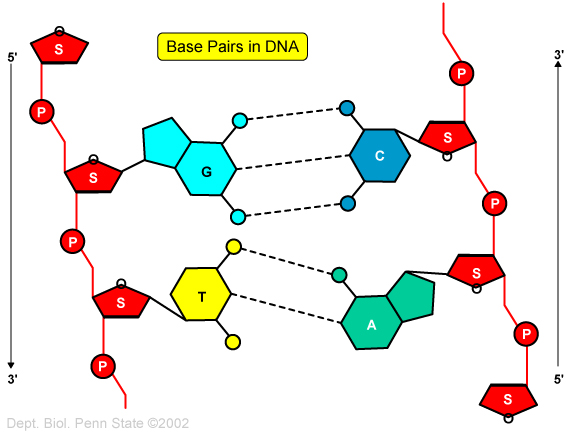
Adenine bonds with ______________.
a)
Guanine
b)
Thymine
c)
Cytosine
d)
Adenine
42.
Guanine bonds with ______________.
a)
Adenine
b)
Guanine
c)
Cytosine
d)
Thymine
43.
Which 2 molecules form the sides (backbone) of the DNA ladder?
a)
deoxyribose sugar and adenine
b)
deoxyribose sugar and a hydrogen bond
c)
deoxyribose sugar and the nucleus
d)
deoxyribose sugar and phosphate
44.
Nitrogenous bases are joined by which type of bond?
a)
polar bonds
b)
ionic bonds
c)
covalent bonds
d)
hydrogen bonds
45.
What is the correct complimentary strand for the following DNA?ATCGAG
a)
TACGAG
b)
ATCGAG
c)
TAGCTG
d)
TAGCTC
46.
Which of the following units are repeatedly joined together to form a strand of DNA?
a)
amino acids
b)
nucleotides
c)
fatty acids
d)
polysaccharides
47.
What are the nucleotides made of?
a)
Sugar, Phosphate, nitrogen base
b)
Phosphate, Adenine, nitrogen base
c)
Thymine, Adenine, Cytomine
d)
Phosphate, Nitrogen, Adenine
48.

DNA is an acronym for _____

a)

Diphosphorus Nucleic Acid

b)

Ribose Nucleic Acid

c)

Deoxyribonucleic Acid

d)

Deoxyribonucleic Acetate

49.
Sometimes, DNA is called "semi-conservative." Why might this be?
a)
The old strand is "conserved" and used to make the new strands
b)
Uracil is "conserved" in that it is only used to make the new strands
c)
ATP is "conserved" via the usage of facilitated diffusion
d)
Ligase is "conserved" in that it is denatured by the process
50.
What is the shape of DNA?
a)
Double helix
b)
Triple helix
c)
Flat, bilayer
d)
Three-pronged rigid ladder
51.
An organism’s genetic makeup or allele combination.
a)
Genotype
b)
Phenotype
c)
Beanotype
d)
Notype
52.

DNA replication is important for mitosis because...

a)

it results in a variety of traits amongst the same type of cells

b)

it ensures more genetic material in the strongest cells

c)

it ensures both cells will have identical, correct genetic information

d)

it creates variety amongst cells

53.
DNA replication turns one strand of DNA into two new strands of DNA. What percent of each new strand is the old strand?
a)
Half of each new DNA is the old DNA
b)
The old strand of DNA was digested, so none
c)
The new DNA is entirely made up of the old DNA
d)
About every sixth base comes from the old DNA
54.

True or False: All of your body cells contain the same genes.

a)

True

b)

False

55.
What is the purpose of mitosis?
a)
To increase the surface area of a cell
b)
To allow cells to divide for growth, repair, and renewal
c)
For increasing genetic variation within a species
d)
To allow for DNA replication and protein synthesis
56.
Mitosis results in the formation of...
a)
Two identical cells with all of the original chromosomes
b)
Two different cells with half of the original chromosomes
c)
Four identical cells with all of the original chromosomes
d)
Four different cells with half of the original chromosomes
57.
What stage is this?
a)
Prophase
b)
Metaphase
c)
Anaphase
d)
Telophase
58.
What stage is this?
a)
Prophase
b)
Metaphase
c)
Anaphase
d)
Telophase
59.
What stage is this?
a)
Prophase
b)
Metaphase
c)
Anaphase
d)
Telophase
60.
What stage is this?
a)
Prophase
b)
Metaphase
c)
Anaphase
d)
Telophase
61.
the division of the cytoplasm is called
a)
mitosis
b)
interphase
c)
cytokinesis
Cytokinesis
d)
somatic
somatic
62.

The structure labeled A is a(n)_________ used to hold sister chromatids together.

a)

chromatid

b)

centriole

c)

centromere

d)

chromophere

63.

What are the yellow curved lines in the image used to separate sister chromatids?

a)

chromosomes

b)

chromatids

c)

spindle fibers

d)

centrioles

64.

The structures labeled B are_________, held together by a centromere.

a)

sister chromatid

b)

centriole

c)

centromere

d)

chromophere

65.
the uncontrolled division of cells that results in malignant growth 
a)
tissues
b)
cancer
c)
mitosis
d)
anaphase
66.
Cells spend the majority of their lifes in
a)
interphase
b)
M
c)
S
d)
G2
67.
In asexual reproduction, all of the offspring are:
a)
Physically Identical
b)
Genetically Identical
c)
Physically and Genetically Identical
d)
Not Identical
68.
A hydra reproduces when an outgrowth, or bud, forms and continues to develop until if falls off of the parent. This is an example of:
a)
Binary Fission
b)
Sporulation
c)
Budding
d)
Vegetative Propagation
69.
a)
budding
b)
sporulation
c)
vegetative propagation
d)
binary fission
70.
a)
budding
b)
binary fission
c)
sporulation
d)
regeneration
71.
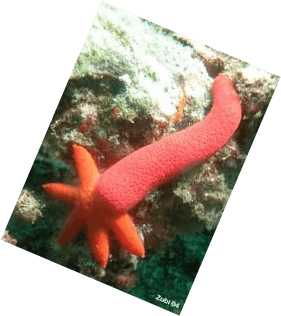
What type of asexual reproduction is taking place?
Fishermen work hard to catch and remove all the starfish that get into their favorite shell fishing beds and the “underwater farms” where they raise clams and oysters. In the past, they put the starfish into their boats, cut them up with knives, and then throw the pieces of starfish overboard. They thought this would kill the starfish. What they did not know was that each piece of starfish will grow into a whole new animal.
a)
Regeneration
b)
Vegetative propagation
c)
Budding
d)
Fission
72.

New plants produced from roots , stems and leaves

a)

propagation

b)

vegetation propagation

c)

vegetative propagation

73.
What is a segment of DNA called?
a)
Chromosome
b)
gene
c)
dominant trait
d)
nucleus
74.

Which organelle produces proteins?

a)

Ribosomes

b)

Lysosomes

c)

Nucleus

d)

Vacuoles

75.

Which cell parts are not present in animal cells?

a)

cell membrane & cytoplasm

b)

nucleus & chloroplasts

c)

cell wall & chloroplasts

d)

ribosomes & mitochondria

76.

Which is NOT a part of cell theory?

a)

All living things are made of cells.

b)

Cells are the smallest units of structure and function in life.

c)

Cells come from other cells.

d)

Cells cannot be created or destroyed.

77.

Large oval structure that acts as the control center of the cell, directing all of the cells’ activities

a)

Vacuole

b)

Ribosome

c)

Golgi Apparatus

d)

Nucleus

78.

Thick, clear, gel-like fluid that fills the region between the cell membrane and the nucleus

a)

Mitochondria

b)

Cytoplasm

c)

Chloroplast

d)

Nucleus

79.

An organelle that forms a maze of passageways in which proteins and other materials are carried from one part of the cell to another

a)

Cell Wall

b)

Endoplasmic Reticulum

c)

Golgi Appartus

d)

Cytoplasm

80.

Organelle in a cell that receives proteins and other newly formed materials from the endoplasmic reticulum, packages them, and distributes them to other parts of the cell

a)

Golgi Apparatus

b)

Lysosome

c)

Endoplasmic Reticulum

d)

Chloroplast

81.

The organelle that captures the energy from sunlight and converts it into chemical energy stored in food during photosynthesis:

a)

Chloroplast

b)

Mitochondrion

c)

Cell Wall

d)

Nucleus

82.

What is the function of the cell membrane?

a)

To control what comes in and out of the cell

b)

To break down food inside the cell

c)

to serve as a barrier

d)

to eat the cells food

83.

What is the function of the Vacuoles

a)

Store food, water and waste

b)

Receive proteins

c)

Assembles amino acids

d)

Found inside the nucleus

84.

The layer of ozone in the upper atmosphere of Earth is important to life because it shields Earth from

a)

solar winds

b)

impacts from meteors.

c)

changes in temperature.

d)

ultraviolet radiation.

85.

Carbon dioxide, methane, and water vapor are examples of

a)

the ozone layer.

b)

greenhouse gases.

c)

fossil fuels.

d)

biomass.

86.

How does deforestation affect levels of carbon in the atmosphere?

a)

Trees remove oxygen from the atmosphere during photosynthesis. With fewer trees, more oxygen remains in the atmosphere.

b)

Trees remove carbon dioxide from the atmosphere during photosynthesis. With fewer trees, more carbon dioxide remains in the atmosphere.

c)

Deforestation removes the harmful chemicals from the environment that farmers use on crops.

d)

Deforestation adds more carbon dioxide to the air which is harmful for the environment.

87.

Which caused the greatest increase of the growth of the human population?

a)

higher death rates

b)

increased marriage rates

c)

medical advancaes

d)

widespread disease

88.

How does deforestation affect levels of carbon in the atmosphere?

a)

Trees remove oxygen from the atmosphere during photosynthesis. With fewer trees, more oxygen remains in the atmosphere.

b)

Trees remove carbon dioxide from the atmosphere during photosynthesis. With fewer trees, more carbon dioxide remains in the atmosphere.

c)

Deforestation removes the harmful chemicals from the environment that farmers use on crops.

d)

Deforestation adds more carbon dioxide to the air which is harmful for the environment.

89.

Which of the following is the most common ozone destroying pollutants?

a)

Chloroflurocarbons

b)

particular matter

c)

Nitrogen dioxide

d)

carbon monoxide

90.
Increased levels of carbon dioxide in the atmosphere have been implicated in which of the following?
a)
Increased global warming
b)
Increased seawater acidity
c)
decreased seawater temperatures
d)
both increased global warming and increased seawater acidity
91.
Which of the following would make a greater contribution to rising sea levels?
a)
melting sea ice
b)
melting land-based ice
c)
increased levels of precipitation in some areas
d)
increased levels of atmospheric water vapor
92.
The term "greenhouse effect" describes
a)
occupational diseases of florists
b)
the trapping of heat energy in the troposphere by certain gaseous molecules
c)
the trapping of heat energy in the stratosphere by nitrogen
d)
efforts by the White House to support environmental legislation
93.

What is the greenhouse effect?

a)

A natural process where gases trap heat in the atmosphere.

b)

A man-made process where gases trap heat in the atmosphere.

c)

A natural process where the ocean traps heat in the atmosphere.

d)

A man-made process where the ocean traps heat in the atmosphere.

94.

What is the MOST significant way that humans contribute to the greenhouse effect?

a)

We do not contribute to the greenhouse effect.

b)

We burn fossil fuels.

c)

We practice animal agriculture.

d)

We make too much waste.

95.

The _____________ the human population, the ______________ the amount of resources being used.

a)

least, least

b)

greater, least

c)

least, greater

d)

greater, greater

96.

How does population growth affect natural resources?

a)

The more people on the planet, the less natural resources that are available for each person.

b)

The less people on the planet, the less natural resources that are available for each person.

c)

The more people on the planet, the more natural resources that are available for each person.

97.

The largest number of individuals that an environment can support long term is...

a)

population density

b)

depopulation

c)

exponential growth

d)

carrying capacity

98.
If the number of births is greater than the number of deaths in a population, what will happen to the growth of the population?
a)
It will increase.
b)
It will decrease.
c)
It will stay the same.
d)
It will fluctuate.
99.

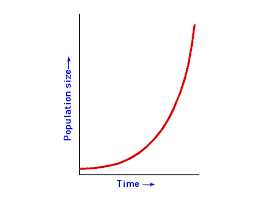
Identify the type of population growth shown on the graph.

a)

logistic growth

b)

exponential growth

c)

predator-prey cycle

d)

boom-bust curve