wayground logo

Free Printable Worksheets

Font size

S
M
L
XL
Worksheets

ecosystem

Total questions: 100

Worksheet time: 57mins

Name
Class
Date
1.
The living part of an ecosystem
a)
Biotic
b)
Abiotic
c)
Mother Earth
d)
Flowers
2.
The non-living part of an ecosystem
a)
Ocean
b)
Lava Flow
c)
Birds
d)
Abiotic
3.
What does every food chain start with? (Even if it's not drawn or written there!)
a)
producers
b)
sun
c)
consumer
d)
decomposers
4.
An organism that needs to eat other organisms to obtain energy is known as a:
a)
Autotroph
b)
Producer
c)
Consumer
d)
Mutualist
5.
Consumer that eats plants
a)
heterotroph
b)
herbivore
c)
producer
d)
community
6.
What does a food web represent?
a)
All connections of energy flow throughout all organisms in a habitat.
b)
The specific ways that mutualism is carried out.
c)
A single pathway or energy flow between organisms. 
d)
How carnivores get their food. 
7.
relationship in which two species live closely together
a)
resource
b)
mutualism
c)
succession
d)
symbiosis
8.
Where an organism lives
a)
habitat
b)
niche 
c)
heterotrogh
d)
biosphere
9.
In this Food Web Pyramid Which type of consumer gets only 10% of the energy stored in plants?
a)
Herbivore
b)
Carnivore
c)
Omnivore
d)
Secondary Consumer
10.
The image provided is an example of a(n):
a)
Carnivore
b)
Herbivore
c)
Producer
d)
Autotroph
11.
When individuals join a population
a)
Aliens
b)
migration
c)
Immigration
d)
Emigration
12.
A population is 
a)
a group of communities that exist in different places
b)
a group of organisms of one species that lives in the same area at the same time
c)
a group of people that populate one place at the same time on different planets
13.
When you leave a population
a)
emigration
b)
mitigation
14.
Carrying Capacity is
a)
the capacity of what one person can carry per day 
b)
how many animals you have in your daily bag limit at the end of the year
c)
wildebeest at a watering hole with zebras
d)
the maximum number of individuals that the environment can support
15.

How can a population grow?

a)

Emigration and death

b)

Immigration and death

c)

Immigration and birth

d)

Emigration and birth

16.
Is a fungal infection in frogs considered biotic or abiotic?
a)
biotic
b)
abiotic
17.
What type of interaction occurs when beech and maple trees are in the same forest? 
a)
cooperation
b)
competition
c)
cohabitance
18.
What type of interaction occurs when bees live in a hive?
a)
cooperation
b)
competition
c)
churros
d)
chimichangas
19.

Producers are plants that take in which gas during the carbon cycle?

a)

oxygen

b)

carbon dioxide

c)

nitrogen

d)

carbon monoxide

20.

symbiosis relationship when 1 organism benefits and the other is harmed

a)

commensalism

b)

parasitism

c)

mutualism

d)

predation

21.

when 1 organism benefits and the other is neither helped nor harmed

a)

parasitism

b)

mutualism

c)

commensalism

d)

predation

22.

when organisms fight over or want the same resource

a)

cooperation

b)

commesalism

c)

combustion

d)

competition

23.

which is the 3rd level consumer

a)

grasshopper

b)

grass

c)

frog

d)

snake

24.

which level contains the most energy?

a)

grass

b)

rabbit

c)

snake

d)

hawk

25.
Anything that can decrease the size of a population including living (biotic) and non living (abiotic) features of an ecosystem such as predators and drought.
a)
limiting factor
b)
habitat
c)
ecosystem
d)
carrying capacity
26.
 plants that convert energy from the sun or chemicals.
a)
decomposer
b)
primary consumer
c)
secondary consumer
d)
producer
27.
An organism that eat's plants and meat.
a)
herbivore
b)
omnivore
c)
carnivore
d)
detrivore
28.
The role or function or job of a species in a community.
a)
habitat
b)
diet
c)
niche
d)
ecosystem
29.
Abiotic
a)
–describes the nonliving parts of the environment
b)
–describes living things in the environment
c)
describes the way in which plants use carbon dioxide
d)
describes all living and nonliving things in the environment
30.
Biotic
a)
–describes living things in the environment
b)
describes the nonliving things in the environment
c)
describe both the living and nonliving things in an environment
d)
describes the part of Earth where ecosystems can be found
31.
Population
a)
–a group of on particular organism that live in the same area
b)
includes all animals living in the same environment
c)
includes both living and nonliving things in an ecosystem
d)
a deer, a frog, and a ducks are an example of a population
32.
Community
a)
–all the populations of species that live in the same area and interact with one another
b)
all living and nonliving things in an ecosystem
c)
is located at the top of the ecological pyramid
d)
a group of animals (for example; otters) that live in the same water source
33.
Biosphere
a)
–the part of Earth where life exists
b)
describes all living things on Earth
c)
the study of living organisms
d)
a deer, a frog, and a ducks are an example of a population
34.
Producers
a)
–organisms that use the sun’s energy to make food.
b)
organisms that must eat other organisms to get food
c)
organisms that cannot make their own food
d)
animals that each both plants and animals
35.
Consumers
a)
–organisms that must eat producers or other animals to get energy.
b)
organisms that can make their own food from the sun's energy
c)
begin all food chains
d)
organisms that get their energy by breaking down dead organisms
36.
Carrying Capacity
a)
– the largest population that an environment can support at any given time
b)
resources that are so scarce that it limits the size of a population
c)
the smallest population that an environment can support at any given time
d)
the amount of nuts a chipmunk can hold in its cheeks at one time
37.
Predator
a)
–an organism that eats all or part of another organism
b)
an organism that is killed and eaten by another organism
c)
the name of a really bad movie
d)
an organism that is large and ferocious
38.
Prey
a)
–an organism that is killed and eaten by another organism
b)
an organism that eats all or part of another organism
c)
an animal that eats meat
d)
an animals that gets its energy by breaking down dead organisms
39.
average weather over time
a)
climate
b)
precipitation
c)
water cycle
d)
nitrogen
40.
model that shows all the possible feeding relationships in a community
a)
food chain
b)
food web
c)
energy pyramid
d)
none of these
41.

What is the series of predictable changes that occur in a community over time called?

a)

succession

b)

limiting factor

c)

carrying capacity

d)

scavenger

42.

Any naturally-occurring event that has an effect on an ecosystem

a)

Natural hazard

b)

Carrying Capacity

c)

Limiting factor

d)

Emigration

43.

Show the position an organism has in a food chain

a)

Trophic Levels

b)

Food Chain

c)

Food Web

d)

Animal Pyramid

44.

Which of these would be considered a decomposer?

a)

lions

b)

snake

c)

mushroom

d)

grass

45.
What are two ways in which the environment can influence population size?
a)
competition and natural disasters
b)
biomes and ecosystems
46.
a)
food webs and consumers
b)
carrying capacity and resource availability  
47.

Why should we remove an invasive species?

a)

They won't be able to survive in a new environment.

b)

They will eat native species and cause other species to decrease.

c)

We should not remove them and let nature be.

48.

As species go extinct what will happen to the biodiversity in that ecosystem?

a)

Decrease

b)

Increase

c)

Stay the same

49.

What is biodiversity?

a)

All the same species living in one area

b)

the variability among organisms

c)

all the endangered species in one area

50.

Does what we do today to the environment affect those after us?

a)

NO

b)

YES

c)

MAYBE

51.

Which are example of fossil fuels?

a)

Oxygen

b)

Coal

c)

Oil

d)

Natural gas

52.

What will happen to the populations of seals, polar bears and penguins if the ice caps melt?

a)

Populations will increase

b)

Nothing will happen to the populations

c)

Populations will decrease

53.
Toxins accumulate in the tissues of organisms as they pass through a food chain/web.
a)
eutrophication
b)
biomagnification
c)
ecological succession
d)
symbiosis 
54.
Which of the following results when nitrogen and sulfur-containing compounds mix with water in the atmosphere?
a)
global warming
b)
ozone depletion 
c)
acid rain
d)
thermal pollution
55.
Which of the following ecological problems is NOT the result of burning fossil fuels? 
a)
greenhouse effect
b)
ozone depletion 
c)
climate change 
d)
acid rain
56.
Fishermen have harvested certain fish to the point where the population of that fish is decreasing. This level of direct harvesting could cause
a)
ecosystems to be improved for future generations
b)
ecosystems to be severely damaged
c)
the restoration of environmental stability
d)
all other fish species to increase in number
57.
During a landslide, many tons of rock slide down a hill in a very short time. A landslide would MOST LIKELY force animals living in the area to —
a)
move to a new area
b)
uncover all the buried plants
c)
develop new adaptations
d)
develop different types of diets
58.
Pollution can cause harm to the ___________.  
a)
air
b)
land
c)
water
d)
all of the above
59.
A ______ plant species is one that occurs in area without human action.
a)
Invasive
b)
Native
c)
Weed
d)
Non-Native
60.
An introduced plant species that occurs in locations beyond its known historical natural range is a ___________.
a)
Non-Native Plant
b)
Native Plant
c)
Indigenous
d)
Weed
61.
How do invasive plants damage the environment?
a)
Compete with native species
b)
Change plant community
c)
Alter diversity
d)
All of these
62.
Which of these is one cause of deforestation?
a)
Urbanization
b)
Buying a chirstmas tree during the holidays
c)
Overbreeding birds in the wild
d)
Cutting down the tree in your backyard
63.
What is deforestation?
a)
Clearing Earth's forests on a massive scale
b)
Eating too much vegetables
c)
Going to a forest and pulling weeds
d)
Clearing the five trees in my backyard
64.

When human-made chemicals and garbage find their way into nature and harm the air, soil, and water it is called

a)

pollution

b)

habitat destruction

c)

overexploitation

d)

climate change

65.
Why are fossil fuels a nonrenewable resource? 
a)
they take millions of years to replace 
b)
they can be used over and over again
c)
they are used to heat and light homes 
d)
they cause air and water pollution 
66.
All of these resources are renewable EXCEPT:
a)
Oxygen
b)
Crude Oil
c)
Ice
d)
Corn
67.
Identify the process shown in this diagram.
a)
Extinction
b)
Toxin Accumulation
c)
Pollution
d)
Biomagnification
68.
Most water pollution is the result of
a)
human activities.
b)
drought.
c)
volcanic eruptions.
d)
storms.
69.
This factor causes a population to decrease due to members moving out.
a)
mortality
b)
emigration
c)
natality
d)
immigration
70.
Logistic population growth leads to this kind of graph
a)
S curve
b)
J curve
c)
M curve
d)
W curve
71.
Exponential population growth leads to this kind of graph
a)
S curve
b)
J curve
c)
M curve
d)
W curve
72.
What is the carrying capacity of this population?
a)
100
b)
200
c)
300
d)
400
73.
Combustion is another word for __________.
a)
Transportation
b)
Respiration
c)
Fossil Fuels
d)
Burning
74.
Organisms that do not decompose can be buried and become what?
a)
water
b)
nutrients
c)
air
d)
fossil fuels
75.
Which of the following removes carbon from the atmosphere?
a)
Combustion
b)
Respiration
c)
Photosynthesis
d)
Death
76.
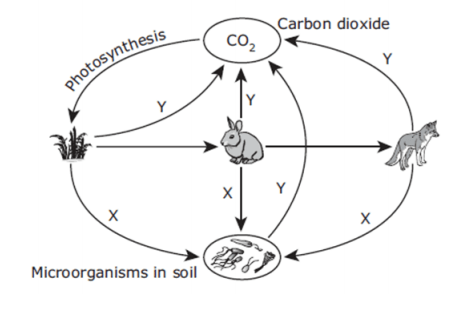
The diagram shows the flow of organic molecules through an ecosystem. What two processes are identified by the labels X and Y?
a)
X : Respiration
Y : Predation
b)
X : Adaptation
Y : Decomposition
c)
X : Fermentation
Y : Nitrogen Fixation
d)
X : Decomposition
Y : Respiration
77.
The average temperature of the surface of Earth has increased approximately 1°C in the past century. Which reason best explains this increase in temperature?
a)
lower levels of ozone in the atmosphere
b)
lower levels of nitrogen in the atmosphere
c)
higher levels of carbon dioxide and other greenhouse gases in the atmosphere
d)
higher levels of oxygen in the atmosphere
78.
What converts nitrogen gas into a useable form for plants and animals?
a)
bacteria
b)
fungi
c)
rain
d)
car exhaust 
79.
What is an example of a legume?
a)
strawberries
b)
carrots
c)
peanuts
d)
corn
80.
The process where excess nutrients enter a body of water causing overgrowth of aquatic plants and algae...
a)
Eutrophication
b)
Acid Precipitation
c)
Nitrogen Fixation
d)
Decomposition
81.
Organisms that convert fixed nitrogen back into nitrogen gas and release nitrogen gas back into atmosphere...
a)
 denitrifying bacteria
b)
fungi
c)
maggots 
d)
all of the above
82.
The process in which Nitrogen circulates and is recycled is called ____________
a)
The nitrogen cycle
b)
The water cycle
c)
The carbon cycle
d)
The phosphorus cycle
83.
Bacteria fix nitrogen on plant roots. Plant roots provide sugar to bacteria. This is an example of
a)
mutualism
b)
parasitism
c)
commensalism
d)
competition
84.

Why are animals important to an ecosystem?

a)

They make their own food.

b)

Mother nature's preference.

c)

They produce carbon dioxide.

d)

They have different roles in the environment.

85.

What is a habitat?

a)

How an animal behaves.

b)

Specific place where an animal lives

c)

A group of the same animals living together.

86.

There are lots of different habitats in the world specific for different animals. Match the correct animal to its habitat.

a)

zebra - rainforest

b)

walrus - desert

c)

baracuda - fresh water lake

d)

polar bear - arctic

87.

What is a climate?

a)

The home or environment of a plant or animal.

b)

The temperature and precipitation of a particular area.

c)

A major ecosystem made up of many habitats.

d)

A community of animals and plants that interact with their environment.

88.

In the moutain river ecosystem pictured above, what would be an abiotic factor?

a)

trees

b)

swans

c)

grasses

d)

water

89.
Series of steps in which organisms transfer energy by eating and being eaten
a)
foodweb
b)
consumer
c)
food chain
d)
omnivore
90.
All the organisms in a particular location, including their nonliving environment
a)
ecosystem
b)
carnivore
c)
niche
d)
population
91.
What does fungi do to dead plants and animals?
a)
Leave them there
b)
Decompose them
c)
Wait for other animals to eat them
d)
Move away
92.
What may happen if the snowshoe hare was removed from the food web pictured?
a)
The insects in the habitat would increase.
b)
The shrew population would decrease due to being only hawk food source.
c)
The willow tree population would decrease.
d)
Foxes would dies due to no food source. 
93.
In the energy pyramid here, how much of the energy in the producers gets passed to the herbivores?
a)
10%
b)
20%
c)
80%
d)
90%
94.
Which of the following leads to a decrease in biodiversity?
a)
protection of ecosystems
b)
pollution control
c)
selective cutting
d)
introduction of exotic or invasive species
95.
What is it called when water is changed from a liquid to a gas?
a)
EVAPORATION
b)
PRECIPITATION
c)
TRANSPIRATION
96.
In the food web shown, the snail would be considered...
a)
primary consumer
b)
secondary consumer
c)
tertiary consumer
d)
producer
97.
All these organisms share the same
a)
Biome
b)
Population
c)
Community
d)
Habitat
98.
When a plant uptakes water and transpires it to the atmosphere, this is known as _______
a)
Condensation
b)
Evapotranspiration
c)
Infiltration
d)
Aquifer
99.
Which these organism below is a primary consumer?
a)
Fungi
b)
Snake
c)
Ladybug
d)
Blue Jay
100.
In the food chain below if the worm contains 6 calories of energy, how much energy is available to the turtle to grow, develop, and reproduce if it ingest 10 worms?
a)
0.06
b)
0.6
c)
6
d)
60