wayground logo

Free Printable Worksheets

Font size

S
M
L
XL
Worksheets

Biology Review Units 1-4

Total questions: 100

Worksheet time: 1hrs 15mins

Name
Class
Date
1.
The ability to maintain a stable internal environment.
a)
hemastasis
b)
hypothesis
c)
homeostasis
2.

Which of the following is NOT an organic macromolecule?

a)

Ice

b)

Protein

c)

Carbohydrate

d)

Nucleic Acid

3.

All organic compounds contain the element...

a)

N

b)

Na

c)

Ca

d)

C

4.

Which organic macromolecule is used for long-term energy and waterproofing?

a)

protein

b)

lipid

c)

carbohydrate

d)

nucleic acid

5.

Proteins that speed up biochemical reactions are_________?

a)

DNA

b)

chromosomes

c)

enzymes

d)

genes

6.

What do nucleic acids include?

a)

DNA and RNA

b)

Glucose and Glycogen

c)

Lipids and Sugars

d)

Chlorophyll and Retinal

7.
An individual belonging to a specific species
a)
Biotic
b)
Community
c)
Organism
d)
Reptile
8.
All of the living and nonliving things in an area that interact with each other are called a/an ______.
a)
community
b)
habitat
c)
population
d)
ecosystem
9.
An area where an organism finds food, shelter and water in a specific arrangement
a)
niche
b)
biosphere
c)
biome
d)
habitat
10.
The living part of an ecosystem
a)
Biotic
b)
Abiotic
c)
Mother Earth
d)
Flowers
11.
The study of how living things interact with one another and with their environment.
a)
Biology
b)
Lithology
c)
Ecology
d)
Farmacology
12.
Two or more members of a particular species living and interacting in the same area
a)
Community
b)
Population
c)
Organisms
d)
Biosphere
13.
Different populations living and interacting with each other in the same area
a)
Biome
b)
Ecosystem
c)
Community
d)
Niche
14.
The image provided is an example of a(n):
a)
Carnivore
b)
Herbivore
c)
Producer
d)
Autotroph
15.
A living relationship between two species in which one organism is harmed is called...
a)
mutualism
b)
commensalism
c)
parasitism
d)
niche
16.
The image provided is an example of a(n):
a)
Producer
b)
Autotroph
c)
Consumer
d)
Insect
17.
The amount of energy that usually transfers from one trophic level to the next...
a)
10%
b)
20%
c)
80%
d)
50%
18.
Which of the following would be the definition of a detritivore?
a)
Animals that eat insects.
b)
Organisms that feed on rocks, recycling the nutrients back into the ground.
c)
Organisms that eat only pants
d)
Things that feed on dead organisms, recycling the nutrients back into the ground.
19.
An illustration that uses arrows to show the many possible directions in which matter and energy can pass through the organisms in an ecosystem.
a)
Food chain
b)
Food web
c)
Energy Pyramid
d)
Succession Map
20.
Water temperature would be an example of ...
a)
A biotic factor
b)
An abiotic factor
21.
In which direction should an arrow be drawn to represent energy flow between these two organisms?
a)
To the Left
b)
To the Right
22.
What kind of relationship is this?
a)
Predator-Prey
b)
Producer-Consumer
c)
Parasite-Host
23.
Which organisms are both secondary and tertiary consumers in this food web?
a)
Chemosynthetic bacteria and amphipods
b)
Zooplankton and mussels
c)
Ratfish and octopuses
d)
Galatheid crabs and zoarcid fish
24.
Which organisms are producers?
a)
Chemosynthetic bacteria and symbiotic bacteria
b)
Amphipods and zooplankton
c)
Tubeworms and zoarcid fish
d)
Octopuses and mussels
25.
In the energy pyramid here, which organisms have the most energy available?
a)
Producers
b)
Carnivores
c)
Herbivores
d)
Top Predator
26.
If there is 1000 Kcal available in the producers in trophic level 1, how much energy is available in the herbivores in trophic level 2?
a)
10 Kcal
b)
1 Kcal
c)
100 Kcal
d)
1000 Kcal
27.
An area where an organism finds food, shelter and water in a specific arrangement
a)
niche
b)
biosphere
c)
biome
d)
habitat
28.
Two or more members of a particular species living and interacting in the same area
a)
Community
b)
Population
c)
Organisms
d)
Biosphere
29.
The image provided is an example of a(n):
a)
Carnivore
b)
Herbivore
c)
Producer
d)
Autotroph
30.
A living relationship between two species in which one organism is harmed is called...
a)
mutualism
b)
commensalism
c)
parasitism
d)
niche
31.
The amount of energy that usually transfers from one trophic level to the next...
a)
10%
b)
20%
c)
80%
d)
50%
32.
An illustration that uses arrows to show the many possible directions in which matter and energy can pass through the organisms in an ecosystem.
a)
Food chain
b)
Food web
c)
Energy Pyramid
d)
Succession Map
33.
Which organisms are both secondary and tertiary consumers in this food web?
a)
Chemosynthetic bacteria and amphipods
b)
Zooplankton and mussels
c)
Ratfish and octopuses
d)
Galatheid crabs and zoarcid fish
34.
If there is 1000 Kcal available in the producers in trophic level 1, how much energy is available in the herbivores in trophic level 2?
a)
10 Kcal
b)
1 Kcal
c)
100 Kcal
d)
1000 Kcal
35.

What would happen to the rabbit population if the fox population moved out of the area represented by the food web?

a)

The rabbit population would increase

b)

The rabbit population would decrease

c)

The rabbit population would neither increase nor decrease

36.
An organism that lives by breaking apart dead organic matter into simpler parts is...
a)
scavenger
b)
consumer
c)
decomposer
d)
carnivore
37.
a)

primary succession

b)

secondary succession

38.

This would lead to

a)

primary succession

b)

secondary succession

39.

An ecosystem is classified into a biome by its

a)

climate

b)

environment

c)

climax community

d)

geriatric population

40.

Symbiosis of benefit to both symbiotes

a)

mutualism

b)

commensalism

c)

parasitism

d)

ismismism

41.

Disease is an example of

a)

density dependent limiting factors

b)

density independent limiting factors

42.

A massive tornado

a)

density dependent limiting factor

b)

density independent limiting factor

43.

An ecosystems limit of growth

a)

carrying capacity

b)

limiting factors

c)

growth cap

44.
The type of polysaccharide which serves as a strengthening tissue in the cell wall of plants is 
a)
cellulose
b)
glucose
c)
lactose
d)
fructose
45.
Proteins are composed of what smaller building blocks?
a)
amino acids
b)
nucleic acids
c)
fatty acids
d)
nucleotides
46.
Which group of organic molecules serve as long-term energy storage and make the cell membrane is?
a)
proteins
b)
carbohydrates
c)
lipids
d)
nucleic acids
47.
The primary purpose the body uses monosaccharides for is?
a)
Building muscles
b)
Helping the Immune System
c)
Immediate Energy
d)
Generating Heat
48.
Building blocks of polymers.
a)
monomer
b)
polypeptide
c)
monosaccharide
d)
glycerol
49.
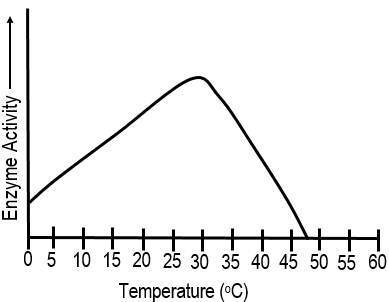
Based on the graph, what temperature does this enzyme work best? 
a)
15 C
b)
40 C
c)
30 C
50.
Which of the following binds to the active site of an enzyme? 
a)
substrate
b)
product
c)
codon
d)
none of the above
51.
What happens when enzymes are heated to a high temperature?
a)
The enzymes die.
b)
The shapes of the enzyme are altered or denatured
c)
The enzymes' amino acid sequence changes.
d)
The enzymes remain the same
52.
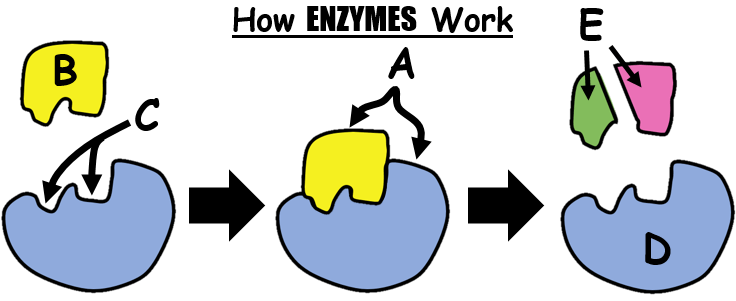
Letter C...
a)
active site
b)
enzymes
c)
substrate
d)
products
53.
Enzymes are _________ that __________ chemical reactions.
a)
proteins, slow down
b)
proteins, speed up
c)
lipids, slow down
d)
lipids, speed up
54.

Which is the strongest acid?

a)

ph of 1

b)

ph of 4

c)

ph of 7

d)

ph of 9

55.

Which is the wrong polymer/monomer pair?

a)

nucleic acids : nucleotides

b)

lipids: monosaccharides

c)

carbohydrates: monosaccharides

d)

proteins : amino acids

56.

Match the following large organic molecule with their building blocks

a)

Starch

1.

Simple Sugars

b)

Protein

2.

Amino Acids

c)

Lipids

3.

Glycerol and Fatty Acids

d)

Nucleic Acids

4.

Nucleotides

57.

Match the following food source with the organic molecule they provide

a)

1.

Complex Carbohydrate

b)

2.

Protein

c)

3.

Lipids

(Unsaturated)

d)

4.

Carbohydrate

(Simple Sugar)

e)

5.

Lipids

(Saturated)

58.

Name the Molecules in the diagram

59.

Organize these options into the right categories

Categorize the following

Starch

Protein

DNA

Glucose

Lipids

Fats

Maltase (enzyme)

Water

Salt (NaCl)

HCl

O2

CO2

Insulin (hormone)

Organic Molecules
Inorganic Molecules
60.

Label the pH scale with the correct terms

61.
The independent variable is the ONE thing you _____.
a)
change on purpose
b)
control or keep constant
c)
measure
62.

The variable that is being measured or observed is called the _______________. Hint: this is the variable that is the result or effect

a)

independent variable

b)

dependent variable

c)

control variable

63.

What is a constant/control in an experiment?

a)

Things that do not change in a experiment. It's the variable that stays the same. You can have many variables stay the same.

b)

It's the variables that the scientist changes in the experiment

c)

It's the variables that are being measured in an experiment

64.
What is being changed in this experiment?
a)
ramp height
b)
the speed that the ball rolls
c)
type of ball
65.
What is the Responding (Dependent) Variable in this graph?
a)
Plant Growth
b)
Growth (cm)
c)
Hours
d)
15
66.

What is the dependent variable of the graph?

a)
Grade
b)
Number of Students
67.
Josie was performing an experiment where she grew the same kind of tomatoes in the same soil and amount of water.  She sat one in the sun and one in a closet for 14 days.  What is the independent variable in Josie's experiment?
a)
tomatoes
b)
soil
c)
sunlight
d)
water
68.

Match the following

a)

Step 1

1.

Question

b)

Step 2

2.

Hypothesis

c)

Step 3

3.

Experiment

d)

Step 4

4.

Data

e)

Step 5

5.

Analyze

69.

An experiment is performed on plants to see how different liquids affect plant growth. Each plant in the experiment is given a different liquid; water, apple juice, or milk. Each plant has the same amount of soil, sunlight, and listens to the same music. In this investigation, the independent variable is ...

a)

The type of plant.

b)

The amount of sunlight.

c)

The type of music.

d)

The type of liquid

70.

When you step out into the cold, your body shivers in order to keep its temperature at 98.6F. Which characteristic of life does this represent?

a)

All living things use energy

b)

All living things contain cells

c)

All living things maintain homeostasis

d)

All living things grow

71.
The basic unit of structure and function in the human body is the....
a)
organ
b)
organ system
c)
cell
d)
tissue
72.

A baby song bird hatches from its egg with both parent songbirds watching. Which characteristic of life does this represent?

a)

All living things reproduce

b)

All living things maintain homeostasis

c)

All living things use energy

d)

All living things grow

73.

Which characteristic is shown: A plant switches position and follows the sunlight throughout the day.

a)

Grow and develop

b)

Respond to a stimulus

c)

Acquire and use energy

d)

Reproduce

74.

Which of these is not true about all organisms?

a)

all living things are multicellular

b)

all living things obtain and use energy

c)

all living things reproduce

75.

The following list represents characteristics of a living thing :

a)

made of cells, has lungs, can reproduce

b)

made of cells, grows and develops, uses energy

c)

has similar chemicals, makes noises, made of cells

76.

Lab Safety: Before starting a lab, always ___.

a)

start immediately without reading the instructions.

b)

eat and drink in the lab.

c)

read and understand the lab instructions.

d)

ignore safety equipment.

77.

Lab Safety: What should you do for chemical splashes in the eyes or on the skin?

a)

Use the eye wash station or safety shower, and notify the teacher.

b)

Wipe it off with a dry cloth.

c)

Ignore it if it doesn't hurt.

d)

Apply a bandage.

78.
Chipped or cracked glassware is okay to use.
a)
True
b)
False
79.

What is the optimum pH in this enzyme reaction?

a)

0.5

b)

1.5

c)

3.5

d)

5.5

80.

The active site of an enzyme is complementary to

a)

one type of substrate molecule

b)

all types of substrate molecules

c)

one type of product molecule

d)

all types of product molecules.

81.

Which sequence of letter represents a synthesis reaction?

a)

Q - R - P

b)

P - Q - R

c)

P - R - Q

d)

Q - P - R

82.
What is a substance called if it speeds up a chemical reaction?
a)
reusable
b)
catalyst
c)
specific
d)
fragile
83.
With what 3 letters do enzymes typically end?
a)
-ose
b)
-ase
c)
-ese
d)
-tic
84.
Letter E...
a)
active site
b)
enzyme
c)
substrate
d)
products
85.
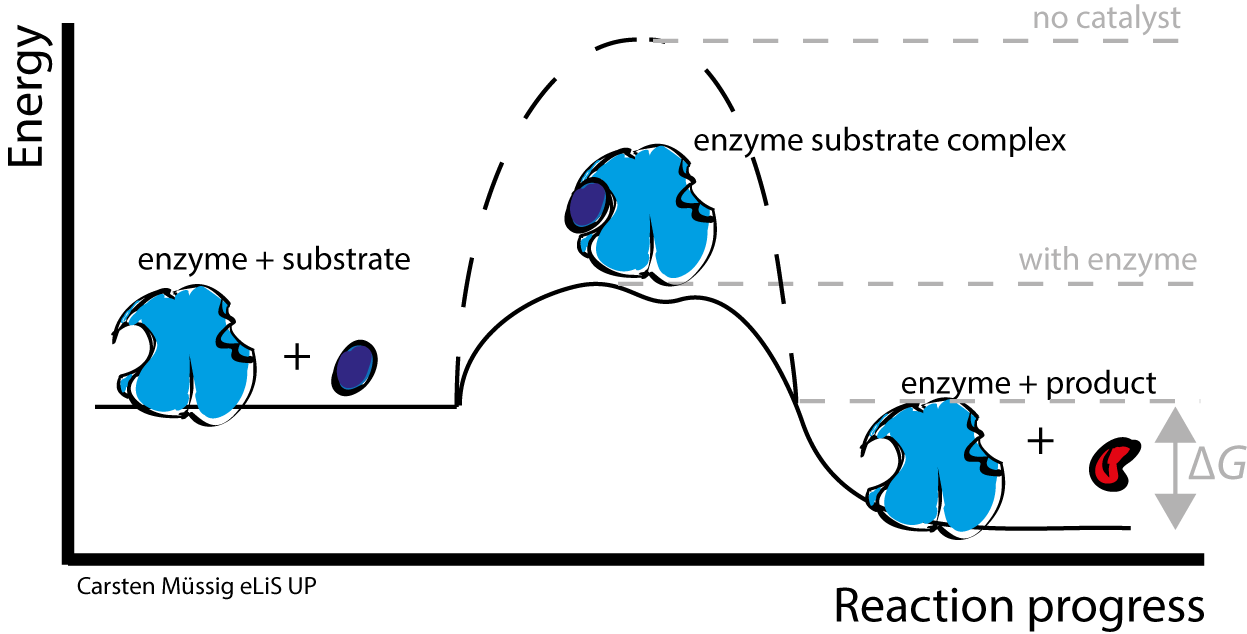
An enzyme speeds up a reaction by
a)
lowering the activation energy.
b)
raising the activation energy.
c)
releasing energy.
d)
absorbing energy.
86.

How many Grams of Sugar are in this entire Gatorade?

a)

8 Grams

b)

16 Grams

c)

24 Grams

d)

32 Grams

87.

What happens when the rabbit population goes up?

a)

The wolf population also increases

b)

The wolf population declines

88.

What is the approximate carrying capacity of this population?

a)

0

b)

1000

c)

2000

d)

2500

89.

Which graph represents logistical growth?

a)

The graph on the left

b)

The graph on the right

90.
What does NOT produce carbon dioxide?
a)
Photosynthesis
b)
Burning Fossil Fuels
c)
Animal respiration
d)
Plants decaying
91.
Which of the following removes carbon from the atmosphere?
a)
Combustion
b)
Respiration
c)
Photosynthesis
d)
Death
92.

Respiration is the process by which animals breath in _____ and release _____. 
a)
photosynthesis, air
b)
carbon, oxygen
c)
oxygen
d)
oxygen, carbon dioxide
93.
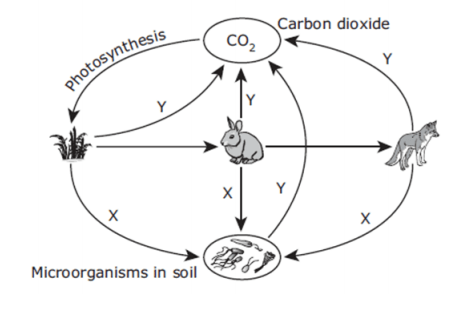
The diagram shows the flow of organic molecules through an ecosystem. What two processes are identified by the labels X and Y?
a)
X : Respiration
Y : Predation
b)
X : Adaptation
Y : Decomposition
c)
X : Fermentation
Y : Nitrogen Fixation
d)
X : Decomposition
Y : Respiration
94.
How animals get the nitrogen they need
a)
from the air they breathe
b)
from the water they drink
c)
from the food they eat
d)
from the Sun
95.
Organism that breaks down dead plants & animals and releases nitrogen back into atmosphere
a)
bacteria
b)
plants
c)
animals
d)
producers
96.
Plants and animals need nitrogen to make __________.
a)

Protein & nucleic acids

b)

Carbohydrates & lipids

c)

Lipids & protein

d)
Minerals
97.
What role do decomposers play in the phosphorous cycle?
a)
absorb phosphorous 
b)
release phosphorous into atmosphere
c)
return phosphorous into the soil
d)
combustion
98.
This is released by the weathering of rocks.
a)
Carbon
b)
Oxygen
c)
Phosphorus
d)
Nitrogen
99.

Water that moves over the ground and can pick up materials & pollution is called

a)

runoff

b)

inflitration

c)

groundwater

d)

root uptake

100.

All the non-living components in an environment (rocks, sun, water, nutrients, air, temperature )

a)

Abiotic factors

b)

Biotic Factors

c)

Carrying capacity

d)

Limiting factors