wayground logo

Free Printable Worksheets

Font size

S
M
L
XL
Worksheets

Biology Semester Exam Review (CP)

Total questions: 100

Worksheet time: 50mins

Name
Class
Date
1.
The purpose of cellular respiration is to produce ?
a)
energy
b)
oxygen
c)
sugar
d)
protein
2.
What is the energy molecule?
a)
DNA
b)
ATP
c)
RNA
d)
AAA
3.

What organelle is responsible for converting glucose and oxygen into ATP?

a)
nucleus
b)
mitochondria
c)
ribosomes
d)
lysosomes
4.
The splitting of the glucose molecule is called?
a)
synthesis
b)
denaturalization
c)
glycolysis
d)
dissolving
5.
The two type of fermentation are alcohol and _____________ acid fermentation. 
a)
lactic
b)
sulfuric
c)
hydrochloric
d)
acetic 
6.
To get the most ATP molecules for energy in cellular respiration, you have to have lots of ?
a)
hydrogen
b)
oxygen
c)
carbon dioxide
d)
water
7.
The waste gas given off by cellular respiration is?
a)
oxygen
b)
carbon dioxide
c)
nitrogen
d)
methane
8.

What are the reactants (taken into) of cellular respiration? (Mark all of them!)

a)

oxygen

b)

glucose

c)

carbon dioxide

d)

water

e)

energy

9.

Which of the following structure is where cellular respiration (Kreb's Cycle and Electron Transport Chain) occurs in the cell?

a)

nucleus

b)

cytoplasm

c)

mitochondria

d)

vacuoles

10.

What is the correct equation for cellular respiration?

a)

6O2 + C6H12O6 -> 6CO2 + 6H2O + Energy

b)

6O2 + C6H12O6 + Energy -> 6CO2 + 6H2O

c)

6CO2 + 6H2O -> 6O2 + C6H12O6 + Energy

d)

6CO2 + 6H2O + Energy -> 6O2 + C6H12O6

11.

Cellular Respiration's goal is to

a)

make water

b)

make ATP

c)

make glucose

d)

make oxygen

12.

What type of respiration requires oxygen?

a)

Aerobic

b)

Anaerobic

13.

How many ATP are produced in aerobic respiration?

a)

2

b)

33

c)

4

d)

36

14.

Which stage of the cellular respiration process produces the most ATP?

a)

Glycolysis

b)

Acetyl CoA

c)

Kreb's Cycle

d)

Electron Transport Chain

15.

Which of the following are reactants of photosynthesis?

a)

CO2 and H2O

b)

O2

c)

H2O and Glucose

d)

None of the above

16.

Photosynthesis produces Glucose for plants. This is a form of __________________________ for plants.

a)

Chemical energy

b)

Thermal energy

c)

Light energy

d)

Radiant energy

17.

Photosynthesis produces Glucose for plants. This is a form of __________________________ for plants.

a)

Chemical energy

b)

Thermal energy

c)

Light energy

d)

Radiant energy

18.

In which organelle does photosynthesis occur?

a)

Cell Wall

b)

Chlorophyll

c)

Chloroplast

d)

Cytoplasm

19.

What are the end products of photosynthesis?

a)

Carbon Dioxide and Water

b)

Glucose and Carbon Dioxide

c)

Oxygen and Glucose

d)

Water and Glucose

20.

What is the byproduct of photosynthesis? What does the plant release?

a)

Oxygen

b)

Carbon Dioxide

c)

Water

d)

Glucose

21.

True or False: Plants make their own food and use the energy from the food that is made.

a)

True

b)

False

22.

True or False: Animals can make their own food inside themselves.

a)

True

b)

False

23.
Which of the following is the correct equation for PHOTOSYNTHESIS?
a)
CO+ light + H2O --> O+ Sugar
b)
CO+ sugar + H2O --> O+ light
c)
O2 + light + H2O --> CO+ Sugar
d)
CO+ O2 + H2O --> Light+ Sugar
24.
What process occurs when light energy is captured in autotrophs and converted into sugar?
a)
Photosynthesis
b)
Cellular Respiration
25.
What is the ultimate ORIGINAL source of energy for living things
a)
Sugar
b)
Sun
c)
Moon
d)
Carbon Dioxide
26.
Which organisms perform Photosynthesis?
a)
Only Autotrophs
b)
Only Heterotrophs
c)
Autotrophs and Heterotrophs
27.
Which of the following is an example of an AUTOTROPH?
a)
Appletree
b)
Dog
c)
Mushroom
d)
Human
28.
What is the pigment in chloroplasts that performs photosynthesis?
a)
Chlorosynthesis
b)
Chlorophyll
c)
ADP
d)
Electron Transport
29.
Which gas is removed from the atmosphere during photosynthesis?
a)
hydrogen
b)
oxygen
c)
nitrogen
d)
carbon dioxide
30.
What are the products of photosynthesis?
a)
water and carbon dioxide
b)
oxygen and glucose
c)
oxygen and carbon dioxide
d)
oxygen and water
31.
Enzymes are...
a)
nucleic acids
b)
proteins
c)
lipids
d)
carbohydrates
32.

Can a change in pH alter the active site of an enzyme

a)

yes

b)

no

33.

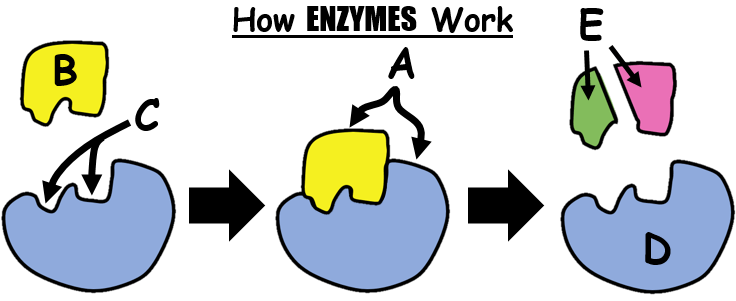
What is indicated by letter C?

a)

enzyme

b)

product

c)

substrate

d)

active site

34.
Which of the following conclusions can be drawn from this graph?
a)
The optimum pH of the enzyme is 6.6.
b)
The optimum pH of the enzyme is 5.8
c)
The enzyme’s activity increases as pH increases 5.0 to 9.0
d)
The enzyme’s activity is greater around pH of 8.0 .
35.

Which 2 factors can affect the rate of enzyme activity?

a)

Light intensity

b)

Temperature

c)

pH

d)

Oxygen concentration

36.

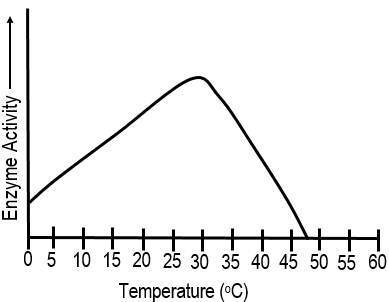
Based on the graph, what temperature does this enzyme work best?

a)

15 C

b)

40 C

c)

30 C

d)

50 C

37.
What is taxonomy?
a)
The study of DNA and RNA
b)
The study of how organisms are related
c)
The study of classifying and describing organisms
d)
The study of organisms in their habitat
38.
The scientific name for an organism is made from the:
a)
class and family name
b)
genus and species name
c)
domain and kingdom name
d)
kingdom and phylum name
39.

Which scientific name is TYPED correctly

a)

carcharhinus melanopterus

b)

Carcharhinus Melanopterus

c)

Carcharhinus melanopterus

d)

Carcharhinus melanopterus

40.

Which taxa are used in a scientific name?

a)

Domain

b)

Genus

c)

Phylum

d)

Species

e)

Class

41.
Term given to describe the 2 name naming system is:
a)
dichotmous key
b)
binomial nomenclature
c)
2 scientific names
d)
binomial key
42.

All of the following have a nucleus except...

a)

Bacteria

b)

Animalia

c)

Plantae (Plant)

d)

Protista (Protist)

43.

What are the kingdoms that are eukaryotic? (select all that apply)

a)

animalia

b)

Fungi

c)

Protista

d)

Plantae

e)

Eubacteria

44.

The LARGEST classification group (at the top) is:

a)

Very exclusive

b)

Very inclusive

c)

Very small

d)

Very specific

45.

Why is the most specific taxonomy category?

a)

Kingdom

b)

Domain

c)

Species

d)

Order

46.

Which taxon comes next? Domain... Kingdom... Phylum

a)

Order

b)

Genus

c)

Class

d)

Family

47.

What would the scientific name of this organism be?

Kingdom: Animalia

Phylum: Chordata

Class: Aves

Order: Charadriiformes

Family: Laridae

Genus: Thalasseus

species: maximus

a)

thalassues maximus

b)

Anamalia maximus

c)

Aves chordata

d)

Thalassues maximus

48.
A series of steps used by scientists to solve a problem or answer a question. 
a)
scientific method
b)
recipe
c)
data collection
d)
metric system
49.
Which is NOT a step in the scientific method?
a)
Make observation
b)
Form a theory
c)
Collect data
d)
Form a hypothesis
50.
A testable explanation to a problem that has not yet been tested. 
a)
data
b)
theory
c)
hypothesis
d)
fact
51.
Testing a hypothesis often involves a(n):
a)
answer
b)
experiment
c)
problem
d)
safety check
52.
This variable in an experiment is the one being changed by the scientist. 
a)
dependent variable
b)
independent variable
c)
data
d)
control group
53.
The summary at the end of an experiment that explains the results. 
a)
conclusion
b)
procedures
c)
materials
d)
responding variable
54.
The name of the information that you get from your experiment (you organize it into charts and graphs).
a)
observations
conclusion
b)
data
c)
variables
d)
hypothesis
55.
An experiment is performed on plants to see how different liquids affect plant growth. Each plant in the experiment is given a different liquid; water, apple juice, or milk. Each plant has the same amount of soil, sunlight, and listens to the same music. In this investigation, the independent variable is ...
a)
The type of plant
b)
The amount of sunlight
c)
The type of music
d)
The type of liquid
56.
Dependent variable means
a)
the scientist controls what to test
b)
educated guess
c)
ask a question
d)
what is being measured
57.
If you increase the amount of spinach you eat, then you will increase the iron in your blood. 
What's the dependent variable?
a)
increase the amount of iron in your blood
b)
spinach you eat
58.
This is the group that we will compare our experimental group to. This group stays "normal."
a)
Control Group
b)
Experimental Group
c)
 Normal Group
d)
Weird Group
59.
This is the group that is affected by the independent variable or the group that is changed.
a)
Control Group
b)
Experimental Group
c)
Changed Group
d)
Cool Group
60.
In a controlled experiment, how many variables can be worked with at a time? 
a)
one
b)
none
c)
two or more
d)
how ever many makes sense.
61.
The independent variable is the ONE thing you _____.
a)
change on purpose
b)
control or keep constant
c)
measure
62.
Mr. S. normally uses praise as a reward to train his dog.  He wants to know the best way to train his dog, so he sets up an experiment to find out if there is a better way to get his dog to respond to commands.  Identify the dependent variable.
a)
amount of times the dog follows the command
b)
type of reward
c)
praise
d)
type of dog
63.

An experiment was carried out to determine whether drinking caffeinated soda increases pulse rate. The pulse rates of two groups of people at rest were measured. Group A was then given caffeinated soda and group B was given caffeine-free soda. One hour after drinking the soda, the pulse rates were measured. The participants in the experiment were all the same age, and they were all given the same amount of soda. The dependent variable in this experiment is the

a)

type of soda given to each group

b)

amount of soda given to each group

c)

pulse rate of each group

d)

age of participants in each group

64.
Every living organism is made up of one or more cells
a)
True
b)
False
65.
A cell is...
a)
the basic unit of structure and function in living organism
b)
an organism
c)
a basic part of everything that we see
d)
found only in animals, not plants
66.
Which of the following are NOT found in animal cells
a)
chloroplasts and cytoplasm
b)
chloroplasts and cell wall
c)
cell wall and cell membrane
d)
mitochondria and nucleus
67.

Which of the following converts food into energy for the cell?

a)

vacuole

b)

mitochondria

c)

cytoplasm

d)

cell membrane

68.
What do vacuoles do? 
a)
They actually do not have an important role
b)
They protect the cell
c)
They are the brain of the cell
d)
storage area for cells; water storage in plants 
69.

Which organelle takes in "sun showers" and helps plants with the process or photosynthesis?

a)

Vacuole

b)

Mitochondria

c)

Cytoplasm

d)

Chloroplast

70.
Which of the following, found ONLY in plant cells, provides structure?
a)
cell wall
b)
chloroplast
c)
mitochondria
d)
vacuole
71.
What is one basic function of the vacuoles?
a)
circulating oxygen
b)
producing food
c)
controlling cell processes
d)
storing water
72.
Chloroplasts in plant cells allow the plant to perform a function that animal cells cannot do.  What is the main function of the chloroplasts found in plant cells?
a)
to absorb light energy and manufacture food
b)
to remove waste materials by active transport
c)
to manufacture chemical energy from food
d)
to control the shape of the cell
73.

Which of the following is true of passive transport?

a)

It requires energy and moves along the gradient

b)

It requires energy and moves against the gradient

c)

It does not require energy and moves along the gradient

d)

It does not require energy and moves against the gradient

74.

Which of the following describes the movement of water?

a)

Endocytosis

b)

Simple diffusion

c)

Facilitated diffusion

d)

Osmosis

75.

Which of the following occurs when a cell engulfs a food particle?

a)

Endocytosis

b)

Simple diffusion

c)

Exocytosis

d)

Protein pumps

76.

The major difference between plant and animal cells regarding osmosis occurs because...

a)

Animal cells want more water than plant cells

b)

Plant cells have a cell wall which stops them from bursting

c)

Animal cells have a cell wall which stops them from bursting

d)

Animal cells don't use water in photosynthesis
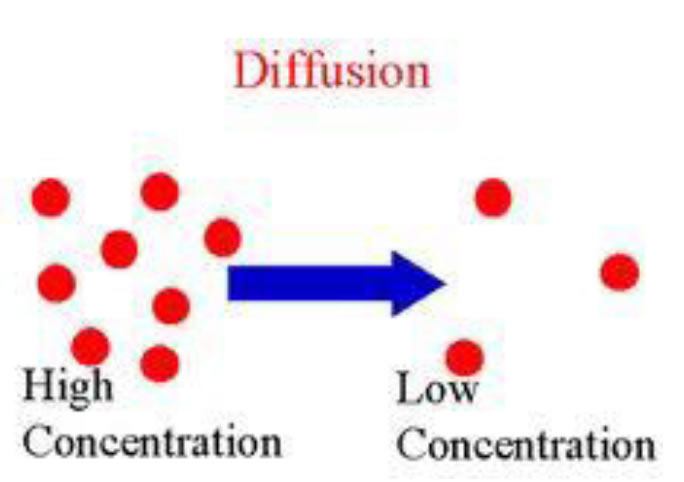
77.
Movement of particles from high to low concentration. 
a)
Passive Transport
b)
Active Transport
78.
This picture represents what type of cell transport?
a)
endocytosis
b)
exocytosis
c)
osmosis
d)
passive transport
79.
Which is true about active transport?
a)
It requires energy
b)
it does not require energy
c)
It moves substances down the concentration gradient
d)
it moves material from high to low concentration
80.

In a hypotonic solution, water will move ______ the cell, causing the cell to ______.

a)

into; shrivel

b)

out of; swell

c)

out of; shrivel

d)

into; swell

81.

Which of the following best describes an isotonic solution?

a)

there is more water inside the cell than outside

b)

there is more water outside the cell than inside

c)

there is an even concentration of water inside and outside the cell

d)

there is no water inside or outside the cell

82.

The cell shrunk in size due to water leaving, which means it was placed in a ____ solution.

a)

Isotonic

b)

Hypertonic

c)

Hypotonic

83.

Molecules that start a reaction

a)

products

b)

reactants

84.

Process by which plants convert sunlight, water, and carbon dioxide into food energy (sugar) and oxygen

a)

photosynthesis

b)

products

c)

reactants

d)

stomata

85.

Molecules that are made during a chemical reaction

a)

products

b)

reactants

86.

A green molecule that uses light energy from sunlight to change water and carbon dioxide gas into sugar and oxygen

a)

chloroplast

b)

chlorophyll

c)

photosynthesis

d)

stomata

87.

Animals breath out this gas and it is used as a reactant in photosynthesis

a)

carbon dioxide

b)

oxygen

c)

sugar

d)

water vapor

88.

Which on of the following is a product of photosynthesis

a)

carbon dioxide

b)

sunlight

c)

oxygen

d)

water

89.

Which one of the following is NOT a reactant in photosynthesis?

a)

carbon dioxide

b)

oxygen

c)

sunlight

d)

water

90.

Which of the following is the correct equation for photosynthesis?

a)

CO2 + Sun + H2O --> O2 + Sugar

b)

CO2 + sugar + H2O --> O2 + Sun

c)

O2 + Sun + H2O --> CO2 + Sugar

d)

CO2 + O2 + H2O --> Sun+ Sugar

91.

Which gas is removed from the atmosphere during photosynthesis?

a)

hydrogen

b)

oxygen

c)

nitrogen

d)

carbon dioxide

92.

The main source of energy for all life comes from ____.

a)

the food we eat

b)

the Earth

c)

the moon

d)

the sun

93.

Enzymes are an example of

a)

Lipids

b)

Carbohydrate

c)

Protein

d)

Nucleic Acid

94.
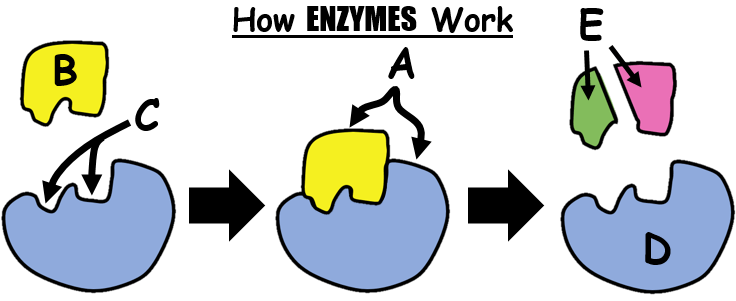
Letter B...
a)
active site
b)
enzyme
c)
substrate
d)
products
95.
Letter C...
a)
active site
b)
enzymes
c)
substrate
d)
products
96.
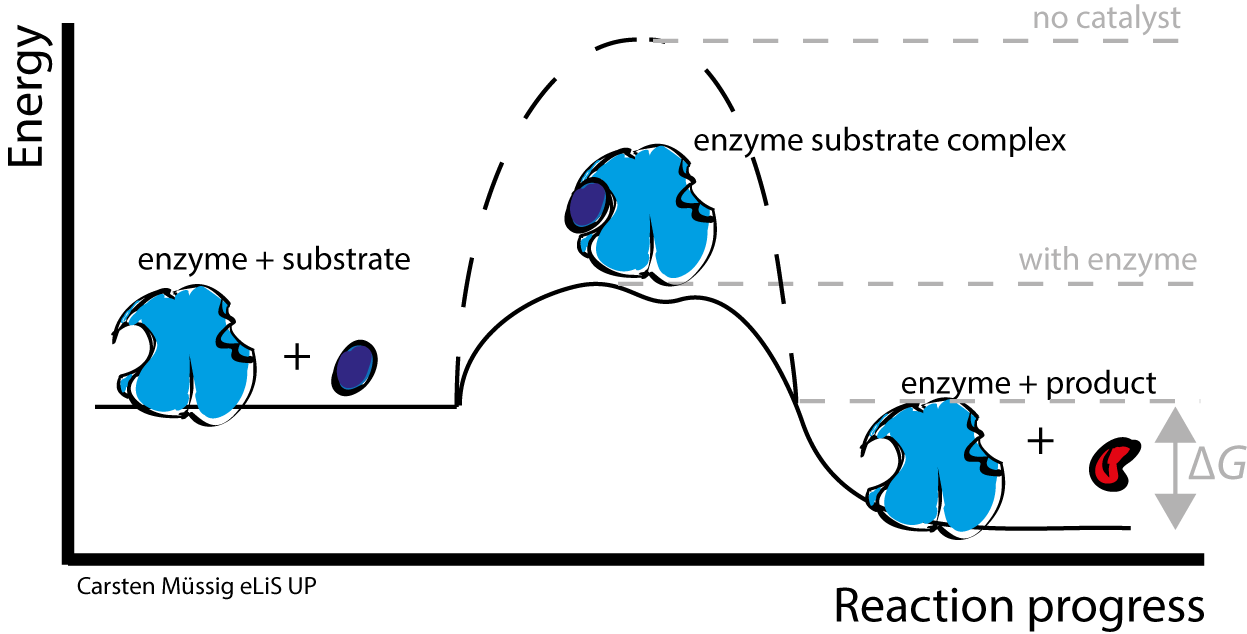
An enzyme speeds up a reaction by
a)
lowering the activation energy.
b)
raising the activation energy.
c)
releasing energy.
d)
absorbing energy.
97.

What happens when enzymes are heated to a high temperature?

a)

The enzymes die.

b)

The shape of the enzyme are changed and it denatures

c)

The enzymes' amino acid sequence changes.

d)

The enzymes remain the same

98.

Which of the following two factors affect an enzyme's operation the most?

a)

amount of light and temperature

b)

blood glucose and pH

c)

temperature and pH

d)

amount of light and pressure

99.

What is activation energy?

a)

the energy from the sun

b)

the energy produced by an enzyme

c)

the energy needed to get a reaction going

d)

none of these

100.

In the following chemical equation, what are the products of this reaction? 2 H2O2 🡪 2 H2O + O2 (gas)

a)

hydrogen peroxide and water

b)

oxygen and hydrogen peroxide

c)

water and oxygen

d)

hydrogen peroxide, water and oxygen gas