
 Worksheets
H Final S1 Review
Total questions: 118
Worksheet time: 2hrs 1mins
Name
Class
Date
1.

In a correctly written symbol what would be located in the "A" position?
a)
number of neutrons
b)
atomic number
c)
number of electrons
d)
mass number
2.
What electron configuration matches an oxygen atom?
a)
1s22s22p63s2, 3p64s23d104p5
b)
1s22s22p4
c)
1s22s22p6
d)
1s22s22p63s23p64s23d1
3.
How many electrons can the first energy level hold?
a)
1
b)
2
c)
8
d)
0
4.

Which form of matter has a definite shape and takes up space (has definite volume)?
a)
liquid
b)
solid
c)
gas
d)
clay
5.

Which form of matter take the shape of a container like this juice?
a)
liquid
b)
solid
c)
glass
d)
gas
6.
Which scientist discovered the electron, which helped him develop a model of the atom?
a)
Niels Bohr
b)
John Dalton
c)
Ernst Rutherford
d)
J.J Thompson
7.
Which of the following is NOT an element?
a)
H2O
b)
H2
c)
O2
d)
Au
8.

The blue numbers in the image below represent ________
a)
I don't know, and don't want to try
b)
coefficients
c)
subscripts
d)
none of the answers are correct
9.
How many O's are in Al₂(SO₄)₃
a)
4
b)
12
c)
7
d)
24
10.
Ionic Bonding involves...
a)
The transfer of protons
b)
The transfer of nuetrons
c)
The transfer of electrons
d)
None Of the above
11.
Covalent compounds
a)
Share electrons
b)
transfer electrons
c)
contain a sea of electrons
d)
conduct electricity
12.
What two types of atoms make a covalent bond?
a)
2 Nonmetals
b)
1 Nonmetal and 1 Metal
c)
2 Metals
d)
2 Noble Gases
13.
Predict the bond that will form between Be and F.
a)
Ionic
b)
Covalent
14.
What is the number of valence electrons for Oxygen?
a)
8
b)
6
c)
2
d)
1
15.
What is the number of valence electrons for Neon?
a)
6
b)
7
c)
8
d)
9
16.
This particle determines what element you have - the elements identity.
a)
electron
b)
proton
c)
neutron
d)
valence shell
17.
An electron has a _____ charge.
a)
negative
b)
positive
c)
neutral
18.
Describe an Electron Cloud?
a)
the mist outside of an atom
b)
home of the protons
c)
where electrons are located
d)
nucleus
19.
What are valence electrons?
a)
electrons on the first orbital always
b)
nucleus
c)
the innermost shell
d)
the number of electrons on the outermost orbital
20.
Which particles make up the nucleus of an atom?
a)
protons and neutrons
b)
electrons and protons
c)
electrons, protons, and neutrons
d)
electrons and neutrons
21.
What charge does the nucleus have and why?
a)
positive - the neutrons do not have a charge
b)
positive - the neutrons and protons are positively charged particles
c)
neutral - the neutral charge dominates the positive charge
d)
neutral - electrons cancel out the positive charge of the atom
22.
What is the mass number and name of an element with 8 protons and 8 neutrons?
a)
16 - Carbon
b)
16 - Oxygen
c)
24 - Oxygen
d)
8 - Neon
23.
An element with a mass number of 10 and an atomic number of 6 has how many protons?
a)
5
b)
8
c)
6
d)
10
24.
An element with a mass number of 11 and an atomic number of 5 has how many neutrons?
a)
11
b)
5
c)
6
d)
16
25.
In the modern periodic table elements are arranged by:
a)
atomic mass
b)
atomic number
c)
valence electrons
d)
number of isotopes
26.
How many electrons does Oxygen need to fill its outer shell?
a)
3
b)
4
c)
1
d)
2
27.
How many Valance electrons does Iodine Have?
a)
6
b)
16
c)
7
d)
17
28.
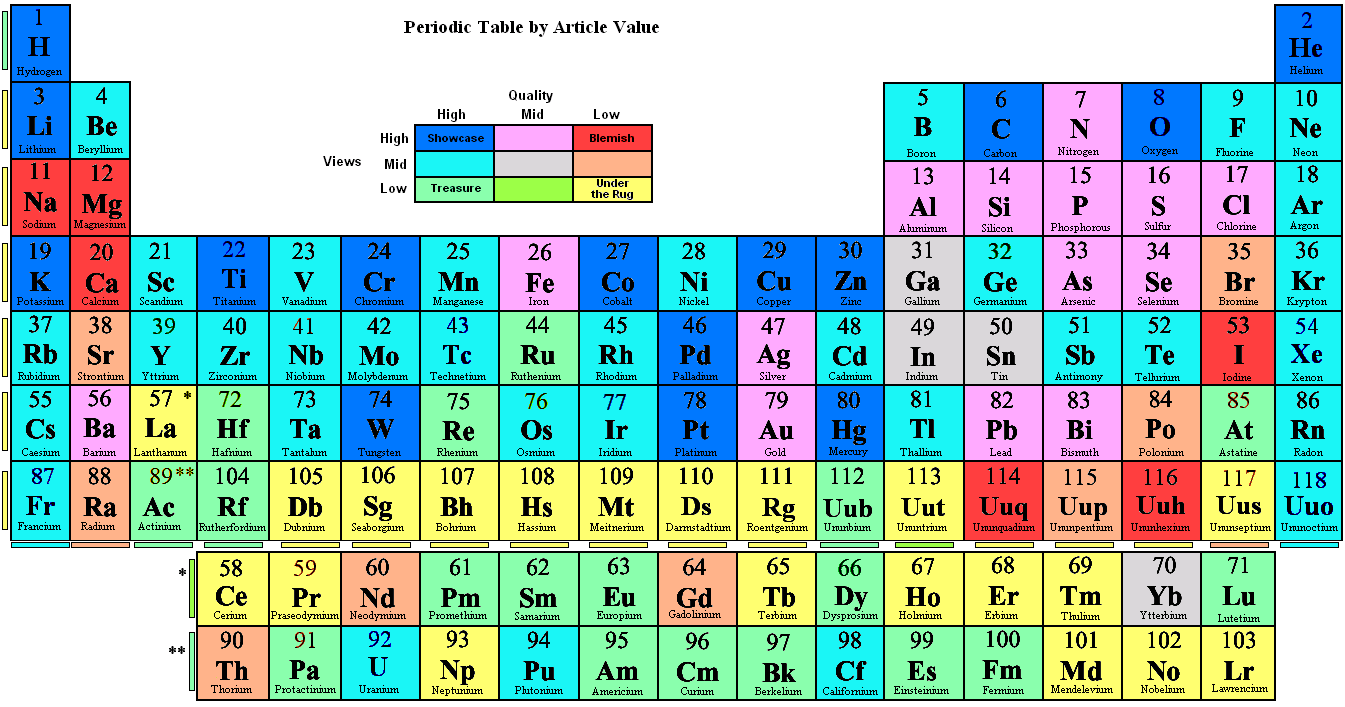
The period for Bromine is ___________.
a)
3
b)
2
c)
4
29.
The periodic table has __ groups.
a)
8
b)
7
c)
18
d)
2
30.
How many electrons do most atoms need to be stable?
a)
1
b)
2
c)
6
d)
8
31.
Electrons occupy orbitals of lowest energy first is part of what electron configuration rule?
a)
Hund’s Rule
b)
Aufbau Principle
c)
Pauli Exclusion Principle
32.
Which of the following will have a higher electronegativity than arsenic (As)?
a)
Carbon (C)
b)
Neon (Ne)
c)
Antimony (Sb)
d)
Germanium (Ge)
33.
As atoms of elements in group 16 are considered in order from top to bottom, the electronegativity of each successive element....
a)
decreases
b)
increases
c)
remains the same
d)
none of the above
34.
Which atom has the largest atomic radius?
a)
potassium
b)
rubidium
c)
francium
d)
cesium
35.
Ionization energy is...
a)
the energy required to add an electron to a specific atom
b)
how much energy it takes to remove an electron from an atom
c)
the energy required to shield the outer electrons from the nucleus
d)
a measure of the ability of an atom to attract electrons
36.
Which periodic group has the smallest atomic radius?
a)
Alkali metals
b)
Halogens
c)
Noble Gases
d)
Transition metals
37.
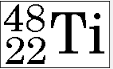
How many protons does this isotope of titanium have?
a)
48
b)
22
c)
26
d)
70
38.
What does the number 37 represent in Chlorine-37?
a)
Atomic number
b)
Mass number
c)
Number of protons
d)
Number of neutrons
39.
What is the charge of a cation
a)
positive
b)
negative
c)
neutral
40.
____ tend to form anions
a)
Nonmetals
b)
Metals
c)
Isotopes
41.
How many protons, electrons and neutrons does an neutral atom of Calcium have? Its atomic number is 20 and the mass number is 40.
a)
20 protons, 18 electrons and 40 neutrons
b)
20 protons, 20 electrons and 20 neutrons
c)
40 protons, 40 electrons and 20 neutrons
d)
20 protons, 18 electrons and 20 neutrons
42.
How many neutrons does the isotope below have? 89 36Kr
a)
53
b)
36
c)
89
d)
125
43.

According to the diagram below, how many bonds will this atom need to make to be stable?
a)
1
b)
2
c)
3
d)
4
44.

What section is the least reactive?
a)
yellow
b)
red
c)
dark blue
d)
orange
45.
A vertical column in the periodic table. Elements share similar properties.
a)
row
b)
group
c)
period
46.
Elements in a ..................have similar chemical properties.
a)
period
b)
group
c)
row
47.
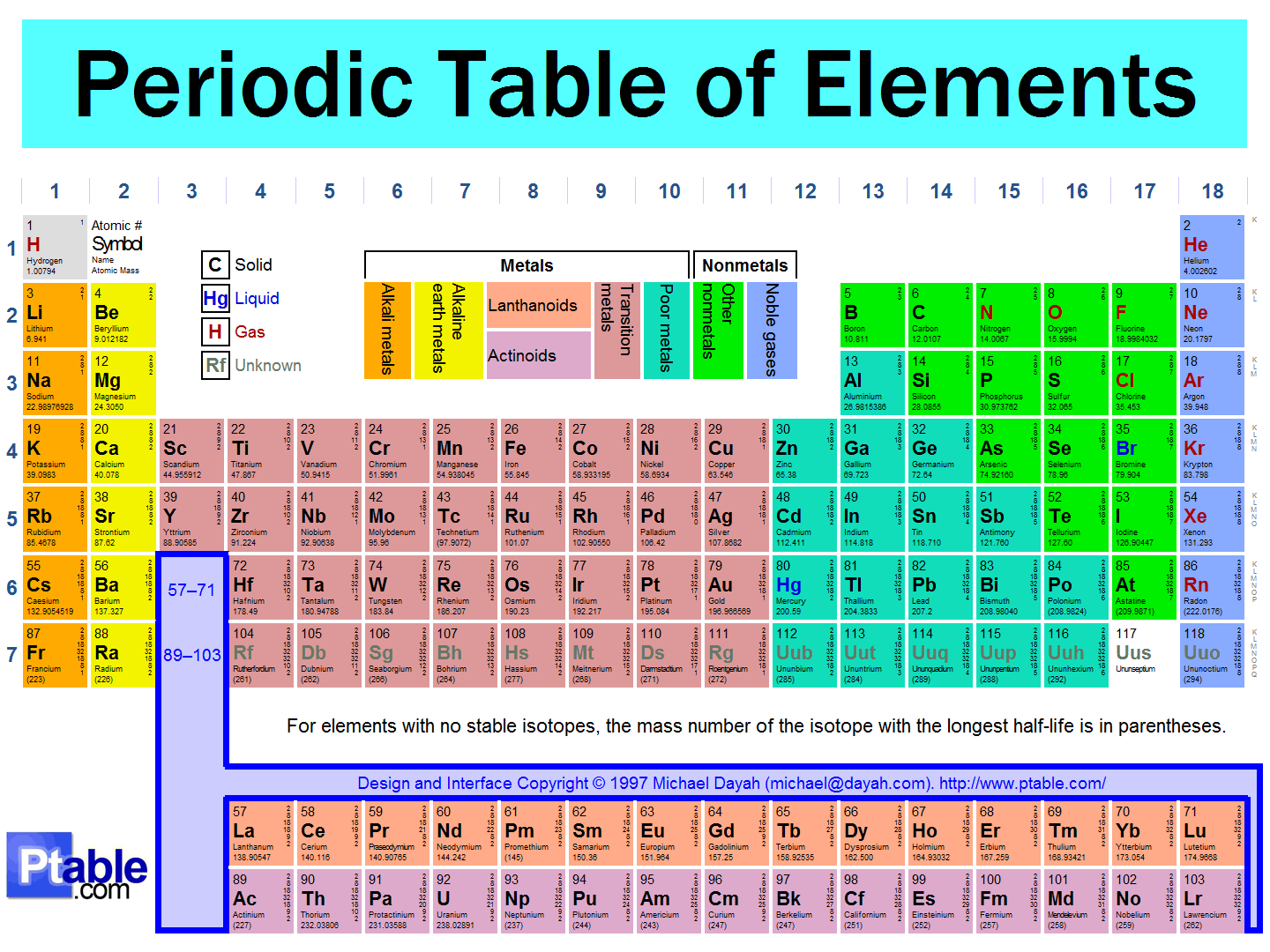
The horizontal row on the periodic table is called a
a)
group
b)
family
c)
period
d)
atomic number
48.
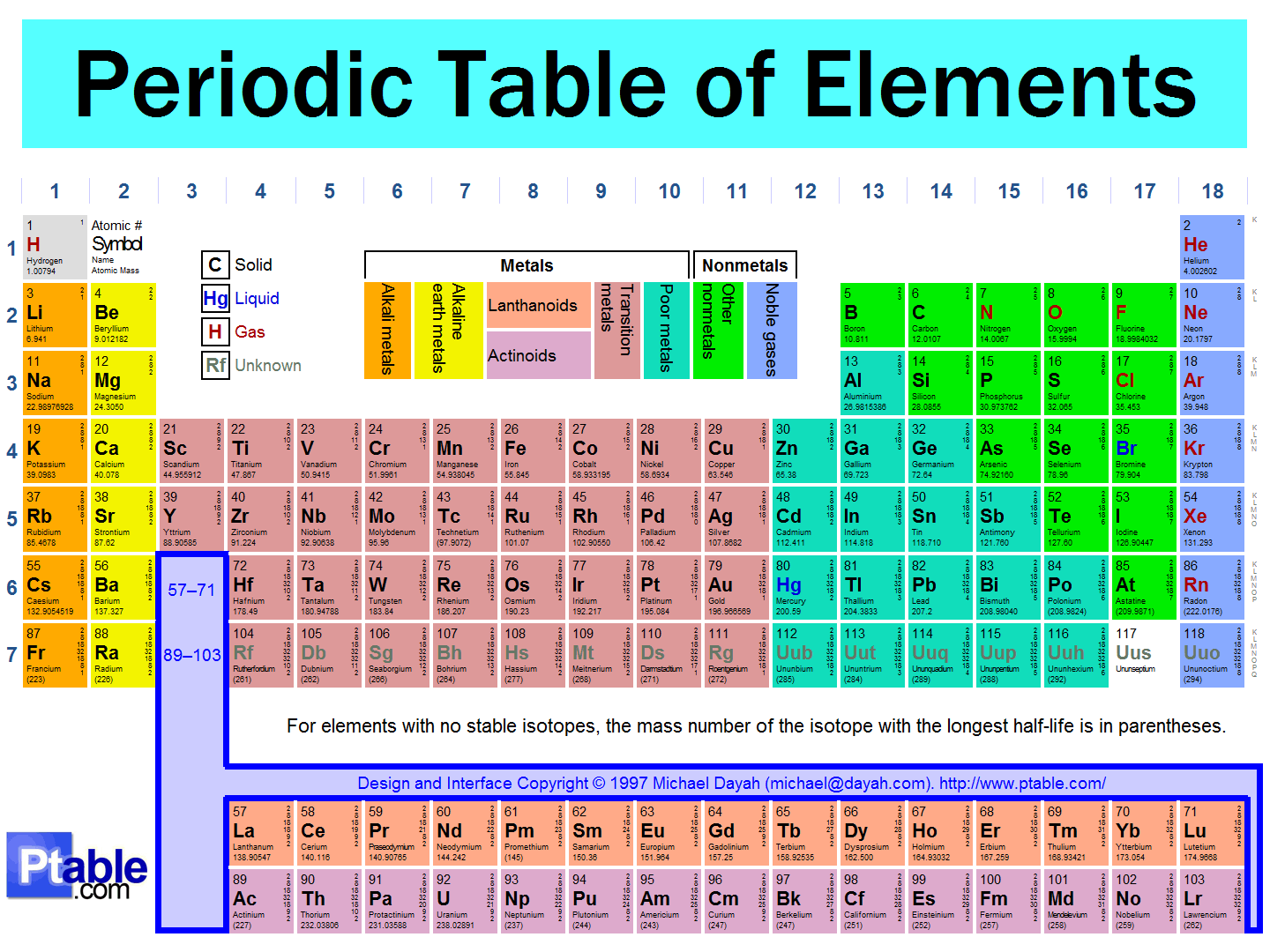
A vertical column is called...
a)
group
b)
tower
c)
period
d)
crew
49.
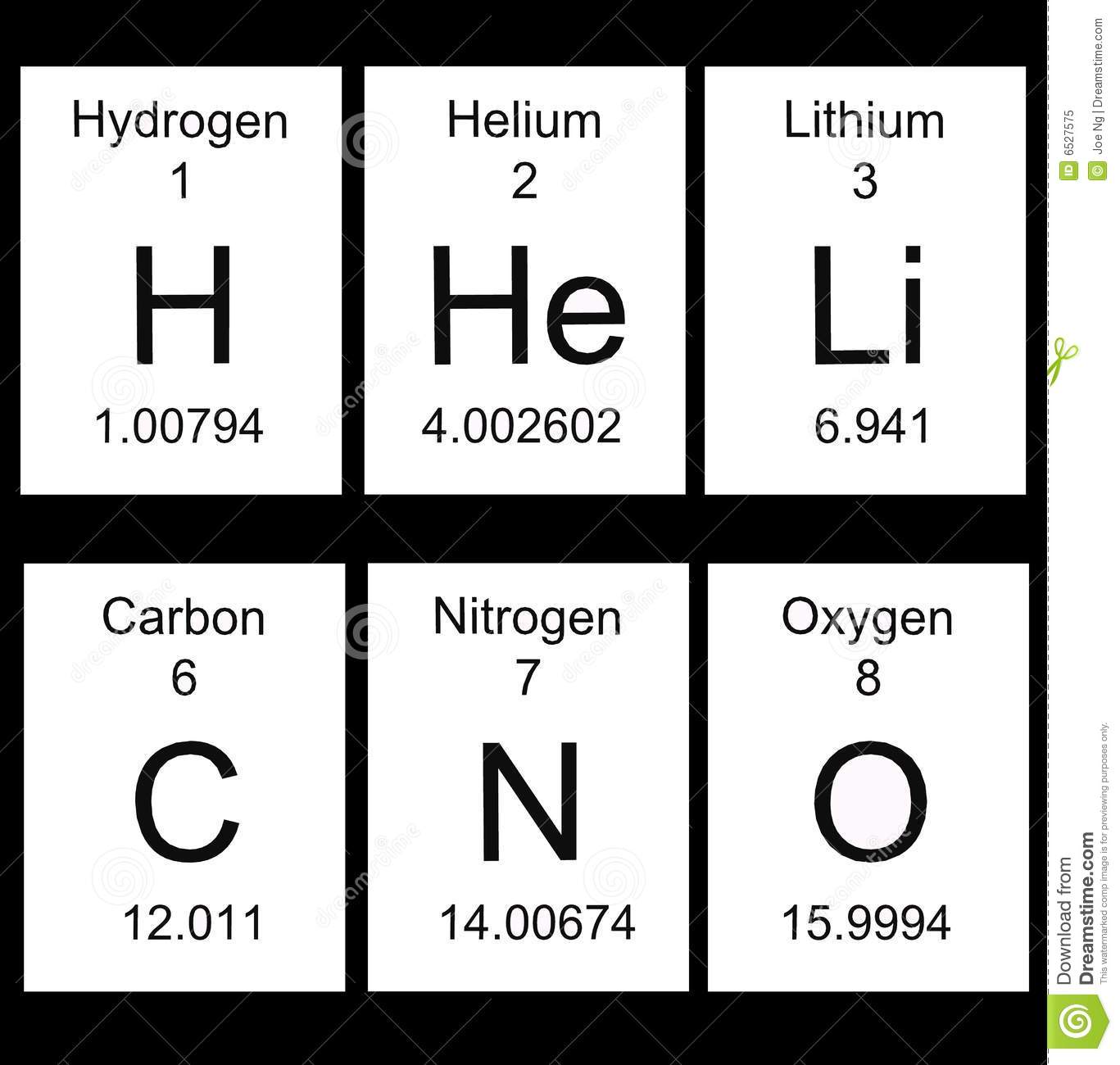
The number at the bottom of each square on the periodic table is the ...
a)
atomic number
b)
atomic mass
c)
chemical symbol
d)
element name
50.
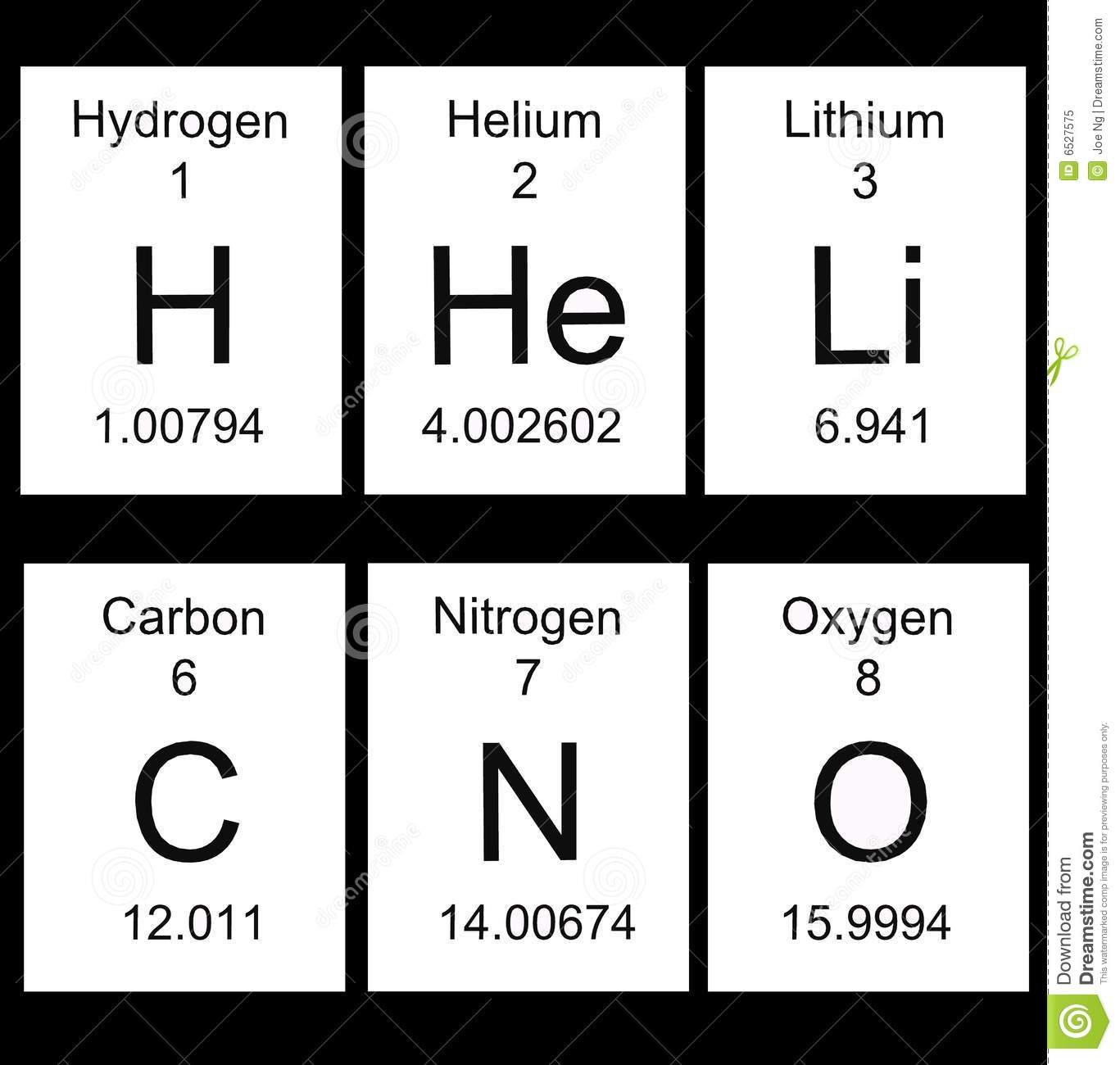
The number at the top of each square on the periodic table is the ...
a)
atomic number
b)
atomic mass
c)
Chemical Symbol
d)
Element Name
51.
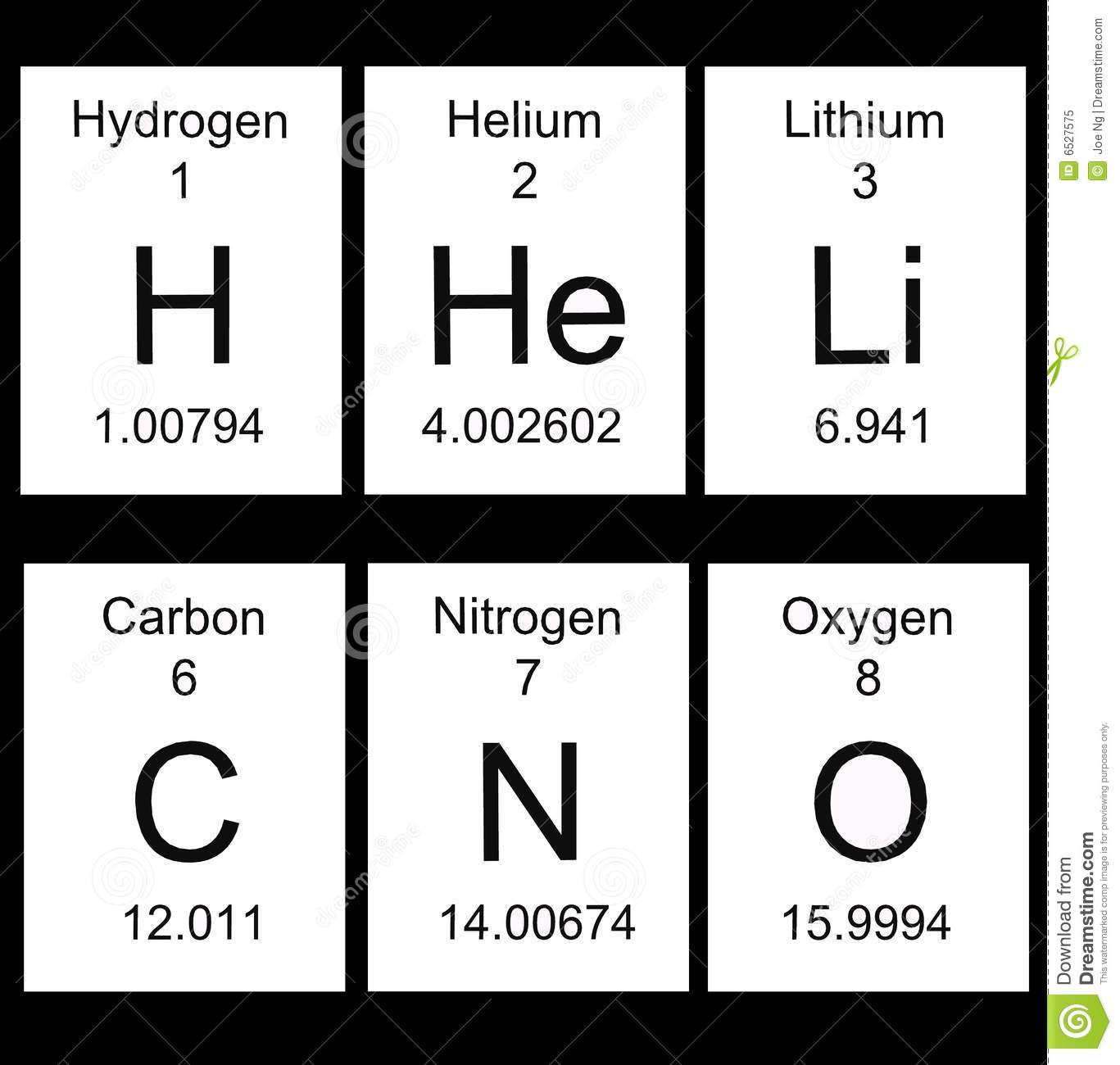
What is the chemical symbol for Lithium?
a)
H
b)
He
c)
Li
d)
N
52.

Most of the elements on the periodic table are classified as _____.
a)
Metals
b)
Nonmetals
c)
Metalloids
d)
Periods
53.

How did Mendeleev arrange the elements?
a)
alphabetical
b)
density
c)
melting point
d)
atomic mass
54.
Identify the following element:
1s22s22p63s23p64s23d10
1s22s22p63s23p64s23d10
a)
nickel
b)
copper
c)
zinc
d)
gallium
55.
If the second energy level (n=2) of an atom contains a total of 5 electrons...how many more electrons can fit in the 2nd energy level?
a)
0
b)
3
c)
5
d)
7
56.

In what section would Transition Metals be found?
a)
orange
b)
light blue
c)
blue
d)
white
57.

Rutherford's gold foil experiment provided evidence that...
a)
Negative and positive charges are spread evenly throughout the atom.
b)
Alpha particles have a positive charge.
c)
Gold is not a dense as previously thought.
d)
There is a dense positively charged nucleus at the center of an atom.
58.
The first person to propose a theory about an atom was
a)
Democritus
b)
Rutherford
c)
Dalton
d)
Aristotle
59.
The law of conservation of mass states that....
a)
Matter can be made
b)
Matter can be destroyed
c)
Matter cannot be made or destroyed
60.
If a chemical equation is BALANCED, is the mass being conserved?
a)
Yes
b)
No
61.

A group of atoms bonded together.
a)
A Molecule
b)
Coefficient
c)
Subscript
d)
An Atom Party
62.

Nonmetals are located in what section of this periodic table?
a)
Blue
b)
Yellow
c)
Pink
63.
A proton is....
a)
A negatively charged subatomic particle
b)
A positively charged subatomic particle
c)
A neutrally charged subatomic particle
d)
The only subatomic particle located in the nucleus
64.
A neutron has a charge of
a)
+2
b)
No charge
c)
-1
d)
+1
65.
Molecules move quickest in which state of matter
a)
solid
b)
liquid
c)
gas
d)
solid, liquid and gas
66.
How is carbon-12 different from carbon-14?
a)
They have a different number of protons
b)
they have a different number of electrons
c)
they have a different number of neutrons
d)
they are different elements
67.

The mass of one proton is greater than the mass of one...
a)
neutron
b)
electron
68.
The atomic number tells you what?
a)
number of electrons
b)
number of protons
c)
number of neutrons
d)
both electrons and protons in an atom.
69.
Which group of the periodic table is composed of inert (not reactive) gases?
a)
alkali metals
b)
alkaline earth metals
c)
halogens
d)
noble gases
70.
Elements which are shiny, conduct electricity and heat are called
a)
metal
b)
nonmetal
c)
metalloid
d)
nonexistent
71.
Which element is not a metal?
a)
H
b)
Re
c)
Al
d)
B
72.

The atoms along the staircase are called
a)
metals
b)
nonmetals
c)
metalloids
d)
noble gases
73.
Which is a halogen?
a)
Helium
b)
Chlorine
c)
Oxygen
d)
Neptune
74.
Which is an alkali metal?
a)
Magnesium
b)
Iron
c)
Sodium
d)
Europium
75.

In this picture, the Electrons are found in which color?
a)
Blue
b)
Red
c)
Green
76.
Are the atoms more stable when they are bonded together or when they are apart?
a)
Bonded Together
b)
Apart
77.
If an element gains 3 electrons, which charge will it have?
a)
positive
b)
1-
c)
2-
d)
3-
78.
How would you write 564,000,000 in scientific notation?
a)
5.64 x 10⁻⁷
b)
5.64 x 10⁶
c)
5.64 x 10⁸
d)
56.4 x 10⁷
79.
How would you write 0.0005 in scientific notation?
a)
50 x 105
b)
5 x 10⁻⁴
c)
5 x 10³
d)
0.5 x 10³
80.
What is 78.5 rounded to one significant figure?
a)
79
b)
78.5
c)
70
d)
80
81.
How many sig figs are there?
4000.
4000.
a)
1
b)
3
c)
4
82.
How many significant figures does the following number have: 1740200
a)
2
b)
1
c)
3
d)
5
83.
Ag--110 and Ag--112 are two forms of silver with different mass # so they are
a)
compounds
b)
isotopes
c)
orbitals
d)
neutrons
84.

Which of the following will have a lower ionization energy than Scandium (Sc)?
a)
Helium (He)
b)
Titanium (Ti)
c)
Calcium (Ca)
d)
Magnesium (Mg)
85.
What term is used to describe "an atom's tendency to attract electrons to itself when is is chemically combined with another element"
a)
electronation
b)
electron affinity
c)
electronegativity
d)
electrolysis
86.
What term is used to describe "A measure of the size of an atom"
a)
chemical reactivity
b)
atomic radius
c)
energy levels
d)
orbit
87.
What does the Law of Conservation of Mass state?
a)
Matter cannot be gained or lost in a chemical reaction.
b)
Matter can only be lost in a chemical reaction.
c)
Matter can only be gained in a chemical reaction.
d)
Matter can be gained and lost in a chemical reaction.
88.
5.41 x 10⁵ has ____ significant figure
a)
3
b)
4
c)
5
d)
6
89.
Calculate and round to the appropriate amount of sig figs
12.35 + 99.0 + 23.654
a)
135.004
b)
135.0
c)
135
d)
135.00
90.
How many significant figures?
0.0062300
0.0062300
a)
3
b)
4
c)
5
d)
7
91.
How many significant figures?
123 456 789 100
123 456 789 100
a)
10
b)
9
c)
11
d)
8
92.
Calculate the wavelength of light that has a frequency of 5.2 x 10¹² Hz.
a)
5.8 x 10 -5 m
b)
5.8 x 10 -7 m
c)
5.19 x 10 14 m
d)
1.56 x 10 23 m
93.

High frequency waves have _________ wavelengths.
a)
varying
b)
long
c)
the same
d)
short
94.
If an AM radio station broadcasts at
9.95 x 10⁵ Hz, what is the wavelength of this radiation?
9.95 x 10⁵ Hz, what is the wavelength of this radiation?
a)
6.59 x 10⁻²⁸ m
b)
1.01 x 10⁻⁶ m
c)
3.32 x 10⁻³ m
d)
302 m
95.

Barium atoms want to form...
a)
an anion
b)
a cation
c)
an onion
d)
a cuddly kitten friend
96.

An atom becomes _________ when it gains electrons.
a)
Positive
b)
Negative
c)
Neutral
d)
Invinsible
97.

What is the ionic symbol for a phosphorus atom?
a)
P-3
b)
P+3
c)
P-2
d)
P+2
98.
Which of the following is a characteristic property of ionic compounds?
a)
They form hard, brittle crystals with characteristic shapes
b)
They have low melting points
c)
They have low boiling points
d)
They contain no charged particles
99.

Which is the correct lewis dot structure for calcium chloride?
a)
A
b)
B
c)
C
100.
The electron configuration of an atom is 1s22s22p6. The number of electrons in the atom is
a)
3
b)
6
c)
8
d)
10
101.
How many neutrons does Fluorine-19 contain?
a)
9
b)
19
c)
10
102.
How many atoms of carbon (C) are in C6H12O6?
a)
3
b)
6
c)
12
d)
24
103.
Which of the following is an ionic compound:
a)
CH4
b)
I2
c)
LiBr2
d)
CO
104.
What would be the proper chemical formula for combining Al3+ and Cl- :
a)
AlCl3
b)
Al3Cl
c)
AlCl
d)
Al3Cl3
105.
Name the following ionic compound: BeCl2
a)
beryllium chlorine
b)
beryllium II chloride
c)
beryllium chloride
d)
beryllium dichloride
106.
Name the following ionic compound: MgSO4
a)
magnesium sulfoxide
b)
magnesium sulfide
c)
magnesium sulfate
d)
magnesium oxide
107.
Name the following compound: FeCl3
a)
iron chloride
b)
iron III chloride
c)
iron chlorate
d)
iron III chlorate
108.
What is the formula of calcium oxide?
a)
CaO2
b)
CaO
c)
Ca2O
d)
CO
109.
What is the formula for iron(II) carbonate?
a)
Fe2CO3
b)
FeCO3
c)
Fe2CO2
d)
FeCO4
110.
What is the formula of Sodium oxide?
a)
Na2O
b)
NaO2
c)
Na2O2
d)
Na2O
111.
What is the chemical formula for Tetrasulfur pentoxide?
a)
SO
b)
S4O
c)
S4O5
d)
S5O4
112.
What is the name of C3Cl8 ?
a)
Carbon octachloride
b)
Tricarbon octachloride
c)
Carbon trichloride
d)
Octacarbon trichloride
113.
What is the name of Br6F10 ?
a)
Bromium fluoride
b)
Hexabromine fluoride
c)
Bromium decafluoride
d)
Hexabromine decafluoride
114.
What is the chemical formula for Fluorine trisulfide ?
a)
S3F
b)
FS3
c)
FS
d)
none of the above
115.
What is the name of S2Br6?
a)
sulfur hexabromide
b)
disulfur hexabromine
c)
disuflur hexabromide
d)
disulfur pentabromide
116.
What is the name of SeF3?
a)
selenium fluoride
b)
selenium trifluoride
c)
triselenium fluoride
d)
selenium trifluorine
117.
Barium hydroxide
a)
BaOH
b)
Ba2OH
c)
Ba(OH)2
118.
Mg(OH)2
a)
magnesium hydroxide acid
b)
hydromagnesium acid
c)
magnesium oxygen hydride
d)
magnesium hydroxide
100 %

