
NEW
Font size
S
M
L
XL
 Worksheets
Weather Test Review
Total questions: 70
Worksheet time: 1hrs 5mins
Name
Class
Date
1.
The symbol on a weather map for a cold front is what?
a)
a line with triangles on it
b)
a line with semi-circles on it
c)
a line with squares on it
d)
a line with circles on it
2.
When a cold front is approaching, what happens?
a)
warm air is pushing under cold air causing humid weather and lower temperatures
b)
warm air is pushing under cold air causing humid weather and higher temperatures
c)
warm air rises, cools, and causes rain and thunderstorms
d)
cold air is pushed over warm air causing rain and thunderstorms
3.
In a high pressure area, the weather will likely be
a)
cooler and clear skies
b)
warm but cloudy
c)
cold and rainy
d)
snowy and clear
4.

Which system results in rainy or stormy weather?
a)
high pressure
b)
low pressure
c)
hurricane
d)
weather system
5.

This is the symbol for which type of front?
a)
cold front
b)
warm front
c)
occluded front
d)
stationary front
6.

This is the symbol for which type of front?
a)
cold front
b)
warm front
c)
stationary front
d)
occluded front
7.

Which type of front is near Seattle?
a)
cold front
b)
warm front
c)
occluded front
d)
stationary front
8.

Which front is located near San Diego?
a)
cold front
b)
warm front
c)
occluded front
d)
stationary front
9.
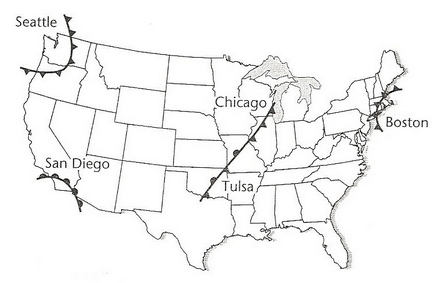
Which type of front is located near Chicago?
a)
warm front
b)
cold front
c)
occluded front
d)
stationary front
10.
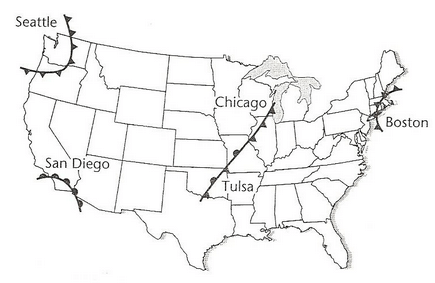
Which type of front is located near Boston?
a)
warm front
b)
cold front
c)
stationary front
d)
occluded front
11.
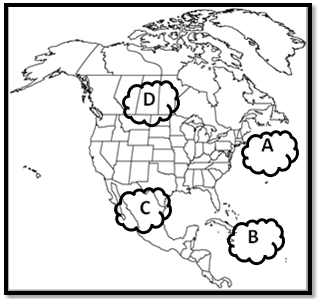
Which type of air would you find at air mass A?
a)
cold, dry
b)
warm, humid
c)
warm, dry
d)
cold, humid
12.
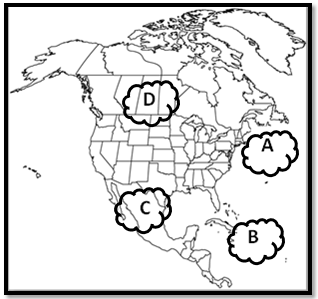
Which type of air would you find at air mass B?
a)
cold, dry
b)
warm, humid
c)
warm, dry
d)
cold, humid
13.
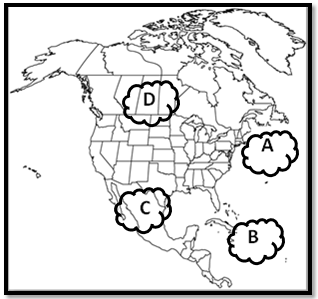
Which type of air would you find at air mass C?
a)
cold, dry
b)
warm, humid
c)
warm, dry
d)
cold, humid
14.
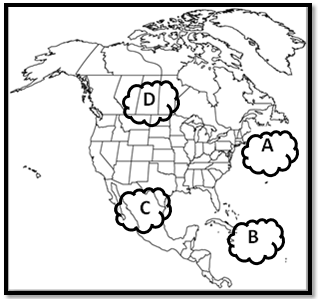
Which type of air would you find at air mass D?
a)
cold, dry
b)
warm, humid
c)
warm, dry
d)
cold, humid
15.
What is a boundary area where air masses meet but do not mix?
a)
low pressure system
b)
super cell
c)
front
d)
high pressure system
16.

What type of storm front is this?
a)
warm front
b)
cold front
c)
stationary front
d)
occluded front
17.

What type of storm front is this?
a)
warm front
b)
cold front
c)
stationary front
d)
occluded front
18.
What characteristics are used to classify air masses?
a)
temperature and humidity
b)
pressure and temperature
c)
latitude and longitude
d)
wind speed and location
19.
What type of weather would you expect to see after a cold front has passed through an area?
a)
cool and clear skies
b)
warm and humid
c)
thunderstorms
d)
foggy
20.
What type of weather would you expect to see after a warm front has passed through an area?
a)
cool and clear skies
b)
warm and humid
c)
thunderstorms
d)
foggy
21.
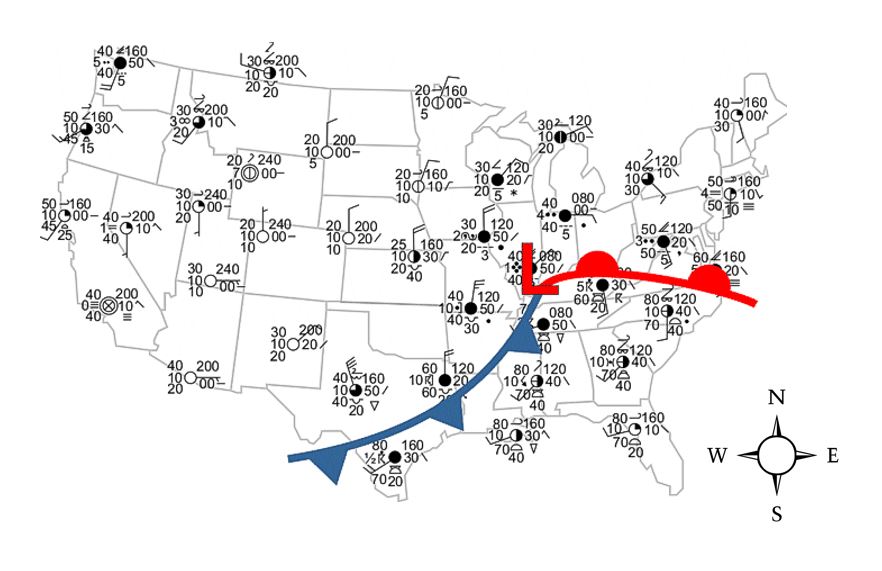
What direction is the warm front moving on the map?
a)
North
b)
South
c)
East
d)
West
22.
What direction is the cold front moving on the map?
a)
Southwest
b)
Northwest
c)
Southeast
d)
Northeast
23.
Where would you find a tropical maritime air mass?
a)
over the ocean, near the equator
b)
over the ocean, near the poles
c)
over a continent, near the equator
d)
over a continent, near the poles
24.
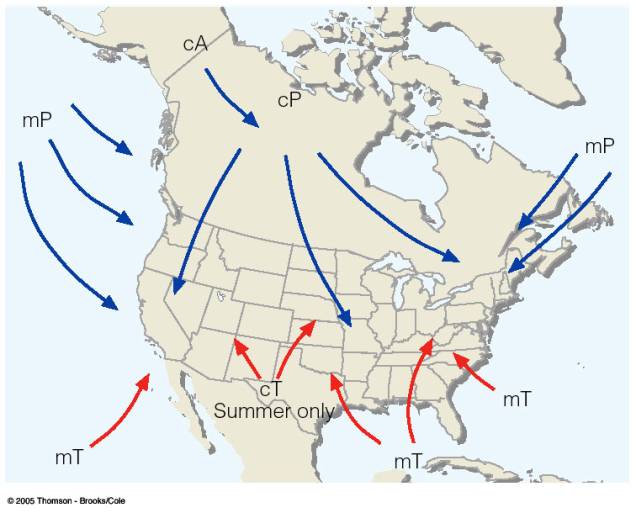
Which abbreviation of an air mass can be identified as dry and hot?
a)
cP
b)
mP
c)
cT
d)
mT
25.
A wet, cold air mass would be -
a)
maritime tropical
b)
maritime polar
c)
continental tropical
d)
continental polar
26.
Which abbreviation of an air mass can be identified as warm and moist?
a)
cP
b)
mP
c)
cT
d)
mT
27.
what is an air mass?
a)
a large body of air that is made of the same temperature and moisuture
b)
when two air masses meet
28.

What is the name of this tool?
a)
Barometer
b)
Hygrometer
c)
Rain Gauge
d)
Thermometer
29.
A _______________ is formed when a warm and cold air mass meet
a)
front
b)
air mass
30.
When a cold air mass crashes into and pushes a warm air mass up, which kind of front is formed?
a)
warm front
b)
cold front
31.
When a warm air mass stretches over a cold air mass, which kind of front is formed?
a)
cold front
b)
warm front
32.
Which type of weather is associated with a cold front?
a)
heavy rain, snow, thunderstorms, and snow for short periods of time
b)
Steady, light rain or snow can occur for longer periods of time
33.
what is an air mass?
a)
a large body of air that is made of the same temperature and moisuture
b)
when two air masses meet
34.
________ air is less dense and tends to rise
a)
cold
b)
warm
c)
moist
d)
dry
35.
If a warm front is currently passing through the city of Chicago, what type of weather conditions is Chicago most likely experiencing?
a)
steady rain showers
b)
cooler, dry weather
c)
hot, dry weather
d)
thunderstorms
36.
What type of weather would you expect to see after a cold front has passed through an area?
a)
cool and clear skies
b)
warm and humid
c)
thunderstorms
d)
foggy
37.

What type of air mass is the highlighted arrow?
a)
continental polar
b)
maritime polar
c)
continental tropical
d)
maritime tropical
38.

What type of air mass is the highlighted arrow?
a)
continental polar
b)
maritime polar
c)
continental tropical
d)
maritime tropical
39.
What causes Hurricanes?
a)
Warm Ocean Water
b)
Convection
c)
Tornadoes that make it to the Ocean
d)
Earthquakes in the Ocean
40.
What part of Earth recieves the most direct sunlight?
a)
The Equator
b)
The Tropics
c)
The Poles
d)
North America
41.
Convection causes Ocean and Wind currents to ...
a)
Rise from the equator to the poles
b)
Drop from the poles to the equator
c)
Die down
d)
Remain the Same
42.
Convection causes Ocean and Wind currents to ...
a)
Rise from the equator to the poles
b)
Drop from the poles to the equator
c)
Die down
d)
Remain the Same
43.
The sun's energy causes heat to be redistributed around the globe through a process called...
a)
Convection
b)
Conduction
c)
Radiation
d)
Election
44.
The Sun's energy causes temperature differences in the globe. In order for the heat to distribute around the globe, wind and ocean currents...
a)
Move heat
b)
Destroy heat
c)
Create heat
d)
Trap heat
45.
Ocean currents travel in a non stop circular pattern because of the Sun's radiant energy. This energy is moved around in ocean currents through...
a)
Conduction
b)
Convection
c)
Radiation
d)
Election
46.

Predict what will happen to Dallas in a few days.
a)
The temperature will decrease and there will be rain
b)
The temperature will increase and there will be rain
c)
There will be a Hurricane
d)
The temperatures will remain the same
47.
A cold front brings...
a)
Cold and wet weather
b)
Cold and dry weather
c)
Thunderstorms that last for long periods of time
d)
Hurricanes
48.
A High Pressure system generally brings...
a)
Wet Weather
b)
Clear Skies
c)
Thunderstorms
d)
Tornadoes
49.
What happens as the oceans cool down?
a)
Storms lose energy
b)
Storms get stronger
c)
The fish get too cold
d)
It gets windy
50.

In what direction is the warm front traveling?
a)
North West
b)
North East
c)
South West
d)
South East
51.

where would the coldest temperatures be?
a)
North
b)
South
c)
East
d)
West
52.
Which material heats up the fastest?
a)
The ocean
b)
A lake
c)
Sand on the beach
d)
Clouds
53.
Which factor affects average temperature in a region?
a)
Distance from the sun
b)
Tilt of the earth
c)
Both answers are correct
d)
Neither answers are correct
54.

Why does air rise over land at the beach?
a)
the air is warmed by the sun, it become less dense and rises
b)
warm air over sea moves in, gets cooler, and rises
c)
trade winds near the equator blow higher at the beach
d)
land is cooler than water at the beach, so air repels away from it
55.

Why is the air warmer over the ocean at night time?
a)
Sand and soil do not cool down quickly, but water does
b)
Sand and soil cool down quickly and water doesn't
c)
Water isn't a good insulator
d)
It's using the energy from the moon to remain warm
56.
What is the MAIN cause of winds?
a)
humidity
b)
earth's tilted axis
c)
the gravitational pull of the moon
d)
the unequal heating of the earth's surface
57.
Cold air is more dense and pushes down more. What kind of pressure is associated with cold air?
a)
high pressure
b)
low pressure
58.
Hot air rises because it is less dense. What does this mean for the air pressure?
a)
It's lower
b)
It's higher
59.
What kind of weather do you expect when the air pressure is LOW?
a)
cool and dry
b)
cloudy and rainy
60.

What kind of pressure system is on the right?
a)
High
b)
Low
61.

Which direction will the wind blow?
a)
from the land towards the sea
b)
from the sea towards the land
c)
it won't blow in this situation
d)
it will blow down to the sea
62.

The heat from a hot burner to a pot is transferred by ______.
a)
convection
b)
insulation
c)
radiation
d)
conduction
63.

When the light bulb heats the wax, the wax rises. When the wax cools, it falls. This cycle of rising/falling is an example of:
a)
Conduction.
b)
Convection.
c)
Radiation.
d)
Torque.
64.

What will the cold front do to the warm air?
a)
push the warm air down creating a high pressure system
b)
push the air up, making it cool, condense and form clouds
c)
Push the warm air backwards
65.

What country is north of the United States?
a)
Mexico
b)
Alaska
c)
Canada
d)
England
66.

This is a warm front. What kind of weather does it bring?
a)
Snow
b)
Heavy thunderstorms
c)
Light rain
d)
It doesn't change the weather
67.
A person who studies weather and weather patterns is a(n)
a)
Botanist
b)
Astronomer
c)
Geologist
d)
Meteorologist
68.
What is the place where air masses meet called?
a)
atmosphere
b)
greenhouse effect
c)
condensation
d)
front
69.
A huge body of air with similar temperature, humidity, and pressure
a)
air mass
b)
air block
c)
cloud
d)
wind
70.
A boundary between two different air masses
a)
cloud
b)
wind
c)
equator
d)
front
Reset

