wayground logo

Free Printable Worksheets

Font size

S
M
L
XL
Worksheets

Open Note : Plate Boundaries and Mantle Concvection

Total questions: 66

Worksheet time: 1hrs 8mins

Name
Class
Date
1.
What is a divergent plate boundary?
a)
A boundary between two plates that are moving apart
b)
A boundary between two plates that are crashing together
c)
A boundary between two plates that are sliding past each other
d)
A boundary between two plates that are not moving
2.
What causes seafloor spreading to occur?
a)
Old crust is destroyed at divergent boundaries.
b)
New crust forms at divergent boundaries, pushing old crust outwards.
c)
Old crust pushes new crust towards divergent boundaries.
d)
New crust forms as plates move over hotspots.
3.
What feature forms near divergent boundaries between two pieces of oceanic crust?
a)
Mid-ocean ridge
b)
Non-volcanic mountain
c)
Continental rift valley
d)
Trench
4.
What causes paleomagnetic stripes to form on the ocean floor?
a)
Different types of rock form in different locations on the ocean floor.
b)
Earth's magnetic field reverses while seafloor spreading occurs.
c)
Earth's magnetic field has been getting stronger over millions of years.
d)
Earthquakes cause Earth's magnetic field to reverse.
5.

What were 2 kinds of evidence were used to prove that the seafloor spread?

a)

rock formations, WWII shipwrecks

b)

magnetic seafloor stripes, WWII ship logs

c)

magnetic seafloor stripes, age of rocks

6.
What technology was used during WWII to detect enemy submarines and produce the first map of the seafloor?
a)
Sonar
b)
Radar
c)
GPS
7.

Process by which new ocean crust forms.

a)

Seafloor spreading

b)

Continental drift

c)

Mid-ocean ridge

d)

Rift

8.
Undersea mountain range.
a)
Rift
b)
Mid-ocean ridge
c)
seafloor spreading
d)
Continental drift
9.
The OLDEST seafloor is located? 
a)
Closest to the mid-ocean ridge
b)
Farthest from the mid-ocean ridge
10.
What are Mid-Ocean Ridges?
a)
A chain of underwater waterfalls 
b)
A chain of underwater volcanos
c)
A chain of underwater mountains
d)
A chain of underwater rocks
11.

Sea-floor spreading begins at the

a)

Deep ocean trench

b)

Mid-ocean ridge

c)

Continent's edge

12.

Why does oceanic crust sink below the continental crust during subduction

a)

oceanic crust is less dense

b)

oceanic crust is more dense

c)

oceanic crust is older

d)

oceanic crust is warmer

13.
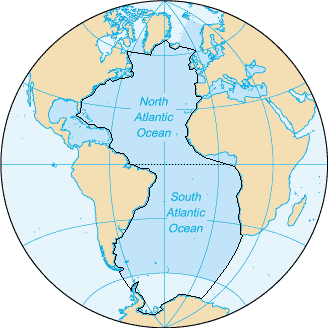
In the Atlantic ocean, where is the youngest seafloor located?
a)
Towards the edges, near the eastern and western continents
b)

Towards the middle of the ocean at the mid-ocean ridge

c)
Towards the north and south poles
d)
Young seafloor is located randomly throughout the ocean
14.

The image shows a mid ocean ridge. What is an important feature of seafloor spreading?

a)

Mid ocean ridges only occur at convergent boundaries.

b)

The convection currents in the core drive the plates apart.

c)

As the plates pull apart, the lava rises to form new crust.

15.

In sea-floor spreading, molten material rises from the mantle and erupts

a)

in deep-ocean trenches

b)

along the edges of all the continents

c)

along mid-ocean ridges

d)

at the north and south plate

16.

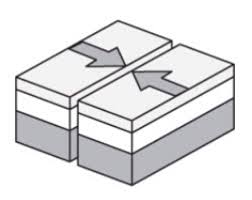
What kind of plate boundary is shown on the picture?

a)

divergent

b)

convergent

c)

transform

d)

trench

17.

What evidence helps scientists show how sea floor spreading occurs?

a)

Thickness of sediment on the Ocean floor.

b)

Magnetic Stripes

c)

The age of the ocean floor

d)

All of the Above

18.

Where do convection cycles happen?

a)

core

b)

mantle

c)

crust

19.

Convection cycles move in the mantle. How does this affect the crust?

a)

crust has no motion

b)

crust moves in random direction

c)

crust moves in same direction convection cycle moves

20.

What is magma made of?

a)

solid rock

b)

melted rock

c)

small pieces of sediment

21.

Which material is more dense?

a)

solid

b)

liquid

c)

gas

22.

Density has to do with what two things?

a)

Material and Volume

b)

Mass and Volume

c)

Mass and Density

d)

Material and Density

23.

Which state of matter is least dense?

a)

Solid

b)

Liquid

c)

Gas

24.

If magma increases in temperature (get hot) what will happen?

a)

It moves down (sinks)

b)

It moves up (rises)

25.

If magma decreases in temperature (cooler) what will happen to the magma?

a)

It will move down (sink)

b)

It will rise up (float)

26.

How does density relate with viscosity?

a)

more dense, higher the viscosity

b)

less dense, higher the viscosity

27.

Which has a higher viscosity?

a)

Oil

b)

Honey

28.

Why does hot mantle rise (go/move up)?

a)

hot = less dense

b)

hot = no change

c)

hot = more dense

29.

Which type of material rises?

a)

Material that is more dense

b)

Material that is less dense

c)

The density does not determine if particles will rise or fall

30.

What is an example of convection currents

a)

Feeling the heat from a bonfire with your friends

b)

Touching a hot curling iron

c)

The movement of air in a circular motion in the atmosphere
31.
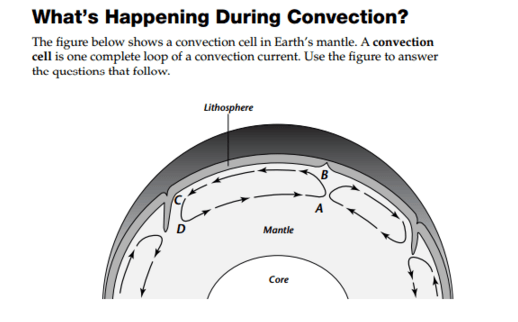
Where is the temperature of the mantle material greater, at point A or point B?
a)
Point A
b)
Point B
32.
What happens to the temperature and density of materials between point B and point C?
a)
material is getting colder and more dense
b)
material is getting hotter and less dense
33.
What force causes the convection cell to turn down at point C?
a)
pressure
b)
density
c)
temperature
d)
gravity
34.
What happens to the temperature and density of materials between point D and point A?
a)
material is getting colder and more dense
b)
material is getting hotter and less dense
35.
What causes the convection cell to turn up at point A?
a)
material is getting colder
b)
material is getting less dense
c)
material is getting more dense
36.

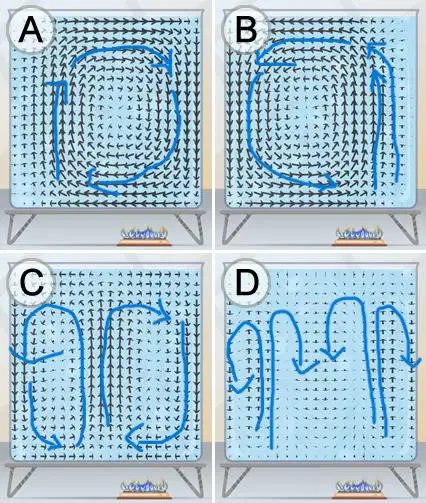
From the Gizmo Lab; A burner is placed below the right side of a beaker. Which image shows the motion of the liquid that will result?

a)

Image A

b)

Image B

c)

Image C

d)

Image D

37.

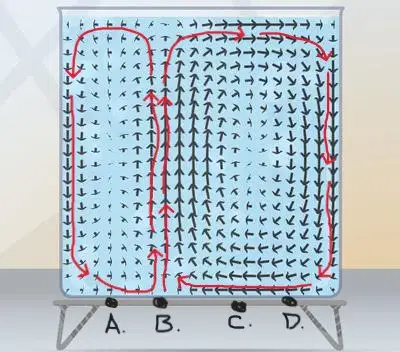
Which point shows the burner placement that will produce the convection cell in red?

a)

Point A

b)

Point B

c)

Point C

d)

Point D

38.
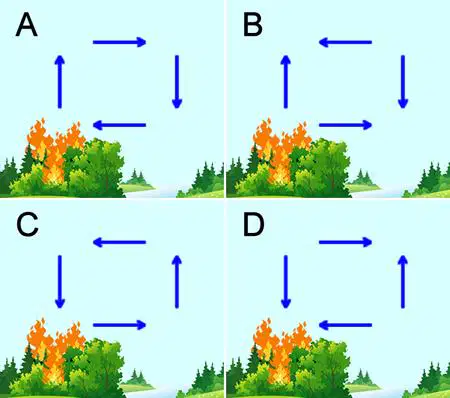
  1. Which of the following statements is true about the movement of fluid in a convection cell?

a)

Image A

b)

Image B

c)

Image C

d)

Image D

39.

A fluid high in viscosity would _________ the rate of convection.

a)

decrease

b)

increase

c)

maintain

40.

Match the following

a)

1.

Convergent

b)

2.

Divergent

c)

3.

Transform

41.

A convergent boundary is where 2 plates (a)  

Choose from the below words
move toward each other.
move away from each other.
move past each other.
42.

A transform boundary is where 2 plates (a)  

Choose from the below words
move toward each other.
move away from each other.
move past each other.
43.

What type of plates are colliding?

a)

oceanic - oceanic plates

b)

Oceanic - continental plate

c)

continental - continental plates

44.
A subduction zone is formed...
a)
when one tectonic plate sinks below another
b)
at every type of convergent plate boundary
c)
at every type of divergent plate boundary
d)
at transform boundaries
45.
What geologic feature/event would you most likely to find at a convergent boundary between two pieces of continental crust?
a)
Volcano
b)
Mountain
c)
Rift
d)
Island Arc
46.

The process by which one lithospheric plate is forced under another

a)

Radiation

b)

Convection

c)

Conduction

d)

Subduction

47.

What is the only event associated with ALL plate boundaries?

a)

Volcanoes

b)

Earthquakes

c)

Subduction

d)

Deep Trenches

48.
Plates slide past one another at ____________ boundaries.
a)
divergent
b)
convergent
c)
transform
d)
submergent
49.
Which of the following causes Earth's tectonic plates to move?
a)
Energy from the Sun
b)
Magnetic Pole Reversal
c)
Convection currents in the mantle
d)
Faults in Mountain Ranges
50.
What kind of plate boundary is shown here?
a)
divergent
b)
convergent
c)
transform
d)
strike slip
51.
Why did the continental plate get volcanoes?
a)
It is made of thicker continental crust
b)
It gets stuck and folds
c)
It has a subducted plate under it that melts
d)
It is more dense
52.
What would you be most likely to find at a convergent boundary between a continental and oceanic plate?
a)
Mountains
b)
Volcanoes
c)
Mid-Ocean Ridge
d)
Rift
53.

What geological feature would an oceanic-oceanic convergent boundary create?

a)

volcanic mountains

b)

mountains

c)

volcanic islands

54.

What geological feature would an oceanic-continental convergent boundary create?

a)

volcanic mountains

b)

mountains

c)

volcanic islands

55.

When one plate forces it's way under another plate.

a)

convection

b)

boundary

c)

subduction

56.

The edges of plates are called....

a)

convection

b)

boundaries

c)

subduction

57.
Name the boundary
a)
convergent boundary
b)
divergent boundary
c)
transform boundary
d)
sergent boundary
58.
What are the two types of crust
a)
continental and oceanic
b)
ocean and upper
c)
lower and upper
d)
pizza and subway
59.
subduction zones in the ocean can create which features?
a)
islands
b)
volcanoes
c)
earthquakes
d)
all of the above
60.
When an oceanic plate and a continental plate collide, which one will subduct?
a)
oceanic
b)
continental
c)
neither
61.
Whenever a subduction zone is formed a ______ is formed.
a)
Mountain
b)
Island Arc
c)
Rift
d)
Volcano
62.
What would you be most likely to find at a convergent boundary between a continental and oceanic plate?
a)
Mountains
b)
Volcanoes
c)
Mid-Ocean Ridge
d)
Rift
63.
Why is there a trench in the water?
a)
Because of the basalt 
b)
Because of the melting oceanic crust
c)
Because the oceanic plate is subducting making a low spot
d)
Because the oceanic plate is stuck and folds downward
64.

The movement of Tectonic Plates is caused by ______________.

a)

the rotation of the Earth

b)

ocean tides

c)

convection in the asthenosphere

d)

the moon's gravity

65.

Which of Earth's layers make up the Tectonics Plates?

a)

Continental Crust

b)

Lithosphere

c)

Asthenosphere

d)

Oceanic Crust

66.

What is formed when these plates converge?

a)

mountains

b)

islands and trenches

c)

volcanos and trenches