
 Worksheets
Test-prep Tuesday
Total questions: 131
Worksheet time: 2hrs 19mins
Name
Class
Date
1.

What is a producer?
a)
an organism that gets energy from eating other organisms
b)
an organisms that uses sunlight to make its own food
c)
an organism that gets energy from eating dead organisms, non-living material or waste
d)
an organism that uses chemical energy to make its own food
2.

A community of living and nonliving things in their natural environment makes up a
a)
food web
b)
ecosystem
c)
food chain
d)
population
3.

What is a herbivore?
a)
an animal that gets energy from eating other animals
b)
an organism that gets energy from eating only plants
c)
an animal that gets energy by eating both plants and other animals
d)
an animal that eats only herbs
4.

An organism that gets energy from eating other organisms is a ______________
a)
producer
b)
consumer
c)
decomposer
d)
prey
5.

A connection of food chains with many food energy paths in an ecosystem is a ____________
a)
ecosystem
b)
food web
c)
environment
d)
population
6.

An animal that is hunted and eaten for food is a
a)
predator
b)
prey
c)
population
7.

An organism that gets energy from breaking down dead organisms, non-living material or waste
a)
producer
b)
consumer
c)
decomposer
d)
autotroph
8.

Directs all cell activities "Brain or Control Center of cell"
a)
Lysosomes
b)
Nucleus
c)
ribosomes
d)
Mitochondria
9.
"powerhouse of the cell" breaks down sugar molecules to release energy, site of cellular respiration, double membrane, self-replicating, contains own DNA, cristae
a)
Mitochondria
b)
Chloroplast
c)
Cell Wall
d)
Vesicle
10.
"Gatekeeper" Separates the cell from the rest of the environment and helps control what passes in and out of the cell. Semi-permeable: allows some materials to pass through but not all
a)
Cell Wall
b)
Cytoplasm
c)
Mitochondria
d)
Cell Membrane
11.
Rigid outer layer made of cellulose that supports and protects the cell (plant, fungi, and bacterial cells)
a)
Nucleolus
b)
Golgi Body
c)
Cell Wall
d)
Cytoskeleton
12.

The organelle that uses the energy of sunlight to make food for the cell.
a)
Chloroplast
b)
Ribosome
c)
Mitochondria
d)
Nucleus
13.

Which number is the ocular lens in the image?
a)
1
b)
7
c)
8
d)
12
14.

Which number is the fine course adjustment knob in the image?
a)
3
b)
4
c)
5
d)
6
15.
A group of tissues that work together
a)
Organ
b)
Tissue
c)
Cell
d)
Steak
16.
A group of similar cells that work together
a)
Molecule
b)
Tissue
c)
Organ
d)
Cell
17.

#3 is which organelle?
a)
chloroplast
b)
cytoplasm
c)
mitochondria
d)
golgi apparatus
18.

"I" is which organelle?
a)
chloroplast
b)
cytoplasm
c)
mitochondria
d)
golgi
19.

#2 is which organelle?
a)
golgi
b)
Endoplasmic reticulum
c)
nucleus
d)
cytoplasm
20.
Mutations are a source of _______________.
a)
Variation
b)
Disease
c)
Polypeptide
21.
DNA molecule segment is : TTACGCAAG
The mutated DNA segment is TTACGCAAC. This is an example of ___ mutation.
The mutated DNA segment is TTACGCAAC. This is an example of ___ mutation.
a)
Base Substitution
b)
Base Insertion
c)
Base Inversion
d)
Translocation
22.
What mutation has occurred here?
T-G-A-C-C-A
T-G-A-G-C-A
T-G-A-C-C-A
T-G-A-G-C-A
a)
Substitution
b)
Deletion
c)
Insertion
d)
Frameshift
23.

The diagram shows the process of
a)
Transcription
b)
Translation
c)
Replication
d)
Mitosis
24.
What causes mutations?
a)
Mistakes in replication or environmental substances
b)
The amino acids
c)
Passed down by genetics
d)
It's how your born
25.
If a mutation occurs in an expressed gene, it will most directly affect the structure of a cell's
a)
ATP
b)
proteins
c)
energy source
d)
membrane
26.
Why is the order of amino acids so important?
a)
The order of amino acids dictates what shape the protein will fold into.
b)
It is not important. The protein folding chamber will force the protein to fold into the correct shape.
27.
ATTTGAGCC- Original
ATTGAGCC - Mutated
The example above is an example of a
ATTGAGCC - Mutated
The example above is an example of a
a)
Insertion- Frameshift
b)
Deletion- Substitution
c)
Deletion -Frameshift
d)
All of the above
28.
The order of nitrogen bases determines the order of __________.
a)
amino acids
b)
monosaccharides
c)
fatty acids
29.
The process by which the nuclear material is divided equally between two new cells
a)
mitosis
b)
cancer
c)
spindle
d)
centromere
30.

Structure (a) is a ____.
a)
chromosome
b)
chromatid
c)
centromere
31.

What is the next phase of mitosis?
a)
Prophase
b)
Metaphase
c)
Anaphase
d)
Telophase
32.

Name the previous phase.
a)
Prophase
b)
Metaphase
c)
Anaphase
d)
Telophase
33.

The stages of mitosis in order
a)
Metaphase, Anaphase, Prophase, Telophase
b)
Prophase, Anaphase, Metaphase, Telophase
c)
Prophase, Metaphase, Anaphase, Telophase
d)
Anaphase, Prophase, Telophase, Metaphase
34.
If the environment gets cold, we will often shiver in order to:
a)
keep body temperature the same as the external temperature
b)
decrease body temperature
c)
increase body temperature
d)
regulate blood pressure
35.
The maintenance of an organism’s internal environment is called:
a)
compensating
b)
homeostasis
c)
balancing
d)
routine
36.
The "cause" for something to happen is the
a)
response
b)
effect
c)
stimulus
d)
homeostasis
37.
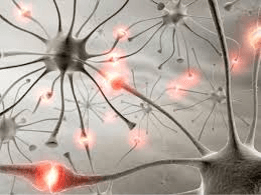
a body system that controls and coordinates all body activities through electric impulses/messages between brain, spinal cord and nerves.
a)
endocrine system
b)
nervous system
c)
nerve
d)
neuron
38.

brain cell /
nerve cell
nerve cell
a)
Dr. Suess tree
b)
neuron
c)
skin cell
d)
red blood cell
39.
chemical made by glands that tell cells to make something or respond in some way.
a)
acid
b)
enzyme
c)
perspiration
d)
hormone
40.
What is the largest outer defense of the body?
a)
Stomach Acid
b)
Mucous Membranes
c)
Cilia
d)
Skin
41.
When a threatening situation appears, what is the name of the instinctive mechanism used by animals to protect themselves?
a)
Flight or Run
b)
Hide and Seek
c)
Fight or Flight
d)
Run and Fight
42.
What is another word that can be used to describe "homeostasis"?
a)
STABLE
b)
EQUAL
c)
COMPLETE
d)
CORRECT
43.
Which of the following is the correct equation for PHOTOSYNTHESIS?
a)
CO2 + light + H2O --> O2 + Sugar
b)
CO2 + sugar + H2O --> O2 + light
c)
O2 + light + H2O --> CO2 + Sugar
d)
CO2 + O2 + H2O --> Light+ Sugar
44.
What process occurs when light energy is captured in autotrophs and converted into sugar?
a)
Photosynthesis
b)
Cellular Respiration
45.
What is the ultimate ORIGINAL source of energy for living things
a)
Sugar
b)
Sun
c)
Moon
d)
Carbon Dioxide
46.
Which organisms perform Photosynthesis?
a)
Only Autotrophs
b)
Only Heterotrophs
c)
Autotrophs and Heterotrophs
47.
Which gas is removed from the atmosphere during photosynthesis?
a)
hydrogen
b)
oxygen
c)
nitrogen
d)
carbon dioxide
48.
What are the products of photosynthesis?
a)
water and carbon dioxide
b)
oxygen and glucose
c)
oxygen and carbon dioxide
d)
oxygen and water
49.
Plants need ________ for photosynthesis
a)
oxygen
b)
soil
c)
carbon dioxide
d)
sugar
50.

If all four plants were watered daily but placed in a closet, receiving no sunlight, what process would NOT occur?
a)
Ingestion of carbon dioxide
b)
Filtration of water through the soil
c)
Photosynthesis
d)
Water absorbtion
51.

The reactants of photosynthesis are
a)
sugar and water.
b)
sugar and oxygen.
c)
carbon dioxide and water.
d)
carbon dioxide and oxygen.
52.

Which statement about photosynthesis is correct?
a)
Plants get the energy they need for photosynthesis from water.
b)
Plants get the energy they need for photosynthesis from soil.
c)
Plants get the energy they need for photosynthesis from sunlight.
d)
Plants do not require energy to perform photosynthesis.
53.

Which of the following is the correct equation for PHOTOSYNTHESIS?
a)
6CO2 + 6H2O --> 6O2 + C6H12O6
b)
6CO2 + C6H12O6 + 6H2O --> O2
c)
6O2 + 6H2O --> 6CO2 + C6H12O6
d)
C6H12O6 + 6O2 ---> 6H2O + 6CO2
54.

Use the diagram to answer the question. Between which parts of the molecule must the bonds be broken to form an ADP molecule?
a)
A and B
b)
A and C
c)
B and C
d)
C and D
55.

Which of the following is considered a waste product of photosynthesis?
a)
glucose
b)
oxygen
c)
carbon dioxide
d)
sunlight
56.
RNA is read in sections called:
a)
Triplets
b)
Genes
c)
Codons
d)
Genes
57.

RNA contains which bases?
a)
adenine, guanine, uracil, cytosine
b)
thymine, guanine, cytosine, uracil
c)
thymine, uracil, cytosine, guanines
d)
adenine, uracil, guanine, thymine
58.

The structure of proteins can be changed by environmental factors such as temperature or pH.
a)
True
b)
False
59.
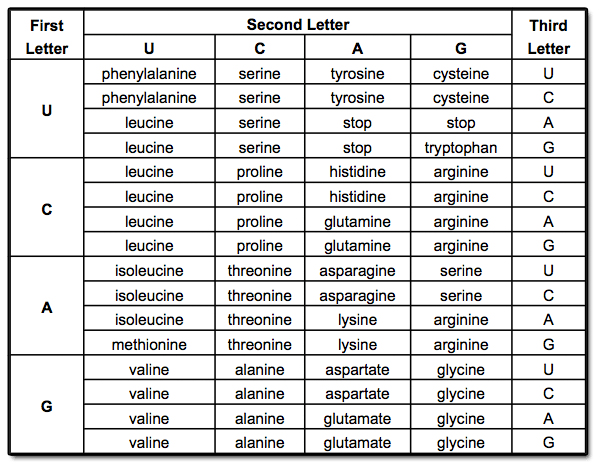
What amino acid is represented by the codon UUA?
a)
Phenylalanine
b)
Tyrosine
c)
Leucine
d)
Stop codon
60.

What process is going on in this photo?
a)
Transcription
b)
Translation
c)
Replication
d)
All the above
61.

What process is going on in this photo?
a)
Transcription
b)
Translation
c)
Replication
d)
All the above
62.
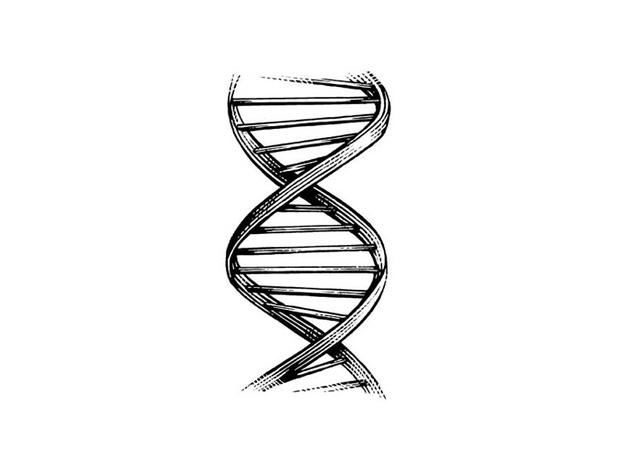
DNA has a _____________ structure.
a)
double helix
b)
single strand
c)
ring
d)
chain
63.
Which carb helps with structure in plants?
a)
Cellulose
b)
Chitin
c)
Starch
d)
Glycogen
64.
Hydrolysis means to ...
a)
(remove water) (put together)
b)
(remove water) (break apart)
c)
(add water) (put together)
d)
(add water) (break apart)
65.
Dehydration synthesis means to ...
a)
(remove water) (put together)
b)
(remove water) (break apart)
c)
(add water) (put together)
d)
(add water) (break apart)
66.
A single unit of sugar is referred to as:
a)
Monosaccharide
b)
Monocarbohydrate
c)
Mononutrient
d)
Monopolymer
67.
Carbohydrates yield how many Calories per gram?
a)
0 Cal/gram
b)
9 Cal/gram
c)
4 Cal/gram
d)
2.25 Cal/gram
68.
Sugars all end with what three letter ending?
a)
-ote
b)
-ate
c)
-ase
d)
-ose
69.

Which of the following graphs best illustrates the relationship between the heat released by the foods listed in Table 1 and the change in water temperature?
a)
A
b)
B
c)
C
d)
D
70.

According to Tables 1 and 2, as the mass of successive sucrose samples increased, the change in the water temperature produced when the sample was burned most likely:
a)
Increased only
b)
Decreased only
c)
Increased, then decreased
d)
Stays the same
71.

Based on the data in Table 2, one can conclude that when the mass of sucrose is decreased by one-half, the amount of heat released when it is burned in a bomb calorimeter will:
a)
Increase by one-half
b)
Decrease by one-half
c)
Increase by one-fourth
d)
Decrease by one-fourth
72.

Which of the following lists the foods from Tables 1 and 2 in increasing order of the amount of heat released per gram of food?
a)
Potato, egg, bread, sucrose, cheese
b)
Sucrose, cheese, bread, egg, potato
c)
Bread, cheese, egg, potato, sucrose
d)
Sucrose, potato, egg, bread, cheese
73.

Based on the information in Tables 1 and 2, the heat released from the burning of 5.0 g of potato in a bomb calorimeter would be closest to which of the following?
a)
5 kJ
b)
10 kJ
c)
15 kJ
d)
20 kJ
74.
A student wants to test the effects of type of exercise on heart rate. What is the independent variable?
a)
type of exercise
b)
heart rate
c)
amount of time exercise occurs
d)
gender of person that exercises
75.
A student wants to test the effects of type of exercise on heart rate. What would be a proper hypothesis?
a)
If type of exercise affects the heart rate of a person, then jumping jacks will increase the heart rate the most
b)
Jumping jacks will cause the highest heart rate
c)
Exercise increases heart rate
d)
If exercise affects heart rate, jumping jacks will increase heart rate the most
76.
On which axis would you place the independent variable?
a)
X
b)
Y
c)
Z
77.
On which axis would you place the dependent variable?
a)
X
b)
Y
c)
Z
78.

Suppose the transfer of genes between two bacteria was interrupted, that the last gene transferred was Gene A, and that no incomplete copies of a gene were transferred. Based on this information, Student 1 would say that the transfer was most likely interrupted how many minutes after the transfer began?
a)
15
b)
30
c)
45
d)
60
79.
Where does cellular respiration take place in eukaryotic cells?
a)
Mitochondria
b)
Chloroplast
c)
Rough ER
d)
Cell Membrane
80.
What products are produced during photosynthesis?
a)
Oxygen and glucose
b)
Carbon dioxide and ATP
c)
Oxygen and sunlight
d)
Glucose and Carbon dioxide
81.
Which of these is a product of photosynthesis and a requirement for cellular respiration?
a)
Glucose
b)
Carbon Dioxide
c)
Sunlight
d)
Water
82.
Aerobic means...?
a)
Needing oxygen or air
b)
Not needing oxygen or air
c)
Photosynthesis
d)
Dancing
83.

In what organelle does cellular respiration take place?
a)
Cell Wall
b)
Chloroplast
c)
Oxygen
d)
Mitochondria
84.
How can photosynthesis be related to cellular respiration?
a)
What's produced (made) by one is needed (the reactants) for the other
b)
They both produce the same products
c)
They both have the same reactants (need the same things)
d)
These 2 processes have nothing in common
85.
Which organisms perform CELLULAR RESPIRATION?
a)
Only Autotrophs
b)
Only Heterotrophs
c)
Autotrophs and Heterotrophs
86.
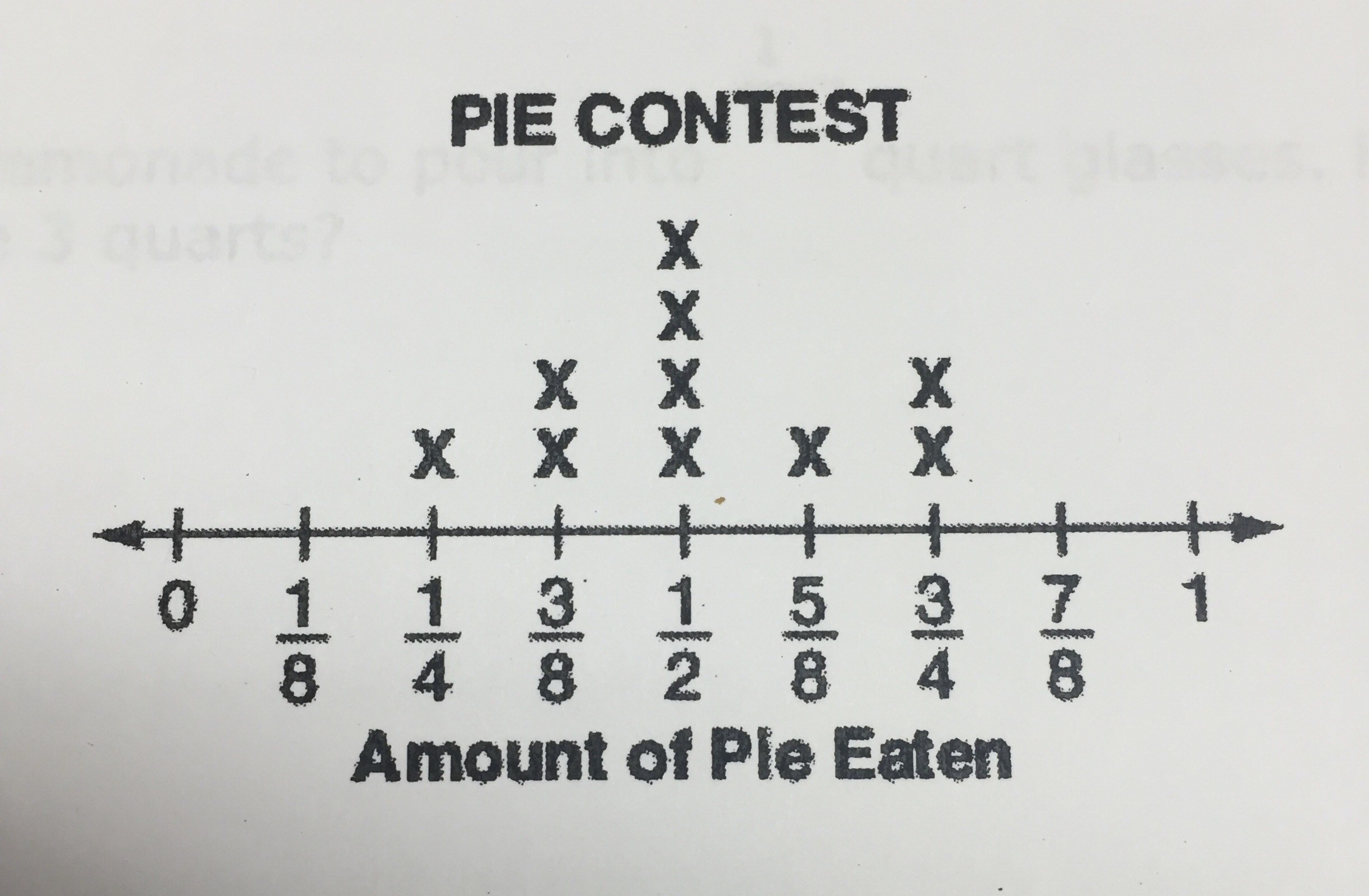
What group ate the most pie?
a)
1/2
b)
5/8
c)
1
d)
3/8
87.
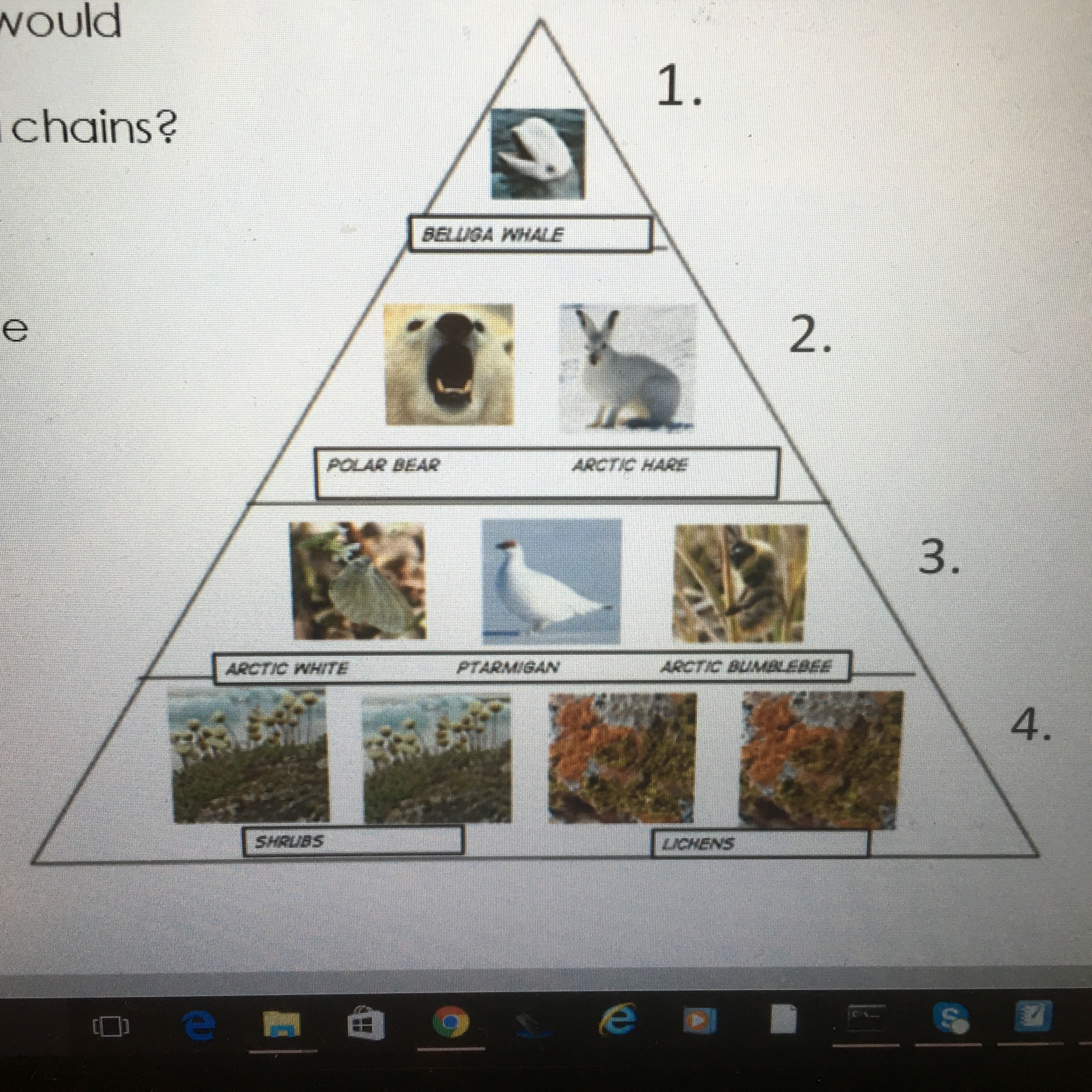
Which group are the producers?
a)
1 and 2
b)
3 and 4
c)
4
d)
3
88.

How much energy is lost when organisms consume another organism from a different level?
a)
90%
b)
20%
c)
50%
d)
10%
89.
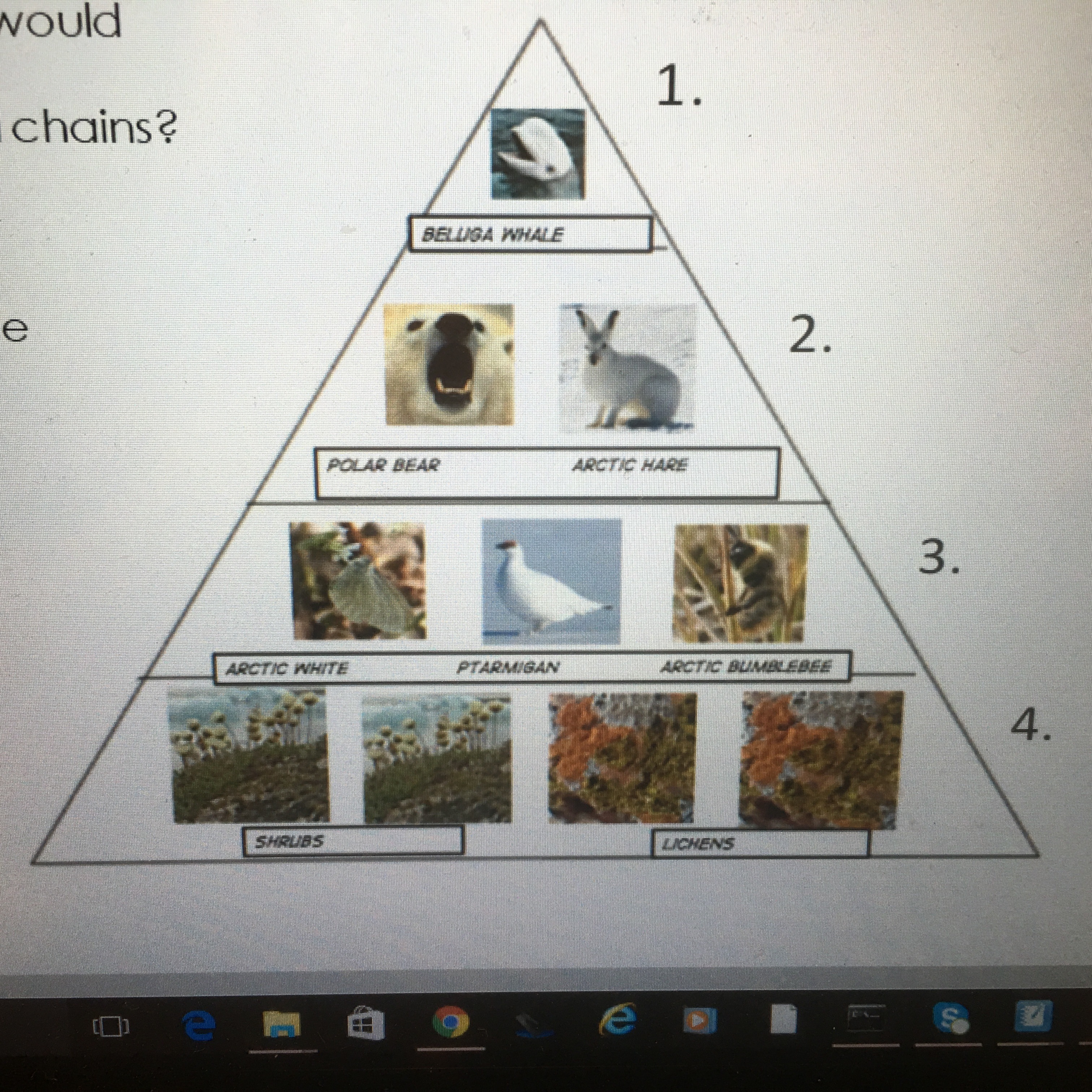
If the original amount of energy in an energy pyramid is 10,000 J what amount is left for the apex predators?
a)
10 J
b)
1 J
c)
100 J
d)
1000 J
90.

What type of growth is represented in the graph?
a)
exponential
b)
logistics
c)
a good kind
d)
representative
91.

What is the carrying capacity of the following graph?
a)
1000
b)
8000
c)
800
d)
600
92.

Which kind of distribution is #1?
a)
clumped
b)
random
c)
even
93.

What does the graph represent?
a)
Emigration
b)
Exponential growth
c)
Immigration
d)
Logistic Growth
94.
Which of the following is NOT a density-dependent limiting factor?
a)
flood
b)
disease
c)
predation
d)
competition
95.
A tree blocks the light from the grass below. This is an example of _________.
a)
mutualism
b)
commensalism
c)
competition
d)
parasitism
96.
Food, water, sunlight, air, soil are resources that are often __________.
a)
limiting factors
b)
wet
c)
messy
d)
found in rocks
97.
Any thing or organism that regulates the size of a population of another organism is known as __________.
a)
a limiting measure
b)
a limiting factor
c)
factorization
d)
materialization of precipitation
98.
Nonliving parts of an ecosystem
a)
Biotic
b)
Abiotic
c)
Prebiotic
d)
Nonbiotic
99.
The living parts of an ecosystem
a)
Biotic
b)
Abiotic
c)
Antibiotic
d)
Probiotic
100.

In the energy pyramid here, which organisms have the most energy available?
a)
Producers
b)
Carnivores
c)
Herbivores
d)
Top Predator
101.
A food web consists of?
a)
Many overlapping food chains in an ecosystem.
b)
A series of events in which one organism eats another and obtains energy.
c)
Amount of energy that moves from one feeding level to another.
d)
Many types of insects that are stuck.
102.
Individuals of a population who move into an area.
a)
Immigration
b)
Emigration
c)
Litigation
d)
Mastication
103.
Individuals of a population who exit an area.
a)
Immigration
b)
Emigration
c)
Mitigation
d)
Lingation
104.

symbiotic relationship in which both organisms benefit
a)
competition
b)
Mutualism
c)
nitrogen fixation
d)
energy pyramid
105.
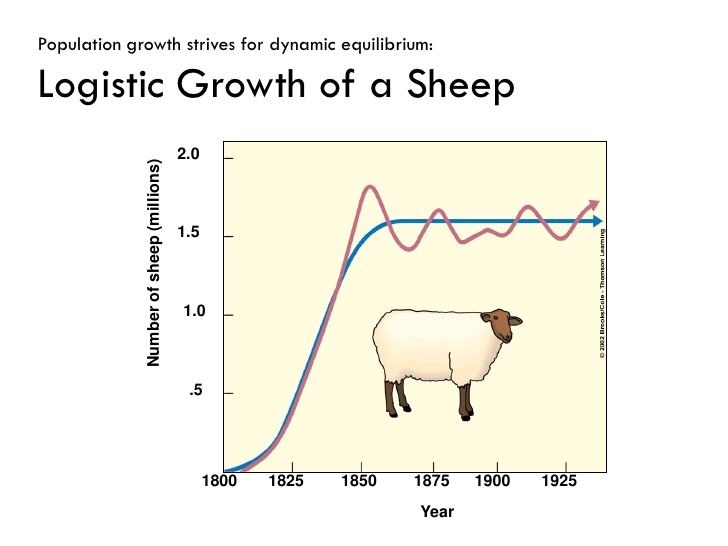
What is the carrying capacity for this sheep population?
a)
1.8 million
b)
1.25 million
c)
1.6 million
d)
1.o million
106.

If a rain drop lands in the ocean, it will eventually _______, and return to the clouds.
a)
condense
b)
evaporate
107.

The energy that drives the water cycle comes from the...
a)
Sun
b)
Moon
c)
Clouds
108.

What is this a picture of?
a)
Nitrogen cycle
b)
carbon cycle
c)
water cycle
d)
plant cycle
109.
How does carbon dioxide leave the atmosphere?
a)
Through transpiration
b)
Through photosynthesis
c)
Through factory emission
d)
Sunlight
110.
Respiration is the process by which ____________ is consumed and _______________ is produced.
a)
Carbon, Oxygen
b)
Oxygen, Carbon dioxide
c)
H20, oxygen
d)
Carbon, H2O
111.
Carbon dioxide is added to the atmosphere by
a)
Burning fossil fuels
b)
Cellular respiration
c)
Decomposing organic matter
d)
All answers are correct
112.

Identify the cycle pictured.
a)
The Water cycle
b)
The Carbon cycle
c)
The Nitrogen cycle
d)
This is not a correct diagram of any cycle.
113.

What cycle is demonstrated in the diagram?
a)
The Carbon cycle
b)
The Water cycle
c)
The Nitrogen cycle
d)
The Life cycle
114.
In the tropical regions of Africa, the crocodile lies with its mouth open. The plover flies into its mouth and feeds on bits of decaying meat stuck in the crocodile’s teeth. The crocodile does not eat the plover. Instead, he appreciates the dental work. The plover eats a meal and the crocodile gets his teeth cleaned. This is an example of
a)
mutualism
b)
commensalism
c)
parasitism
d)
predation
115.

A group of ecosystems with similar organisms and climates.
a)
desert
b)
deciduous
c)
canopy
d)
Biome
116.
How can people change biomes?
a)
By melting the permafrost with campfires
b)
By cutting down trees and polluting the water
c)
By raising different kinds of animals on farms
d)
By using canoes and boats to navigate rivers
117.
Why are organisms so well-adapted to the conditions of the biomes in which they live? Choose the best answer.
a)
They have migrated to biomes that suit their biological needs
b)
They have slowly evolved to adapt to their environments
c)
They have killed off other, better-adapted species
d)
They have quickly changed their biological makeup to suit their environments
118.

A graph showing the population of two species is shown. Which of the following is the most likely relationship between the two species?
a)
Species A and B do not affect one another.
b)
Species A and B have a symbiotic relationshp
c)
Species A and B occupy the same niche
d)
Species A and B have a predatory-prey relationship
119.
Which of these BEST describes how some birds survive when the weather gets cold?
a)
a. They store twigs and sticks in their nest
b)
b. They migrate to a warmer climate
c)
c. They grow more feathers to stay warm in the winter
d)
d. They hide in bushes and wait for warm weather
120.

Approximately what percentage of Italy's population is under 10 years old?
a)
2%
b)
8%
c)
20%
d)
80%
121.

Refer to the diagram of the survivorship curve.
Which curve best describes an organism that invests a lot of energy in parenting?
Which curve best describes an organism that invests a lot of energy in parenting?
a)
A
b)
B
c)
C
d)
this is not a survivorship curve
122.
A rabbit is running away from a fox. What is the stimulus for this behavior?
a)
avoiding a predator
b)
food
c)
migration
d)
estivation
123.
Homozygous is when...
a)
the alleles are the same
b)
the alleles are different
c)
the alleles are absent
d)
the alleles are present
124.
G = green, g = yellow
The genotype for a yellow plant is...
The genotype for a yellow plant is...
a)
GG
b)
Gg
c)
gg
d)
all of the choices result in yellow
125.

B = brown fur b = white fur
In the punnett square, what is the probability for white fur?
In the punnett square, what is the probability for white fur?
a)
0%
b)
25%
c)
50%
d)
75%
126.

In the diagram, what is the genotype of the two plants found in the second generation (F1)?
a)
GG
b)
Gg
c)
gg
d)
cannot tell from the data available
127.
Dominant alleles are represented by a:
a)
Male gene
b)
lowercase letter
c)
recessive trait
d)
capital letter
128.
What is a phenotype?
a)
The expression of a trait; physical appearance.
b)
refers to the genetic makeup of an individual
c)
An organism that has the same genes for a trait (ex. TT or tt)
d)
the passing of traits from parent to offspring
129.
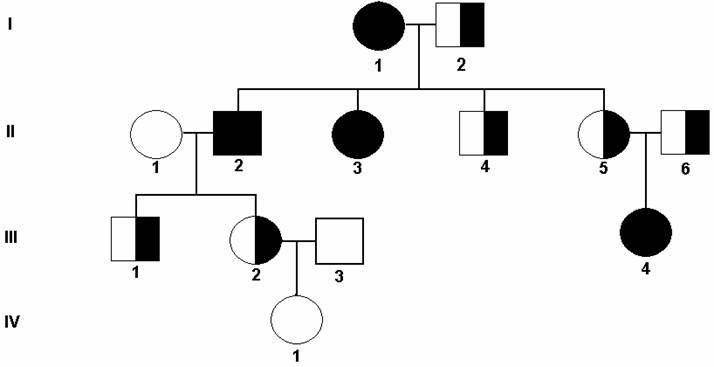
In the second generation-how many people have the disease or display the physical trait?
a)
2
b)
4
c)
5
d)
6
130.
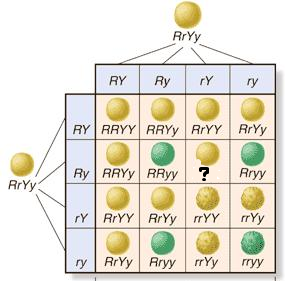
What genotype is missing from this Punnett Square?
a)
RrYy
b)
RRYY
c)
rryy
d)
RrYY
131.
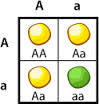
The dominant trait as seen in this Punnett square is
a)
yellow pea seeds
b)
green pea seeds
c)
there is no dominant seed
d)
Jolly green giant
100 %

