
 Worksheets
Unit 9: Classification & Viruses Quiz 2 Review
Total questions: 126
Worksheet time: 2hrs 20mins


Which of the following is an example of a vertebrate animal?
fly
worm
bird
starfish
Invertebrates do NOT have a
brain.
heart.
stomach.
backbone.


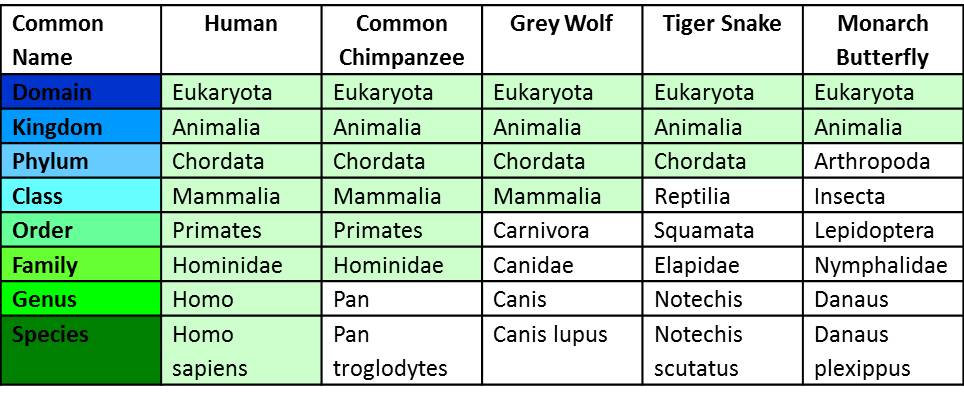
Canis lupus


Scientists currently classify organisms based on features they share. How will this most likely change in the future?
They will be classified based on DNA analysis.
They will be classified based on similar organs.
They will be classified based on common descent.
They will be classified based on protein production.


Heterotrophs- obtain food from other animals.
Observing the table above, Fungi and Animals are________?

What kingdom do unicellular, prokaryotic organisms that live in extreme environments?
Animal
Archaebacteria
Eubacteria
Plant

The diagram shows taxonomic groups and a major distinguishing characteristic of all but two of them. Which characteristics will be used to complete the chart?
nonphotosynthetic - photosynthetic
autotrophic - heterotrophic
no nucleus - nucleus
motile - nonmotile

A student want to use the Venn diagram to show the characteristics of two kingdoms of organisms. The characteristics that the two kingdoms share will be listed in the shaded area where the circles intersect. Which of these is a characteristic that the student should list in the shaded part of the diagram?
heterotrophic
mobile
prokaryotic
multicellular

I. Cell wall
II. Cell Membrane
III. Multicellular
IV. Heterotrophic
V. Autotrophic



Scientists can determine relatedness among organisms by comparing partial amino acid
sequences. The table shows four partial amino acid sequences from four organisms.Which organism is the LEAST related to the other three organisms?
Organism 1
Organism 2
Organism 3
Organism 4


What is an illness caused by a virus, protist, fungi, or bacteria called?
Gluteus maximus
Pathogen
sickle cell anemia
Disease


Why do viruses have projections on the outside?
To send signals to other viruses.
To maintain their structure.
To attach to the host cell.
To reproduce.
takes over the cell's functions.
Which of the following statements is true?
All cells are prokaryotes
All eukaryotes have a nucleus
All viruses are prokaryotes
All viruses are living

Which of the following is a virus?
A
B
C
D
Which of the following would be a prokaryotic cell?
A
B
C
D
Which of the following would contain DNA?
A and B
A and C
A and D
all of these

Lactobacillus bulgaris is a bacteria used to make yogurt. Lactobacillus bulgaris cells are
viruses
prokaryotes
eukaryotes
proteins
Lactobacillus bulgaris is a bacteria used to make yogurt. It breaks down the milk sugar lactose which causes lactose intolerance in people. We would conclude from this that lactobacillus bulgaris is
a disease causing bacteria
a beneficial bacteria
a danger to the public
one of the leading causes of premature death

What kind of cells make up viruses?
unicellular
eukaryotes
prokaryotes
none of these, viruses are not cells

What disease would a physician prescribe antibiotics for?
Flu
Cold
AIDS
Strep Throat

What disease would a physician not prescribe antibiotics for?
Flu
Whooping Cough
Urinary Tract Infection
Strep Throat

The protein coat surrounding the virus
capsid
cell wall
flagellum
cytoplasm
What is the function of the spike proteins on the virus surface?
copy the genetic material
bind to specific cell proteins
rupture the cell membrane
reproduce the virus
What is a bacteriophage?
a bacteria that fights viruses
a bacteria that causes disease
a virus that infects bacteria
a virus that infects plant cells

What is the function of the structure labeled C?
produces the cytoplasm
allows the virus to enter the cell
protects the virus from attack
carries the genetic code of the virus

What is the function of the structure labeled A?
binds with the surface protein of the host cell
binds with the genetic material of the host cell
destroys the host cell after transfer of the DNA

The structure labeled B is called ___.
a ribosome
a cell membrane
a capsid
a spike protein
In this type of viral infection, the host cell makes hundreds of new viruses which cause the cell to burst.
Lytic
Lysogenic
In this type of viral infection, the host cell is not immediately taken over. Viral DNA is inserted into host DNA and replicated with it for many generations.
Lytic
Lysogenic
Obtains and uses energy for growth and development.
Viruses
Cells
Both

