wayground logo

Free Printable Worksheets

Font size

S
M
L
XL
Worksheets

1st Quarter Review

Total questions: 136

Worksheet time: 2hrs 19mins
Name
Class
Date
1.
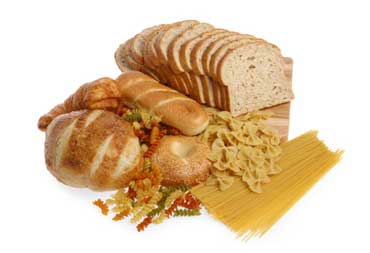
Which biomolecule is found in pasta and bread?
a)
Lipid
b)
Protein
c)
Nucleic Acid
d)
Carbohydrate
2.
What biomolecule do enzymes belong to? 
a)
Carbohydrate
b)
Lipid
c)
Nucleic Acid
d)
Protein
3.
Which biomolecule is a main source of quick energy?
a)
Nucleic Acid
b)
Protein
c)
Lipid
d)
Carbohydrate
4.
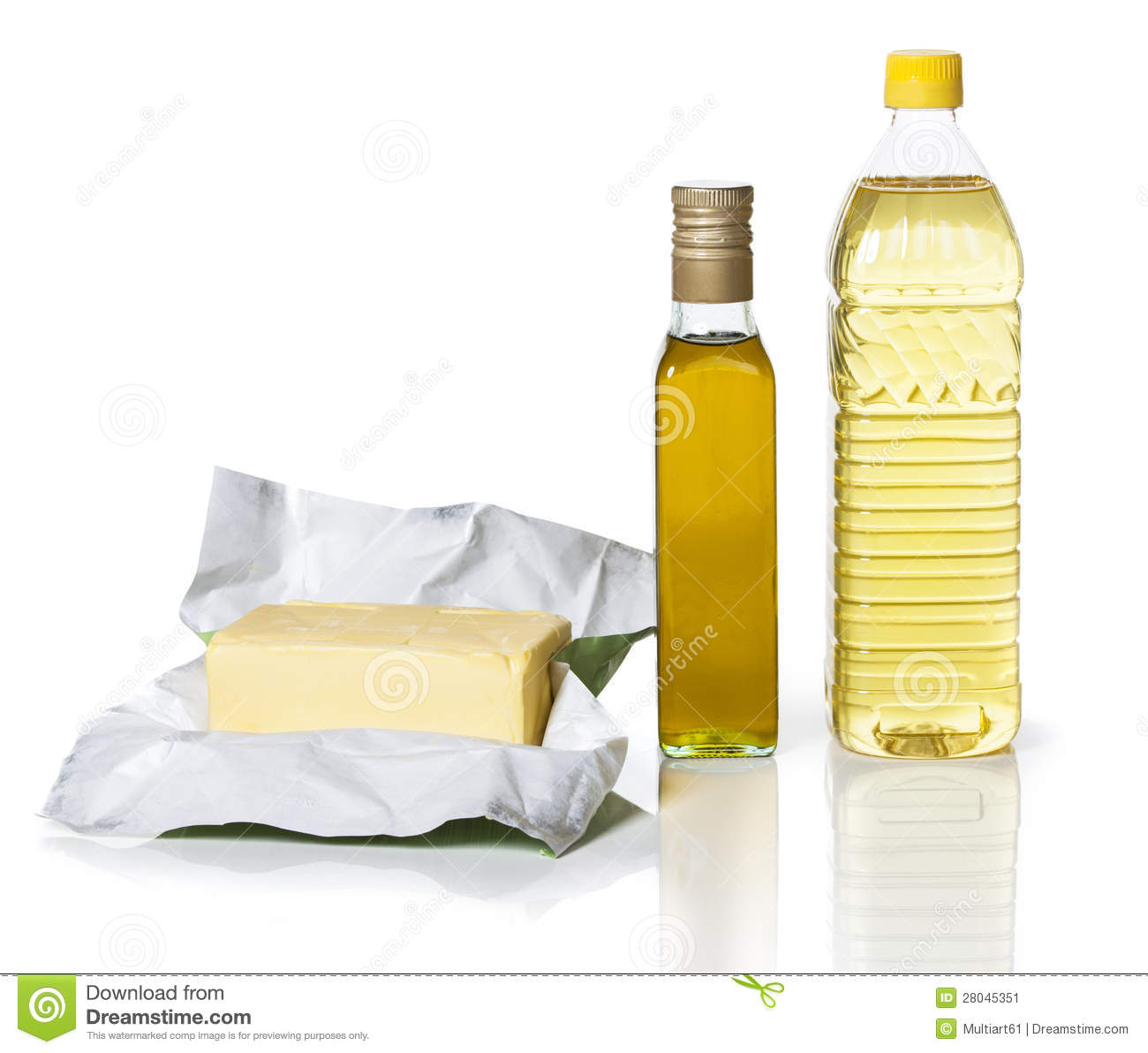
Which biomolecule is found in fats, oils, and waxes and is a source of long-term energy
a)
Proteins
b)
Nucleic Acid
c)
Lipids
d)
Carbohydrate
5.
What is the function of a nucleic acid?
a)
Stores genetic information
b)
Stores energy
c)
Quick source of energy
d)
Builds structures
6.
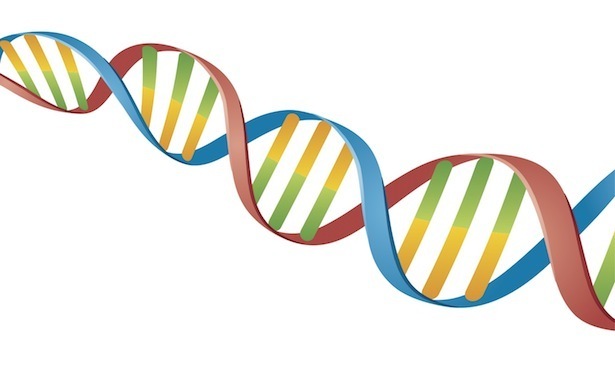
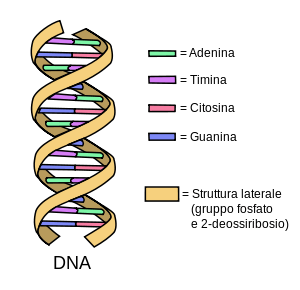
Which biomolecule is made of nucleotides and contain you DNA?
a)
Carbohydrate
b)
Lipids
c)
Protein
d)
Nucleic Acid
7.

Which biomolecule helps form muscles?

a)

Nucleic Acid

b)

Carbohydrate

c)

Protein

d)

Lipids

8.
Which biomolecule is responsible for insulation and energy storage?
a)
Protein
b)
Nucleic Acid
c)
Lipid
d)
Carbohydrate
9.
Which biomolecule has sugars and starches?
a)
Lipids
b)
Proteins
c)
Carbohydrates
d)
Nucleic Acid
10.
What type of molecule is this?
a)
Nucleic acid
b)
Protein
c)
Carbohydrate
d)
Lipid
11.
A monomer is ...
a)
a single atom
b)
a building block for polymers
c)
a single element
d)
is an inorganic molecule
12.
Enzymes are considered to be 
a)
Lipids
b)
Carbohydrate
c)
Protein
d)
Nucleic Acid
13.
What is the purpose  of an enzyme?
a)
give permission for the reaction
b)
raise activation energy
c)
speed up reactions
d)
control how many reactions occur
14.
The waxy, organic substances used by aquatic birds to coat their feathers, when analyzed consists mostly of 
a)
lipids
b)
proteins
c)
carbohydrates
d)
nucleic acids
15.
The arrangement of which three components is used to distinguish one molecule from another?
a)
carbon, hydrogen, and oxygen
b)
glucose, fructose, and ribose
c)
peptide, fatty acid, and purine
d)
water, carbon dioxide, and notrogen
16.
What are the four biological molecules?
a)
proteins, carbohydrates, lipids, nucleic acids
b)
A, T, C, G
c)
water, air, earth, and fire
d)
Joe, Nick, and Kevin Jonas
17.
Which biomolecule are in starches and fibers?
a)
Lipid
b)
Protein
c)
Nucleic Acid
d)
Carbohydrate
18.
Proteins don't have specific shapes.
a)
True
b)
False
19.
Once an enzyme does it's work, the enzyme is ___________.
a)
destroyed
b)
unchanged
c)
duplicated
d)
changed
20.
A balance that an organism maintains by regulating what goes into and out of the cell.
a)
Hypertonic
b)
Homeostasis
c)
Plasmolysis
d)
Hypotonic
21.
The type of cellular transport that requires no energy.
a)
Active Transport
b)
Protein Pumps
c)
Passive Transport
d)
Endocytosis
22.
What condition occurs when too much water moves into the cell and the cell membrane bursts?
a)
Plasmolysis
b)
Exocytosis
c)
Endocytosis
d)
Cytolysis
23.
The process of engulfing food or liquid particles into the cell.
a)
Osmosis
b)
Exocytosis
c)
Endocytosis
d)
Diffusion
24.
Which type of cellular transport moves molecules from low concentrations to high concentrations?
a)
Osmosis
b)
Diffusion
c)
Passive Transport
d)
Protein Pumps
25.
The release of large particles, often waste materials from the inside of the cell to the outside of the cell.
a)
Osmosis
b)
Exocytosis
c)
Endocytosis
d)
Diffusion
26.
What type of solution has more solutes and less water than a cell that it contains?
a)
Isotonic
b)
Hypertonic
c)
Hypotonic
d)
None of the Above
27.
What happens to a plant cell that is placed into a hypotonic solution?
a)
It shrinks
b)
Plasmolysis
c)
It swells
d)
Cytolysis
28.
A cell with a 5% salt solution is placed into a beaker with a 10% salt solution.  This solution is considered to be _____ to the cell.
a)
Isotonic
b)
Hypertonic
c)
Hypotonic
d)
None of the Above
29.
A cell with a 5% salt solution is placed into a beaker with a 10% salt solution.  What will happen to the cell?
a)
It will shrink
b)
It will swell
c)
No change
d)
Cytolysis
30.
This picture represents what type of cell transport?
a)
endocytosis
b)
exocytosis
c)
osmosis
d)
passive transport
31.
Osmosis is the movement of _____ across a membrane.
a)
food
b)
energy
c)
oxygen
d)
water
32.
Which is true about active transport?
a)
It requires energy
b)
it does not require energy
c)
It moves substances down the concentration gradient
d)
it moves material from high to low concentration
33.
Molecules diffusing with the concentration gradient through a protein channel is...
a)
Facilitated Diffusion
b)
Simple Diffusion
c)
Active Transport
d)
Osmosis
34.
In a nerve cell, ATP energy is used to pump sodium (Na) out of the cell and potassium (K) into the cell. This is an example of...
a)
Facilitated Diffusion
b)
Simple Diffusion
c)
Active Transport
d)
Osmosis
35.
This cell organelle helps organisms maintain homeostasis by controlling what substances may enter or leave cells.
a)
vacuole
b)
nucleus
c)
cell membrane
d)
cell wall
36.
The cell below is in a _________ solution.
a)
Hypotonic
b)
Hypertonic
c)
Isotonic
37.
The cell below is in a _____________ solution.
a)
Hypertonic
b)
Hypotonic
c)
Isotonic
38.
A cell in an isotonic solution will
a)
swell
b)
shrink
c)
stay the same size
d)
impossible to tell
39.
During pinocytosis, the cell takes in liquids. 
a)
True
b)
False
40.
What type of transport is this?
a)
facilitated diffusion
b)
active transport
c)
diffusion
d)
osmosis
41.
A cell will __________________ in a hypotonic solution.
a)
swell and perhaps burst (lyse)
b)
shrink
c)
the size of the cell will not change
d)
the size of the cell will change from large to small and from small to large
42.
Two examples of passive transport are
a)
Earth and Sun
b)
Diffusion and Osmosis
c)
Energy and Wind
d)
None of the above
43.
What is homeostasis?
a)
How the body releases oxygen
b)
Passive transportation 
c)
How the body regulates itself for survival
d)
Active transport
44.
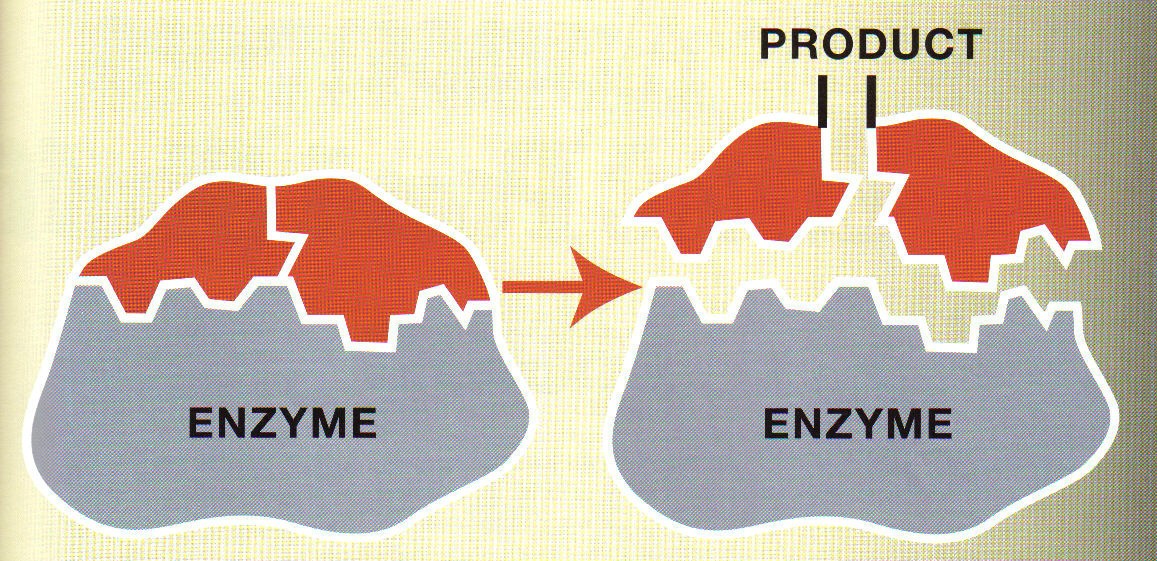
What is a substance called if it speeds up a chemical reaction?
a)
reusable
b)
catalyst
c)
specific
d)
fragile
45.
With what 3 letters do enzymes typically end?
a)
-ose
b)
-ase
c)
-ese
d)
-tic
46.
Any substance that is acted upon by an enzyme is called a(n)?
a)
Coenzyme
b)
Substrate
c)
Vitamin
d)
Polypeptide
47.
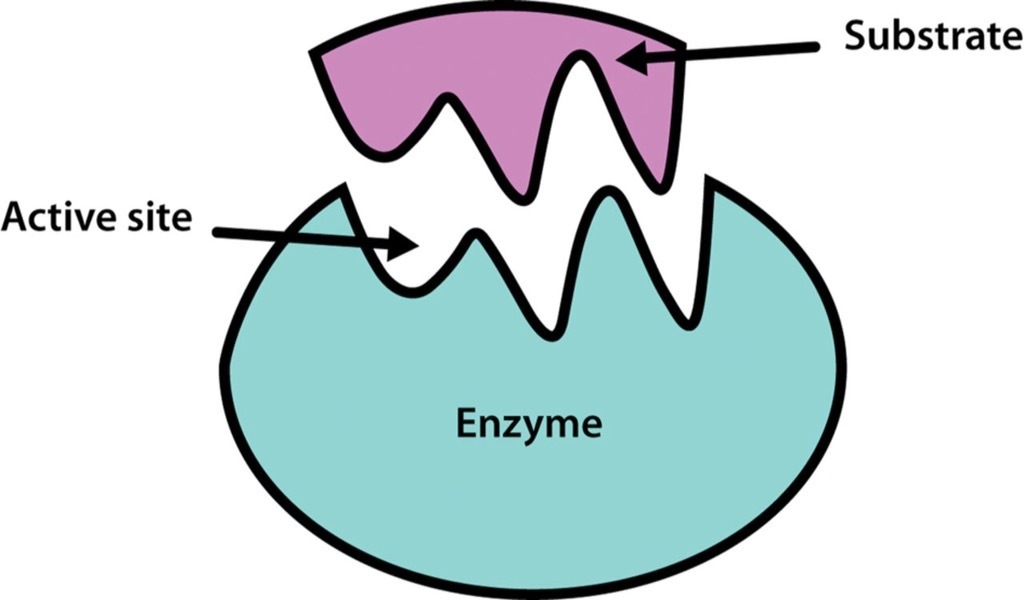
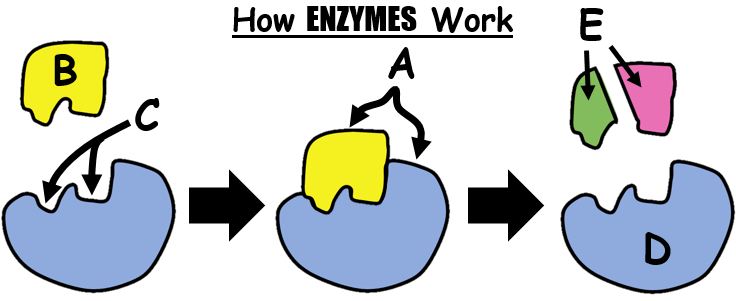
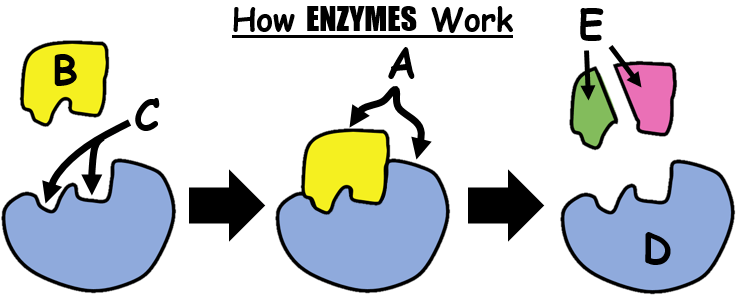
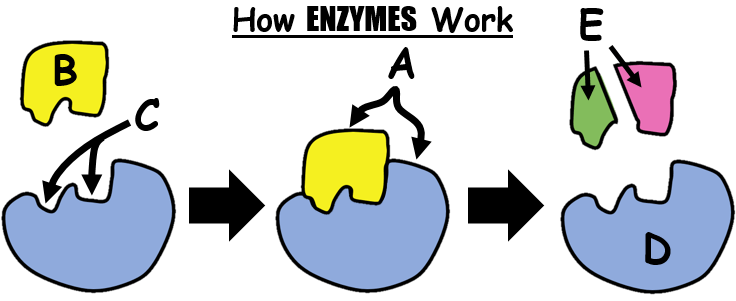
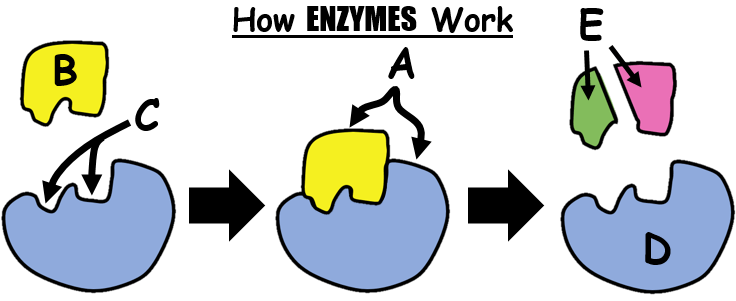
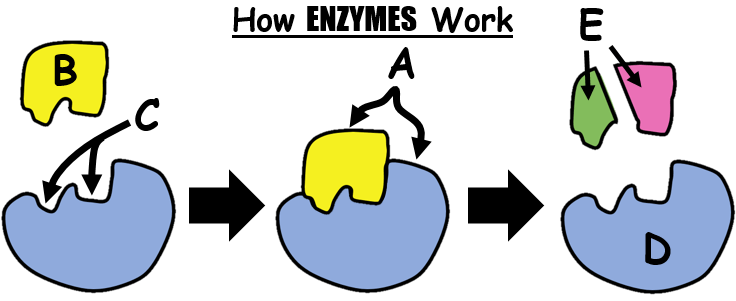
In the diagram, what is letter A? 
a)
product
b)
substrate
c)
enzyme-substrate complex
d)
active site
48.
Enzymes are...
a)
nucleic acids
b)
proteins
c)
lipids
d)
carbohydrates
49.
An enzyme speeds up a chemical reaction in the cell but can only be used once.  True or False? 
a)
true
b)
false
50.
Which of these is most likely an enzyme?  
a)
Sucrose
b)
Galactose
c)
Fructose
d)
Amylase
51.
Enzymes speed up reaction rates by changing...
a)
Activation Energy
b)
pH
c)
Hydrogen Bonds
d)
Kinetic Energy
52.
Letter D...
a)
active site
b)
enzyme
c)
substrate
d)
products
53.
Letter B...
a)
active site
b)
enzyme
c)
substrate
d)
products
54.
Letter C...
a)
active site
b)
enzymes
c)
substrate
d)
products
55.
Letter E...
a)
active site
b)
enzyme
c)
substrate
d)
products
56.
Which enzyme is most efficient in a basic solution?
a)
A
b)
B
57.
Enzymes are capable of increasing the rate of a chemical reaction within a living cell.  Enzymes accomplish this through which of the following means?
a)
reducing the number of products   
b)
reducing the activation energy
c)
increasing the temperature of the cell
d)
increasing the concentration of reactants 
58.
Each enzyme only has 1 substrate that will fit its active site.  What is this called?
a)
reusable
b)
catalyst
c)
specific
d)
fragile
59.
Where do substrates bind on an enzyme?
a)
voltage-gated channels
b)
surface receptor
c)
calcium channels
d)
active site
60.
What is structure A?
a)
Substrate
b)
Active site
c)
Enzyme
d)
Products
61.
What is the name for the mechanism of enzyme activity?
a)
Lock and key
b)
jigsaw puzzle
c)
hammer and nail
d)
two hands pattern
62.
At 40 degrees Celsius, your biological enzymes will...
a)
Functional optimally
b)
Denature
c)
Wait until the temp. increases
d)
Wait until the temp. decreases
63.
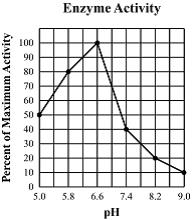
Which of the following conclusions can be drawn from this graph?
a)
The optimum pH of the enzyme is 6.6.
b)
The optimum pH of the enzyme is 5.8
c)
The enzyme’s activity increases as pH increases 5.0 to 9.0
d)
The enzyme’s activity is greater around pH of 8.0 .
64.
What makes an enzyme substrate specific?
a)
Size
b)
Shape
c)
Name
d)
Location it is found in
65.
A group of similar types of cells that work together to do a specific job is called a/an _____.
a)
tissue
b)
organ
c)
stem cell
d)
organ system
66.
A group of different tissues working together to do a job is called a/an _____.
a)
tissue
b)
organ
c)
stem cell
d)
organ system
67.
A group of different organs working together to do a series of jobs is called a/an _____.
a)
tissue
b)
organ
c)
stem cell
d)
organ system
68.
What is the correct order of organization
a)
tissues-cells-organs-organ systems-organism
b)
cell-tissue-organs-organ systems-organism
c)
organism-cells-tissues-organ systems-organism
d)
tissues-cells-organs-organ sytems-organism
69.
When many organ systems work together it can form...
a)
organ
b)
cells
c)
organ system
d)
organism 
70.
The ___________ is the basic unit of life
a)
organ
b)
cell
c)
atom
d)
tissue
71.
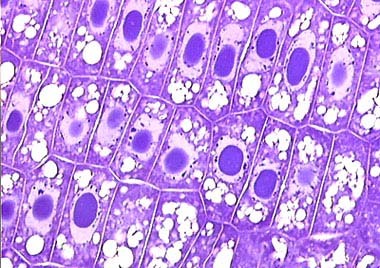
This is a example of ........
a)
cell
b)
tissue
c)
organ 
d)
organ system
72.
This is a example of ........
a)
cell
b)
organ system
c)
organ
d)
tissue
73.
This is a example of ........
a)
organ
b)
organ system
c)
tissue
d)
cell
74.

Which of the following is not under the Cell Theory?

a)

Cells are the basic unit of life

b)

All organisms are made up of cells

c)

Cells came from other cells

d)

A cell is an indestructible particle

75.

What is the full name of DNA?

a)

Departmental Network Administrator

b)

Does Not Apply

c)

Deoxyribonucleic Acid

d)

Ribonucleic Acid

76.

What is a unique characteristic of the plasma (cell) membrane?

a)

Semipermeable

b)

Rigid

c)

Jelly-like

d)

Orange

77.

What is the name of this organelle?

a)

Mentos

b)

Mitochondrion

c)

Chlorophyll

d)

Chloroplast

78.

Which type of cell is this?

a)

Prokaryote

b)

Eukaryote

79.
What type of cell has a nucleus? 
a)
eukaryotic
b)
prokaryotic 
80.
Plants and animal cells are examples of ___ cells 
a)
prokaryotic cells 
b)
eukaryotic cells 
81.

Which type of cells has a chloroplast?

a)

Prokaryote

b)

Plant Cell

c)

Animal Cell

82.

All of the following contain a cell wall except:

a)

prokaryotes

b)

animal cells

c)

plant cells

d)

bacteria

83.

Prokaryotic cells do not have…….

a)

membrane bound organelles

b)

cell membrane

c)

DNA or RNA

d)

life

84.
This is a picture of:
a)
Prokaryote
b)
Eukaryote
85.
Which of the following is not a characteristic of a Prokaryotic cell?
a)
unicellular
b)
floating DNA
c)
very small
d)
complex
86.

Bacteria are considered what?

a)

Eukaryotes

b)

Prokaryotes

87.

Prokaryotes do NOT have....

a)

membrane bound organelles

b)

DNA or RNA

c)

Cell membrane

d)

Life

88.
What do viruses need to reproduce?
a)
they need genetic material
b)
They need a host cell
c)
They need  bacteria
d)
They need insulin
89.
How does a virus cause a person to develop the common cold?
a)
invades the host cell to reproduce
b)
removes energy from the host cell
c)
produces toxins in the host cell
d)
protects the host cell from bacteria
90.
A virus can be classified by its type of
a)
mitochondria
b)
chromosomes
c)
nucleic acid
d)
carbohydrates
91.
A(n) _____ is a virus that enters a bacterial cell.
a)
endospore
b)
decomposer
c)
plasmid
d)
bacteriophage
92.
When a virus invades a living cell, its _______
takes over the cell's functions.
a)
outer coat
b)
genetic material
c)
core
d)
cytoplasm
93.
Antibiotics kill viruses
a)
True
b)
False
94.
What part of a virus is the protein capsule that houses the genetic material (DNA/RNA)?
a)
tail
b)
nucleus
c)
capsid
d)
glycoprotein
95.
Which viral life cycle kills its host cell by lysing?
a)
lytic
b)
mitosis
c)
lysogenic
d)
S phase
96.
Which viral life cycle allows viral genetic material to lay dormant while the host cell reproduces?
a)
lytic
b)
mitosis
c)
lysogenic
d)
S phase
97.
Which of these is an animal virus?
a)
Tobacco mosaic virus
b)
bacteriophage
c)
influenza
98.
Which of these is a plant virus?
a)
tobacco mosaic virus
b)
bacteriophage
c)
influenza
d)
polio
99.
Is a virus considered living or non-living?
a)
Living
b)
Non-Living
c)
Neither
100.
What is a host?
a)
Organism that lives on the cell and causes it harm 
b)
Something that causes harm to the cell 
c)
Cell that the virus invades and takes over
101.
What is the first step of the virus reproduction cycle?
a)
The viruses genetic material (DNA) starts to take over the functions of the cell
b)
The host cell bursts open, releasing the new viruses
c)
The virus injects its genetic material into the cell
d)
A virus attaches to the surface of a host cell
102.
What is the last step in the viral reproduction cycle?
a)
A virus attaches to the surface of a host cell
b)
The proteins and genetic material start to assemble in the cell
c)
The host cell bursts open, releasing the new viruses
d)
The virus injects its genetic material into the cell
103.
Which is bigger, a bacteria or a virus?
a)
Bacteria
b)
Virus
104.
Which of the following helps prevent the spread of infectious diseases?
a)
Surgery
b)
Medication
c)
Vaccines
105.
Reasons that viruses are considered to be nonliving is because
a)
They are not cellular
b)
They cannot reproduce on their own
c)
They cannot make proteins
d)
all of the above
106.
What is a way to become immune to a disease without first having the disease?
a)
antibiotics
b)
Anti-retroviral drugs
c)
Vaccinations
d)
Exposure Therapies
107.
A(n) _____ is a virus that enters a bacterial cell.
a)
endospore
b)
decomposer
c)
plasmid
d)
bacteriophage
108.
Why do doctors suggest people get a flu vaccine every year?
a)
Flu viruses replicate more rapidly over time
b)
Flu viruses can mutate from year to year
c)
Vaccines are absorbed by the body after a year
d)
Vaccines get stronger over time
109.
Which can be treated with antibiotics?
a)
Virus
b)
Bacteria
c)
Mutagen
d)
Parasite
110.
Viruses are found in _____.
a)
air
b)
water
c)
soil
d)
all of these
111.
Virus is latin for 
a)
disease
b)
illness
c)
bacteria
d)
poison 
112.
Which of the following is one important difference between a virus and a bacterial cell?
a)
a virus is much larger in size than a bacterial cell
b)
a virus always causes more severe disease than a bacterial cell
c)
a virus can never reproduce on its own, but a bacterial cell can
d)
a virus does not contain genetic material, but a bacterial cell does
113.
This is the organelle that does photosynthesis.
a)
Chloroplast
b)
Mitochondria
c)
Ribosomes
d)
Nucleus
114.
This is the organelle that does Cellular Respiration.
a)
Chloroplast
b)
Mitochondria
c)
Ribosomes
d)
Nucleus
115.
This is energy for the cell.
a)
ATP
b)
Glucose
c)
Granum
d)
ATP Synthase
116.
What are the products of photosynthesis?
a)
Carbon dioxide and water
b)
Carbon dioxide and oxygen
c)
Glucose and oxygen
d)
Glucose and water
117.
Which gas is removed from the atmosphere during photosynthesis?
a)
hydrogen
b)
oxygen
c)
nitrogen
d)
carbon dioxide
118.
Which of the following best describes photosynthesis?
a)
Photosynthesis converts radiant energy into chemical energy.
b)
Photosynthesis produces carbohydrates.
c)
Plants need sunlight, carbon dioxide, water, nutrients, and chlorophyll to complete photosynthesis.
d)
Plants use chlorophyll, water, and carbon dioxide to make sugar.
119.
What gas is released by plants during photosynthesis?
a)
sulfur
b)
carbon dioxide
c)
oxygen
d)
hydrogen
120.
How can photosynthesis be related to cellular respiration?
a)
What's produced by one is needed for the other
b)
They both produce the same products
c)
They both have the same reactants (need the same things)
d)
These 2 processes have nothing in common
121.
Why is photosynthesis important?
a)
creates oxygen for animals to breath
b)
creates energy for heterotrophs to use
c)
creates food for plants to use
d)
all of these are correct
122.
Where does carbon dioxide enter plants?
a)
The leaves
b)
Stem
c)
Roots
123.
Why do plants go through photosynthesis?
a)
To make food for us
b)
To make food for themselves
c)
They're bored and have nothing else to do
124.
The main source of energy for all life comes from ____.
a)
the Earth
b)
the moon
c)
the sun
d)
the food we eat/make
125.
Where does a plant absorb the water that it uses during photosynthesis?
a)
Leaves
b)
Stem
c)
Roots
d)
Petals
126.
The diagram below shows the relationship between photosynthesis and cellular respiration and the organelles in which they occur.Which statement describes how photosynthesis and cellular respiration are interrelated?
a)
 Oxygen is produced during cellular respiration and stored during photosynthesis.
b)
Carbon dioxide and water released by cellular respiration are used in photosynthesis.
c)
Photosynthesis releases the energy that is stored during the process of cellular respiration.
d)
 Glucose is used during cellular respiration to produce food that is broken down during photosynthesis.
127.
How are cellular respiration and photosynthesis related, in terms of energy?
a)
The energy captured in photosynthesis is used to power cellular respiration.
b)
The energy transformed in cellular respiration is used to power photosynthesis.
c)
Photosynthesis and respiration perform the same task in terms of energy transformation.
d)
Energy is not involved in either photosynthesis or cellular respiration.
128.
What is the correct equation for cellular respiration?
a)
6O2 + C6H12O6 -> 6CO2 + 6H2O + Energy
b)
6O2 + C6H12O6 + Energy -> 6CO2 + 6H2O
c)
6CO2 + 6H2O -> 6O2 + C6H12O6 + Energy
d)
6CO2 + 6H2O + Energy -> 6O2 + C6H12O6
129.
Cellular Respiration's goal is to
a)
make water
b)
make ATP
c)
make glucose
d)
make  oxygen
130.

Select all that are inputs for Photosynthesis.

a)

Water

b)

Carbon Dioxide

c)

Oxygen

d)

Sunlight (Light Energy)

e)

Glucose (Sugar/food)

131.

Select all that are outputs of Photosynthesis.

a)

Water

b)

Carbon Dioxide

c)

Oxygen

d)

Sunlight (Light Energy)

e)

Glucose (Sugar/food)

132.

Select all that are outputs of Cellular Respiration.

a)

Water

b)

Carbon Dioxide

c)

Oxygen

d)

ATP (Cellular Energy)

e)

Glucose (Sugar/food)

133.

Select all that are inputs for Cellular Respiration.

a)

Water

b)

Carbon Dioxide

c)

Oxygen

d)

Sunlight (Light Energy)

e)

Glucose (Sugar/food)

134.

BTB was used to indicate the amount of carbon dioxide present in the test tubes. A plant was placed in each test tube. The test tube on the left was placed in the dark and the one on the right was in the light. Which of the following best explains the results?

a)

The solution in the right test tube became more blue because the algae was doing more photosynthesis and using carbon dioxide.

b)

The solution in the right test tube became more blue because the algae was doing more photosynthesis and producing carbon dioxide.

c)

The solution in the right test tube became more blue because the algae was only doing cellular respiration and producing carbon dioxide.

d)

The solution in the right test tube became more yellow because the algae was only doing cellular respiration and using carbon dioxide.

135.

If the amount carbon dioxide is increased what happens to the rate of photosynthesis?

a)

it increases

b)

it decreases

c)

it doesn't change

d)

it is not affected

136.

If the amount of glucose is increased for an animal cell, what will happen?

a)

the cell will produce less ATP

b)

the cell will produce no ATP

c)

the cell will produce more ATP

d)

the cell will produce the same amount of ATP