
 Worksheets
CA #3- Semester Review
Total questions: 130
Worksheet time: 3hrs 16mins

Lactose is found in milk products. It is converted by the body into a usable form in a series of chemical reactions. The diagram shows the series of reactions that convert lactose into a usable form. If Enzyme 2 is denatured, the levels of which substance will increase?
Lactose
Galactose
Galactose -1-phosphate
Glucose - 6 - phosphate
Enzymes are proteins that help increase the rate of chemical reactions inside cells. Which of the following suggests that the shape of an enzyme determines the enzyme's function?
Enzymes are specific to a substrate.
Enzymes can operate in a wide range of conditions.
Enzymes are activated by neighboring molecules.
Enyzmes can be found in all life-forms.
Plants such as the Venus flytrap and the sundew attract and consume insects. These plants are able to produce substances which break down the insect into compounds that are useable by the plant. One element obtained from these compounds is nitrogen. The plants obtain much of their nitrogen from amino acids in the insects. Which of these chemical compounds are the source of the amino acids?
lipids
nucleic acids
proteins
carbohydrates
Which of the following biological molecules is correctly paired with on of the functions it primarily serves in living cells?
lipid - catalyze chemical reaction
carbohydrate - components of cytoskeleton
proteins - long term energy storage
nucleic acids - store genetic information
Starch is a complex carbohydrate which provides large amounts of energy as it is digested in the body. As starch is digested, it is broken apart into -
fatty acids
nucleotides
amino acids
sugars
A scientist removed the cell membranes from bacteria cells in a culture. She analyzed the cell membranes for specific molecules. Which of these was probably the most common type of molecule present in the bacteria cell membranes?
lipid
nucleic acid
amino acid
carbohydrate
Which of the following is the main reason that humans need to include carbohydrates in their diet?
Carbohydrates are broken down in the cells for energy.
Carbohydrates combine to form many different proteins.
Carbohydrates act as catalysts to speed up chemical reactions.
Carbohydrates are the building blocks for cell growth and repair.

According to the graph, addition of the enzyme amylase causes the reaction to -
slow down
speed up
give off heat
take in heat
Fats, oils, waxes, cholesterol, and hormones are good examples of what group of Biomolecules?
carbohydrates
lipids
proteins
nucleic acids
Which of the following are parts to the cell theory?
All living things are made of cells
Cells are the smallest unit of life
Cells can only come from other cells
There are many different types of cells
Main Component
Phospholipid
Serve as channels and pumps
Proteins
Serve as cell to cell communication
Carbohydrates
Serve to strengthen the membrane
Cholesterol
What is the only organelle that both Prokaryotes and Eukaryotes have?
Mitochondria
Vacuoles
Ribosomes
Lysosomes
Helps process proteins and transports them
Rough E.R.
Digests material in cell
Lysosome
Packages material for cell
Golgi Bodies
Produces steroids and detoxifies alcohol
Smooth E.R.
Provides support to the cytoplasm
Cytoskeleton
Produces ATP
Mitochondria
Creates chemical energy from light
Chloroplast
Stores water for photosynthesis
Large Central Vacuole
Provides rigid support for some cells
Cell Wall
Forms from endocytosis
Vesicle
Which of the following represents Osmosis


Which type of cell is this?
Prokaryote
Eukaryote

What is a STEM CELL?
Cells found in the stems of plants.
Cells that can differentiate into specialized cells.
Cells that control your genes to be expressed.
Cells that provide nutrients to your blood.
What does cell differentiation mean?
Process by which a cell absorbs nutrients.
Process by which a less specialized cell becomes a more specialized cell.
Process by which a specialized cell becomes a less specialized cell.
Process by which cells enter the cell cycle.
Cell differentiation is most directly regulated by...
ATP
DNA
Lipids
Sugars
True or False: Environmental factors, such as temperature, can affect gene expression.
True
False
Everything in your body is controlled by....
Chloroplasts
DNA
Cancer
Mitosis
What organelle performs photosynthesis (converting light energy into chemical energy, or glucose)?
Nucleus
Endoplasmic Reticulum
Chloroplast
Mitochondria
How are photosynthesis and cellular respiration related? (2 correct answers)
The products of photosynthesis are the reactants of cellular respiration.
The products of photosynthesis are the products of cellular respiration.
The products of cellular respiration are the reactants of photosynthesis.
The reactants of cellular respiration are the reactants of photosynthesis.
(a) equation: H2O ( (b) ) + CO2 ( (c) ) --> O2 ( (d) ) + C6H12O6 ( (e) )
(a) equation: O2 ( (b) ) + C6H12O6 ( (c) ) --> H2O ( (d) ) + CO2 ( (e) )
Match the following chemical formulas to their name:
carbon dioxide
CO2
oxygen
O2
glucose
C6H12O6
water
H2O

This is the equation is for? 6Co2 + 6H2O ----> C6 H12 O6 6O2
photosynthesis
cellular respiration

During which phase of the cell cycle does the cell spend the most time?
Mitosis
Cytokinesis
Interphase
Match the image to the correct answer

Prophase

Metaphase

Anaphase

Telophase

Cytokinesis
Label the parts of the Cell Cycle
G1
S phase
G2
Mitosis
Mitosis is the division of the (a)
Click where DNA replication takes place
Cytokinesis is the division of the (a)
How many phases does Mitosis have?
3
6
4
5
Match each phase with its correct description
Cell grows rapidly while carrying out normal functions.
G1 Phase
Cells must replicate their DNA before cell division to ensure that identical genetic information is passed to the next generation.
S Phase
FINISHES GROWING
Errors in DNA replication are checked- if something is wrong, cell needs to fix its errors before it divides!
G2 Phase
What are the THREE MAIN events in cell division
INTERPHASE
CYTOKINESIS
PHOTOSYNTHESIS
MITOSIS
What type of cells do we have the most of?
(a)
Put the Cell Cycle phases in order

Prophase

Metaphase

Anaphase

Telophase

Cytokinesis
Label the picture
Interphase
Prophase
Metaphase
Anaphase
Telophase
Cytokinesis
What happens during G2 phase
Cell grows rapidly
DNA replication
Checks for errors in DNA
Cell divides
What happens during G1 phase
Cell grows rapidly
DNA replication
Checks for errors in DNA
Cell divides
(a) is the uncontrolled growth of cells, often resulting in a tumor or mass of abnormal cells
What is the result of the cell cycle?
Three cells
Four daughter cells
2 identical cells
1 clone cell
Match the following for mitosis and meiosis.
PMAT happens once or twice
Mitosis & Meiosis
makes 4 genetically different cells
Meiosis
Sister Chromatids (already crossed over) pull apart
Anaphase 2 of Meiosis
Homologous Chromosomes pulled apart & Independent assortment
Anaphase 1 of Meiosis
makes 2 identical cells
Mitosis
2 diploid (2n) daughter cells form in what phase of Meiosis?
Telophase 2
Telophase/Cytokinesis 1
Anaphase 2
Cytokinesis 2
Which of the following are CORRECT observations about MITOSIS and MEIOSIS? (Check all that apply.)
Mitosis produces cells that identical to the parent cell.
Meiosis produces cells that have half the number of chromosomes as the parent cell.
All cells go through INTERPHASE as part of the cell cycle, whether it goes to mitosis or meiosis next.
In both types of cell division, the chromosomes are only duplicated once.
Only in Mitosis, do you see chromosomes pair up to form a tetrad.
how many chromosomes do human gametes have?
46
23
18
36

Crossing over usually occurs between:
Sister Chromatids
Homologous Chromosomes
Alleles
Non-Homologous Chromosomes
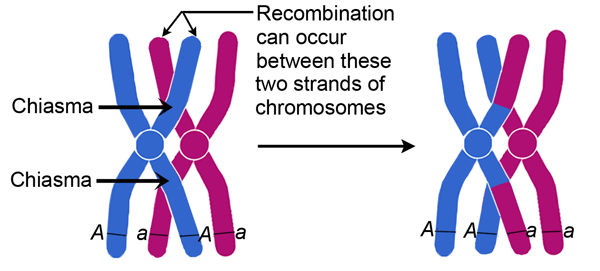

In which stage of MEIOSIS does crossing over occur? (The exchange of genetic material between chromosomes in a tetrad.)
Anaphase I
Metaphase I
Prophase I
Telophase I
How many chromosomes are in the somatic cells of humans?
46
23
42
26
IN WHICH OF THE FOLLOWING PICTURES ARE THE CHROMOSOMES CONDENSING AND THE SPINDLES FORMING?


ANAPHASE

TELOPHASE
(PLANT)

METAPHASE

TELOPHASE
(ANIMAL)

PROPHASE

Bacteria

Mitosis

Meiosis

Crossing over
Which of the following genotypes is homozygous recessive?
Tt
tt
TT
T
What does heterozygous mean?
An organism that has the same alleles for a trait (TT or tt)
An organism that has different alleles for a trait (Tt)
When neither allele is fully dominant; offspring is a mixture of both
the different forms of a trait (hair color--> brown, blonde, red
Physical characteristic or trait
phenotype
genotype
If a heterozygous parent and a homozygous recessive parent mate, what percentage of their offspring will be dominant?
25%
50%
75%
100%


B = brown fur b = white fur
In the punnett square, what is the probability for white fur?
0%
25%
50%
75%
What is genetic recombination?
The combination of genes produced by crossing over and independent assortment.
When genes located close to each other on the same chromosome tend to travel together during meiosis.
A map that shows the sequence of genes on a chromosome.
The occurrence of one or more extra sets of chromosomes.

Which organelle is the location where protein is made?
Ribosome
Nucleus
Cytoplasm
Nucleotide
During transcription, this type of ribonucleic acid is responsible for copying the DNA and brining it out of the nucleus.
tRNA
mRNA
rRNA
dRNA

mRNA occurs during this process
Translation
Transcription
Replication
Delivery
Which of the following is the complementary mRNA sequence to this DNA strand: AACTGAA
UUGACUU
TTGACTT
AACTGAA
AACUGAA

What brings the amino acids to the ribosome to assemble a protein?
DNA
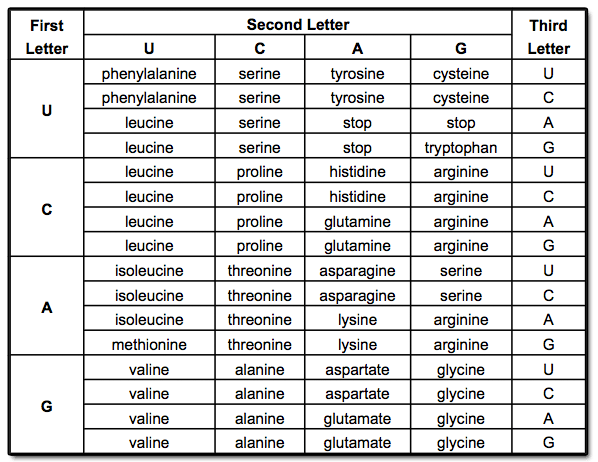

TRANSCRIBE this DNA sequence: TACGTTACT
AUGCAAUGA
ATGCAATGA
AUGGATUGA
TACGTTACT

Siamese cats have a gene for albinism, which blocks the transcription of the melanin protein in hair that causes dark color. However, the melanin protein is still expressed in areas of the cat like ears, feet, tail, and face, which have a lower body temperature than the cat's core. How is this color pattern possible?
Some cells in the Siamese cat just have a different gene for color than others.
Cells in the cat's feet, tail, etc. must mutate the gene for melanin.
The expression of the gene for albinism is controlled by temperature.
The gene for albinism changes as the cat gets older.
True or false, mutations create genetic variation?
True
False
If mutations occur in somatic (body) cells, they can be passed to off spring
True
False
A mutation is defined as:
A change in the cell's structure
Anything that changes in an embryo
Any change in the physical features of a human
A change in the DNA sequence
Which of the following is a type of mutation where a section of chromosome is flipped around?
insertion
deletion
inversion
translocation
A frameshift mutation is which of the following?
Point mutation
Insertion
Deletion
Subtitution
What mutation has occurred here?
T-G-A-C-C-A
T-G-A-G-C-A
Substitution
Deletion
Insertion
Frameshift
DNA molecule segment is : TTACGCAAG
The mutated DNA segment is TTCGCAAG. This is an example of ___ mutation.
Substitution
Deletion
Insertion
Inversion

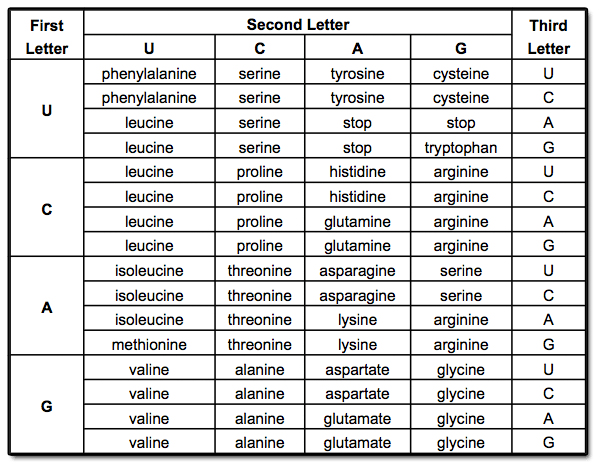
Which mutation will cause translation to stop?
Mutations 1 and 3 only
Mutation 1 only
Mutation 2 only
Muations 1, 2, 3

Part of a chromosome is repeated
Gene Mutation
Point Mutation
Deletion Mutation
Duplication Mutation

Part of a chromosome
is deleted
Deletion Mutation-Gene
Translocation
Deletion Mutation -Chromosomal
Crossing Over

(RRYY x rryy)
R = round seeds, r = wrinkled seeds Y = yellow seeds, y = green seeds
What percent will have Round and Yellow seeds?


A roan cow shows codominance in fur color (brown and white). What is the phenotype ratio expected in offspring a female roan and a male roan mate together?
All four would be brown and White
Half would be orange, half would be white
2 Brown: 2 Brown and White: 0 White
1 Brown: 2 Brown and White: 1 White

What is the genotype of individual IV – 2?
HH
HY
hh
Yh

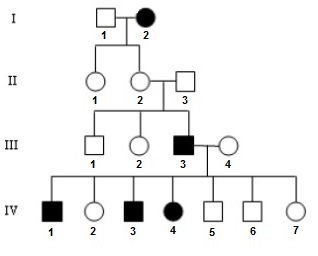

Cystic fibrosis is an autosomal recessive disease .
Study the pedigree what are the possible genotypes of #10? (more than one answer)
AA
Aa
aa
XAXa

The karyotype diagram below represents a human female with the genetic disorder known as Turner syndrome. Chromosomal analysis of this karyotype reveals the mutation is a result of
a missing X chromosome
a missing Y chromosome
an extra 21 chromosome
missing chromosome #9

The karyotype diagram below represents a human male. Chromosomal analysis of this karyotype reveals the abnormality in this karyotype is:
a missing X chromosome
a missing Y chromosome
an extra 21 chromosome
missing chromosome #9
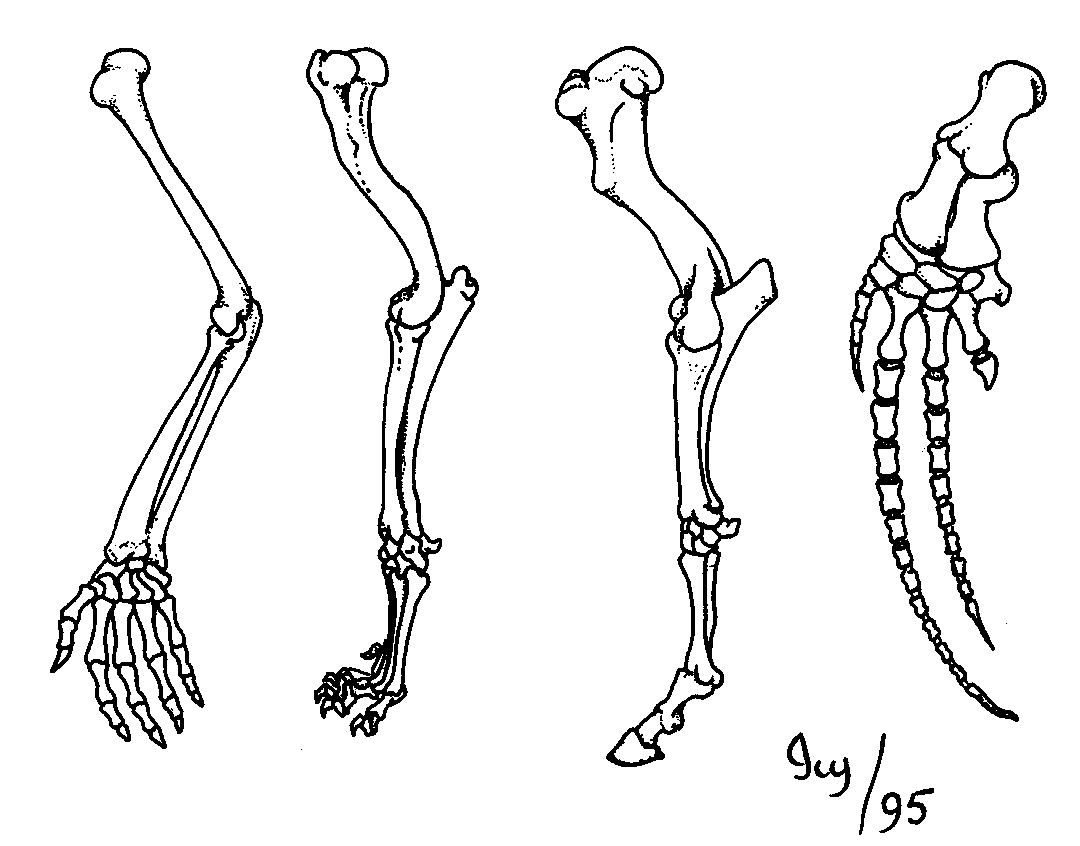


Vestigial structures
structures that perform a similar function but are not similar in origin
remnants of once-important structures that have slowly lost all or most of their function
features found in different organisms that share structural similarities but may have very different functions
preserved remains of an organism

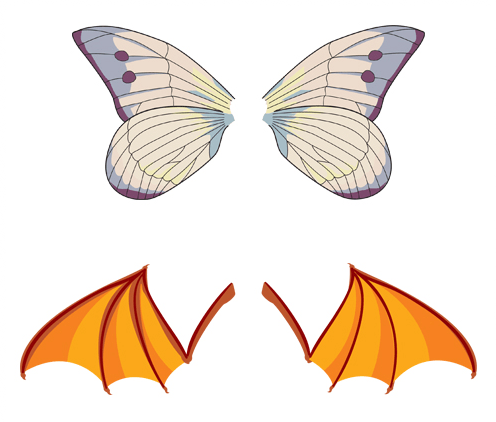
What is this an example of?
Homologous structure
Analogous structure
Vestigial organs
Functional adaption
Analogous Structure
Same function different structure
Homologous Structure
Same structure different function
Comparative Embryology
Comparing embryological development of different species
Biochemical Evidence
Comparing DNA and amino acid sequences of different species
Vestigial Structures
Structures in the body of an organism that no longer work.

What number is the common ancestor of C and D
1
2
3
4
What is is the study of how and why plants and animals live where they do?
Evolution
Adaptive Radiation
Biogeography
Biogeology
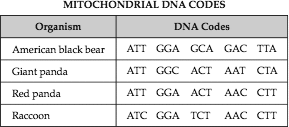
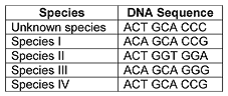
What conclusions can be made based on this table shown?
the American black bear and the giant panda are most closely related
the giant panda and the red panda are most closely related
the red panda and the racoon are the most closely related
the giant panda and the racoon are most closely related
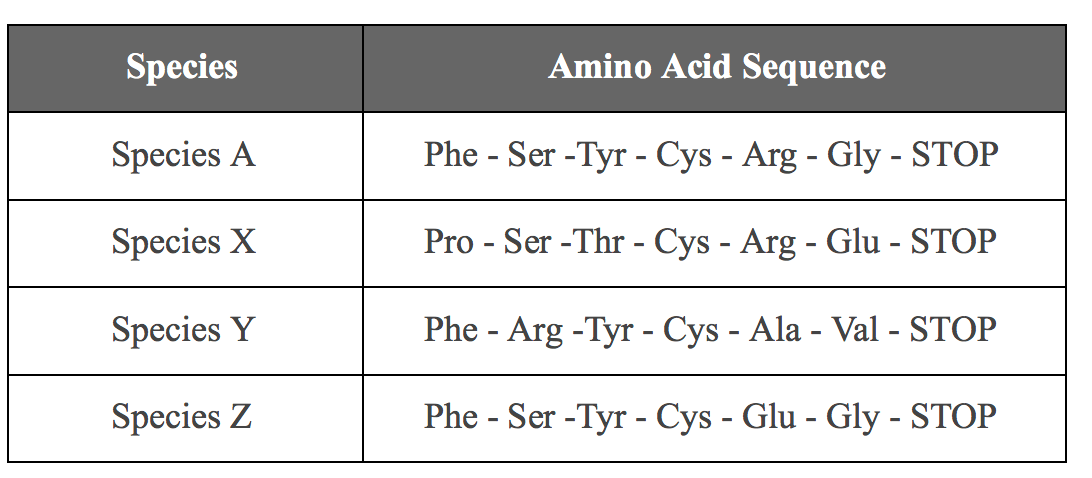
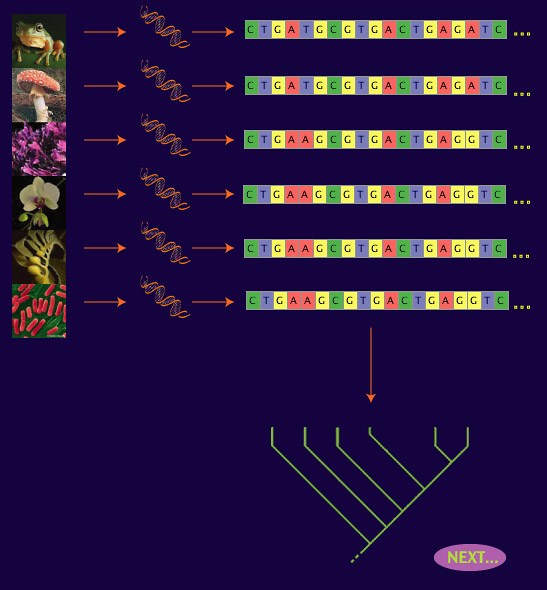
A scientist compares DNA taken from four different living species. Which of the following statements is true?
Species X evolved from Species Y.
Species A and Z share a recent common ancestor.
Species A and Species Y are the same.
Species Y and Species Z can interbreed.
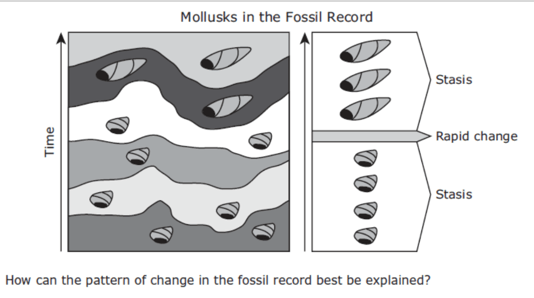
How can the pattern of change in the fossil record best be explained?
The mollusks were well adapted to their stable environment. A large, sudden change occurred in their environment. After the change the mollusks with the bigger shells were better adapted for the new environment.
The mollusks were well adapted to their stable environment. The mollusks hybridized with a smaller species of mollusk. A new species of mollusk with a bigger shell resulted.
The mollusks were not well adapted to their environment. The length of the mollusks' shells changed gradually over time. The mollusks in the original population that had small shells died over a period of many years.

