wayground logo

Free Printable Worksheets

Font size

S
M
L
XL
Worksheets

AQUATIC SCIENCE MID TERM FINAL REVIEW 2019

Total questions: 135

Worksheet time: 2hrs 3mins

Name
Class
Date
1.
Polar bears are ________ of penguins
a)
not a predator
b)
a major predator
2.
Water freezes at what temperature ?
a)
0o F
b)
100o C
c)
32o C
d)
0o C
3.
Water boils at what temperature?
a)
132o  F
b)
212o C
c)
100o C
d)
None of the above
4.
The ability of water to move through and around substances is called?  (Examples:  Water moving through a paper towel; water being transported from the roots to the top leaves of a tree.)
a)
Capillary action
b)
Cohesion action
c)
Concave action
d)
None of the above
5.
What enables a water strider to stand on the water?
a)
Adhesion
b)
Cohesion
c)
Surface Tension
d)
None of the above
6.
What word describes when water is attracted to other substances?
a)
cohesion
b)
adhesion
c)
capillary action
d)
surface tension
7.
The attraction that causes water and other liquids to form drops on thin films (like wax paper) is called ________________. This is also water’s ability to be attracted to other water molecules.
a)
adhesion
b)
capillary action
c)
cohesion
d)
surface tension
8.
Which is NOT a unique property of water?
a)
Frozen water floats on liquid water.
b)
Water covers most of the Earth’s surface and retains a large amount of heat.
c)
Water molecules stick to each other through hydrogen bonds.
d)
Water cools very rapidly.
9.
Water is a universal solvent because it...
a)
It can be found anywhere
b)
It freezes when it gets cold
c)
floats when frozen
d)
Dissolves most substances
10.
What do you call the land that water flows across, under, and through on its way to a body of water?
a)
Tributary
b)
River system
c)
Headwaters
d)
Watershed
11.
Biotic factors of a watershed are:
a)
Living
b)
Non-living
12.
An estuary has this kind of water:
a)
Salt
b)
Fresh
c)
Salt and Fresh
d)
None of the above
13.
The flow of water from rain, snow melt, or other sources over land.
a)
runoff
b)
drainage
c)
watersheds
d)
aquifer
14.
Which of these is an example of precipitation?
a)
snow
b)
air
c)
clouds
d)
vapor
15.
Which best explains why runoff is important?
a)
It returns water to other locations on Earth
b)
It increases the chance of flooding
c)
It makes evaporation occur faster
d)
It increases condensation
16.
What is it called when plants give off water vapor as a waste product?
a)
condensation
b)
evaporation
c)
sublimation
d)
transpiration
17.
What is the water cycle?
a)
the 3 forms of water
b)
the movement of water on, above, or below the surface of the Earth
c)
when water melts
d)
when clouds form
18.
Condensation creates-
a)
rain 
b)
clouds
c)
ice
d)
groundwater 
19.
In which step of the water cycle does water change from liquid to a gas?
a)
evaporation
b)
condenstation
c)
participation 
d)
accumulation 
20.
Condensation occurs when water vapor cools and changes from a 
a)
gas to a solid
b)
liquid to a gas
c)
gas to a liquid
d)
solid to a gas
21.
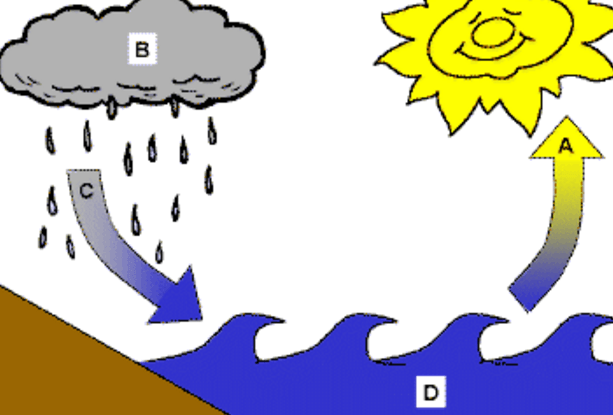
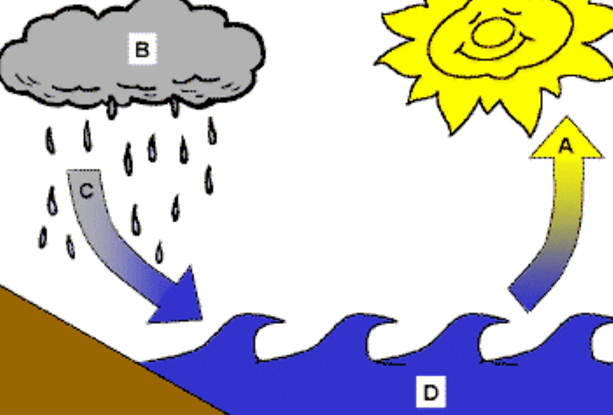
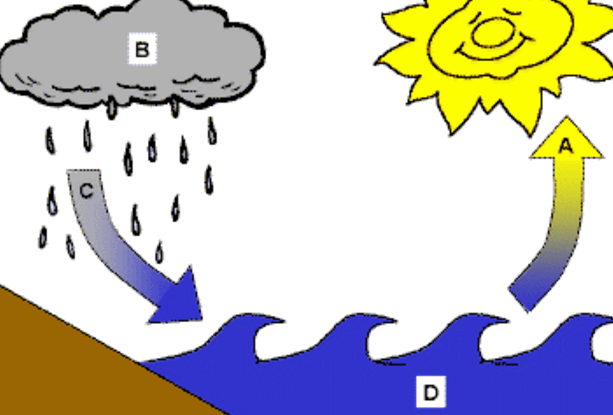
Letter B is representing what part of the water cycle? 
a)
Condenstation
b)
Evaporation
c)
Accumulation 
d)
Precipitation 
22.
Letter C is representing what part of the water cycle? 
a)
Condenstation
b)
Evaporation
c)
Accumulation 
d)
Precipitation 
23.
Letter A is representing what part of the water cycle? 
a)
Condenstation
b)
Evaporation
c)
Accumulation 
d)
Precipitation 
24.
What is the name of the plate boundary that slides past each other?
a)
Divergent
b)
Convergent
c)
Transform
d)
Mr. C the Slide Man
25.
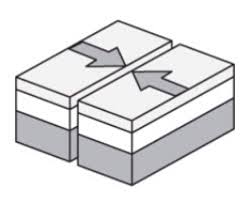
Name the boundary
a)
convergent boundary
b)
divergent boundary
c)
transform boundary
d)
sergent boundary
26.
The area around the pacific plate where boundaries form is called...
a)
death ring
b)
fire zone
c)
ring of fire
d)
zone of fire
27.
What was the name given to all the continents when they were joined as one super continent? 
a)
Supreme Continent
b)
Eurasia
c)
Plate tectonics
d)
Pangaea
28.
A divergent boundary occurs when plates ....
a)
Pull apart
b)
Come together
c)
Slide past each other
d)
subducting
29.
The theory of _______ states that Earth’s crust and upper mantle are broken into sections that are in constant, slow motion.
a)
plate tectonics
b)
continental drift
c)
seafloor spreading
d)
divergent boundaries
30.
Warm ocean currents generally come from
a)
The North Pole
b)
The South Pole
c)
The Equator
d)
Both A and B
31.
The Gulf stream carries _____________ water from the east coast of The United States to the West coast of Europe.
a)
Cold
b)
Warm 
c)
Freezing
d)
Fresh
32.
Two types of water currents are
a)
local and global
b)
sea and land
c)
surface and deep
d)
warm and cold
33.
What name is given to large, destructive waves caused by underwater earthquakes and volcanoes?
a)
Spring tide
b)
Longshore current
c)
Tsunami
d)
Swell
34.
Upwelling is associated with
a)
a decrease in access to nutrients for phytoplankton
b)
cooler, nutrient-rich waters being pushed up from deeper ocean waters
c)
temperature gradients moving water from the equator to the poles
d)
an increase in human fatalities
35.
Ocean currents have an affect on which two things
a)
climate and weather
b)
temperature and density
c)
land and sea
d)
equator and poles
36.
The huge pieces of the earth's crust are called ____________________________. 
a)
crust
b)
plates
c)
directions
d)
seismos
37.
This famous transform fault is located in the western United States creates significant earthquake activity for California
a)
New Madrid
b)
Denali Fault
c)
Ramapo Seismic Zone
d)
San Andreas
38.
Storm with sustained wind speeds of 74+ mph
a)
Thunder storm
b)
Tropical depression
c)
Tropical storm
d)
Hurricane
39.
NOT a location where hurricanes form
a)
Northern Atlantic Ocean
b)
Indian Ocean
c)
Pacific Ocean
d)
Gulf of Mexico
40.
What is usually the most damaging part of a hurricane?
a)
Eye
b)
Lightning
c)
Storm surge
d)
Hail
41.
A hurricane gets its energy from
a)
Warm ocean waters
b)
high air pressure
c)
winds along surface
d)
Sun
42.
Calmest winds of a hurricane
a)
Eye wall
b)
Eye
c)
Upper elevations
d)
Storm surge
43.
How many categories of hurricanes
a)
2
b)
3
c)
4
d)
5
44.
Why does cold water or land cause a hurricane to weaken?
a)
because the high pressure of the hurricane can't handle the cold water from a low pressure system
b)
because the land always cools faster than the ocean
c)
because the land breeze shreds the hurricane
d)
because they cut off the energy supply to the hurricane
45.
Where are the highest winds in the hurricane found?
a)
at the extreme outside, because they have to move faster the further they are from the middle
b)
in the center, called the eye of the hurricane
c)
in the storm surge of the hurricane
d)
in the eyewall of the hurricane
46.
What destroys a hurricane? 
a)
Strong vertical winds
b)
Cold water
c)
Movement over land
d)
All of the above
47.
Hurricane season goes from ______ 1st to _______ 30th
a)
June, October
b)
April, September
c)
June, November
d)
May, October
48.
What is the name of a hurricane in Asia?
a)
Cyclone
b)
Typhoon
c)
Bob
d)
Dennis
49.
What is the name of a hurricane in North America?
a)
Hurricane
b)
Typhoon
c)
Cyclone
d)
Tornado
50.
Which of the following was the deadliest hurricane in recorded history?
a)
Hurricane Ike 2008
b)
Hurricane Harvey 2017
c)
Galveston Hurricane of 1900
d)
Hurricane Katrina 2005
51.
The hurricane that caused the most damages in the US in billions of dollars was
a)
Galveston Hurricane of 1900
b)
Hurricane Ike 2008 at 29 billion
c)
Hurricane Harvey 2017
d)
Hurricane Sandy 2012
52.
This is called
a)
ecological succession
b)
abiotic factors
c)
niche partitioning
d)
biodiversity
53.
Ecology is.......
a)
Organisms and their environment
b)
Medical research
c)
Electricity
d)
Astronomy
54.
Diversity....or Biodiversity...
a)
The number of plants an animal eats
b)
The type of food an organism eats
c)
The way an organism reproduces
d)
The number of different species in an area
55.
Zooxanthelle  are found in 
a)
Kelp
b)
Sand
c)
Coral
d)
Deep Sea Volcanoes
56.
The nonliving aspects of an ecosystem.
a)
Abiotic factors
b)
Biotic factors
57.
Which level will contain plants?
a)
A
b)
B
c)
C
d)
D
58.
A living relationship between two species in which one organism is harmed is called...
a)
mutualism
b)
commensalism
c)
parasitism
d)
niche
59.
symbiotic relationship in which both organisms benefit
a)
competition
b)
Mutualism
c)
nitrogen fixation
d)
energy pyramid
60.
 A barnacle living on a whales skin..the whale is not harmed or affected
a)
commensalism
b)
mutualism
c)
parasitism
61.
An organism that lives by breaking apart dead organic matter into simpler parts is...
a)
scavenger
b)
consumer
c)
decomposer
d)
carnivore
62.
Autotrophs make up the _______ level in all ecosystems.
a)
First
b)
Second
c)
Third
d)
Fourth
63.
What is the original source of almost all energy in most ecosystems?
a)
carbohydrates
b)
sunlight
c)
water
d)
carbon
64.
What is made of the skeletons of small animals?
a)
intertidal area
b)
coral reef
c)
estuary
d)
Sargasso Sea
65.
Where have organisms adapted to keep from being swept away?
a)
intertidal area
b)
coral reef
c)
estuary
d)
Sargasso Sea
66.
The area that has warm, sunlit water and is where the ocean floor begins to slope downward is the
a)
intertidal zone
b)
neritic zone
c)
oceanic zone
d)
benthic zone
67.
The area that contains the deep water of the open ocean and is where the sea floor drops sharply is the
a)
intertidal zone
b)
neritic zone
c)
oceanic zone
d)
benthic zone
68.
The ocean floor, some parts of which get no sunlight, is the 
a)
intertidal zone
b)
neritic zone
c)
oceanic zone
d)
benthic zone
69.
The place where the ocean meets the land is the
a)
intertidal zone
b)
neritic zone
c)
oceanic zone
d)
benthic zone
70.
The base of the ocean's food chains is formed by
a)
blue whales
b)
plankton
c)
coral reefs
d)
sargassums
71.
Which factors limit the productivity of a marine ecosystem?
a)
availability of light and nutrients
b)
availability of nutrients and fresh water
c)
availability of light and chemosynthetic organisms
d)
availability of photosynthetic organisms and fresh water
72.
Which best describes the most abundant form of ocean life?
a)
fish
b)
algae
c)
microbes
73.
one organism kills and eats another
a)
mutualism
b)
commensalism
c)
parasitism
d)
predation
74.
both organisms need the same resources
a)
mutualism
b)
commensalism
c)
competition
d)
predation
75.
Coral reefs provide
a)
shelter
b)
tourism
c)
protection from storms
d)
all the above
76.
What percent of all the plants and animals in the ocean live around coral reefs?
a)
25 percent
b)
30 percent
c)
50 percent
d)
10 percent
77.
Who causes the most damage to coral reefs?
a)
Whales
b)
Fish
c)
Boats
d)
Humans
78.
What is a tiny individual coral animal?
a)
Polyps
b)
Crevice
c)
Atolls
d)
Erosion
79.
In warm tropical ocean ecosystems, all other life forms depend on which of the following:
a)
Coral
b)
Shrimp
c)
Algae
d)
Bacteria
80.
What type of organism are corals?
a)
Plants
b)
Animals
c)
Bacteria
d)
Fungi
81.
Arctic ecosystems are considered marine ecosystems because nearly all the_________ in this area comes from the ocean.
a)
Animals
b)
Food
c)
Snow
d)
Fresh water
82.
Which of the following is a factor that influences where an organism lives in an aquatic ecosystem?
a)
sunlight
b)
nutrient availability 
c)
temperature
d)
all of the above
83.
Bottom dwelling organisms.
a)
Plankton
b)
Fish
c)
Mammals
d)
Benthos
84.
Free swimming organisms
a)
Benthos
b)
Nekton
c)
Amoba
d)
Crustacean
85.
Organisms that cannot swim against current.
a)
Fish
b)
Plankton
c)
Crustacean
d)
Benthos
86.
In Antartic ecosystems, all animals depend on which species in the food chain? 
a)
Penguins
b)
Polar bears
c)
Krill
d)
Leopard seals
87.
Red mangroves 
a)
are much like normal trees thus growing well past the high tide line
b)
have their roots coming out of the trunk thus propping them up in the water
c)
have many roots poking out of the mud exposed to the air
d)
are a species of fish
88.
This is a
a)
white mangrove
b)
red mangrove
c)
black mangrove
d)
red cypress tree
89.

Example of carrying capacity: How many 1 inch fish can fit in a 10 gallon aquarium?

a)

20

b)

50

c)

10

d)

2

90.

Standing ankle deep at Surfside Beach, you are in the __________zone.

a)

oceanic

b)

benthic

c)

intertidal

d)

litoral

91.

By the orientation of the arowanas mouth, this species habitat is

a)

benthic

b)

at the surface

c)

living in the middle depth of rivers

d)

not enough information

92.

What invasive species is taking over our native Texas species? ( Hint: we REALLY REALLY hate them!!!! )

a)

kudzu

b)

Burmese pythons

c)

Fire ants

d)

mosquitos

93.
Why do goldfish need more gallons per fish than normal aquarium fish?
a)
Goldfish need 8-10 gallons per fish.
b)
They tend to be dirty and their bodies are fatter.
c)
Goldfish feed at the bottom of the tank.
94.
What are tiny organisms that float near the surface of the water?
a)
plankton
b)
organisms
c)
abiotic factor
d)
insects
95.
The _________ zone is the ocean floor.
a)
intertidal
b)
neritic
c)
oceanic
d)
benthic
96.
The deepest parts of the benthic zone do not get any _________.
a)
sunlight
b)
food
c)
fish
d)
chemicals
97.
Through evaporation, the ocean provides most of the water that makes up Earth's _____________.
a)
precipitation
b)
condensation
c)
evaporation
98.
An area where fresh water from streams and rivers spills into the ocean is called an _____________.
a)
plankton
b)
estuary
c)
sargassums
d)
coral reefs
99.
Where would you find cattails and reeds?
a)
Limnetic zone
b)
Littoral zone
c)
Profundal zone
d)
Benthic zone
100.
Which zone contains the most life in a lake or pond?
a)
Littoral zone around the shoreline
b)
Profundal zone in the deep and dark
c)
Benthic zone in the sediment
d)
Limnetic zone in the open lake as far as light reaches
101.
Plankton are NOT....
a)
top carnivores of pond food webs
b)
tiny, microscopic organisms
c)
easy prey for other aquatic life
d)
producers
102.
Which lake is the deepest in the world with its deepest point at 5,387 feet deep?
a)
Lake Baikal
b)
Lake Superior
c)
Lake Michigan
d)
Lake Tahoe
103.
Which of the following is NOT a biotic factor?
a)
Walrus
b)
Squid
c)
Salinity
d)
Algae
104.
Which of the following organisms pulls carbon from the atmosphere to make food?
a)
Dolphins
b)
Sharks
c)
Phytoplankton
d)
Fish
105.
Which of the following is the process of pulling CO2 form the atmosphere to make food?
a)
Photosynthesis
b)
Cellular Respiration
c)
Decomposition
d)
Nitrification
106.
When plants and animals die their bodies _______ and carbon atoms are returned to the atmosphere.
a)
Cellular Respiration
b)
Decomposition
c)
Nitrification
d)
Photosynthesis
107.

The picture shows a

a)

coral reef

b)

kelp forest

c)

open ocean

d)

estuary

108.

Adaptations for attachment and the ability to bend with the waves, as well as to protect against drying out, are part of organisms in this ecosystem:

a)

coral reef

b)

estuary

c)

rocky shore

d)

kelp forest

109.

This picture shows a(n)

a)

sandy beach

b)

open ocean

c)

kelp forest

d)

estuary

110.

The BIGGEST function of an estuary is providing

a)

salt products

b)

a nursery for baby organisms

c)

recreation

d)

most of the world's oxygen

111.

Which ecosystem provides most of the world's oxygen?

a)

kelp forest

b)

estuary

c)

coral reef

d)

open ocean

112.

In which ecosystem would we find barnacles, seastars, birds, mussels and seaweed?

a)

rocky shore

b)

kelp forest

c)

coral reef

d)

none of these

113.
WHEN A LEECH FEEDS OFF OF A LIVING ORGANISMS BLOOD IT IS CALLED...
a)
PREDATION
b)
COMPETITION
c)
PARASITISM
114.
WHEN SMALLER FISH EAT THE LEFTOVERS THAT FALL UNDER A SHARK AS THE SHARK EATS WE CALL THIS...
a)
MUTUALISM 
b)
COMMENSALISM
115.
WHICH STATEMENT ILLUSTRATES HOW HUMAN ACTIVITIES CAN CHANGE THE DIVERSITY OF AN ECOSYSTEM?
a)
GREENHOUSE EFFECT
b)
STRANGE WEATHER
c)
WATER POLLUTION
116.

True or false: dead zones can occur in both fresh and marine waters around the world.

a)

True

b)

False

117.

The Photic Zone (Sunlight Zone) houses 90% of life in our oceans. Why?

a)

Phytoplankton (base of the food chain) conducting phtosynthesis

b)

Apex predators (top of the food chain) consuming large marine organisms

c)

Most ocean life tends to float to the top layer of the ocean

d)

This is a great place for fish to hide from predators

118.

As saltwater evaporates in a tide pool what happens to the salinity level of that water?

a)

decreases

b)

stays the same

c)

increases

119.
The expulsion of zooxanthellae due to unfavorable conditions is called
a)
Exudation
b)
Bleaching
c)
Decalcification
d)
Denudation
120.
Where is the Great Barrier Reef located?
a)
Puerto Rico
b)
Florida
c)
Indonisia
d)
Australia
121.
Coral polyps eat zooxanthellae
a)
True
b)
False
122.
Why does photosynthesis not occur in the deep ocean? 
a)
Lack of nutrients
b)
Low oxygen levels
c)
Excess sunlight
d)
Sunlight does not penetrate
123.
The role or function or job of a species in a community.
a)
habitat
b)
diet
c)
niche
d)
ecosystem
124.
If the water bug population suddenly decreased dramatically, which organism would be effected immediately?
a)
Dragonfly
b)
Daphnia
c)
Tadpole
d)
Kookaburra
125.
a)
Producers
b)
Decomposers
c)
Omnivores
d)
Predators
126.

Where would you expect to find the coldest water?

a)

Abyssal Pelagic Zone

b)

Oceanic Zone

c)

Supratidal Zone

d)

Neritic Zone

127.

Upper part of the oceanic zone that receives light

a)

benthic zone

b)

photic zone

c)

aphotic zone

d)

neritic zone

128.

Lower part of the oceanic zone that receives NO light

a)

benthic zone

b)

photic zone

c)

aphotic zone

d)

neritic zone

129.

Zone that is made up of the entire ocean floor

a)

Neritic

b)

Photic

c)

Aphotic

d)

Benthic

130.

Which one of the following answer choices best describes Neritic Zone habitats that exists in cold, nutrient rich waters found in the Temperate Climate zone?

a)

Kelp Forests

b)

Coral Reefs

c)

Estuaries

d)

Freshwater Ecosystems

131.

Which one of the following answer choices best describe Neritic Zone habitats that exists Tropical Climate zone and has very high biodiversity?

a)

Kelp Forests

b)

Coral Reefs

c)

Estuaries

d)

Freshwater Ecosystems

132.

Which one of the following answer selections best describes the marine ecosystem found in the Marianas Trench?

a)

Intertidal Zone

b)

Neritic Zone

c)

Bathayal Zone

d)

Abyssal Zone

133.

A heterotrophic floating organism is:

a)

Nekton

b)

Krill

c)

Phytoplankton

d)

Zooplankton

134.

Which of the following pairs correctly links the organism with how it lives/moves in the ocean?

a)

nekton - bottom dwelling

b)

plankton - free swimming

c)

benthos - drifting

d)

nekton - free swimming

135.

When can you use your cell phone in class?

a)

When finished with work.

b)

Never ( or with permission )

c)

When you receive a text or call.

d)

During a test.