wayground logo

Free Printable Worksheets

NEW

Font size

S
M
L
XL
Worksheets

parts of a chemical reaction

Total questions: 58

Worksheet time: 2hrs 49mins

Name
Class
Date
1.
The reason we have so many materials in the world is because 
a)
there are so many elements.
b)
atoms rearrange and recombine to form new materials.
2.
A compound is made up of
a)
one or more different atoms.
b)
one or more atoms.
c)
one or more mixtures.
d)
one or more solutions.
3.
A molecule is made up of
a)
one or more mixtures.
b)
one or more compounds.
c)
one or more atoms.
d)
one or more solutions.
4.
The atom is made of three distinct parts. They are
a)
quarks, positrons, electrons
b)
neutrons, positrons, ions
c)
protons, neutrons, electrons
d)
solids, liquids, gases
5.
Which of these is a compound?
a)
Copper
b)
Carbon Dioxide
c)
Sodium
d)
Zinc
6.
Which of these is an element?
a)
Carbon
b)
Water
c)
Salt
d)
Sugar
7.
Jane shook, then opened a bottle of soda, and it fizzed over. Is this evidence of a chemical reaction?
a)
yes
b)
no
8.
The substances you put together in a chemical reaction and are on the left side of an equation are called
a)
products.
b)
reactants.
c)
elements.
d)
compounds.
9.
The substances you get in a chemical reaction and are listed on the right side of a chemical equation are called
a)
products.
b)
reactants.
c)
elements.
d)
compounds.
10.

How many Hydrogen atoms are in a molecule of water?

(H2O)

a)

0

b)

1

c)

2

d)

3

11.
A chemical equation that shows the same number of each kind of atom on both sides of the equation is said to be...
a)
Balanced
b)
Unbalanced
c)
An Incomplete Reaction
d)
A complete Reaction
12.
Anything that has mass and take up space is considered
a)
Matter
b)
Energy
c)
Chemisty
d)
Endothermic
13.
CaCOis an example of a chemical
a)
symbol
b)
formula
c)
subscript
d)
reaction
14.
An shorter way to show a chemical reaction , using symbols instead of words is called
a)
Chemical Equation
b)
Chemical Formula
c)
Symbol
d)
Subscript
15.
The substances listed on the left side of a chemical reactions are the
a)
Product 
b)
Coeffecients
c)
Precipitates
d)
Reactants
16.
When chemicals react with each other to make new chemicals, it's called _____
a)
a physical reaction
b)
a chemical reaction
c)
a chemical equation
d)
rusting
17.
Water is _____
a)
two parts O and one part H
b)
two parts H and one part O
c)
one part H and one part O
d)
two parts H and two parts O
18.
When electricity was run through water, and the gases were collected, there was _____
a)
the same amount of hydrogen and oxygen
b)
half as much hydrogen as oxygen
c)
twice as much oxygen as hydrogen
d)
twice as much hydrogen as oxygen
19.
What is the coefficient of the oxygen molecule in the elephant toothpaste equation?
2 H2O2 -> 2 H2O + O2
a)
0
b)
1
c)
2
d)
4
20.
What do you call the substances on the left side of a chemical equation?
a)
yield
b)
products
c)
reactants
d)
compounds
21.
Chose the correct labels for the parts of a chemical equation.
a)
reactants yield products
b)
reactants make compounds
c)
products equal reactants
d)
products yield reactants
22.
Based on the diagram, what is the formula for hydrogen peroxide?
a)
H2O12
b)
H2O2
c)
H4O10
d)
there is no way to determine the formula
23.
Which contains the greatest number of elements?
a)
5CH4
b)
Fe2O3
c)
C6H12O6
d)
C8H10N4O2
24.
How are chemical bonds formed?
a)
by sharing, giving, or taking electrons from another atom
b)
through radioactive decay
c)
by losing or gaining neutrons in the nucleus
d)
by exchanging protons with another atom
25.
Which is NOT an indicator of a chemical change?
a)
temperature change
b)
formation of a precipitate
c)
shape change
d)
production of light
26.
A subscript tells you...
a)
the # of atoms in the entire equation
b)
the # of elements in the equation
c)
the # atoms of the element it sits behind
d)
the # of compounds present
27.
A coefficient tells you...
a)
the # of atoms in the entire equation
b)
the # of elements in the equation
c)
the # atoms of the element it sits behind
d)
the # of molecules of that substance
28.
The Law of Conservation of Mass proves that -
a)
the number of atoms in a chemical reaction does not change
b)
there are more atoms on the reactant side than the product side
c)
there are more atoms on the product side than the reactant side
d)
no new matter can be made
29.

Coefficients of a molecule are ______ by all other coefficients and subscripts of that molecule.

a)

Added

b)

Subtracted

c)

Multiplied

d)

Divided

30.

Aqueous means a substance is a

a)

liquid

b)

water molecule

c)

liquid because it was dissoved in water

d)

Liquid because it is in water

31.
Which of the following is NOT an element?
a)
H2O
b)
H2
c)
O2
d)
Au
32.
How many atoms are there TOTAL in:
H2SO4
a)
6
b)
5
c)
7
d)
3
33.
How many Hydrogen are in 4H2O?
a)
6
b)
8
c)
2
d)
4
34.
Properties of a substance change,but the identity of the substance does not change.
a)
Physical Change
b)
Chemical Change
c)
Yields
d)
Reactant
35.
The numbers that appear in front the formulas.
a)
Subscripts
b)
Coefficients
c)
Yields
d)
Products
36.
A solid that forms from a solution during a chemical reaction.
a)
Yields
b)
Precipitate
c)
Reactant
d)
Product
37.
How many molecules are in 10MgCl2?
a)
10
b)
2
c)
30
d)
13
38.
All of the following are chemical changes except
a)
iron rusting
b)
water evaporating
c)
wood burning
d)
food rotting
39.
The formula below represents the most common carbohydrate known as glucose. Which information can be determined from the chemical formula?
C6H12O6
a)
The structural arrangement of the atoms in a glucose molecule
b)
The color of a glucose molecule
c)
The size of a glucose molecule
d)
The number of atoms of each element in a glucose molecule
40.
How many atoms of carbon (C) are in C6H12O6?
a)
3
b)
6
c)
12
d)
24
41.
Which of the following is an example of a chemical change?
a)
Water evaporating
b)
Tearing paper into smaller pieces
c)
Combining baking soda and vinegar
d)
Mixing sugar and water
42.
All of the following are indicators of a chemical change except --
a)
change in the state of matter
b)
formation of a gas
c)
change in temperature
d)
formation of a precipitate
43.
How many elements are in C6H12O6?
a)
1
b)
2
c)
3
d)
4
44.

How many atoms of carbon (C) are in C6H12O6?

a)

3

b)

6

c)

12

d)

24

45.
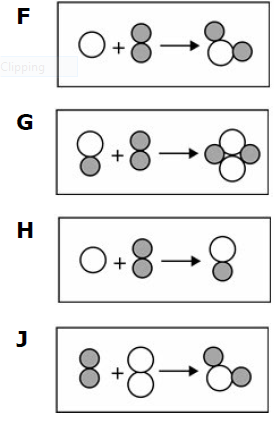
Which of the following models best demonstrates a balanced chemical equation?
a)
F
b)
G
c)
H
d)
J
46.
For an investigation a student poured a blue solution of CuSO4 into a beaker. The student placed a shiny, silver-colored strip of zinc metal in the solution and observed the changes.
The student inferred that a chemical reaction occurred. What evidence supports this inference?
a)
A dark solid formed on the zinc metal.
b)

The zinc metal remained silver-colored and shiny
c)
The CuSO4 solution turned blue when the zinc metal was added.
d)
None of these
47.
Which of the following equations demonstrates an actual chemical reaction that forms a new substance?
a)
A
b)
B
c)
C
d)
D
48.
The chemical formula for glucose, a simple sugar, is C6H12O6. The formula for ethanol is C2H6O. What accounts for the differences in these compounds?
a)
The elements that make up glucose are different than the elements that make up ethanol
b)
The ratio of the elements is different in ethanol than in glucose
c)
The chemical properties of the elements are different in glucose and ethanol
d)
Glucose has more elements than the ethanol
49.
Which of these formulas contain equal numbers of nitrogen atoms?
a)
Formulas I and III
b)
Formulas I and IV
c)
Formulas II and III
d)
Formulas I, II, and V
50.
Two clear colorless solutions were combined.
The student observed that the temperature changed from 25 •C to 23 •C when the solutions were combined and that a white substance rapidly formed and settled to the bottom of the container. What most likely happened to produce these results?

a)
One of the original compounds came out of solution
b)
The solutions reacted chemically
c)
Some of the water froze into ice crystals
d)
Rapid evaporation of water occurred, leaving a solid
51.
The equation below represents a chemical reaction that occurs in living cells. How many atoms are represented in the reactants of this equation?
a)
6
6
b)
12
12
c)
24
24
d)
36
36
52.
In which of these compounds are there twice as many oxygen atoms as hydrogen atoms?
a)
H3PO4
b)
H2SO4
c)
HCIO3
d)
H20
53.

How many atoms in all are in a molecule of serotonin?

C10H12N2O

a)
22
b)
24
c)
25
d)
4
54.
Coal contains carbon and other elements. Carbon dioxide forms when coal burns in the presence of oxygen. Which of these is the best evidence that a chemical reaction occurs when coal burns?
a)
The shape of the coal changes
b)
Oxygen is present
c)
A new substance is produced
d)
Coal is made up of more than one element
55.
A scientist performed four investigations using eight different liquids. In each investigation, the scientist combined two of the liquids under a fume hood and recorded observations in the table below.In which investigation is it least likely that the liquids reacted chemically?
a)
1
b)
2
c)
3
d)
4
56.

The Law of Conservation of Mass states

a)

that matter exists in all states and reacts the same

b)

that matter can only be changed into new substances by introducing a catalyst

c)

that matter exists in the same state throughout any chemical change

d)

that matter cannot be created or destroyed and that the mass of the products must equal the mass of the reactants

57.

How many Al atoms are in this compound? 4Al2O3

a)

2

b)

8

c)

6

d)

4

58.

How many F atoms are in this compound?

6MgF2

a)

2

b)

6

c)

8

d)

12