
NEW
Font size
S
M
L
XL
 Worksheets
Grade 8 Unit B Review
Total questions: 63
Worksheet time: 1hrs 19mins
Name
Class
Date
1.
What system controls voluntary and involuntary life functions?
a)
Nervous System
b)
Skeletal System
c)
Digestive System
d)
Respiratory System
2.
Why is the blood that flows from the lungs to the heart bright red?
a)
It has oxygen in it
b)
It has carbon dioxide in it
c)
It has food coloring in it
d)
It has waste in it
3.
What is a system in the human body?
a)
A group of cells that work together.
b)
A group of tissues that work together.
c)
A group of organs that work together.
d)
Microscopic bugs that live in our eyelashes.
4.
Which term refers to a multi-cellular organism?
a)
Paramecium
b)
Eukaryote
c)
Prokaryote
d)
Multiyote
5.
How does an amoeba eat?
a)
It surrounds the prey and engulfs it.
b)
It attacks prey and eats it.
c)
It splits in half.
d)
It orders Taco Bell
6.
What do you call a group of cells that all perform the same function?
a)
Tissues
b)
Cells
c)
Organs
d)
Human
7.
Which organ system is responsible for getting energy from food?
a)
Nervous system
b)
Digestive system
c)
Circulatory system
d)
Endocrine system
8.
Which part of the cell holds a person's DNA?
a)
Nuclear Envelope
b)
Golgi Apparatus
c)
Cell Wall
d)
Nucleus
9.
Where does digestion begin in the human body?
a)
Cells
b)
Stomach
c)
Large Intestine
d)
Mouth
10.
What does the circulatory system do?
a)
Carries nutrients through the body
b)
Carries oxygenated and deoxygenated blood through the body
c)
Inhale and exhale
d)
Excretes waste
11.
What are the main organs of gas exchange in the respiratory system?
a)
diapragm
b)
lungs
c)
trachea
d)
bronchi
12.
What Is Digestion?
a)
The process of circulating blood
b)
To process of breaking down food into smaller particles that can be absorbed
c)
The process of enzymes breaking down nutrients
13.

The highlighted organ is the
a)
liver
b)
large intestine
c)
small intestine
d)
stomach
14.

The highlighted organ is the
a)
pancreas
b)
small intestine
c)
large intestine
d)
liver
15.
How does the circulatory system depend on the respiratory system?
a)
Removes oxygen-rich blood from the circulatory system.
b)
Provides the circulatory system with oxygen rich blood.
c)
Helps the circulatory system transport nutrients to cells in the body.
d)
Helps the circulatory system remove excess water waste from cells.
16.
This organelle takes food and turns it into ENERGY for plant and animal cells.
a)
Chloroplast
b)
Mitochondria
c)
Lysosome
d)
Ribosome
17.
The site of photosynthesis
a)
ribosome
b)
mitochondria
c)
chloroplast
d)
nucleus
18.

The ___________ is the basic unit of life
a)
organ
b)
cell
c)
atom
d)
tissue
19.

Directs all cell activities through the DNA located there.
a)
Lysosomes
b)
Nucleus
c)
ribosomes
d)
Mitochondria
20.
Which organelle is only found in a plant cell?
a)
nucleus
b)
chloroplast
c)
mitochondria
d)
cell membrane
21.
What is found in both plant and animal cells but is much larger in plant cells?
a)
Nucleus
b)
Mitochondria
c)
Chloroplast
d)
Vacuole
22.
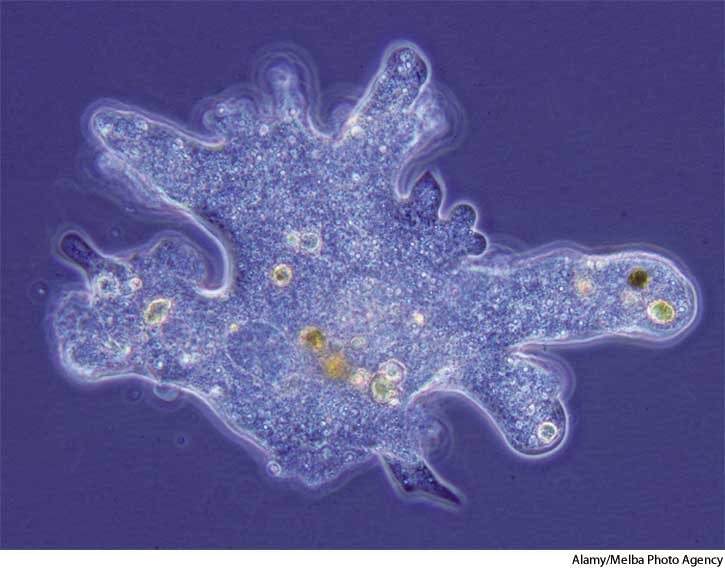
An Amoeba is a unicellular, animal-like protist that lives in ponds and streams. According to cell theory, where did this cell come from?
a)
another pre-existing amoeba cell.
b)
energy from sun that allowed the protist to reproduce.
c)
a multicellular organism.
d)
the nonliving environment.
23.

What number is pointing to the cell membrane?
a)
1
b)
2
c)
3
d)
4
24.
The __________ system directs the body to inner and outer changes.
a)
digestive
b)
circulatory
c)
nervous
d)
skeletal
25.
The __________ is the main organ of the nervous system.
a)
heart
b)
lungs
c)
brain
d)
skin
26.
In multicellular organisms, tissues are comprised of _______.
a)
organs
b)
systems
c)
cells
d)
blood
27.
This thin layer protects the cell and regulates what substances enter and leave the cell.
a)
cell membrane
b)
cell
c)
cell wall
d)
golgi body
28.
In a plant cell, a stiff wall surrounds the membrane, giving the cell a rigid, boxlike shape.
a)
cell membrane
b)
cell
c)
ribosome
d)
cell wall
29.
Most of the cell's energy is produced within these rod-shaped organelles. This organelle is considered the "powerhouse" of the cell.
a)
ribosomes
b)
mitochondria
c)
vacuole
d)
endoplasmic reticulum
30.
Groups of similar cells that carry out a particular job are called:
a)
animals
b)
plants
c)
tissues
d)
organs
31.
Multicellular means?
a)
they contain huge number of cells
b)
one cell only
c)
cytoplasm
d)
cheese
32.
Which of the following statements is true about cells?
a)
All living things are made up of one or more cells.
b)
The cell is the basic unit of a living organism.
c)
Cells come from other cells.
d)
All the above.
33.

What is the function of the heart?
a)
Protects organs and produces red blood cells.
b)
Generates heat.
c)
Breaks down food into nutrients.
d)
A pump that moves the blood.
34.

This system transports oxygen, nutrients and waste around the body.
a)
Digestive
b)
Urinary
c)
Respiratory
d)
Circulatory
35.

What body system consists of the heart?
a)
Excretory
b)
Digestive
c)
Circulatory
d)
Respiratory
36.
What do the arteries do?
a)
pumps blood to the heart
b)
pumps blood to and from the heart
c)
carry's blood away from the heart
d)
a muscle
37.
What part of the blood carries minerals, vitamins, sugar, and other foods to the body's cells?
a)
Platelets
b)
White blood cells
c)
Plasma
d)
Red blood cells
38.
The heart is divided into how many parts.
a)
2
b)
4
c)
8
d)
1
39.
______________ are the smallest blood vessels.
a)
Arteries
b)
Veins
c)
Capillaries
40.
What do the veins do?
a)
The veins carry oxygen- poor blood back to the heart.
b)
Helps the body move and gives the body its shape.
c)
Regulates behavior and controls sensory functions.
d)
Moves air into and out of the lungs.
41.
How long does it take for your heart to pump blood through your entire body?
a)
1 minute
b)
7 minutes
c)
15 minutes
d)
30 minutes
42.
The upper right and left chambers of your heart are called
a)
capillaries
b)
atria
c)
ventricles
d)
vena cava
43.
The ____________ are the stronger chambers of your heart that pump blood away.
a)
atria
b)
veins
c)
ventricles
d)
arteries
44.
The four components of blood are:
a)
plasma, red blood cells, capillaries, white blood cells
b)
water, oxygen, red blood cells, platelets
c)
plasma, white blood cells, red blood cells, oxygen
d)
plasma, white blood cells, red blood cells, platelets
45.
What is a health problem associated with sugar?
a)
Liver damage
b)
Brain damage
c)
Greater risk of diabetes
d)
Lung cancer
46.
Which of these is a health problem associated with smoking?
a)
Brain damage
b)
Greater risk of diabetes
c)
Athletes foot
d)
Greater risk of lung cancer
47.
The brain and the spinal cord make up the what?
a)
Circulatory System
b)
Respiratory System
c)
Central Nervous System
d)
None of these
48.
Your lungs are full of tiny passages (sacs) called...
a)
Alveoli
b)
Dust particles
c)
Sponges
d)
Mucus
49.
What helps push food down the digestive tract?
a)
Peristalsis
b)
Tongue
c)
Chyme
d)
Teeth
50.
What grinds up food when it enters your mouth?
a)
Peristalsis
b)
Tongue
c)
Chyme
d)
Teeth
51.
Extra Credit!
When you breathe in, what does your diaphragm do?
When you breathe in, what does your diaphragm do?
a)
Goes Up
b)
Pulls Down
c)
Doesn't Move
d)
None of these
52.
Which organ of the excretory system stores urine until the body is ready to eliminate it?
a)
ureters
b)
urethra
c)
urinary bladder
d)
urea
53.
What is the main function of the excretory system?
a)
to collect and remove wastes from the body
b)
to strengthen skeletal muscles
c)
to protect the nervous system
d)
to bring oxygen to body cells
54.
Tiny filtering structures where urine is produced in the kidneys are called
a)
ureters.
b)
alveoli.
c)
nephrons.
d)
bronchi.
55.
Under normal conditions, which of the following substances is found in urine?
a)
blood cells
b)
protein
c)
glucose
d)
urea
56.
In which excretory organ is urea produced?
a)
skin
b)
liver
c)
kidneys
d)
lungs
57.
Which excretory organ eliminates water and some chemical wastes in perspiration?
a)
lungs
b)
skin
c)
liver
d)
kidneys
58.
What function do the kidneys perform?
a)
eliminate carbon dioxide
b)
supply oxygen to body cells
c)
remove urea and excess water
d)
play a role in gas exchange
59.

These organs are responsible for what?
a)
storing urine
b)
storing water
c)
filtering blood
d)
they don't have a particular job
60.
Urine flows out of the kidneys through narrow tubes called
a)
Gallbladder
b)
Ureter
c)
Nephrons
d)
Urethra
61.

What is #2?
a)
Kidney
b)
Ureters
c)
Bladder
d)
Urethra
62.

What is #3?
a)
Kidney
b)
Ureters
c)
Bladder
d)
Urethra
63.

What is #4?
a)
Kidney
b)
Ureter
c)
Bladder
d)
Urethra
Reset

