wayground logo

Free Printable Worksheets

Font size

S
M
L
XL
Worksheets

CCR Biology B FINAL review

Total questions: 94

Worksheet time: 2hrs 29mins

Name
Class
Date
1.
What is another term for "selectively permeable"?
a)
porous
b)
completely permeable
c)
permanent
d)
semipermeable
2.
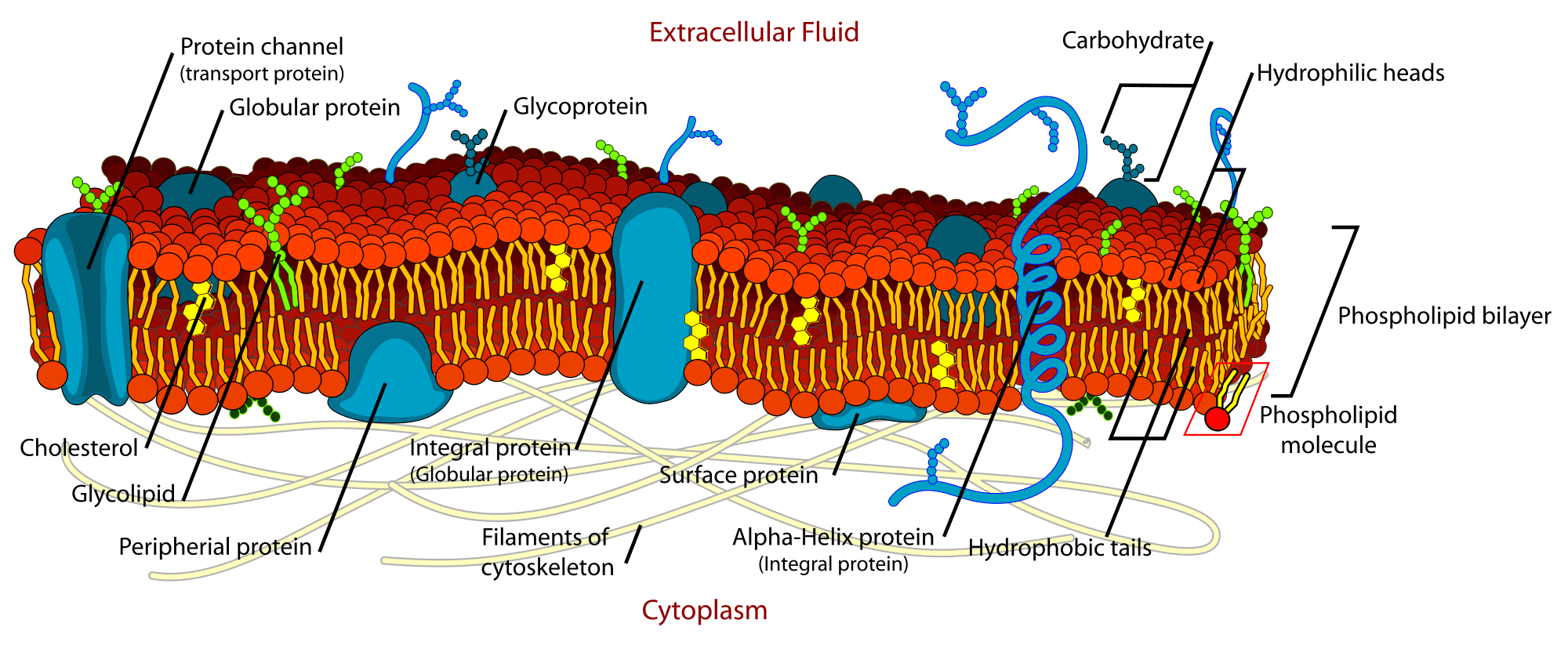
Part of the plasma membrane responsible for cell recognition... 
a)
C
b)
E
c)
B
d)
D
3.
The function of the plasma membrane is....
a)
to regulate what enters and leaves the cell.
b)
fight bacteria and viruses that enter the cell.
c)
provide rigid support and protection to the cell.
d)
make sure each cell can move
4.
Hydrophilic means...
a)
water-loving
b)
water-fearing
c)
nonpolar
d)
lipid soluble
5.
Hydrophobic region of the cell membrane?
a)
E
b)
B
c)
C
d)
6.
Hydrophilic portion of cell membrane?
a)
A
b)
C
c)
D
d)
7.
What is this image?
a)
cell membrane
b)
proteins
c)
carbohydrates
d)
lipids
8.
Most of the cell membrane is made of...
a)
Lipids
b)
Carbohydrates
c)
Proteins
d)
Nucleic acids
9.
What is embedded in the phospholipid bilayer?
a)
proteins
b)
salt
c)
water
d)
trapped animals
10.
This picture represents which type of cellular transport?
a)
passive transport
b)
endocytosis
c)
exocytosis
d)
osmosis
11.
The cell below is in a _________ solution.
a)
Hypotonic
b)
Hypertonic
c)
Isotonic
12.
This cellular structure helps organisms maintain homeostasis by controlling what substances may enter or leave cells.
a)
vacuole
b)
nucleus
c)
cell membrane
d)
cell wall
13.
A cell in a hypotonic solution will
a)
swell
b)
shrink 
c)
stay the same size
d)
impossible to tell
14.
What type of transport is this?
a)
facilitated diffusion
b)
active transport
c)
diffusion
d)
osmosis
15.
What are two types of passive transport?
a)
endo and exocytosis 
b)
cookies and milk
c)
active and passive 
d)
Osmosis and diffusion
16.
The diagram is an example of 
a)
diffusion
b)
active transport
c)
osmosis
d)
equilibrium
17.
This is a diagram of...
a)
exocytosis
b)
active transport
c)
osmosis
d)
equilibrium
18.
Which is true about active transport?
a)
It requires energy
b)
it does not require energy
c)
It moves substances down the concentration gradient
d)
it moves material from high to low concentration
19.

Spraying Axe body spray in a corner of the room and someone on the opposite corner smells it is an example of what?

a)

Osmosis

b)

Facilitated diffusion

c)

Active transport

d)

Diffusion

20.
Active transport requires ______, moves materials from __________________, and goes _______ the concentration gradient.
a)
No energy, low to high, against
b)
ATP, high to low, with
c)
ATP, low to high, with
d)
ATP, low to high, against
21.
This picture represents what type of cell transport?
a)
endocytosis
b)
exocytosis
c)
osmosis
d)
passive transport
22.
if you put a plant in salt water it will ...
a)
swell because water diffuses into the cells
b)
swell because water diffuses out of the cell
c)
shrivel because water diffuses out of the cell
23.
The cell below is in a _____________ solution.
a)
Hypertonic
b)
Hypotonic
c)
Isotonic
24.
The main source of energy for all life comes from ____.
a)
the Earth
b)
the moon
c)
the sun
d)
the food we eat/make
25.
The reactants of photosynthesis are
a)
sugar and water.
b)
sugar and oxygen.
c)
carbon dioxide and water.
d)
carbon dioxide and oxygen.
26.
Which statement about photosynthesis is correct?
a)
Plants get the energy they need for photosynthesis from water.
b)
Plants get the energy they need for photosynthesis from soil.
c)
Plants get the energy they need for photosynthesis from sunlight.
d)
Plants do not require energy to perform photosynthesis.
27.
What are the products of photosynthesis?
a)
Carbon dioxide and water
b)
Carbon dioxide and oxygen
c)
Glucose and oxygen
d)
Glucose and water
28.
What pigment absorbs sunlight for photosynthesis?
a)
chloroplast
b)
thylakoid
c)
grana
d)
chlorophyll
29.
Which of the following is the correct equation for PHOTOSYNTHESIS?
a)
6CO2 + 6H2O --> 6O+ C6H12O6
b)
6CO+ C6H12O6 + 6H2O --> O
c)
6O2 + 6H2O --> 6CO+ C6H12O6
d)
C6H12O6 + 6O2 ---> 6H2O + 6CO2 
30.
Which gas is removed from the atmosphere during photosynthesis?
a)
hydrogen
b)
oxygen
c)
nitrogen
d)
carbon dioxide
31.
In which  organelle does photosynthesis occur?
a)
mitochondria
b)
stomata
c)
xylem
d)
chloroplast
32.
Which of the following is considered a waste product of photosynthesis?
a)
glucose
b)
oxygen
c)
carbon dioxide
d)
sunlight
33.
The energy is stored 
a)
in the carbon bonds
b)
in the phosphate bonds
c)
in the hydrogen bonds
d)
in all of thesse
34.
What are the reactants for cellular respiration?
a)
glucose and carbon dioxide
b)
water and glucose
c)
glucose and ATP
d)
glucose and oxygen
35.
Which is not a step in aerobic respiration?
a)
glycolysis
b)
Krebs' Cycle
c)
Calvin Cycle
d)
electron transport
36.
Which process occurs in the cytoplasm?
a)
glycolysis
b)
aerobic respiration
c)
Krebs' cycle
d)
Electron transport
37.
Which process occurs in the mitochondria
a)
glycolysis and Krebs' Cycle
b)
Krebs' Cycle and Electron Transport
c)
Calvin Cycle and Electron Transport
d)
Glycolysis only
38.
What does it mean for something to be anaerobic?
a)
It requires CO2
b)
It does not require CO2
c)
It requires oxygen
d)
It does not require oxygen
39.
Where in the cell does aerobic respiration take place?
a)
Nucleus
b)
Cytoplasm
c)
Mitochondria
d)
Cell membrane
40.
What organisms undergo cellular respiration? 
a)
All living organisms
b)
Just plants
c)
Just animals
d)
Only eukaryotes
41.
Why do we use yeast to bake bread? 
a)
Their waste gas - CO2 helps bread rise
b)
The alcohol that they form makes bread dangerous
c)
They consume all the oxygen which would ruin the bread
42.
The purpose of cellular respiration is to make
a)
food from energy
b)
ATP from glucose
c)
heat for the organism
d)
oxygen
43.
What are the products of aerobic respiration?
a)
Glucose and oxygen
b)
Carbon dioxide and water
c)
Lactic acid
d)
Carbon monoxide
44.
The purpose of cellular respiration is to make
a)
food from energy
b)
ATP from glucose
c)
heat for the organism
d)
oxygen
45.
Glycolysis occurs where?
a)
cytoplasm
b)
mitochondria
46.
When animals exercise with a lack of oxygen their muscles can form
a)
lactic acid
b)
alcohol
c)
minions
d)
oxygen
47.
What are the two reactants of cellular respiration?
a)
C6H12O6 & 6CO2
b)
6 CO2 & 6H2O
c)
C6H12O& 6O2
d)
6CO2 & 6O2
48.
What is the name of the process that helps make beer and wine?
a)
Fermentation
b)
Alcoholic fermentation
c)
Lactic acid fermentation
d)
Glycolysis
49.
a)
Prophase
b)
Interphase
c)
Anaphase
d)
Telophase
50.
a)
Anaphase
b)
Cytokinesis
c)
Telophase
d)
Metaphase
51.
a)
Cytokinesis
b)
Interphase
c)
Anaphase
d)
Metaphase
52.
a)
Anaphase
b)
Cytonkinesis
c)
Interphase
d)
Prophase
53.
a)
Cytokinesis
b)
Anaphase
c)
Telophase
d)
Prophase
54.
The phase in mitosis where chromosomes move away and are pulled apart by spindles to opposite sides of the cell.
a)
prophase
b)
anaphase
c)
metaphase
d)
telephase
55.
Why isit be important to replicate DNA before a cell divides in mitosis?
a)
In order to produce 2 daughter cells with the exact same genetic information
b)
In order for the cell to be able to increase in size.
c)
In order for the DNA to be contained in the nucleus.
d)
In order for the cell to re-order the DNA sequencing in the new cells.
56.
In mitosis, the two resulting cells are
a)
different from the starting cell and identical to each other.
b)
different from the starting cell and different from each other.
c)
identical to the starting cell and different from each other.
d)
identical to the starting cell and identical to each other.
57.
How many chromosomes do humans have?
a)
46
b)
21
c)
10
58.
Fruit fly body cells have 8 chromosomes. After mitosis, you would expect a resulting fruit fly daughter cell to have -
a)
16 chromosomes.
b)
46 chromosomes.
c)
8 chromosomes.
d)
4 chromosomes.
59.
This is the longest part of a cells life cycle and includes the G1, S and G2 phases.
a)
Metaphase
b)
Prophase
c)
Cytokinesis
d)
Interphase
60.
How many cells are created at the end of Mitosis?
a)
1 diploid cell
b)
2 diploid cells
c)
3 diploid cells
d)
4 diploid cells
61.
In the S stage of interphase_______________
a)
the cell grows
b)
the nucleus divides
c)
the cell membrane divides
d)
the DNA is replicated
62.
Which of the following units are repeatedly joined together to form a strand of DNA?
a)
amino acids
b)
nucleotides
c)
fatty acids
d)
polysaccharides
63.
Which of the following best describes a DNA molecule?
a)
double helix
b)
contains ribose
c)
made of amino acids
d)
contains Uracil
64.
Which sequence of DNA bases would pair with this partial strand
ATG TGA CAG
a)
ATG TGA CAG
b)
TAC ACT GTC
c)
GTA AGT GAC
d)
CAT TCA CTG
65.
What determines the code, or information, of a DNA molecule?
a)
the shape (structure) of the nitrogen bases
b)
the order (sequence) of the nitrogen bases
c)
the color of the nitrogen bases
d)
the frequency (number) of nitrogen bases
66.
Which 2 molecules form the sides (backbone) of the DNA ladder?
a)
deoxyribose sugar and adenine
b)
deoxyribose sugar and a hydrogen bond
c)
deoxyribose sugar and the nucleus
d)
deoxyribose sugar and phosphate
67.
A process in which DNA has the unique ability to make an exact copy of itself.
a)
Replication
b)
Translation
c)
Transcription
68.
Which type of RNA takes the instructions from the nucleus to the cytoplasm?
a)
mRNA
b)
tRNA
c)
rRNA
d)
RNA polymerase
69.
What is the product of transcription?
a)
DNA
b)
mRNA
c)
tRNA
d)
proteins
70.
The process to go from mRNA to a protein is called ____
a)
transcription
b)
rRNA
c)
replication
d)
translation
71.
Choose the nucleotide sequence of the RNA strand that would be complementary to the following strand: 
GTAGTCA
a)
UATUAGA
b)
ACGACTG
c)
CAUCAGU
d)
CATCAGT
72.
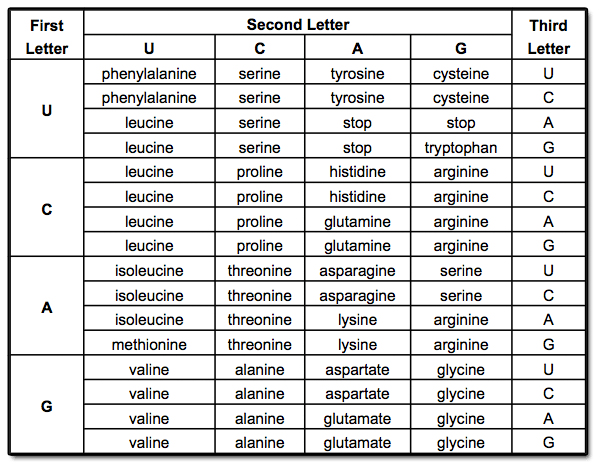
What amino acid is represented by the codon UUA?
a)
Phenylalanine
b)
Tyrosine
c)
Leucine
d)
Stop codon
73.
What is the location in the cell for transcription?
a)
nucleus
b)
cytoplasm
c)
ribosome
d)
mitochondria
74.
This diagram shows the process of:
a)
Transcription
b)
Translation
c)
Replication
d)
Mitosis
75.
What is occurring in this picture?
a)
Translation
b)
DNA Replication
c)
Polymerase is unzipping the DNA
d)
Transcription
76.
Transcription takes place in the 
a)
cytoplasm
b)
chloroplast
c)
nucleus
d)
mitochondria
77.

What mutation has occurred here?

T-G-A-C-C-A

T-G-A-G-C-A

a)

Substitution

b)

Deletion

c)

Insertion

d)

Frameshift

78.

DNA molecule segment is : TTACGCAAG

The mutated DNA segment is TTCGCAAG. This is an example of ___ mutation.

a)

Substitution

b)

Deletion

c)

Insertion

d)

Inversion

79.

Why are insertion and deletion mutations so harmful?

a)

They change all of the codons from the mutation on down the line, which changes the amino acid sequence

b)

They insert things that an organism doesn't need.

c)

They often delete things that organisms need.

d)

Insertion and deletions are not any more harmful than substitution mutations.
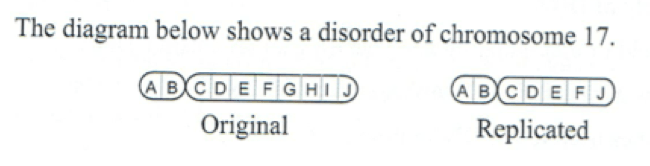
80.
Which of the following would result in a frameshift mutation?
a)
Insertions only
b)
Substitution only
c)
Deletion only
d)
Insertions and Deletions
81.
If a mutation occurs in a body cell, will the trait be passed onto the organism's offspring?
a)
No, the trait is in a somatic cell
b)
Yes, the trait is in a somatic cell
c)
No, the trait must be in a sex cell
d)
Yes, the trait is in a sex cell
82.
What type of chromosomal mutation has occurred?
a)
substitution
b)
insertion
c)
deletion
d)
nondisjunction
83.
Which of the following is an example of a GENOTYPE?
a)
25%
b)
Blue
c)
1:2:1
d)
Bb
84.
Which of the following is an example of a homozygous dominant genotype?
a)
RR
b)
Rr
c)
rr
85.
Which of the following is an example of a heterozygous genotype?
a)
RR
b)
Rr
c)
rr
86.
What percentage of the offspring will be purebred dominant?
a)
0%
b)
25%
c)
50%
d)
75%
87.
This is an example of what?
a)
Complete dominance
b)
Incomplete dominance
c)
Codominance
d)
None of the above
88.
Term for homozygous organisms that display two dominant phenotypes at the same time
a)
codominance
b)
incomplete dominance
c)
multiple alleles
d)
linked genes
89.
The physical appearance of a trait is known as the-
a)
genotype
b)
phenotype
c)
characteristics
d)
intelligence
90.

Widow's peak is dominant to no widow's peak. What are the potential outcomes of the offspring if BOTH the mother and father are heterozygous (Ww).

a)

75% of offspring will have widows peak, 25% will not

b)

50% of offspring will have widows peak, 50% will not

c)

25% of offspring will have widows peak, 25% will not

d)

100% no widows peak

91.

Detached earlobes are dominant to attached earlobes. What are the potential outcomes for offspring if the mother has ATTACHED earlobes and the father is homozygous for detached earlobes. DD x dd

a)

100% detached earlobes

b)

75% attached earlobes 25% detached

c)

50% detached 50% attached

d)

75% detached 25% attached

92.

Dimples are dominant to no dimples. If a homozygous dominant mother and father have children, what will their genotype be? (DD x DD)

a)

100% DD

b)

100% dd

c)

50% DD 50% dd

d)

50% Dd

93.

The blending of two phenotypes that appears in the heterozygote (red x white= pink)

a)

Incomplete Dominance

b)

Codominance

94.

When both alleles are expressed and are equally dominant

a)

Incomplete Dominance

b)

Codominance