
 Worksheets
Photosynthesis Exam 2 review
Total questions: 75
Worksheet time: 1hrs 23mins
Name
Class
Date
1.
Which organelle performs PHOTOSYNTHESIS?
a)
Chloroplast
b)
Mitochondria
2.
Which of the following is the correct equation for PHOTOSYNTHESIS?
a)
CO2 + light + H2O --> O2 + Sugar
b)
CO2 + sugar + H2O --> O2 + light
c)
O2 + light + H2O --> CO2 + Sugar
d)
CO2 + O2 + H2O --> Light+ Sugar
3.
What process occurs when light energy is captured in autotrophs and converted into sugar?
a)
Photosynthesis
b)
Cellular Respiration
4.
What is the ultimate ORIGINAL source of energy for living things
a)
Sugar
b)
Sun
c)
Moon
d)
Carbon Dioxide
5.
Which organisms perform Photosynthesis?
a)
Only Autotrophs
b)
Only Heterotrophs
c)
Autotrophs and Heterotrophs
6.
Which of the following is an example of an AUTOTROPH?
a)
Appletree
b)
Dog
c)
Mushroom
d)
Human
7.
Which of the following is an example of a HETEROTROPH?
a)
Grass
b)
Algae
c)
Lemon Tree
d)
Bear
8.
What is the pigment in chloroplasts that performs photosynthesis?
a)
Chlorosynthesis
b)
Chlorophyll
c)
ADP
d)
Electron Transport
9.
Which gas is removed from the atmosphere during photosynthesis?
a)
hydrogen
b)
oxygen
c)
nitrogen
d)
carbon dioxide
10.
What are the products of photosynthesis?
a)
water and carbon dioxide
b)
oxygen and glucose
c)
oxygen and carbon dioxide
d)
oxygen and water
11.
Plants need ________ for photosynthesis
a)
oxygen
b)
soil
c)
carbon dioxide
d)
sugar
12.
What is photosynthesis?
a)
The process in which humans eat their food
b)
When a photographer takes a photo.
c)
To get your pictures from the photo lab.
d)
The process in which plants make their food.
13.
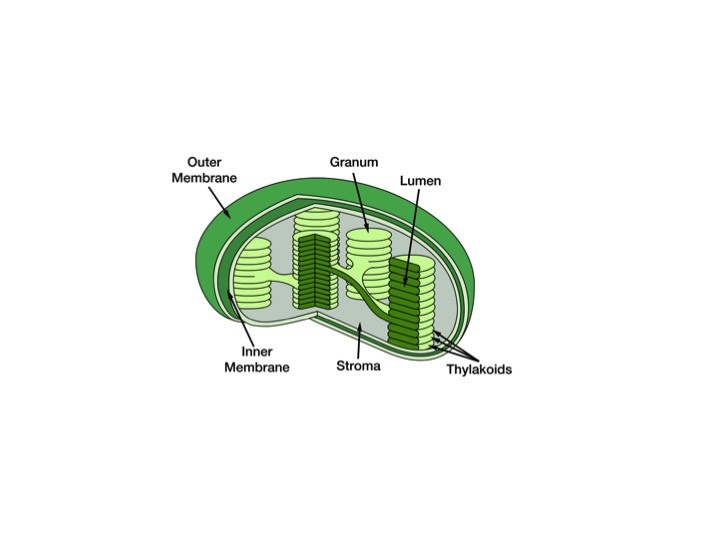
Chloroplasts are...
a)
Structures of animal cells to produce ATP
b)
Organelles where lipids are elaborated
c)
Specialized structures of plants where food is made
d)
Waste organelle of plants
14.
What is the pigment in chloroplasts that performs photosynthesis?
a)
Chlorosynthesis
b)
Chlorophyll
c)
ADP
d)
Electron Transport
15.
Leaves look green because.....
a)
they eat their vegetables
b)
to blend into their environment
c)
they contain a molecule named chlorophyll
d)
they are sick
16.

Which organelle from the plant cell is primarily responsible for converting sunlight to energy?
a)
Mitochonria
b)
Nucleus
c)
Vacuole
d)
Chloroplast
17.
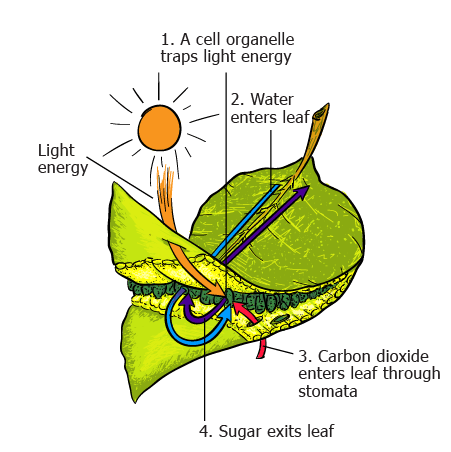
Look at the image
What substances and organelle work together to absorb sunlight to perform photosynthesis in this example?
What substances and organelle work together to absorb sunlight to perform photosynthesis in this example?
a)
cell wall and chloroplast
b)
mitochondria and water
c)
vacuole and carbon dioxide
d)
chloroplast and chlorophyll
18.
Green plants reflect ________ light.
a)
Red
b)
Green
c)
All
d)
Red and Violet
19.
Which classification of cell experiences photosynthesis?
a)
Plants
b)
Chloroplasts
c)
Eukaryotes
d)
All of the above
20.
__________ is a stack of thylakoids
a)
Granum
b)
Stomata
c)
Stroma
d)
Chloroplast
21.
The light reactions occur in the ________ and the dark reactions take place in the ________.
a)
Chloroplast / thylakoid membrane
b)
stroma / thylakoid
c)
mesophyl / stomata
d)
thylakoid membrane / stroma
22.
Where is glucose synthesized
a)
Photosystem II
b)
Photosystem I
c)
Calvin Cycle
d)
Glycolysis
23.
Where does the carbon come from that is used to form glucose?
a)
The soil
b)
CO2 in the air
c)
From other carbohydrates
d)
Calvin Cycle
24.
Since we're building a carbohydrate in the Calvin Cycle, is the process endergonic or exergonic and why?
a)
Endergonic because carbohydrate production is catabolic
b)
Exergonic because carbohydrate production is anabolic
c)
Endergonic because carbohydrate production is anabolic.
d)
Exergonic because carbohydrate production is catabolic
25.
Organisms, such as plants, that make their own food are called
a)
autotrophs
b)
heterotrophs.
c)
thylakoids.
d)
pigments.
26.
Energy is released from ATP when
a)
a phosphate group is added.
b)
adenine bonds to ribose.
c)
ATP is exposed to sunlight.
d)
a phosphate group is removed.
27.
Photosynthesis uses sunlight to convert water and carbon dioxide into
a)
oxygen.
b)
high-energy sugars and starches.
c)
ATP and oxygen.
d)
oxygen and high-energy sugars and starches.
28.
Most plants appear green because chlorophyll
a)
does not absorb green light.
b)
reflects violet light.
c)
absorbs green light.
d)
none of the answers
29.
In which eukaryotic organelles does photosynthesis occur?
a)
mitochondria
b)
stomata
c)
xylem
d)
chloroplast
30.
What are the products of photosynthesis?
a)
Carbon dioxide and water
b)
Carbon dioxide and oxygen
c)
Glucose and oxygen
d)
Glucose and water
31.
What pigment absorbs sunlight for photosynthesis?
a)
chloroplast
b)
thylakoid
c)
grana
d)
chlorophyll
32.
Which gas is removed from the atmosphere during photosynthesis?
a)
hydrogen
b)
oxygen
c)
nitrogen
d)
carbon dioxide
33.
Which of the following is the correct equation for PHOTOSYNTHESIS?
a)
6CO2 + 6H2O --> 6O2 + C6H12O6
b)
6CO2 + C6H12O6 + 6H2O --> O2
c)
6O2 + 6H2O --> 6CO2 + C6H12O6
d)
C6H12O6 + 6O2 ---> 6H2O + 6CO2
34.

Use the diagram to answer the question. Between which parts of the molecule must the bonds be broken to form an ADP molecule?
a)
A and B
b)
A and C
c)
B and C
d)
C and D
35.
Which of the following best describes photosynthesis?
a)
Photosynthesis converts radiant energy into chemical energy.
b)
Photosynthesis produces carbohydrates.
c)
Plants need sunlight, carbon dioxide, water, nutrients, and chlorophyll to complete photosynthesis.
d)
Plants use chlorophyll, water, and carbon dioxide to make sugar.
36.
Which of the following is NOT a product of the light reactions?
a)
ATP
b)
NADPH
c)
Oxygen
d)
Glucose
37.
Which substance from the light-dependent reactions of photosynthesis is a source of energy for the light-independent (Calvin) reactions?
a)
ADP
b)
H2O
c)
NADPH
d)
pyruvic acid
38.
What is the purpose of splitting water in PS2 of the light dependent reaction?
a)
Provides e- for PS2 and H+ for the thylakoid space
b)
To produce Oxygen for animals
c)
There is no purpose
39.
It is important to create a concentration of H+ in the thylakoid space so that the H+ can diffuse through_________ to create ______.
a)
ATP synthase, ATP
b)
NADH, NADPH
c)
proton pump, protons
40.

Where do the light reactions happen?
a)
mitochondria membrane
b)
thylakoid membrane
c)
stroma
d)
central vacuole
41.

According to this absorption spectrum, what color is not used by the chlorophyll pigments?
a)
green
b)
blue
c)
yellow
d)
red
42.

The interior space of the chloroplast is called:
a)
Lamellae
b)
Grana
c)
Stroma
d)
Thylakoids
43.
When carbon first enters the Calvin cycle, what molecule does it combine with?
a)
PGA
b)
G3P
c)
RuBP
d)
ATP
44.

What is the name of the enzyme that fixes carbon in photosynthesis?
a)
Rubisco
b)
NADPH reductase
c)
Carbon Fixase
d)
Calvinase
45.

What is the product of the Calvin Cycle?
a)
Rubisco
b)
Glyceraldehyde 3-Phosphate (G3P)
c)
Oxygen
d)
Starch
46.

How many carbons does G3P have?
a)
1
b)
2
c)
3
d)
6
47.
Where do the light-independent reactions occur?
a)
thylakoid
b)
stroma
c)
lumen
d)
mitochondria
48.
Which of the following is NOT a reactant of the dark reactions?
a)
NADPH
b)
ATP
c)
Oxygen
d)
Carbon dioxide
49.

What is the name of a pigment-containing complex found in a thylakoid?
a)
chlorophyll a
b)
photosystem
c)
grana
d)
stroma
50.

What supplies the electrons that are lost in PS I?
a)
the electrons from PS II
b)
water
c)
glucose
d)
oxygen
51.
What is the function of NADP+?
a)
It absorbs light
b)
It is an electron carrier
c)
It is a light-reflecting pigment
d)
It acts as long-term energy storage
52.
Beyond Basics: The splitting/breaking of water
a)
occurs during Cellular Respiration
b)
is called hydrolysis
c)
produces oxygen, electrons and hydrogens
d)
occurs during fermentation
53.
Beyond Basics: NADP+, NAD+, and FAD are
a)
involved in photosynthesis
b)
accept electrons and hydrogens for transport
c)
are involved in cellular respiration
d)
are unrelated compounds
54.
Beyond Basics: Carbon fixation
a)
is part of the Krebs Cycle
b)
is part of the Calvin Cycle
c)
is part of the ETC
d)
is part of the Light Reactions
55.
Beyond Basics: Electrons become energized during photosynthesis when
a)
they are absorbed by water
b)
they undergo carbon fixation
c)
they are struck with light energy
d)
they are incorporated into oxygen
56.
In a plant cell, where are the ATP synthase complexes located?
a)
In a plant cell, where are the ATP synthase complexes located?
b)
thylakoid membrane and plasma membrane
c)
plasma membrane only
d)
thylakoid membrane and inner mitochondrial membrane
57.
A plant has a unique photosynthetic pigment. The leaves of this plant appear to be reddish yellow. What wavelengths of visible light are being absorbed by this pigment?
a)
green and yellow
b)
blue, green, and red
c)
green, blue, and yellow
d)
blue and violet
58.
In mitochondria, chemiosmosis translocates protons from the matrix into the intermembrane space, whereas in chloroplasts, chemiosmosis translocates protons from
a)
the stroma to the thylakoid space.
b)
the thylakoid space to the stroma.
c)
the matrix to the stroma.
d)
the stroma to the photosystem II.
59.
When oxygen is released as a result of photosynthesis, it is a direct by–product of
a)
chemiosmosis.
b)
splitting water molecules.
c)
the electron transfer system of photosystem II.
d)
the electron transfer system of photosystem I.
60.
The color of light least effective in driving photosynthesis is _________
a)
blue
b)
red
c)
orange
d)
green
61.
Cyclic electron flow in the cloroplast produces________
a)
ATP
b)
NADPH
c)
both ATP and NADPH
d)
glucose
62.

Which pigment is most efficient at higher energy areas of the electromagnetic spectrum?
a)
Chlorophyll A
b)
Chlorophyll B
c)
Carotenoids
d)
No pigment is efficient at high energies
63.

Plants with the largest amount of which pigment will be best suited for growing conditions where light has a green hue.
a)
Chlorophyll A
b)
Chlorophyll B
c)
Carotenoids
d)
A combination of all 3
64.
During which phase of photosynthesis is O2 created?
a)
Light dependent reactions
b)
Calvin Cycle
c)
Citric Acid Cycle
d)
Glycolysis
65.

Which of the following molecules is not needed for the Calvin Cycle?
a)
CO2
b)
ATP
c)
NADPH
d)
H2O
66.
How is a molecule oxidized?
a)
Electrons are added to the molecule
b)
Electrons are taken from the molecule
c)
Electrons are shared with the molecule
d)
Protons are added to the molecule
67.
How is a molecule reduced?
a)
electrons are given to the molecule
b)
electrons are taken from the molecule
c)
money is taken from the molecule
d)
protons are given to the molecule
68.
Which of the following is directly associated with Photosystem I?
a)
harvesting light energy to make ATP
b)
receiving electrons from the thylakoid membrane ETC
c)
generation of molecular oxygen
d)
extraction of hydrogen electrons from the splitting of water
69.
Compared to C3 plants, C4 plants
a)
) have higher rates of photorespiration.
b)
can
continue to fix CO2 even at relatively low CO2 concentrations and high oxygen concentrations.
c)
do not use rubisco for carbon fixation.
d)
grow better under cool, moist conditions.
70.
CAM plants keep stomata closed in daytime, thus reducing loss of water. They can do this because they
a)
fix CO2 into
organic acids during the night when temperatures are cooler.
b)
fix CO2 into by
combining it with RuBP in the Calvin cycle.
c)
obtain CO2 through their roots during the day.
d)
fix
CO2 into organic acids in the mesophyll cells,
which do not rely on stomata.
71.
Where do the light-dependent reactions occur?
a)
thylakoid membrane
b)
stroma
c)
mesophyll
d)
mitochondria
72.
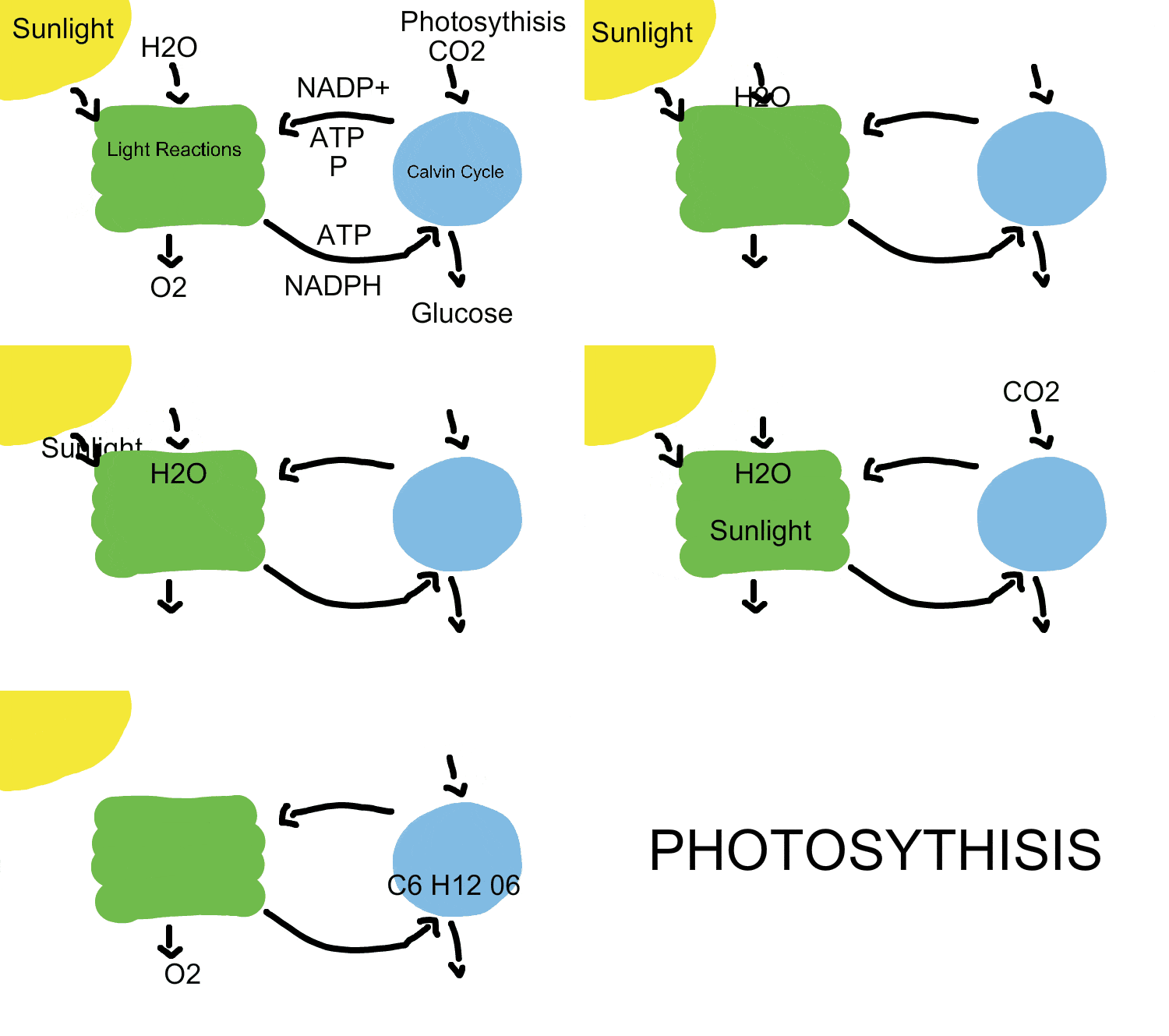
Chlorophyll absorbs a higher percentage of _____ and _______ light.
a)
purple and green
b)
red and blue
c)
black and orange
d)
yellow and green
73.

The reactants of photosynthesis are
a)
sugar and water.
b)
sugar and oxygen.
c)
carbon dioxide and water.
d)
carbon dioxide and oxygen.
74.

How many sugar molecules are produced from every six molecules of carbon dioxide that enter the Calvin cycle?
a)
1
b)
3
c)
6
d)
12
75.

Is ADP or ATP more like a fully charged battery, and why?
a)
ADP, because it has three phosphate groups; breaking and reforming the bonds among them releases energy.
b)
ATP, because it has three phosphate groups; breaking and reforming the bonds among them releases energy.
c)
ADP, because it has two phosphate groups; breaking and reforming the bonds among them releases energy.
d)
ATP, because it has two phosphate groups; breaking and reforming the bonds among them releases energy.
100 %

