wayground logo

Free Printable Worksheets

Font size

S
M
L
XL
Worksheets

8th - Genetics Test Review

Total questions: 80

Worksheet time: 52mins

Name
Class
Date
1.

Why do single-celled organisms divide?

a)

Grow

b)

Develop

c)

Repair

d)

Reproduce

2.

Why do multicellular organisms divide? (Select all answers that apply.)

a)

Grow

b)

Develop

c)

Repair

d)

Reproduce

3.

Where is DNA found in eukaryotic cell?

a)

Cell membrane

b)

Mitochondria

c)

Nucleus

d)

Chloroplast

4.

What is a molecule in a cell that contains information a cell needs to live and function and traits an organism inherits?

a)

Nucleus

b)

DNA

c)

Allele

d)

Punnett Square

5.

What is the threadlike material of DNA that wraps around proteins?

a)

Nucleus

b)

Gene

c)

Allele

d)

Chromatin

6.

What is chromatin organized in specific lengths that are rod shaped or X shaped?

a)

Gene

b)

Allele

c)

Pedigree

d)

Chromosome

7.

After DNA is copied, there are two identical structures held together by a centromere. What are the two identical structures called?

a)

Chromatin

b)

Cell Cycle

c)

Allele

d)

Chromatid

8.

What holds together two chromatids?

a)

Nucleus

b)

Pedigree

c)

Gene

d)

Centromere

9.

What stage of the cell cycle does a cell spend most time in?

a)

Interphase

b)

Mitosis

c)

Cytokinesis

10.

________________ is the life cycle of a eukaryotic cell when a parent cell divides into two, new identical cells.

a)

Mitosis

b)

Cytokinesis

c)

Cell cycle

d)

Interphase

11.

Which of the following is the order of the mitosis phases?

a)

Telophase, Anaphase, Metaphase, Prophase

b)

Anaphase, Metaphase, Prophase, Telophase

c)

Prophase, Metaphase, Anaphase, Telophase

d)

Prophase, Anaphase, Metaphase, Telophase

12.

What phase of mitosis is described: duplicated chromosomes line up in the middle of the cell?

a)

Prophase

b)

Metaphase

c)

Anaphase

d)

Telophase

13.

What phase of mitosis is described: nuclear membranes form around each complete set of chromosomes?

a)

Prophase

b)

Metaphase

c)

Anaphase

d)

Telophase

14.

What phase of mitosis is described: duplicated chromosomes condense to be two chromatids held together by a centromere?

a)

Prophase

b)

Metaphase

c)

Anaphase

d)

Telophase

15.

What phase of mitosis is described: chromatids from duplicated chromosomes and are pulled to opposite sides of cell?

a)

Prophase

b)

Metaphase

c)

Anaphase

d)

Telophase

16.
Structure (b) is a ____.
a)
chromosome
b)
chromatid
c)
centromere
17.
Structure (a) is a ____.
a)
chromosome
b)
chromatid
c)
centromere
18.
Structure (c) is a ____.
a)
chromosome
b)
chromatid
c)
centromere
19.
a)

Prophase

b)

Interphase

c)

Anaphase

d)

Telophase

20.
a)
Anaphase
b)
Cytokinesis
c)
Telophase
d)
Metaphase
21.
a)
Cytokinesis
b)
Interphase
c)
Anaphase
d)
Metaphase
22.
a)
Anaphase
b)
Cytonkinesis
c)
Interphase
d)
Prophase
23.
a)
Cytokinesis
b)
Anaphase
c)
Telophase
d)
Prophase
24.
_____ chromosomes are in a human body cell. 
a)
23
b)
46
c)
92
25.
A __________ cell has a full set of chromosomes. 
a)
haploid
b)
diploid
26.
In a cell, where are chromosomes located?
a)
Cytoplasm
b)
Mitochondria
c)
Cell Membrane
d)
Nucleus
27.
Of the 46 chromosomes in a human body cell, they make up ______ pairs. 
a)
5
b)
12
c)
22
d)
23
28.
Of the 23 chromosome pairs, _______ pairs are homologous. 
a)
2
b)
8
c)
18
d)
22
29.
_____________ chromosomes are a chromosome pair that have the same sequence of genes and same structure. 
a)
Sex
b)
Homologous
30.
What are sex chromosomes named?
a)
A and B
b)
M and F
c)
B and P
d)
X and Y
31.
What is the arrangement of the sex chromosomes for a male?
a)
XX
b)
XY
32.
What is the only sex chromosome a female can give?
a)
X
b)
Y
33.
A ________ cell contains one chromosome from each chromosome pair. 
a)
body
b)
sex
34.
A _________ cell has a half set of chromosomes. 
a)
haploid
b)
diploid
35.
Based on the body cell pictured, how many chromosomes does this cell contain?
a)
1
b)
2
c)
4
d)
8
36.
Based on the body cell pictured, how many chromosomes would be in this organism's sex cell?
a)
1
b)
2
c)
4
d)
8
37.
___________ is a cell division that produces haploid cells.
a)
Mitosis
b)
Meiosis
38.
Prior to meiosis, during __________ chromosomes are duplicated. 
a)
interphase
b)
prophase
c)
prometaphase
d)
cytokinesis
39.
During meiosis _____, duplicated pairs of homologous chromosomes and sex chromosomes split apart into tow new cells. 
a)
I
b)
II
40.
During meiosis I, when will duplicated chromosome pairs come together?
a)
Prophase I
b)
Metaphase I
c)
Anaphase I
d)
Telophase I/Cytokinses
41.
During meiosis I, when will duplicated chromosome pairs line up in the middle of the cell?
a)
Prophase I
b)
Anaphase I
c)
Metaphase I
d)
Telophase I/Cytokinesis
42.
During meiosis I, when will duplicated chromosomes separate from their pair and move to opposite sides of the cell?
a)
Anaphase I
b)
Metaphase I
c)
Prophase I
d)
Telophase I/Cytokinesis
43.
During meiosis I, when will the cell divide into two new cells?
a)
Anaphase I
b)
Prophase I
c)
Metaphase I
d)
Telophase I/Cytokinesis
44.
During meiosis _____, the two cells are divided into four haploid cells. 
a)
I
b)
II
45.
During meiosis II, when do chromatids from a duplicated chromosome pull apart and move to opposite sides of the cell?
a)
Prophase II
b)
Metaphase II
c)
Anaphase II
d)
Telophase II/Cytokinesis
46.
During meiosis II, when does the nuclear membrane re-form and cells divide into four haploid sex cells?
a)
Anaphase II
b)
Metaphase II
c)
Prophase II
d)
Telophase II/Cytokinesis
47.
The function of _________ is produce genetically identical cells. 
a)
mitosis
b)
meiosis
48.
The function of __________ is to produce haploid sex cells. 
a)
mitosis
b)
meiosis
49.
A male shark has 40 chromosomes in each of its sex cells. How many would be present in its body cells?
a)
20
b)
40
c)
80
d)
160
50.
Why do we need meiosis?
a)
To double the number of chromosomes going into sex cells
b)
To halve the number of chromosomes going into sex cells
c)
To triple the number of chromosomes going into sex cells
d)
To not change the number of chromosomes going into sex cells
51.
What is another reason we need meiosis?
a)
So the offspring has genes from both parents
b)
So the offspring has genes from one parent
c)
So the offspring has genes from neither parents
d)
So the offspring makes its own genes
52.
How are your chromosomes inherited?
a)
most of your chromosomes from your mother
b)
most of your chromosomes from your father
c)
a random number of chromosomes from each parent
d)
half your chromosomes from your mother and half from your father.
53.
What type of asexual reproduction is pictured?
a)
Binary Fission
b)
Budding
c)
Spores
d)
Vegetative Reproduction
54.
What type of asexual reproduction is pictured?
a)
Binary Fission
b)
Budding
c)
Spores
d)
Vegetative Reproduction
55.
What process occurs when a sperm cell from male and egg cell from female joins?
a)
Mitosis
b)
Meiosis
c)
Binary Fission
d)
Fertilization
56.
What is the cell formed from fertilization?
a)
Baby
b)
Zygote
c)
Offspring
d)
New Cell
57.

What is a physical characteristic of an organism?

a)

Heredity

b)

Allele

c)

Trait

d)

Phenotype

58.

What is the passing of traits from parent to offspring?

a)

Alleles

b)

Punnett Square

c)

Heredity

d)

Genetics

59.

What is study of heredity?

a)

Gregor Mendel

b)

Genetics

c)

Alleles

d)

Pedigree

60.

What are different versions of a gene?

a)

Dominant

b)

Genotype

c)

Phenotype

d)

Allele

61.

What allele is represented by a capital letter?

a)

Dominant

b)

Recessive

62.

A _______________ allele will only show in an organism's phenotype if they are two present.

a)

dominant

b)

recessive

63.
AA and Aa always show up as
a)
dominant
b)
recessive
64.
aa always shows up as
a)
dominant
b)
recessive
65.

Classify the following genotype: FF

a)

Heterozygous

b)

Homozygous Dominant

c)

Homozygous Recessive

66.

Classify the following genotype: rr

a)

Heterozygous

b)

Homozygous Recessive

c)

Homozygous Dominant

67.

Classify the following genotype: Ee

a)

Heterozygous

b)

Homozygous Dominant

c)

Homozygous Recessive

68.

The following genotype BB is classified as a _____________.

a)

purebred

b)

hybrid

69.

The genotype Cc is classified as ____________.

a)

purebred

b)

hybrid

70.
How many alleles (letters) do each person carry for a trait?
a)
1
b)
2
c)
3
d)
4
71.
How many alleles (letters) does a child get from each parent for each trait?
a)
1
b)
2
c)
3
d)
4
72.

If B is the allele for brown eyes and b is the allele for blue eyes, what is the phenotype if the genotype is Bb?

a)

Brown eyes

b)

Blue eyes

73.

If B is the allele for brown eyes and b is the allele for blue eyes, what is the phenotype if the genotype is bb?

a)

Brown eyes

b)

Blue eyes

74.

If B = brown eyes and b = blue eyes, what is true about two brothers that have brown eyes in which one of their genotypes is BB and the other brother's genotype is Bb?

a)

they have same phenotype and genotype

b)

they have different genotypes and phenotypes

c)

they have same phenotype but different genotypes

d)

they have same genotype but different phenotypes
75.

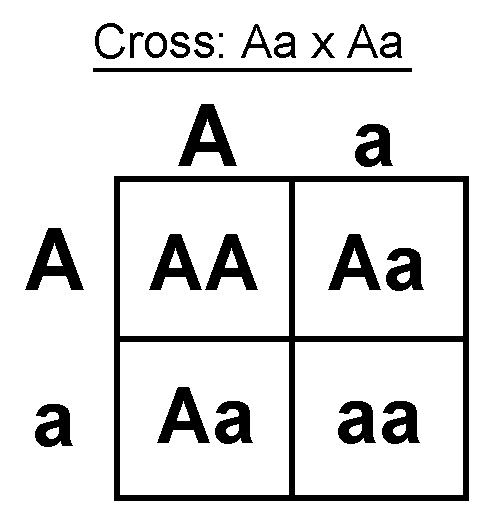
What are the possibilities of the phenotypes for the offspring? (A=brown hair and a=blond hair)

a)

50 % Brown Hair and 50% Blond Hair

b)

25 % Brown Hair and 75% Blond Hair

c)

75 % Brown Hair and 25% Blond Hair

d)

0% Brown Hair and 100% Blond Hair

76.

A red flower (Rr) is crossed with a white flower (rr). What are the possible genotypes for the offspring?

a)

0 RR; 0 Rr: 4 rr

b)

2 RR; 0 Rr: 2 rr

c)

4 RR; 0 Rr: 0 rr

d)

0 RR; 2 Rr: 2 rr

77.
What is the probability of heterozygous offspring?
a)
25%
b)
50%
c)
0%
d)
100%
78.
What allele combination should go in the missing box?
a)
AA
b)
Aa
c)
aa
d)
none of these
79.

_________________ are useful to trace sex-linked disorders associated with alleles on sex chromosomes.

a)

Punnett squares

b)

Pedigrees

80.

Why do all the daughters in generation II carry the colorblind gene?

a)

Mom passed on the gene

b)

Dad passed on the gene

c)

Their brother has it

d)

Their brother gave it to them