wayground logo

Free Printable Worksheets

Font size

S
M
L
XL
Worksheets

Honors/AP Central Dogma Review

Total questions: 130

Worksheet time: 2hrs 54mins

Name
Class
Date
1.
Which of the following best describes a DNA molecule?
a)
double helix
b)
contains ribose
c)
made of amino acids
d)
contains Uracil
2.
Which of the following units are repeatedly joined together to form a strand of DNA? (This is the MONOMER of DNA.) 
a)
amino acids
b)
nucleotides
c)
fatty acids
d)
polysaccharides
3.
Adenine bonds with ______________.
a)
Guanine
b)
Thymine
c)
Cytosine
d)
Adenine
4.
Guanine bonds with ______________.
a)
Adenine
b)
Guanine
c)
Cytosine
d)
Thymine
5.
What are the 4 nitrogen bases?
a)
adenine, thymine, cytoplasm, and guanine
b)
adenine, thymine cytosine, and guanine
c)
adenine, thymine, cytosine, and gylcerol
d)
adenine, thymine, cytosine, and glucose
6.
Which 2 molecules forms the sides (backbone) of the DNA ladder?
a)
deoxyribose and adenine
b)
deoxyribose and a hydrogen bond
c)
sugar and the nucleus
d)
deoxyribose (sugar) and phosphate
7.
Which sequence of DNA bases would pair with this partial strand
ATG TGA CAG
a)
ATG TGA CAG
b)
TAC ACT GTC
c)
GTA AGT GAC
d)
CAT TCA CTG
8.
A process in which DNA has the unique ability to make an exact copy of itself.
a)
Replication
b)
Translation
c)
Transcription
9.
Which organelle is DNA usually found in?
a)
cell membrane
b)
vacuole
c)
chloroplast
d)
nucleus
10.
Nitrogenous bases are joined by which type of bond?
a)
polar bonds
b)
ionic bonds
c)
covalent bonds
d)
hydrogen bonds
11.
In a molecule of double-stranded DNA, the amount of Adenine present is always equal to the amount of
a)
cytosine
b)
guanine
c)
thymine
d)
uracil
12.
The enzyme that unzips the DNA to prepare for replication
a)
helicase
b)
replicase
c)
polymerase
d)
synthase
13.
DNA replication results in two DNA molecules,
a)
each one with two original strands
b)
each one with two new strands
c)
each one with one new strand and one original strand
d)
one with two new strands and the other with two original strands
14.
What are the three components of a nucleotide?
a)
sugar, hydrogen, nitrogen base
b)
sugar, oxygen, nitrogen base
c)
sugar, phosphate, nitrogen base
d)
sugar, phosphate, protein
15.
DNA Replication is the process of turning 1 DNA molecule into...
a)
1 DNA molecule
b)
2 DNA molecules
c)
3 DNA molecules
d)
4 DNA molecule
16.
The name of the 5 carbon sugar that makes up DNA is _____
a)
phosphate
b)
deoxyribose
c)
ribose
d)
polymerase
17.
The concept that DNA is made of two strands running in opposite directions is called:
a)
Antiparallel
b)
Isomerism
c)
Enantiomerism
d)
S/R Chirality
18.
The term used to describe DNA Replication is:
a)
Semi-Conservative
b)
Conservative
c)
AntiParallel
d)
Dispersive
19.
Small segments of DNA made on the lagging strand are called:
a)
Okazaki Fragments
b)
ERVs
c)
Transposable Elements
d)
Telomeres
20.
What strand has a free 3' end on the parental DNA?
a)
Leading
b)
Lagging
21.
What is a mistake called when copying DNA?
a)
Mutation
b)
Okasaki fragment
c)
Replication
22.

What is a primer?

a)

An enzyme that builds the new strand of DNA

b)

A "flag" that is created by primase to help direct DNA polymerase

c)

Nitrogen base

d)

Sugar and phosphate backbone

23.

The direction that DNA polymerase builds the new DNA strand.

a)

5' to 3'

b)

3' to 5'

c)

Counter clockwise

24.

The 2nd step of DNA replication.

a)

DNA polymerase brings over new nucleotides to build opposite strand of DNA.

b)

Helicase unzips DNA molecule into two separate strands.

c)

SSB proteins bind to single strand of DNA.

d)

Primase makes a primer for DNA polymerase.

25.

The 3rd step of DNA replication.

a)

DNA polymerase brings over new nucleotides to build opposite strand of DNA.

b)

Helicase unzips DNA molecule into two separate strands.

c)

SSB proteins bind to single strand of DNA.

d)

Primase makes a primer for DNA polymerase.

26.

The 4th step of DNA replication.

a)

DNA polymerase brings over new nucleotides to build opposite strand of DNA.

b)

Helicase unzips DNA molecule into two separate strands.

c)

SSB proteins bind to single strand of DNA.

d)

Primase makes a primer for DNA polymerase.

27.

What mutation has occurred here?

Original DNA strand: T-G-A-C-C-A

T-G-A-G-C-A

a)

Substitution

b)

Deletion

c)

Insertion

d)

Frameshift

28.
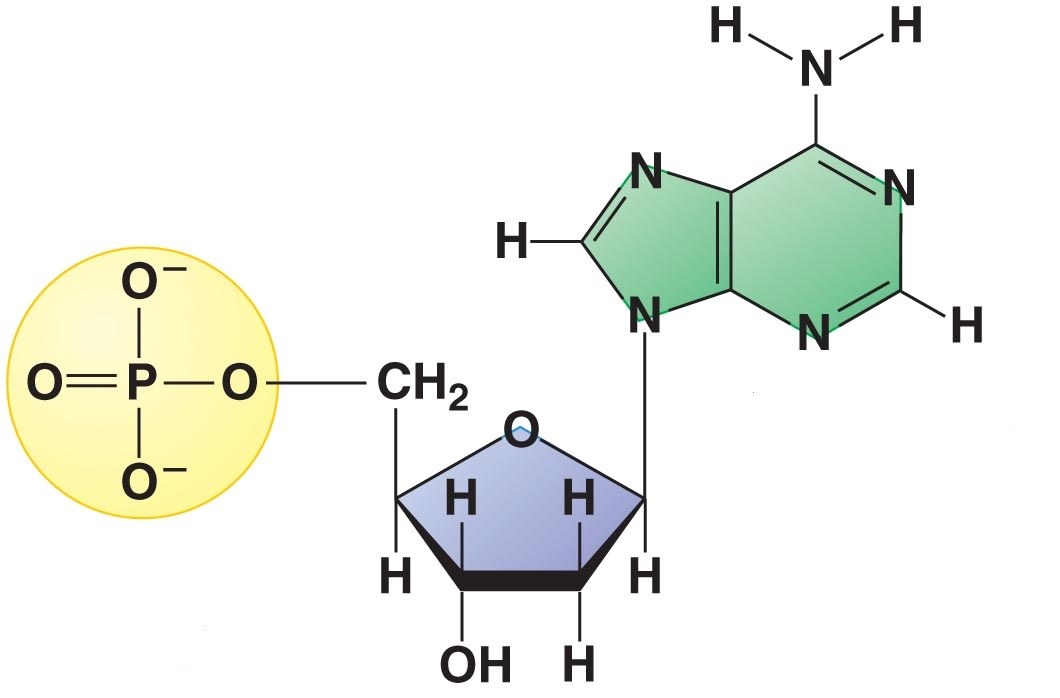
Name this structure
a)
double helix
b)
nucelotide
c)
twisted ladder
d)
hydrogen bond
29.
What does DNA stand for?
a)
Deoxyribonucleic acid
b)
Denitrogenous acid
c)
Deribonucleic acid
d)
Diribonucleic acid
30.
Which two scientists are accredited with correctly deducing the double helix model of DNA?
a)
Watson and Crick
b)
Wilkins and Franklin
c)
Wilkins and Crick
d)
Watson and Franklin
31.
Which process is used to make mRNA from the DNA in the nucleus?
a)
transcription
b)
translation
c)
replication 
32.
Which RNA bases would pair with TACGAA in transcription
a)
AUGCUU
b)
ATGCTT
c)
GCATCC
d)
GCAUCC
33.
How many amino acids are coded for by this sequence of nucleotides:
ATG GGA ACT CCA
a)
4
b)
2
c)
6
d)
12
34.
One difference between DNA and RNA is that....
a)
Only RNA has the base Uracil
b)
only RNA contains the base Thymine
c)
only RNA contains the base Cytocine
d)
only RNA contained the base Guanine
35.
what does mRNA do?
a)
carry info from genes to ribosomes
b)
carry amino acids to ribosomes
c)
help with RNA splicing
d)
make up ribosomes
36.
Where does transcription take place?
a)
nucleus
b)
ribosome
c)
cytoplasm
d)
smooth ER
37.
A triplet of mRNA is called a
a)
codon
b)
anticodon
c)
amino acid
d)
peptide bond
38.
DNA codes for...
a)
cholesterol
b)
proteins
c)
fatty acids
d)
a sandwich
39.
What is occurring in this picture?
a)
Translation
b)
Replication
c)
Translocation
d)
Transcription
40.
How many different amino acids are there?
a)
15
b)
20
c)
40
d)
100
41.
Which is NOT required to make proteins
a)
DNA
b)
RNA
c)
Ribosomes
d)
lysosomes
42.

What is the building block of proteins?

a)

Monosacchrides

b)

Polysaccharides

c)

amino acids

d)

Triglycerides

43.
The job of tRNA is to
a)
carry amino acids to the ribisomes
b)
carry ribisomes to the ER
c)
carry glucose to mitochondria
d)
carry mRNA out of the nucleus
44.
What is the correct amino acid sequence for the mRNA code AUGCCAGUAUGA
a)
Met-Pro-Ala-Val
b)
Met-Pro-Val
c)
Tyr-Gly-His
d)
Tyr-Gly-Arg-His
45.
Who is responsible for producing this image?
a)
Francis Crick
b)
James Watson
c)
Rosalind Franklin
d)
Watson and Crick
46.
what does rRNA do?
a)
carry info from genes to ribosomes
b)
carry amino acids to ribosomes
c)
help with RNA splicing
d)
make up ribosomes
47.
Which type of RNA contains the codons?
a)
mRNA
b)
tRNA
c)
all RNA
d)
rRNA
48.
What type of gene mutation has occurred here? 
Normal-
T-G-A-C-C-A
Mutant-
T-G-A-C-C-A-A
a)
Base Substitution
b)
Base Deletion
c)
Base Insertion
d)
Frameshift 
49.
What type of gene mutation has occurred here? Normal-
AGA-TTC-ATA-GCG
Mutant-
AGA-TTC-AAT-AGC-G
a)
deletion frameshift
b)
insertion frameshift
c)
substitution
d)
nonsense
50.
A mutation that does NOT show up through protein function is called
a)
deletion mutation
b)
inversion mutation
c)
silent mutation
d)
transverse mutation
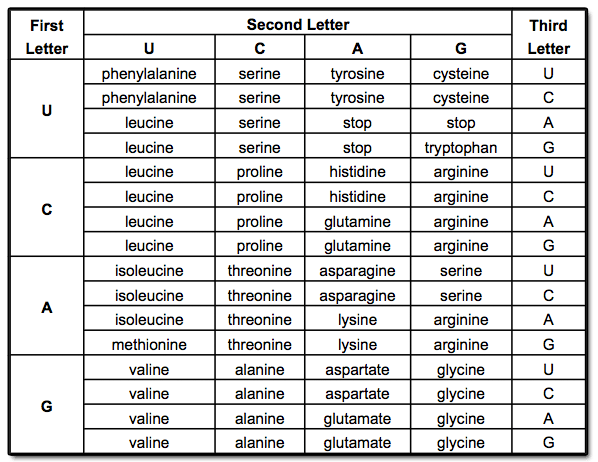
51.
Which amino acid is made from the RNA codon UUA?
a)
Phenylalanine
b)
Leucine
c)
Serine
d)
Tyrosine
52.
Which amino acid is made from the RNA codon GUA?
a)
Phenylalanine
b)
Leucine
c)
Serine
d)
Valine
53.
Which of the following is a correct difference between RNA and DNA?
a)
RNA is single stranded and DNA is double stranded
b)
RNA is double stranded and DNA is single stranded
c)
DNA uses Uracil and RNA uses Thymine
d)
RNA has deoxyribose and DNA has ribose
54.
What is the correct sequence?
a)
RNA --> DNA --> Protein
b)
Protein --> RNA --> DNA
c)
DNA --> RNA --> Protein
d)
DNA --> Protein --> RNA
55.
If an mRNA molecule has introns and exons in it, where is it?
a)
At a ribosome
b)
In the nucleus
c)
In a prokaryotic cell
d)
could be in the nucleus or the ribosome
56.
What enzyme is responsible for adding nucleotides to the growing RNA strand?
a)
DNA Polymerase
b)
RNA Primase
c)
RNA Polymerase
d)
Topoisomerase
57.
Put these in the correct order from first to last in translation:
Elongation
Termination
Initiation
a)
1) Elongation 2) Initiation 3)Termination
b)
1) Initiation 2) Termination 3) Elongation
c)
1) Initiation 2) Elongation 3) Termination
d)
1) Elongation 2) Termination 3) Initiation
58.
What role does RNA polymerase have in translation?
a)
Synthesizes the new mRNA molecule
b)
Synthesizes the amino acid chain
c)
Opens the DNA sequence
d)
none
59.
What type of bond is forming during translation?
a)
Peptide
b)
Polypeptide
c)
Glycosidic
d)
Hydrogen
60.
Which molecule can we find the promoter and terminator in?
a)
DNA
b)
mRNA
c)
tRNA
d)
polypeptide chain
61.
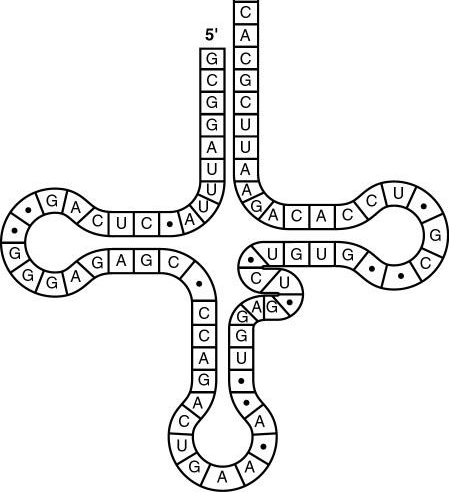
What structure of this molecule binds with the mRNA molecule?
a)
Amino Acid
b)
tRNA
c)
Anticodon
d)
Codon
62.
If a messenger RNA codon is UAC, which of the following would be the complementary anticodon triplet in the transfer RNA?
a)
ATG
b)
AUC
c)
AUG
d)
ATT
63.
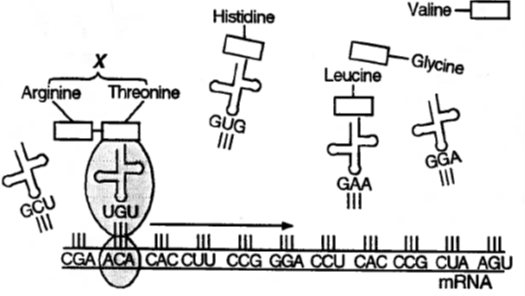
What is the name for this RNA --> proteins?
a)
translation
b)
transcription
c)
replication
d)
none of these
64.
What process is going on in this photo? 
a)
Transcription 
b)
Translation 
c)
Replication 
d)
All the above 
65.
A particular triple of bases in the coding sequence of DNA is AAA. The anticodon on the tRNA that binds the mRNA codon is
a)
UUU
b)
TTT
c)
AAA
d)
UUA
66.
Human DNA is:
a)
Single Stranded
b)
Double Stranded
67.
The role of DNA in your cells is:
a)
the main energy unit for the cell
b)
an energy storing molecule
c)
provide structure to the cell
d)
code for proteins
68.
Which enzyme builds the complementary strand of DNA from the template strand of DNA during DNA replication?
a)
RNA Helicase
b)
DNA Helicase
c)
RNA Polymerase
d)
DNA Polymerase
69.
What is a polymer made up of amino acids called?
a)
Polydiester
b)
Polypeptide
c)
Polypolymerase
d)
Polysaccharide
70.
Translation occurs:
a)
Outside of the Nucleus
b)
Inside of the Nucleus
71.
Translation is performed by:
a)
Ribosomes 
b)
Mitochondria
c)
Golgi Bodies
d)
Endoplasmic Reticulum 
72.
A mutation which causes the wrong amino acid to be placed into a polypeptide
a)
Nonsense
b)
Missense
c)
Silent
73.
A mutation which causes a stop codon before the polypeptide is completed
a)
Nonsense
b)
Missense
c)
Silent
74.
Frameshift mutations are caused by:
a)
Insertions & Deletions
b)
Substitutions 
75.
The percentage of adenine in DNA is equal to 45%, what is the percent of cytosine in the same DNA?
a)
45
b)
10
c)
5
d)
0
76.
What did Erwin Chargaff conclude from his experiments?
a)
Nitrogen bases are held together by peptide bonds
b)
A and T, C and G always occur in equal amounts
c)
Proteins are the carriers of genetic information
d)
C and G rarely occur in eukaryotic organisms
77.
What does this image show?
a)
Double Helical Structure of DNA
b)
Triple Helical Structure of DNA
c)
I don't know, is that a Rorschach test?
d)
The image is inconclusive
78.
Who was responsible for the experiment depicted by the image/data table?
a)
Rosalyn Franklin
b)
Watson and Crick
c)
Erwin Chargaff
d)
Frederick Griffith
79.
Who was responsible for the model shown?
a)
Rosalyn Franklin
b)
Watson and Crick
c)
Erwin Chargaff
d)
Franklin Griffin
80.
Who was responsible for the experiment depicted by the image/data table?
a)
Hershey & Chase
b)
Watson and Crick
c)
Erwin Chargaff
d)
Rosalind Franklin
81.
Hershey & Chase used radioactive _______ to label the DNA core of the bacteriophage.
a)
Phosphorus
b)
Nitrogen
c)
Carbon
d)
Sulfur
82.
When Hershey and Chase radioactively labeled the DNA of the bacteriophage, they found radioactive phosphorous _____.
a)
in the bacterial cells
b)
in the liquid medium
c)
Both A & B
83.
Where can you find ribosomes inside of eukaryotic cells? 
a)
only inside of the nucleus
b)
free-floating
c)
attached to the Endoplasmic Reticulum
d)
both free-floating and attached to the Endoplasmic Reticulum
84.
How many pieces make up a ribosome?
a)
1
b)
2
c)
3
d)
4
85.
How many ribosomes are there in a cell?
a)
17
b)
356
c)
564,897
d)
it varies
86.
After a ribosome synthesizes a polypeptide, what happens to the ribosome?
a)
it leaves the cell
b)
it is broken down or re-used
c)
it never synthesizes polypeptides
d)
it sleeps
87.
A ribosome can be best described as...
a)
a protein factory
b)
a trash collector
c)
the powerhouse of the cell
d)
the brain of the cell
88.
What are ribosomes made of?
a)
tissue
b)
organelles
c)
ribosomal RNA molecules and proteins
d)
DNA
89.
Transcription begins at sequences called
a)
Start Codons
b)
Promoters
c)
Origins
d)
Introns
90.
Transcription produces RNA by copying the:
a)
Coding Strand
b)
Template Strand
91.
RNA polymerase creates RNA in the _________ direction
a)
5' to 3'
b)
3' to 5'
92.
Splicing is accomplished by:
a)
Spliceosomes
b)
DNA Ligase
c)
RNA Polymerase I
d)
SSBPs
93.
What is not done after Transcription?
a)
Chunking of mRNA into codons
b)
Intron Splicing
c)
5' Cap addition
d)
Poly A-tail added
94.
tRNA molecules move through the ribosome in the order:
a)
A-P-E
b)
E-P-A
c)
E-A-P
d)
P-E-A
95.
Translation begins with a(n):
a)
Start Codon
b)
Intron
c)
Promoter
d)
Origin
96.
The codon 5'-UAC-3' would have an anti-codon match:
a)
3'-AUG-5'
b)
3'-TAC-5'
c)
5'-AUG-3'
d)
5'-CAU-3'
97.
When the Ribosome reaches ________________ the process of translation stops
a)
Stop Codon
b)
Okazaki Fragment
c)
Terminator
d)
taq Polymerase
98.
The first tRNA molecule moves through the __________ sites in the ribosome
a)
A-P-E
b)
P-E
c)
E-P-A
d)
A-P
99.
The amino acid sequence of a polypeptide chain comprises the ____ structure of the protein.
a)
Primary
b)
Secondary
c)
Tertiary
d)
Quaternary
100.
Which enzyme fixes the Okazaki fragments in the lagging strand?
a)
Helicase
b)
Polymerase
c)
Ligase
d)
Primerase
101.
What are the gaps between the newly synthesized DNA on the lagging strand called?
a)
Okazaki fragments
b)
Polymer gaps
c)
Helicase fragments
d)
Acidic gaps
102.
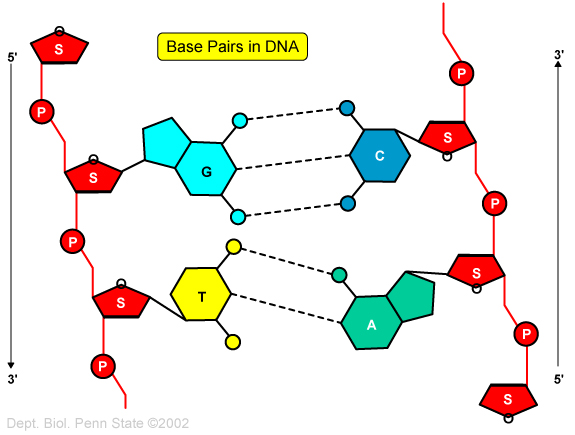
This picture is illustrating the ____ nature of DNA.
a)
anti-parallel
b)
deoxyribosic
c)
helical
d)
radioactive
103.
Polymerase is able to replicate the new DNA ______ along the leading strand.
a)
continuously
b)
only in short fragments
c)
very slowly
d)
prokaryotically
104.
How do the leading, and the lagging strands differ?
a)
The leading strand is synthesized in the same direction as the movement of the replication fork, and the lagging strand is synthesized in the opposite direction.
b)
The leading strand is synthesized at twice the rate of the lagging strand.
c)
The leading strand is synthesized in short fragments that are ultimately stitched together, whereas the lagging strand is synthesized continuously. 
d)
The leading strand is synthesized by adding nucleotides to the 3' end of the growing strand, and the lagging strand is synthesized by adding nucleotides to the 5? end. 
105.
Consider the replication bubble diagrammed at the right. Which letters represent leading strands? 
a)
W and X
b)
Y and Z
c)
W and Z
d)
X and Y
106.
Which enyzme would be found only on the lagging strand?
a)
DNA polymerase
b)
Primase
c)
Ligase
d)
Topoisomerase
107.
This Y shaped region where DNA is unwound to start replication is called...
a)
replication fork
b)
Leading strand
c)
Lagging strands
d)
replication splicing
108.

What mutation has occurred here?

T-G-A-C-C-A

T-G-A-G-C-A

a)

Substitution

b)

Deletion

c)

Insertion

d)

Frameshift

109.

Which of the following would result in a frameshift mutation?

a)

Insertions only

b)

Substitution only

c)

Deletion only

d)

Insertions and Deletions

110.

DNA molecule segment is : TTACGCAAG

The mutated DNA segment is TTCGCAAG. This is an example of ___ mutation.

a)

Substitution

b)

Deletion

c)

Insertion

d)

Inversion

111.

A mutation is defined as:

a)

A change in the cell's structure

b)

Anything that changes in an embryo

c)

Any change in the physical features of a human

d)

A change in the DNA sequence

112.

ATTTGAGCC- Original

ATTGAGCC - Mutated

The example above is an example of a

a)

Insertion- Frameshift

b)

Deletion- Substitution

c)

Deletion -Frameshift

d)

All of the above

113.

Why are insertion and deletion (frameshift) mutations so harmful?

a)

They change all of the codons from the mutation on down the line, which changes the amino acid sequence

b)

They insert things that an organism doesn't need.

c)

They often delete things that organisms need.

d)

Insertion and deletions are not any more harmful than substitution mutations.

114.

What mutation has occurred here?

T-G-A-C-C-A

T-G-A-G-C-A

a)

Substitution

b)

Deletion

c)

Insertion

d)

Frameshift

115.

Identify the DELETION mutation form the following:

ATG CCA AAT

a)

ATG TCA AAT

b)

ATG CCT AAA T

c)

ATC CA AT

d)

ATG CCA AAT

116.

Which mutation will cause translation to stop?

a)

Mutations 1 and 3 only

b)

Mutation 1 only

c)

Mutation 2 only

d)

Muations 1, 2, 3

117.

Which type of mutation does the model demonstrate?

a)

Deletion

b)

Substitution

c)

Insertion

d)

Translocation

118.

A promoter is a

a)

binding site for DNA polymerase

b)

binding site for RNA polymerase

c)

start signal for transcription

d)

stop signal for transcription

119.
What is the function of the poly-A tail in mRNA?
a)
to add modified guanin to the 3' end of the mRNA
b)
to indicate the site of translational termination
c)
to code for the binding of RNA polymerase to the DNA
d)
to help protect the mRNA from degradation by hydrolytic enzymes 
120.

What are the three key players in translation?

a)

Enzymes, hormones, and vitamins

b)

DNA, RNA, and proteins

c)

Lipids, carbohydrates, and nucleic acids

d)

mRNA, tRNA, and ribosomes

121.

What is the role of tRNA in translation?

a)

tRNA carries specific amino acids to the ribosome and matches them to the mRNA codon during translation.

b)

tRNA is responsible for producing ATP during translation.

c)

tRNA helps in DNA replication.

d)

tRNA transports lipids to the ribosome.

122.

Describe the process of elongation in translation.

a)

The mRNA adds amino acids to the growing polypeptide chain according to the ribosome sequence.

b)

The ribosome removes amino acids from the growing polypeptide chain according to the mRNA sequence.

c)

The tRNA adds nucleotides to the growing polypeptide chain according to the mRNA sequence.

d)

The ribosome adds amino acids to the growing polypeptide chain according to the mRNA sequence.

123.

What is the function of the P site in the large subunit?

a)

To phosphorylate the polypeptide

b)

To hold the growing polypeptide

c)

To assist with the tertiary structure of the polypeptide

d)

To perform the base pairing for the polypeptide

124.

Which of the following is the direction that mRNA is read?

a)

3' to 5'

b)

5' to 3'

c)

N terminus to C terminus

d)

C terminus to N terminus

125.

Which of the following describes the conversion factor between nucleic acids and proteins?

a)

3 amino acids = 1 nucleotide

b)

3 amino acids = 3 nucleotides

c)

3 nucleotides = 1 amino acid

d)

3 nucleotides = 3 amino acids

126.

RNA ploymerase synthesizes mRNA in the ____ direction.

a)

3'-->5'

b)

5'-->3'

c)

5'-->5'

d)

3'-->3'

127.

By copying itself, DNA replication insures the continuity of hereditary information.

a)

true

b)

false

128.
Which of the following events in translation is the first to occur in eukaryotes?
a)
elongation of the polypeptide
b)
base pairing of activated methionine-tRNA to AUG of the messenger RNA
c)
binding of the larger ribosomal subunit to smaller ribosomal subunits
d)
the small subunit of the ribosome recognizing and attaching to the 5'cap
129.
Which ribosome part contains a tRNA after it has dropped off its amino acid & is about to exit?
a)
A site
b)
P site
c)
E site
d)
B site
130.

Which enzyme is responsible for unwinding the DNA double helix during transcription?

a)

DNA polymerase

b)

Ribozyme

c)

RNA polymerase

d)

Helicase