wayground logo

Free Printable Worksheets

Font size

S
M
L
XL
Worksheets

Science II Term 3 Final Prep

Total questions: 70

Worksheet time: 1hrs 9mins

Name
Class
Date
1.
What is another name for natural selection?
a)
survival of the smartest
b)
survival of the fastest
c)
survival of the biggest
d)
survival of the fittest
2.

Which layer is the newest?

a)

1

b)

2

c)

3

d)

4

3.
What happens in divergent evolution? 
a)
organisms become more similar
b)
organisms become less similar
c)
species become more related
d)
adaptive radiation always occurs
4.

Sometimes bones in the front limbs of animals are very similar in structure. What do we call similar bone structures that indicate a link to a common ancestor?

a)

Adaptations

b)

Gradualism

c)

Homologous Structures

d)

Extinction

5.
What most likely caused the finches on the Galapagos Islands to have beaks that were different from the finches living on the South American mainland?
a)
The finches on the island had to drink salt water.
b)
There were different types of predators living on the island.
c)
The finches on the mainland built different types of nests
d)
There are different types of food available on the island.
6.

What is long periods of no change with quick bursts of rapid change in a species called?

a)

Gradualism

b)

Punctuated equilibrium

c)

Adaptive radiation

d)

Extinction

7.

What is slow change over a long period of time in a species called?

a)

Punctuated equilibrium

b)

Geographic equilibrium

c)

Homeostasis

d)

Gradualism

8.

Vestigial structures are structures that are:

a)

Still used

b)

No longer used

c)

Occasionally used

9.
In natural selection, the selective agent is the
a)
humans
b)
mutations
c)
breeders
d)
environment
10.
The preserved remains of traces of an organisms that lived in the past
a)
Adaptation
b)
Fossil
c)
Mutation
d)
Evolution
11.
This provides information about the history of life on earth and how organisms lived and evolved over time.
a)
fossil data
b)
fossil evidence
c)
fossil  record
d)
remains of fossil
12.
What does the image represent?
a)
Founder effect
b)
Bottleneck effect
c)
Natural Selection
d)
Mutations
13.
Which organisms are most likely to survive?
a)
the best adapted
b)
the fastest
c)
the strongest
d)
the most domesticated (tamed)
14.

Survival of the fittest means-

a)

organisms that are best able to reproduce

b)

organisms that are the strongest

c)

organisms that are the fastest

d)

organisms that are the top of the food chain

15.
The lava released by a volcanic eruption separates two populations of a species of monkey. What does this represent?
a)
biological isolation
b)
geographical isolation
c)
temporal isolation
d)
anatomical isolation
16.
What type of selection is depicted in the picture? 
a)
stabilizing 
b)
disruptive
c)
directional 
d)
the answer is not here
17.
What type of natural selection is this?
a)
Disruptive Selection
b)
Directional Selection
c)
Stabilizing Selection
d)
Sexy Selection
18.
There was once a large population of cheetah, but about 12,000 years ago most of the cheetahs were killed off because of human activity and only a few survived.  What is this an example of?
a)
Bottleneck Effect
b)
Genetic Drift
c)
Founder Effect
d)
Natural Selection
19.
Although their large and elaborate tail feathers make male peacocks more noticeable to predators and prevent them from flying, female peacocks prefer bright colored tails in mates.  What is this an example of?
a)
Sexual Selection
b)
Gene Flow
c)
Genetic Drift
d)
No Mutations
20.
What must members of the same population be able to do?
a)
Reproduce with each other
b)
Fight each other
c)
They must look the same
d)
They must act the same
21.
The type of genetic drift that follows the colonization of a new habitat by a small group of individuals is called
a)
the Hardy-Weinburg principle
b)
the founder effect
c)
directional selection
d)
the bottleneck effect
22.
Gentoo penguins will present a mate with a pebble that they find to attract a mate. Emperor penguins have a specific call and movement that they make to attract a mate. Which type of isolation do these penguins demonstrate?
a)
temporal isolation 
b)
behavioral isolation
c)
geographical isolation
d)
anatomical isolation
23.
What is the process in which humans breed organisms for certain traits?
a)
natural selection
b)
inheritance
c)
artificial selection
d)
descent withOUT modification
24.
Which of the following is NOT an example of natural selection? 
a)
People selectively breeding hamsters.
b)
Insect populations developing resistance to certain pesticides.
c)
Bacteria becoming resistant to antibiotics.
d)
Male birds of certain species developing colorful feathers to attract female mates.
25.
Which of the following is a term for a group of similar organisms that can reproduce fertile offspring?
a)
individual
b)
population
c)
species
d)
fossil
26.
B=brown eyes
b= blue eyes
What is true about two brothers that have brown eyes?
One has genotype BB the other Bb.
a)
they have same phenotype and genotype
b)
they have different genotypes and phenotypes
c)
they have same phenotype but different genotypes
d)
they have same genotype but different phenotypes
27.
What does heterozygous mean?
a)
An organism that has the same genes for a trait (TT or tt)
b)
An organism that has different genes for a trait (Tt)
c)
When neither gene is fully dominant; offspring is a mixture of both
d)
the different forms of a trait (hair color--> brown, blonde, red
28.
If a heterozygous tall pea plant is crossed with a short pea plant, what are the possible genotypes of the future offspring?
a)
100% Tt
b)
50% Tt, 50% tt
c)
75%Tt, 25%tt
d)
25%TT, 50%Tt, 25%tt
29.
If T=Tall & t=short, what is the genotypic ratio?
a)
1:3
b)
3:1
c)
1:2:1
d)
2:2
30.
Which process and type of resulting cells are represented?
a)
mitosis, gametes
b)
mitosis, body cells
c)
meiosis, gametes
d)
meiosis, body cells
31.
Which of the following cell types is formed by meiosis?
a)
muscle cells
b)
skin cells
c)
sperm cells
d)
blood cells
32.
Which best describes the process shown?
a)
mutation in which the DNA content of the gene is ltered
b)
segregation of sister chromatids
c)
condensation and segregation of the alleles
d)
crossing-over which alleles are exchanged
33.
What is one advantage of sexual reproduction?
a)
offspring are identical to parents
b)
offspring are resistant to viruses
c)
offspring are born live, rather thna from eggs
d)
offspring inherit a wider variety of genetic information
34.
The sex of an offspring is determined by ______________________.
a)
the mother
b)
the father
c)
the mother and the father
d)
by the environment
35.
What is a phenotype?
a)
The expression of a trait; what you see.
b)
refers to the genetic makeup of an individual
c)
An organism that has the same genes for a trait (ex. TT or tt)
d)
the passing of traits from parent to offspring
36.
The inherited combination of alleles is known as the offspring's
a)
heredity
b)
phenotype
c)
genotype
d)
redigree
37.
The man who studied genetics and came up with genetics is
a)
Watson
b)
Crick
c)
Mendel
d)
Darwin
38.
An offspring will receive how many alleles from each parent to determine a specific trait?
a)
one
b)
two
c)
three
d)
five
39.
the passing of genetic traits from parent to offspring.
a)
heredity
b)
trait
c)
gene
d)
allele
40.
Magda is a tall, 11 year old drummer. She has a scar on her right cheek. She is good at swimming. Which of her traits did Magda most likely inherit?
a)
height
b)
the scar
c)
ability to swim
d)
ability to play drums
41.
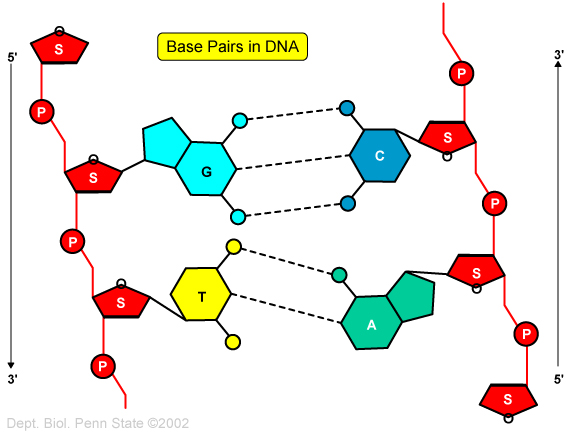
Which sequence of DNA bases would pair with this partial strand
ATG TGA CAG
a)
ATG TGA CAG
b)
TAC ACT GTC
c)
GTA AGT GAC
d)
CAT TCA CTG
42.
In a molecule of double-stranded DNA, the amount of Adenine present is always equal to the amount of
a)
cytosine
b)
guanine
c)
thymine
d)
uracil
43.
Guanine bonds with ______________.
a)
Adenine
b)
Guanine
c)
Cytosine
d)
Thymine
44.
Which organelle is DNA usually found in?
a)
cell membrane
b)
vacuole
c)
chloroplast
d)
nucleus
45.
Nitrogenous bases are joined by which type of bond?
a)
polar bonds
b)
ionic bonds
c)
covalent bonds
d)
hydrogen bonds
46.
What are the three components of a nucleotide?
a)
sugar, hydrogen, nitrogen base
b)
sugar, oxygen, nitrogen base
c)
sugar, phosphate, nitrogen base
d)
sugar, phosphate, protein
47.
The backbone of a DNA molecule is made from a ______________ and a _______________ group.
a)
lipid, carbon
b)
sugar, phosphate
c)
nitrogen, oxygen
d)
nitrogen, sulfur
48.
What are the four nitrogen bases?
a)
adenine, thymine, guanine, cytosine
b)
adenine, lysine, prolene, guanine
c)
arganine, cytosine, lysine, purine
d)
lysine, cytosine, lucine, guanine
49.

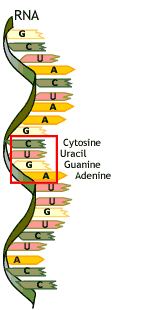
In RNA the base T is replaced with

a)

U

b)

G

c)

C

d)

A

50.
The three letter code is called a?
a)
script
b)
codon
c)
tri code
d)
gene
51.

The shape of the DNA molecule is a __________________?

a)

"S"

b)

helix

c)

double helix

d)

curve

52.
The sugar in DNA is ?
a)
sucrose
b)
glucose
c)
deoxyribose
d)
fructose
53.
A segment of DNA is called a
a)
Chromosome
b)
Gene
c)
Phenotype
d)
Genotype
54.
In RNA, Uracil pairs with ______. 
a)
cytosine
b)
adenine
c)
guanine
d)
thymine
55.
Contains the bases adenine, uracil, cytosine and guanine
a)
DNA
b)
RNA
c)
Both
56.
This cannot leave the nucleus
a)
DNA
b)
RNA
c)
Both
57.
This nucleic acid is single stranded
a)
DNA
b)
RNA
c)
Both
58.
Cell membranes are said to be
a)
selectively permeable
b)
non-permeable
c)
permeable
d)
psuedopermeable
59.
The function of the plasma membrane is....
a)
regulate what enters and leaves the cell.
b)
fight bacteria and viruses that enter the cell.
c)
make sure each cell reproduces 
d)
make sure each cell can move
60.
What makes up the cell membrane?
a)
 DNA
b)
 Phospholipids
c)
Steroids
61.
Which of the following body systems work together for support, protection, and movement?
a)
respiratory and cardiovascular
b)
skeletal and muscular
c)
skeletal and integumentary
d)
digestive and respiratory
62.
This system helps the body respond to signals and information from both inside and outside the body.
a)
Nervous System
b)
Muscular System
c)
Skeletal System
63.
My heart is a _________, that pumps blood through the body. 
a)
Cell
b)
Tissue
c)
Muscle
d)
Bone
64.
Which system takes oxygen into the body and eliminates carbon dioxide?
a)
immune
b)
nervous
c)
respiratory
d)
circulatory
65.
Directs all cell activities through the DNA located there.
a)
Lysosomes
b)
Nucleus
c)
ribosomes
d)
Mitochondria
66.
You might think of me as the trash collector, but recycler is maybe more accurate. What am I?
a)
mitochondria
b)
lysosome
c)
vacuole
d)
ribosome
67.
This organelle takes food and turns it into ENERGY for plant and animal cells.
a)
Chloroplast
b)
Mitochondria
c)
Lysosome
d)
Ribosome
68.
The site of photosynthesis
a)
ribosome
b)
mitochondria
c)
chloroplast
d)
nucleus
69.
What is the gel-like substance inside of cells called?

a)
photoplasm
b)
photosynthesis
c)
cytoskeleton
d)
cytoplasm
70.
The ___________ is the basic unit of life
a)
organ
b)
cell
c)
atom
d)
tissue