wayground logo

Free Printable Worksheets

Font size

S
M
L
XL
Worksheets

Unit 14: Respiratory System Review

Total questions: 105

Worksheet time: 1hrs 5mins
Name
Class
Date
1.
What is the main function of the respiratory system?
a)
to provide oxygen and remove carbon dioxide from the body
b)
to bring oxygen to the body
c)
to break down food and absorb nutrients
d)
to remove oxygen from the body and deliver carbon dioxide
2.
What are the main organs of gas exchange in the respiratory system?
a)
diapragm
b)
lungs
c)
trachea
d)
bronchi
3.
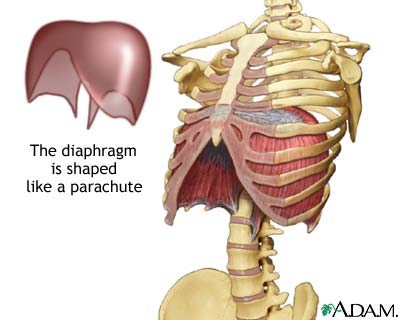
What is function of the dome-shaped diaphragm?
a)
This is where gas exchange happens.
b)
Air passes through the diaphragm on the way to the lungs.
c)
It attaches to the lungs to help in breathing.
d)
It is under the lungs and keeps them from falling down to your stomach.
4.
When you breathe, your lungs take in ___ and remove ___. 
a)
air/oxygen
b)
oxygen/carbon dioxide 
c)
carbon dioxide/waste 
d)
waste/air 
5.
What is the function of the bronchi?
a)
Transport air from nose to lungs
b)
Transport air from trachea to lungs
c)
Transport air from lungs to alveoli
d)
Transport air from alveoli to blood
6.
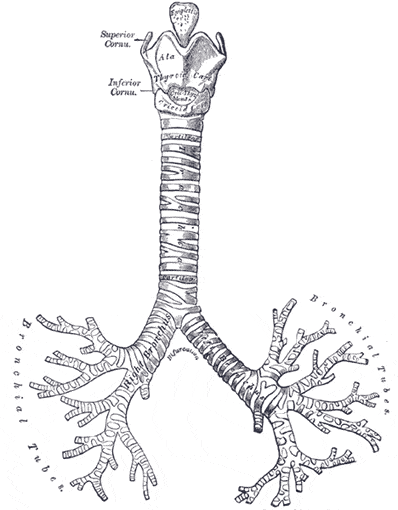
The two main branches from the trachea (one to each lung)
a)
bronchi
b)
alveoli
c)
capillaries
d)
bronchioles
7.
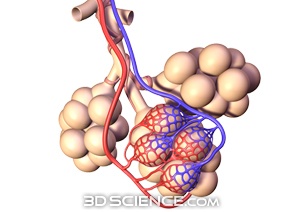
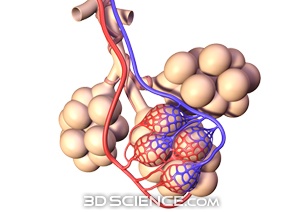
The air sacs that are covered with capillaries where gas exchange takes place
a)
bronchi
b)
lungs
c)
oxygen
d)
alveoli
8.
Within the lungs, the exchange of oxygen and carbon dioxide occurs between the ___ and the capillaries. 
a)
trachea 
b)
bronchi 
c)
alveoli
d)
diaphragm
9.
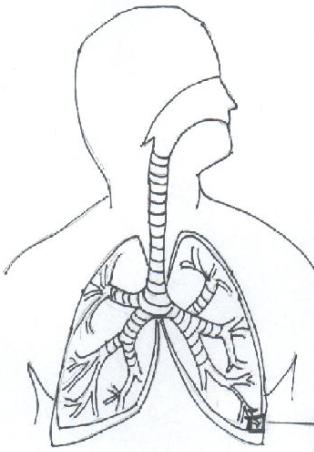
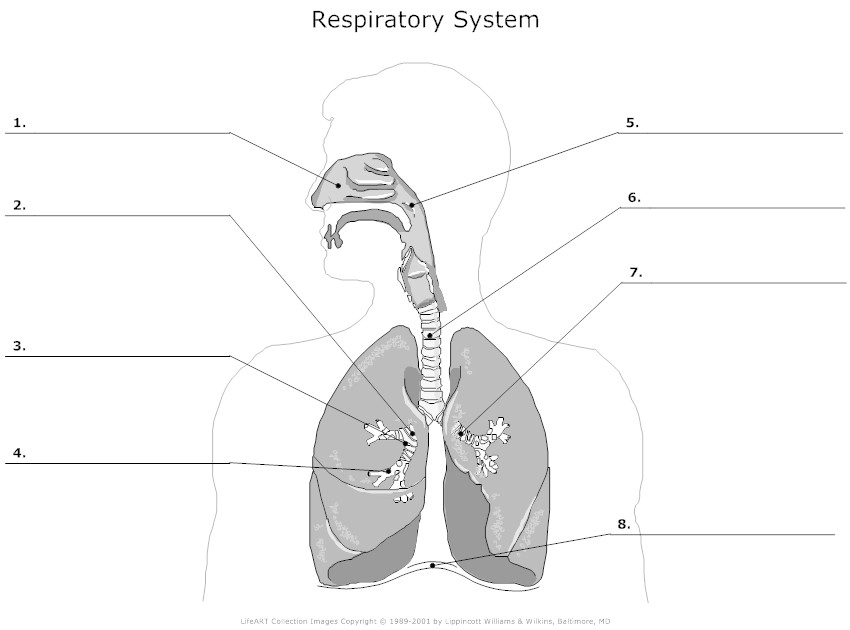
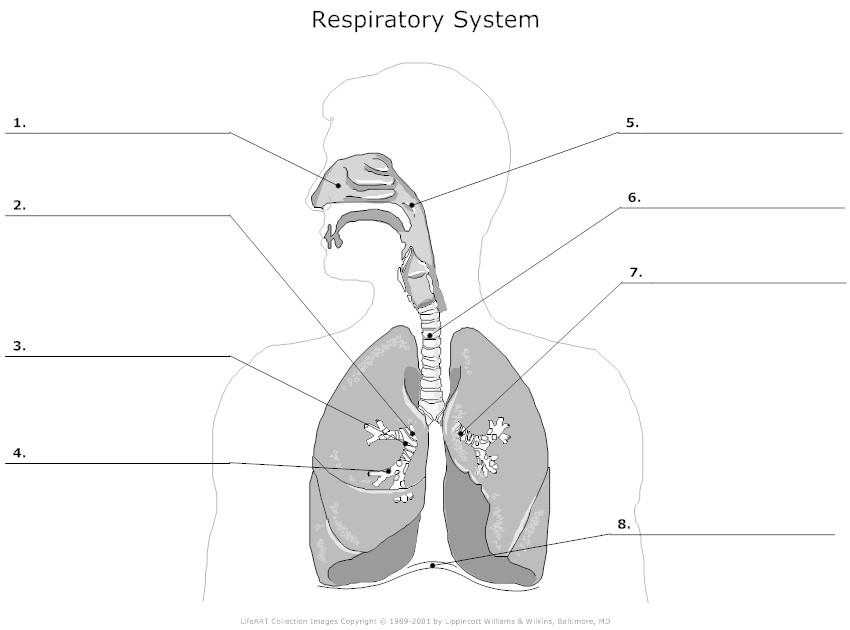
Name the organ label # 6. 
a)
alveoli 
b)
bronchi 
c)
trachea 
d)
lungs 
10.
What is tube that is also known as your wind pipe?
a)
esophogus
b)
bronchi
c)
trachea
d)
alveoli
11.
Name the structure labeled 8 
a)
lungs 
b)
trachea 
c)
diaphragm 
d)
alveoli 
12.
The passageway that is shared by both the digestive and respiratory system is the....
a)
larynx
b)
pharynx
c)
trachea
d)
nose
13.
Flap of skin that covers the opening to the windpipe during swallowing
a)
Stomach
b)
Trachea
c)
Pancreas
d)
Epiglottis
14.
The Pharynx is the muscle that moves the lungs
a)
True
b)
False
15.
What is the respiratory system ? 
a)
The respiratory system is the system that helps circulate our blood . 
b)
The respiratory system is the system that takes in oxygen and takes the unneeded particles and creates carbon dioxide. 
c)
The respiratory system is  a system that is similar to the circulatory system. 
d)
The respiratory system is a system that holds the heart as an internal organ. 
16.
What does the Larynx hold ?
a)
The larynx holds the whole respitory system. 
b)
The larynx holds the trachea. 
c)
The larynx holds the vocal chords. 
d)
The larynx hold the wind pipe. 
17.
True or false? The Respiratory system is known to have the brain as one of it's organs. 
a)
True 
b)
False 
18.
We receive oxygen and take out what from our bodies ? 
a)
Our need to live 
b)
Carbon Dioxide 
c)
Molecules unneeded to the body. 
d)
Chemicals needed to the body . 
19.
What happens when the organs such as the nose, throat , voice box , wind pipe, and the lungs work together?  
a)
They create the circulatory system.  
b)
They create esophagus and trachea.  
c)
When all of the organs work together they create the  external organ known to be the nose.  
d)
They help create the Respiratory System which then helps us to breathe. 
20.
What is the epiglottis ? 
a)
The epiglottis is the area where you swallow. 
b)
The eppiglotis holds the wind pipe.
21.
What is the main bone structure that protects the lungs
a)
Vertebrae
b)
Rib cage
c)
Skull
d)
Pelvis
22.
What is the function of the bronchi (bronchial tubes)?
a)
Transport air from nose to lungs
b)
Transport air from trachea to lungs
c)
Transport air from lungs to alveoli
d)
Transport air from alveoli to blood
23.
What are the most five important organs part of the respiratory system? 
a)
The nose,throat,lungs, and sub system 
b)
The nose,throat ,windpipe,voice box, lungs 
c)
Nose , Trachea
d)
Nose, Trachea, windpipe,oesphogus,lungs 
24.
How is carbon dioxide released from the body? 
a)
When we exhale
b)
When we urinate
c)
When we sweat
d)
When we inhale
25.
What is an other word for windpipe?
a)
Larynx
b)
Trachea
c)
Oesophagus
d)
Diaphragm
26.

The beginning of the respiratory system that warms and moistens the air.

a)

trachea

b)

nares

c)

bronchi

d)

diaphragm

27.
Given the following structures:
1. larynx
2. nasal cavity
3. pharynx
4. trachea
Which of the following is the correct order that air would flow during inhalation. 
a)
1,2,3,4
b)
2,3,1,4
c)
2,1,3,4
d)
4,2,3,1 
28.
What is the small flap of tissue called that covers the air-only passage when we swallow?
a)
Bronchioles
b)
Larynx
c)
Alveoli
d)
Epiglottis
29.
Cellular respiration needs two reactants. 
They are....
a)
Carbon dioxide and water 
b)
energy and food
c)
glucose and oxygen 
d)
nitrogen and fluid 
30.

What is the protein that carries oxygen in blood?

a)

Hemogoblin

b)

Harry Pote

c)

Respiratory System

d)

Estrogen

31.
The passageway that is shared by both the digestive and respiratory system is the....
a)
larynx
b)
pharynx
c)
trachea
d)
nose
32.
The Pharynx is the muscle that moves the lungs
a)
True
b)
False
33.

The fatty substance that lines the inner surface of the alveoli.

a)

ciliated mucus

b)

pleural fluid

c)

mucus

d)

surfactant

34.

In what body cavity are the lungs located?

a)

abdominal

b)

pelvic

c)

thoracic

d)

dorsal

35.

The thin, moist, slippery membrane that covers the lungs is.

a)

alveoli

b)

pleura

c)

surfactant

d)

sinus

36.

What respiratory structure serves as a common passage way for air and food?

a)

Epiglottis

b)

Larynx

c)

Pharynx

d)

Trachea

37.

Which structure extends from the larynx, in front of the esophagus, and forms the two bronchi?

a)

Trachea

b)

Larynx

c)

Pharynx

d)

Epiglottis

38.

Joe blows into a spirometer and relaxes his diaphragm. This process is:

a)

aspiration

b)

exhalation

c)

inhalation

d)

sound production

39.

Blood transported from the cardiovascular system to cells and tissues in order for gases to the exchanged is:

a)

Aspiration

b)

External respirations

c)

Internal respiration

d)

Perspiration

40.

The medulla oblongata will trigger respiration in response to:

a)

Increase CO2 and increase O2 in the blood

b)

Increase CO2 and decrease O2 in the blood

c)

Increase in O2 and decrease in CO2 in the blood

d)

Decrease CO2 and decrease O2

41.

Organ that contains alveoli, bronchioles, and bronchi.

a)

Diffuse

b)

Kidney

c)

Drake

d)

Lungs

42.
The two main branches from the trachea (one to each lung)
a)
bronchi
b)
alveoli
c)
capillaries
d)
bronchioles
43.
a flap of tissue that closes when we eat so food doesn't not go down the trachea
a)
larynx
b)
pharynx
c)
trachea
d)
epiglottis
44.
Letter B is pointing to which organ of the Respiratory System?
a)
Nose
b)
Trachea
c)
Lungs
d)
Diaphragm
45.
A chamber behind the nose and mouth that leads to the trachea
a)
pharynx
b)
trachea
c)
epiglottis
d)
larynx
46.
During exhalation the diaphragm moves up and the volume of air decreases in the lungs.
a)
True
b)
False
47.
cleans, moistens, and warms the air
a)
trachea
b)
larynx
c)
nasal passage
d)
windpipe
48.
The diaphragm is found:
a)
At the back of the throat.
b)
Below the larynx.
c)
Under the epiglottis.
d)
Under the rib cage.
49.
When you exercise, your heart beats faster to...
a)
spread oxygen throughout your body more quickly.
b)
make you feel excited.
c)
let you know you're working hard.
d)
inflate your lungs
50.
The movement of oxygen from the alveoli to the blood and from the blood to the tissues is due to the process of... 
a)
osmosis
b)
diffusion
c)
cytokinesis
d)
phagocytosis
51.
When the diaphragm contracts and moves down, the lungs are...
a)
expanding with air
b)
shrinking - pushing air out
52.
Given the following structures:
1. alveoli
2. bronchi
3. bronchioles
Which of the following is the correct order in which air would flow after inhalation? 
a)
1,2,3
b)
2,1,3
c)
2,3,1
d)
3,2,1
53.
Surfactant...
a)
decreases the surface tension of fluid in the alveoli
b)
increases the energy required to keep the lungs inflated
c)
makes the lungs tend to collapse
d)
traps foreign particles that enter the lungs
54.
Each lung is contained within the thoracic cavity, but is also surrounded by the pluera. 
a)
True
b)
False
55.
Which body function is made possible by the fibrous bands stretched across the larynx?
a)
swallowing
b)
breathing
c)
diffusion
d)
speech
56.
When the diaphragm relaxes...
a)
the volume of the thoracic cavity increases and the pressure decreases, causing air to rush into the lungs.
b)
the volume of the thoracic cavity decreases and the pressure increases causing air to rush out of the lungs. 
57.
Gases move from a lower pressure to a higher pressure. 
a)
True
b)
False
58.

The nasal septum divides the nose into two hollow sac's called?

a)

Nostrils

b)

Nasal cavities

c)

Nasal sinuses

59.

The process of respiration is controlled by what part of the brain?

a)

Cerebrum

b)

Mid brain

c)

Medulla Oblongata

d)

Pons

60.

Alveoli made of 1 layer squamous epithellial tissue & contain rich network of blood capillaries

a)

True

b)

False

61.

During expiration, the diaphragm and the intercostal Muscles do what?

a)

Contract

b)

Relax

62.

An increased amount of CO2 in the blood causes a_____ in rate of respiration?

a)

Increase

b)

Decrease

63.
The __________ are openings of the nose that allows air to enter.
a)
cavities
b)
septum
c)
nares
d)
cilia
64.
provides for a passageway for both food and air; throat
a)
pharynx
b)
larynx
c)
trachea
d)
bronchi
65.
leaflike piece of cartilage that closes the opening into the larynx during swallowing; prevents food and liquids from entering the respiratory tract
a)
bronchi
b)
bronchioles
c)
alveoli
d)
epiglottis
66.
tube extending from the larynx to center of the chest; carries air between the pharynx and bronchi; windpipe
a)
bronchi
b)
trachea
c)
alveoli
d)
bronchioles
67.
the process of breathing 
a)
inspiration 
b)
expiration
c)
ventilation
68.
the process of breathing in air; inhalation
a)
ventilation
b)
inspiration
c)
 expiration
d)
 respiration
69.
exchange of oxygen and carbon dioxide between the lungs and bloodstream
a)
external respiration
b)
internal respiration
c)
cellular respiration
70.
the exchange of carbon dioxide and oxygen between the tissue cells and the bloodstream
a)
external respiration
b)
internal respiration
c)
cellular respiration
71.
This part of the body is called
a)
pharynx
b)
larynx
c)
nasal cavity
d)
pneumonia
72.
Movement of air in and out of the lungs is known as:
a)
Ventilation
b)
Respiration
c)
Gas exchange
d)
Inspiration
73.
Which of the following is true?
a)
Oxygen diffuses along the concentration gradient from the alveoli into the capillaries
b)
Oxygen diffuses against the concentration gradient from the alveoli into the capillaries
c)
Oxygen diffuses along a concentration gradient from the capillaries to the alveoli
d)
Oxygen diffuses against the concentration gradient from the capillaries to the alveoli
74.
Which of the following are features of the alveoli that adapt them to gas exchange?
I. High surface area
II. Thin walls
III. Dry surfaces
a)
I and II only
b)
I only
c)
II and III
d)
I, II and III
75.
Which is the correct order of structures that air passes through?
a)
Trachea --> bronchi --> bronchioles --> alveoli
b)
Bronchi ---> trachea--> bronchioles --> alveoli
c)
Bronchioles --> bronchi --> trachea --> alveoli
d)
Trachea --> bronchioles --? bronchi --> alveoli
76.
Which of the following happens during inspiration?
a)
Diaphragm contracts
b)
Abdominal muscles contract
c)
External intercostal muscles relax
d)
Internal intercostal muscles contract
77.
Which of the following happens during expiration?
a)
Internal intercostal muscles contract
b)
External intercostal muscles contract
c)
Diaphragm contracts
d)
Abdominal muscles relax
78.
Gas exchange occurs by:
a)
simple diffusion
b)
osmosis
c)
active transport
d)
none of these
79.
Fresh air moving in and out of the lungs is:
a)
pulmonary ventilation
b)
external respiration
c)
internal respiration
d)
pulmonary expiration
80.

Air exchange between the capillaires and alveoli is

a)

ventilation

b)

external gas exchange

c)

internal gas exchange

d)

Respiratory gas transport

81.
the ____ look like a wasp's nest and is where the exchange of oxygen and carbon dioxide takes places.
a)
alveoli
b)
bronchial tubes
c)
lung
d)
diaphragm
82.
What is the function of the bronchi (bronchial tubes)?
a)
Transport air from nose to lungs
b)
Transport air from trachea to lungs
c)
Transport air from lungs to alveoli
d)
Transport air from alveoli to blood
83.
Tiny tubes that branch off of bronchi
a)
capillaries
b)
alveoli
c)
bronchioles
d)
pluera
84.
Choose the flowchart with the proper order of airflow into the body. 
a)
nose->pharynx->larynx->trachea->bronchi-> bronchioles->alveoli
b)
nose->larynx->pharynx->trachea->bronchi-> bronchioles->alveoli
c)
nose->pharynx->larynx->trachea->bronchioles-> bronchi->alveoli
d)
nose->bronchi->pharynx->larynx->trachea->bronchioles->alveoli
85.
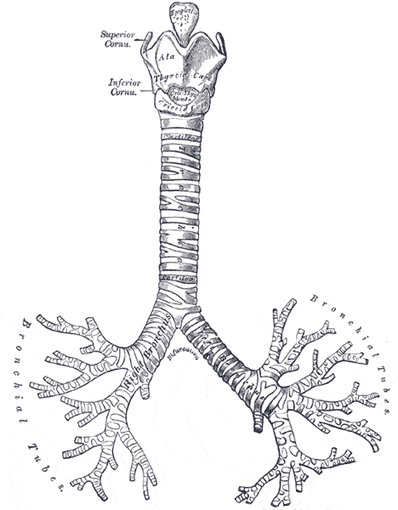
Marked box
a)
trachea
b)
brochial tree
c)
lung
d)
larynx
86.
E
a)
trachea
b)
bronchi
c)
alveoli
d)
bronchioles
87.
C
a)
trachea
b)
bronchi
c)
alveoli
d)
bronchioles
88.
What type of cells make up the respiratory membrane?
a)
cuboidal
b)
columnar
c)
pseudostratified
d)
squamous
89.
How does breathing into a paper bag help hyperventilation?
a)
increases CO2 concentration in blood
b)
increases O2 concentration in blood
c)
helps you to concentrate on breathing
d)
decreases air intake volume
90.
Where is the respiratory center?
a)
medulla and the pons
b)
frontal and dorsal cortex
c)
cerebellum and temporal lobe
d)
lower brain stem
91.
What type of tissue makes up the lungs?
a)
calciferous
b)
spongy
c)
bony
d)
fatty
92.
What carries carbon dioxide in the bloodstream?
a)
hemoglobin 
b)
acetate (C2H3O2)
c)
white blood cells
d)
bicarbonate (HCO3)
93.
What carries oxygen in the bloodstream?
a)
hemoglobin 
b)
acetate (C2H3O2)
c)
white blood cells
d)
bicarbonate (HCO3)
94.
What allows gas transfer across membranes?
a)
active transport
b)
diffusion between differing concentrations
c)
cell faciliation
d)
circulation
95.
External respiration is between the 
a)
lungs and cells
b)
blood and air
c)
blood and cells
d)
lungs and outside environment
96.
Internal respiration is between the
a)
blood and cells
b)
blood and air
c)
air and cells
d)
lungs and capillaries
97.
The respiratory epithelium is what type of epithelium?
a)
Simple columnar
b)
Pseudostratified ciliated columnar
c)
Stratified ciliated squamous
d)
Transitional
98.

Which of the following is found in the alveoli of the lungs?

a)

simple cuboidal

b)

simple squamous

c)

stratified cuboidal

d)

transitional

99.
This tissue is ONLY found lining the upper respiratory tract (trachea, bronchi, and bronchioles). The cells have cilia in order to sweep debris out of the lungs.
a)
Simple Squamous Epithelium
b)
Stratified Columnar Epithelium
c)
Transitional Epithelium
d)
Psuedostratified Columnar Epithelium
100.

Which peripheral nerve controls the diaphragm to regulate breathing?

a)

Obturator

b)

Phrenic

c)

Femoral

d)

Tibial

101.
The first place air enters in the respiratory system is 
a)
trachea
b)
primary bronchus
c)
pharynx
d)
external nares
102.
alveoli
a)
secrete a surfactant
b)
interface with capillaries
c)
are connected to one another via pores
d)
all of these
103.
Hemoglobin
a)
attracts oxygen with an iron atom
b)
becomes oxyhemoglobin when bonded to O2
c)
Gives blood its red color
d)
All of these
104.
a)
Left primary bronchus
b)
Right primary bronchus
c)
Left secondary bronchus
d)
Trachea
105.

Which nerve in the body controls the intercostal muscles?

a)

Phrenic nerve

b)

Thoracodorsal nerve

c)

Intercostal nerves

d)

Vagus nerve