
 Worksheets
Chem I: Bonding Exam Review
Total questions: 54
Worksheet time: 33mins
Name
Class
Date
1.

Choose the correct shape for this molecule:
a)
Trigonal planar
b)
Trigonal pyramidal
c)
Tetrahedral
d)
Linear
2.

Choose the correct shape for this molecule:
a)
Trigonal planar
b)
Trigonal pyramidal
c)
Bent
d)
Linear
3.

Choose the correct shape for this molecule:
a)
Bent
b)
Trigonal pyramidal
c)
Trigonal planar
d)
Linear
4.

Choose the correct shape for this molecule:
a)
Trigonal planar
b)
Trigonal pyramidal
c)
Bent
d)
Tetrahedral
5.

Choose the correct shape for this molecule:
a)
linear
b)
Trigonal pyramidal
c)
Bent
d)
Tetrahedral
6.

Choose the correct shape for this molecule:
a)
Tetrahedral
b)
Trigonal pyramidal
c)
Bent
d)
Trigonal planar
7.

Choose the correct shape for this molecule:
a)
Bent
b)
Trigonal pyramidal
c)
Tetrahedral
d)
Trigonal planar
8.

Choose the correct shape for this molecule:
a)
Bent
b)
Linear
c)
Tetrahedral
d)
Trigonal pyramidal
9.
According to VSEPR, molecules adjust their shapes to keep which of the following as far away as possible?
a)
Pairs of valence electrons
b)
Inner shell electrons
c)
Mobile Electrons
d)
Electrons closest to the nucleus
10.
What is the measure of a tetrahedral bond angle?
a)
90 Degrees
b)
109.5 Degrees
c)
120 Degrees
d)
180 Degrees
11.
Which of the following shapes has one or two lone pairs of electrons on the central atom?
a)
Bipyramidal
b)
Bent
c)
Trigonal Planar
d)
Tetrahedral
12.
The bond angle for a trigonal planar molecule is
a)
90 Degrees
b)
109.5 Degrees
c)
120 Degrees
d)
180 Degrees
13.
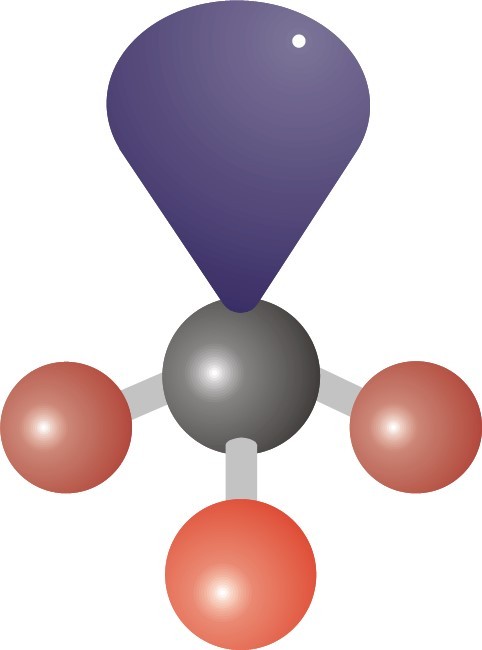
Who could this be?
a)
H2O
b)
NH3
c)
CO2
d)
CH4
14.
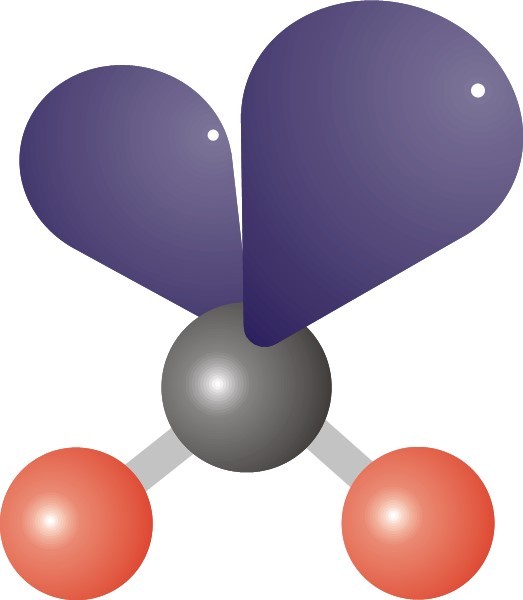
Who could this be?
a)
CO2
b)
NH3
c)
H2S
d)
CH4
15.
A bond where electrons are NOT shared equally?
a)
polar covalent
b)
nonpolar covalent
16.
VSEPR stands for ________ theory.
a)
Valence Structure of Electron Pyramids and Regression
b)
Varied Shell of Electrons Paired and Replaced
c)
Varied Shell Energy of Protons and Radiation
d)
Valence Shell Electron Pair Repulsion
17.
How many electrons are shared in a triple bond?
a)
6
b)
3
c)
6 pairs
d)
5
18.
What two types of atoms make a covalent bond?
a)
2 Nonmetals
b)
1 Nonmetal and 1 Metal
c)
2 Metals
d)
2 Noble Gases
19.
How are covalent bonds explained?
a)
When one atom takes the other atom's electron
b)
When the atom shares an electron with an another atom
c)
When the two nucleus merge
d)
When the neutrons leave the nucleus
20.

Will this molecule be polar or nonpolar? CCl4
a)
polar
b)
nonpolar
21.

Will this molecule be polar or nonpolar? PH3
a)
polar
b)
nonpolar
22.

*
a)
linear
b)
trigonal planar
c)
trigonal pyramid
d)
bent of angular
23.

*
a)
trigonal pyramid
b)
linear
c)
bent
d)
angular
24.
What is the shape of H2O?
a)
linear
b)
tetrahedral
c)
bent
d)
trigonal pyramidal
25.
What kind of bond occurs between the carbons in C2H2?
a)
single
b)
double
c)
triple
d)
quadruple
26.
What is the name of pairs of electrons that do not participate in bonding?
a)
outer pair
b)
unvalenced pair
c)
lone pair
d)
inner pair
27.
What kind of chemical bond forms between a metal and a nonmetal?
a)
Covalent bond
b)
Ionic bond
c)
Can be either covalent or ionic
d)
Hydrogen bond
28.

How many bonds can Hydrogen form?
a)
All the bonds
b)
One bond
c)
4 bonds
d)
Hydrogen can not form bonds
29.
Hydrogen is usually the central atom
a)
True
b)
False
30.

This molecule has______bond and is a _________molecule.
a)
non-polar; non-polar
b)
polar, polar
c)
polar,
non-polar
non-polar
d)
non-polar; polar
31.

This molecule has______bonds and is a _________molecule.
a)
non-polar; non-polar
b)
polar; non-polar
c)
polar; polar
d)
non-polar; polar
polar, pointing straight down
polar, pointing straight down
32.
Is the molecule H2O polar or non-polar?
a)
polar
b)
non-polar
33.
Is the molecule H2 polar or non-polar?
a)
polar
b)
non-polar
34.
Put these in increasing electronegativity order:
C, H, and O
C, H, and O
a)
H < C < O
b)
H < O < C
c)
O < C < H
d)
C < H < O
35.
What kind of bond do you have: Li and Cl
a)
Non-polar covalent
b)
Polar covalent
c)
ionic
d)
James Bond
36.
What kind of bond do you have: Br and Br
a)
Non-polar covalent
b)
Polar covalent
c)
ionic
d)
James Bond
37.
What kind of compound is CO2?
a)
Non-polar molecule with polar bonds
b)
Polar molecule with polar bonds
c)
ionic
d)
polar molecule with non-polar bonds
38.
Which has the greater electronegativity:
H, N, O or F?
H, N, O or F?
a)
H
b)
F
c)
N
d)
O
39.
The polarity of a bond between two elements can be best determined by
a)
The difference in electronegativity between the elements
b)
The difference in first ionization energy between the elements
c)
The number of electrons shared in the bond
d)
The difference in atomic radius between the elements
40.
Which two substances are covalent compounds?
a)
C6H12O6 (s) and KI (s)
b)
KI (s) and NaCl (s)
c)
C6H12O6 (s) and HCl (g)
d)
NaCl (s) and HCl (g)
41.
Which substance contains bonds that involve a transfer of electrons from one atom to another?
a)
CO2
b)
NH3
c)
KBr
d)
Cl2
42.
Which formula represents a polar molecule?
a)
H2
b)
H2O
c)
CO2
d)
CCl4
43.
When forming an ionic bond, a metal atom
a)
Gains electrons to form a cation
b)
Loses electrons to form a cation
c)
Gains electrons to form an anion
d)
Loses electrons to form an anion
44.
Which of the following elements has the weakest attraction for electrons in a chemical bond?
a)
S
b)
Cl
c)
O
d)
F
45.
Large differences in electronegativity result in __________ bonding between atoms.
a)
Covalent
b)
Mettalic
c)
Ionic
d)
Hydrogen
46.

In this Lewis structure, the symbol above F means...
a)
electrons are being transferred to Fluorine
b)
electrons are less attracted to F than H
c)
electrons are more attracted to F than H
d)
Fluorine has formed a cation
47.
what causes a partial charge on a molecule with 2 atoms? (dipoles)
a)
unequal sharing of electrons
b)
an electronegativity difference between 0.3 and <1.7
c)
electron spends more time around one of the atoms
d)
all of the above
48.
Hydrogen bonding occurs in molecules when ___________________.
a)
a hydrogen atom forms a covalent bond with another atom.
b)
a hydrogen atom in a molecule forms a bond with any atom.
c)
a hydrogen atoms form an ionic bond with another atom on an adjacent molecule.
d)
a hydrogen atom bonded to F, O or N is attracted to an electron pair on a F, O or N atom on an adjacent molecule.
49.
What explains the very high melting and boiling point of water
a)
Strong dipole-dipole bonds between water molecules
b)
Strong hydrogen bonds between water molecules
c)
Dispersion forces which are present in all molecules
d)
Asymmetrical shape of the polar bonds.
50.
Hydrogen bonding occurs when hydrogen is bonded to N, O, or F. Which of the following has hydrogen bonding?
a)
CBr4
b)
NO2
c)
H2S
d)
NH3
51.
Does H2S have hydrogen bonding?
a)
yes
b)
no
52.
Does HF have hydrogen bonding?
a)
yes
b)
no
53.
Does CH4 have hydrogen bonding?
a)
yes
b)
no
54.
A substance capable of hydrogen bonding has a ___________ boiling point than a similar substance that doesn't hydrogen bond.
a)
higher
b)
lower
100 %

