
 Worksheets
Atmosphere and Weather Review
Total questions: 98
Worksheet time: 1hrs 17mins
Name
Class
Date
1.
Condition of Earth's atmosphere at a particular time & place
a)
climate
b)
biogeography
c)
precipitation
d)
weather
2.
Earth's atmosphere is held down by
a)
radiation
b)
gravity
c)
magnetism
d)
conduction
3.
Two gases that make up 99% of Earth's atmosphere
a)
carbon dioxide & oxygen
b)
nitrogen & carbon dioxide
c)
nitrogen & oxygen
d)
nitrogen & water vapor
4.
Percentage of Earth's atmosphere that carbon dioxide makes up
a)
less than 1%
b)
5%
c)
20%
d)
80%
5.
Layer of Earth's atmosphere where most of the water vapor and carbon dioxide is found
a)
thermosphere
b)
mesosphere
c)
stratosphere
d)
troposphere
6.
Layer of Earth's atmosphere where weather occurs
a)
thermosphere
b)
mesosphere
c)
stratosphere
d)
troposphere
7.
Layer of Earth's atmosphere in which we live
a)
thermosphere
b)
mesosphere
c)
stratosphere
d)
troposphere
8.
Earth's ozone layer is important because it absorbs
a)
visible light
b)
ultraviolet radiation
c)
x-rays
d)
radio waves
9.
Layer of Earth's atmosphere that contains most of the ozone
a)
thermosphere
b)
mesosphere
c)
stratosphere
d)
troposphere
10.
Uppermost layer of Earth's atmosphere
a)
thermosphere
b)
mesosphere
c)
stratosphere
d)
troposphere
11.
Warm air rises and creates
a)
low pressure
b)
medium pressure
c)
high pressure
d)
uneven pressure
12.
Cold air sinks and creates
a)
low pressure
b)
medium pressure
c)
high pressure
d)
uneven pressure
13.
Which gas in our atmosphere is most abundant?
a)
Argon
b)
Oxygen
c)
Nitrogen
d)
Carbon Dioxide
14.
In which layer does the atmosphere have the greatest density of air molecules?
a)
mesosphere
b)
thermosphere
c)
stratosphere
d)
troposphere
15.
What is the percentage of oxygen in Earth's atmosphere?
a)
99%
b)
21%
c)
78%
d)
15%
16.
What is the percentage of nitrogen in Earth's atmosphere?
a)
17%
b)
21%
c)
78%
d)
90%
17.

What DECREASES as you travel up in the atmosphere?
a)
Altitude
b)
Atmosphere
c)
Meteors
d)
Air Pressure
18.
Which of the following is NOT a reason why the atmosphere is important?
a)
It is made of many layers.
b)
It provides gases living things need.
c)
It provides warm temperatures.
d)
It protects us from UV rays and meteors.
19.
In what layer of earth's atmosphere do meteoroids burn up?
a)
Mesosphere
b)
Thermosphere
c)
Tropsphere
d)
Stratosphere
20.
Considered to be a part of the thermosphere.
a)
ionosphere
b)
thermosphere
c)
troposphere
d)
mesosphere
21.
The coldest layer.
a)
troposphere
b)
thermosphere
c)
exosphere
d)
mesosphere
22.
The hottest layer.
a)
troposphere
b)
thermosphere
c)
exosphere
d)
mesosphere
23.
Where satellites orbit.
a)
troposphere
b)
thermosphere
c)
exosphere
d)
mesosphere
24.
Where you will find Aurora Borealis (Northern Lights)
a)
troposphere
b)
ionsophere
c)
exosphere
d)
mesosphere
25.
Which order is correct from the earth to space?
a)
thermosphere
troposphere
exosphere
mesosphere
stratosphere
ionosphere
troposphere
exosphere
mesosphere
stratosphere
ionosphere
b)
thermosphere
troposphere
stratosphere
exosphere
mesosphere
ionosphere
troposphere
stratosphere
exosphere
mesosphere
ionosphere
c)
exosphere
ionosphere
thermosphere
mesosphere
stratosphere
troposphere
ionosphere
thermosphere
mesosphere
stratosphere
troposphere
d)
troposphere
thermosphere
troposphere
stratosphere
exosphere
mesosphere
thermosphere
troposphere
stratosphere
exosphere
mesosphere
26.
What does the earth's atmosphere do?
a)
help to regulate the temperature on Earth
b)
Help UV rays to reach the Earth's surface
c)
Creates meteors in the sky
d)
Keep ocean waters cold
27.
Which statement is true?
a)
The troposphere has the highest temperature because of the distance from the Sun
b)
The troposphere has the highest pressure because gravity keeps the air down.
c)
The exosphere has the highest temperature because of the distance from the Sun
d)
The exosphere has the highest pressure because gravity keeps the air down.
28.
As you go higher in the troposphere, the temperature _______________.
a)
decreases
b)
increases
c)
stays the same
29.
When I cold front is approaching, what happens?
a)
warm air is pushing under cold air causing humid weather and lower temperatures
b)
warm air is pushing under cold air causing humid weather and higher temperatures
c)
warm air rises, cools, and causes rain and thunderstorms
d)
cold air is pushed over warm air causing rain and thunderstorms
30.
When a warm front is approaching, what happens?
a)
advancing cold air pushes up and over retreating warm air causing warm temperatures and mild rain
b)
advancing warm air pushes up and over retreating cold air causing warm temperatures and mild rain
31.
If an air mass is rising, it must be
a)
cold and less dense
b)
cold and more dense
c)
warm and more dense
d)
warm and less dense
32.
If an air mass is sinking, it must be
a)
cold and less dense
b)
cold and more dense
c)
warm and more dense
d)
warm and less dense
33.
In a high pressure area, the weather will likely be
a)
warmer and clear skies
b)
warm but cloudy
c)
cold and rainy
d)
cold and clear
34.
In a high pressure systems
a)
there are few clouds because the air in moving downward
b)
there are many clouds because the air is very humid
c)
there are few clouds because the air is moving outward
d)
there are many clouds because the air is moving upward
35.
When two air masses meet and weather occurs, what is created?
a)
Fronts
b)
Weather
c)
Climate
d)
Seasons
36.

What does this symbol on a weather map indicate?
a)
High pressure system
b)
Low pressure system
c)
Cold front
d)
Warm front
37.

What does this symbol on a weather map indicate?
a)
High pressure system
b)
Low pressure system
c)
Cold Front
d)
Warm Front
38.
Winds are caused by differences in
a)
precipitation
b)
humidity
c)
air pressure
d)
turbulance
39.

What does this weather instrument (shown here) measure?
a)
wind speed
b)
air pressure
c)
amount of fallen rain
d)
temperature
40.

This weather instrument measures air pressure.
a)
anemometer
b)
barometer
c)
rain gauge
d)
wind vane
41.

This weather instrument measures the speed of wind.
a)
anemometer
b)
barometer
c)
rain gauge
d)
wind vane
42.
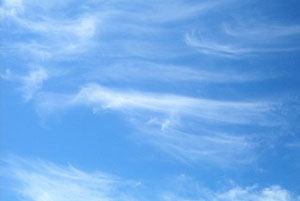
This type of cloud is thin, wispy, and made of ice crystals
a)
cumulus cloud
b)
stratus cloud
c)
cirrus cloud
d)
cumulonimbus cloud
43.
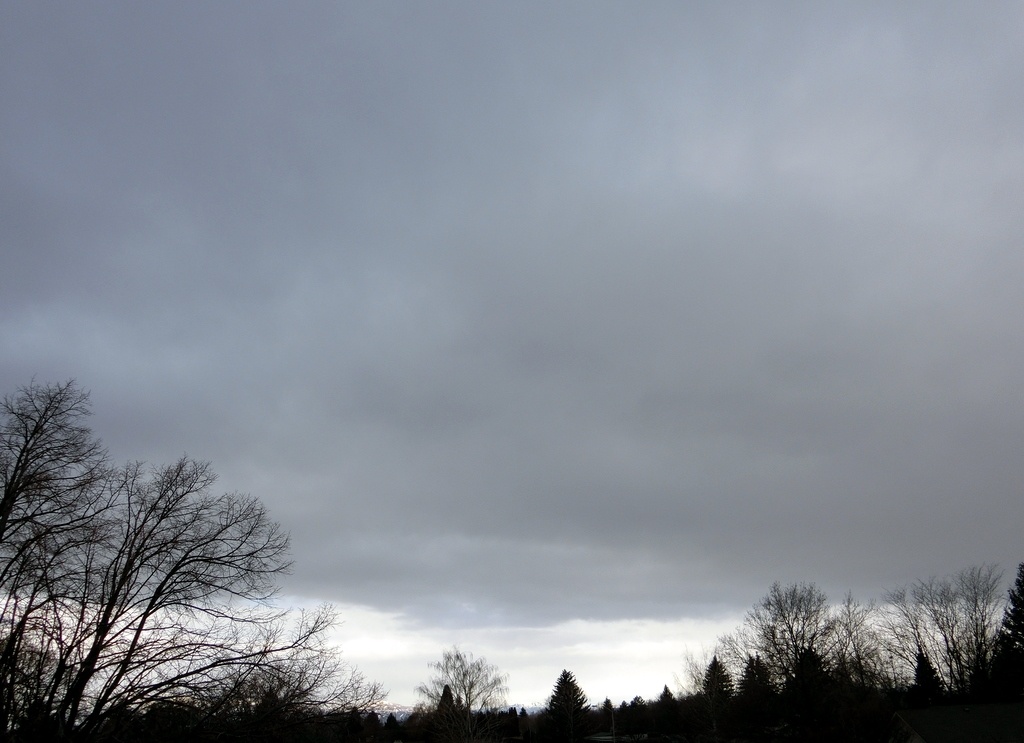
This type of cloud is thin and flat, and the edges are not clearly defined
a)
cirrus cloud
b)
cumulus cloud
c)
stratus cloud
d)
cumulonimbus cloud
44.
This type of cloud is thick and puffy on top, and generally flat on the bottom. It has well-defined edges and can change shape rapidly.
a)
cumulus cloud
b)
stratus cloud
c)
cirrus cloud
d)
cloud 9
45.
Nimbostratus and cumulonimbus clouds can signal what type of upcoming weather?
a)
fair skies
b)
hot, sunny weather
c)
windy weather
d)
rainy weather
46.
Cumulus and cirrus clouds can signal what type of upcoming weather?
a)
fair skies
b)
hot, sunny weather
c)
windy weather
d)
rainy weather
47.

what type of cloud is shown?
a)
cumulus
b)
cirrus
c)
stratus
48.

Cumulonimbus clouds mean ...
a)
fair weather (nice)
b)
thunderstorms
c)
rain/storms coming
d)
long periods of rain
49.

Identify the cloud type.
a)
altocumulus
b)
cirrostratus
c)
nimbostratus
d)
cirrus
50.

Identify the cloud type.
a)
nimbostratus
b)
cumulonimbus
c)
cirrus
d)
altocumulus
51.

Identify the cloud type.
a)
stratocumulus
b)
cirrostratus
c)
altostratus
d)
nimbostratus
52.
Which root means "medium" elevation?
a)
cirro
b)
alto
c)
nimbo
d)
cumulus
53.
Which root word means flat and layered?
a)
stratus
b)
cumulus
c)
nimbus
d)
cirro
54.
Which root word means wispy and feathery?
a)
cirrus
b)
stratus
c)
cumulus
d)
nimbus
55.
Which type of clouds form at high elevations and are made of ice crystals?
a)
cumulus
b)
altostratus
c)
nimbostratus
d)
cirrus
56.

What does this symbol on a weather map indicate?
a)
High pressure system
b)
Low pressure system
c)
Cold front
d)
Warm front
57.

What does this symbol indicate on a weather map?
a)
High pressure system
b)
Low pressure system
c)
Cold front
d)
Warm front
58.
What kind of weather is usually associated with a high pressure system?
a)
Sunny weather
b)
Precipitation (rain, snow, etc.)
59.
Which weather tool measures air pressure?
a)
thermometer
b)
barometer
c)
anemometer
d)
psychrometer
60.
This weather tool measures wind speed and direction
a)
thermometer
b)
barometer
c)
anemometer
d)
psychrometer
61.
Which weather tool measures temperature?
a)
thermometer
b)
barometer
c)
psychrometer
d)
anememeter
62.
Mark looks at the clouds in the sky and decides that he does not need to
take his umbrella with him today. Which clouds did Mark most likely see
in the sky?
take his umbrella with him today. Which clouds did Mark most likely see
in the sky?
a)
cirrus
b)
nimbostratus
c)
cumulonimbus
63.
Which type of cloud is most often observed during a thunderstorm?
a)
cirrus
b)
stratus
c)
cumulus
d)
cumulonimbus
64.
Hot air (RISES / FALLS) __________.
a)
RISES
b)
FALLS
65.
Cold air (RISES/ FALLS) _________.
a)
RISES
b)
FALLS
66.
Which condition usually means cloudy, stormy weather?
a)
high pressure
b)
low pressure
67.

name this front
a)
warm front
b)
cold front
c)
stationary front
d)
occluded front
68.
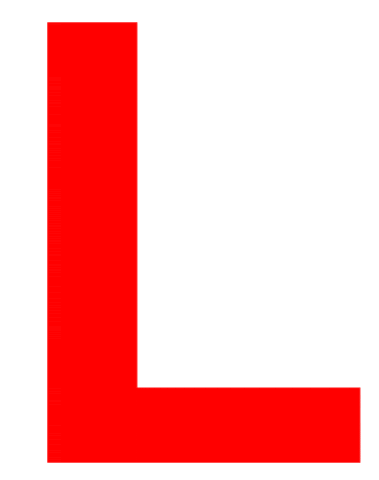
What does this symbol on a weather map indicate?
a)
High pressure system
b)
Low pressure system
c)
Cold front
d)
Warm front
69.
When a warm air mass gently slides on top of a cold air mass, and you have drizzly rain and then warmer weather, what type of front is it?
a)
warm front
b)
cold front
c)
occluded front
d)
stationary front
70.

What type of storm front is this?
a)
warm front
b)
cold front
c)
stationary front
d)
occluded front
71.
What are the daily conditions of temperature, humidity and precipitation?
a)
weather
b)
climate
72.
____________ is any form of water that falls from clouds and reaches Earth's surface
a)
snow
b)
precipitation
c)
rain
d)
sleet
73.
What kind of precipitation is it when raindrops fall as liquid water but freeze when they touch a cold surface?
a)
freezing rain
b)
snow
c)
hail
74.
A _______ forms when water vapor in a cloud is converted directly into ice crystals.
a)
hail storm
b)
raindrop
c)
snowflake
75.
True or False. Rain, freezing rain, and sleet all are forms of precipitation that start to fall as liquid water.
a)
True
b)
False
76.
Ice particles smaller than 5 millimeters in diameter are called __________.
a)
hailstone
b)
sleet
c)
snow
77.
What is the most common type of precipitation?
a)
rain
b)
snow
c)
sleet
d)
hail
78.
What types of air masses form over oceans?
a)
Maritime
b)
Continental
c)
Polar
d)
Tropical
79.
A dry and cold air mass would be...
a)
Maritime polar
b)
Continental polar
c)
Maritime tropical
d)
Continental tropical
80.
A dry and hot air mass would be...
a)
Maritime arctic
b)
Maritime tropical
c)
Continental tropical
d)
Continental polar
81.
A severe storm that develops over tropical oceans
a)
hurricane
b)
tornado
c)
thunderstorm
82.
A violent, dangerous, rotating column of air that is in contact with both the surface of the earth and a cloud.
a)
Hurricane
b)
Tornado
c)
Thunderstorm
83.
A heavy storm that is accompanied by rain, thunder, lightning, and strong winds.
a)
Hurricane
b)
Tornado
c)
Thunderstorm
84.

a)
hurricane
b)
tornado
c)
thunderstorm
85.

a)
hurricane
b)
tornado
c)
thunderstorm
86.
Usually last an hour or hours.
a)
Hurricane
b)
Tornado
c)
Thunderstorm
87.
Form anywhere, generally along cold fronts
a)
hurricane
b)
tornado
c)
thunderstorm
88.
Form in the Caribbean or Atlantic Ocean.
a)
Hurricane
b)
Tornado
c)
Thunderstorm
89.
Most form in the central plains states.
a)
Hurricane
b)
Tornado
c)
Thunderstorm
90.

A cold front is approaching Minneapolis. What will happen to the air temperature?
a)
stay the same
b)
increase
c)
decrease
91.
The Earth's ____________ is the layer of gases that surround the planet and make it possible for living things to survive on Earth.
a)
atmosphere
b)
water cycle
c)
shell
d)
land
92.
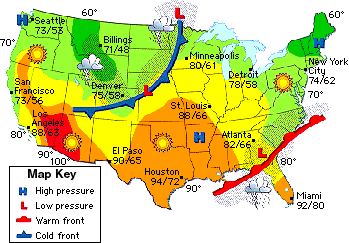
A low pressure system is located over Georgia. What type of weather will they have?
a)
clear, sunny skies
b)
cloudy and rainy
93.
A high pressure system is located north of New York City. What type of weather will be experienced there?
a)
clear, sunny skies
b)
cloudy and rainy
94.

a)
Warm Front
b)
High Air Pressure
c)
Cold Front
d)
High Temperatures
95.

a)
High Pressure
b)
Warm Front
c)
Cold Front
d)
Mountains
96.
Low Pressure is associated with this type of weather...
a)
Cloudy/Overcast Weather
b)
Cold Weather
c)
Warm Weather
d)
Fair Weather
97.
Our weather generally moves in this direction...
a)
West to East
b)
East to West
c)
North to South
d)
South to North
98.
____________ air sinks/falls because it is ____________dense.
a)
Cold, More
b)
Warm, Less
c)
Cold, Less
d)
Warm, More
100 %

