wayground logo

Free Printable Worksheets

Font size

S
M
L
XL
Worksheets

GSCE Unit 2 Chemistry

Total questions: 206

Worksheet time: 4hrs 9mins

Name
Class
Date
1.
a)
2
b)
3
c)
5
2.
a)
2
b)
6
c)
10
d)
16
3.
Which pair of elements have similar chemical properties?
a)
H and He
b)
Na and Cs
c)
Na and Mg
d)
Mg and Al
4.
What are ionic bonds?
a)
valence electrons transferred between atoms
b)
Inner most electrons transferred between atoms
5.
An atom that has gained or lost electrons is called ...
a)
a winner
b)
an isotope
c)
an ion
d)
a loser
6.
Atoms that gain electrons become...
a)
negatively charged
b)
positively charged
c)
remain neutrally charged
d)
21
7.
What is the charge on a chloride ion?
a)
-1
b)
1
c)
+2
d)
+1
8.

What is the formula for the compound between sodium and oxygen?

a)

Na2O

b)

NaO2

c)

Na2O2

d)

Na2O

9.
What two types of atoms make a covalent bond?
a)
2 Nonmetals
b)
1 Nonmetal and 1 Metal
c)
2 Metals
d)
2 Noble Gases
10.
How are covalent bonds explained?
a)
When one atom takes the other atom's electron
b)
When the atom shares an electron with an another atom
c)
When the two nucleus merge
d)
When the neutrons leave the nucleus
11.
How many are shared in a single bond?
a)
2 pairs
b)
4
c)
2
d)
1
12.
How many are shared in a double bond?
a)
2
b)
4 pairs
c)
6
d)
4
13.
Are the atoms more stable when they are bonded together or when they are apart? 
a)
Bonded Together
b)
Apart
14.
Ionic Bonding involves...
a)
The transfer of protons
b)
The transfer of nuetrons 
c)
The transfer of electrons
d)
None Of the above
15.
What do atoms that form positive ions tend to do?
a)
Tend to lose electrons 
b)
Tend to lose protons
c)
Tend to gain electrons
d)
Tend to gain protons
16.
What usually forms the positive ion?
a)
Metal
b)
Non Metals
c)
None
17.
What usually forms the negative ion?
a)
nonmetals
b)
metal
c)
none
18.
Covalent compounds
a)
Share electrons
b)
transfer electrons
c)
contain a sea of electrons
d)
conduct electricity
19.
What two types of atoms make a covalent bond?
a)
2 Nonmetals
b)
1 Nonmetal and 1 Metal
c)
2 Metals
d)
2 Noble Gases
20.
What happens when an atom loses an electron?
a)
Neutral (no charge)
b)
Positive charge
c)
Negative charge
21.
What happens when an atom gain an electron?
a)
Neutral(no charge)
b)
Positive charge
c)
Negative charge
22.
What charges attract?
a)
Opposite
b)
Same
23.
What charges repel?
a)
Same
b)
Opposite
24.
What elements generally make an ionic bond?
a)
metal and nonmetal
b)
2 or more nonmetals
c)
metal
d)
none of the above
25.
What elements generally make a covalent bond?
a)
metal and nonmetal
b)
2 or more nonmetals
c)
metal
d)
none of the above
26.
Predict the bond that will form between Be and F.
a)
Ionic
b)
Covalent
27.
Predict the bond that will form between Se and Cl.
a)
Ionic
b)
Covalent
28.
A mixture of two or more metals is called:
a)
mixture
b)
solution
c)
compound
d)
alloy
29.
Which of the following is an alloy?
a)
sterling silver
b)
chromium
c)
nickel
d)
lead
30.
What is the basis of a metallic bond?
a)
the attraction of neutral metal atoms.
b)
the attraction between protons and neutrons.
c)
the attraction between positive metal ions and interlocking electrons.
d)
the attraction between positive metal ions and free floating electrons.
31.
Metallic bonding is...
a)
a type of covalent bond.
b)
a type of ionic bond.
c)
an attraction between positive ions and electrons.
32.
Which of these is NOT an alloy?
a)
bronze
b)
copper
c)
brass
d)
stainless steel
33.
Electrons that are free to move in metals
a)
delocalized electrons
b)
oxidation number
c)
chemical bond
d)
salts
34.
What is the ability of a substance to be pulled into a thin strand?
a)
Malleability
b)
Ductility 
c)
Conductivity
d)
Solubility
35.
What is the ability of a substance to be rolled or pounded into a thin sheet?
a)
Malleability
b)
Ductility
c)
Conductivity
d)
Solubility
36.
What is the ability of a substance to allow heat, sound, or electricity to flow through it?
a)
Malleability
b)
Ductility
c)
Solubility
d)
Conductivity
37.

Why are metals malleable?

a)

They are shiny

b)

The electrons are held tightly within the lattice structure making it strong

c)

The electrons are delocalized and able to move between the atoms

d)

The electrons are shared between two metal ions and this holds the atoms together

38.

Why does the melting point of metals increase across period 3, from Sodium (Na) to Aluminium (AI)?

a)

Size of atoms gets smaller

b)

Attraction force between nuclei and free electron increases

c)

Increased space between the valence electrons in the "sea"

d)

Increased number of valence electrons contributed to the "sea"

39.

Which of these are considered properties of metals? (choose ALL that apply)

a)

brittleness

b)

low melting point

c)

luster (shininess)

d)

malleability

e)

ductility

40.

Why do metallic compounds conduct electricity as solids?

a)

core electrons are mobile, allowing electricity to flow through the metal

b)

valence electrons are mobile, allowing electricity to flow through the metal

c)

protons are mobile, allowing electricity to flow through the metal

d)

the metal cations are mobile, allowing electricity to flow through the metal

41.
I can hit a metal with a hammer without the metal shattering because of its __________.
a)
Ductility
b)
Malleability
c)
Conductivity
d)
Lustrousness
42.
Metals like to ________ electrons.
a)
Gain
b)
Lose
c)
Anhilate
d)
Juggle
43.
In metals, the _______ electrons form a shared sea of electrons.
a)
Metallic
b)
Inner
c)
Outer
d)
Ionic
44.
Why do metals conduct
a)
They are shiny
b)
The electrons are held tightly within the lattice
c)
The electrons are delocalised and able to move
d)
The electrons are shared between two metal ions
45.
In general, what can be said of the melting points of metals?
a)
They are low.
b)
They are high.
c)
They are lower than nonmetals.
d)
They do not have melting points.
46.
Why do metals have high melting points?
a)
They don't
b)
The negatively charged electrons act as a glue to hold the positively charged ions together.
c)
All the electrons become delocalised
47.
In general, this type of bond will form a compound with a high melting point.
a)
Ionic
b)
Covalent
48.
Which of the following is NOT a property of ionic compounds?
a)
They have very high melting points
b)
They conduct electricity when in solution
c)
They have high boiling points
d)
They are insoluble in water
49.
This is a correct dot diagram for fluorine (F)
a)
true
b)
false
50.
This is a correct dot diagram for oxygen (O)
a)
true
b)
false
51.
How many electrons are being shared in the picture?
a)
1
b)
2
c)
4
d)
3
52.
What types of bonds are these? 
a)
Ionic
b)
Covalent
53.
What types of bonds are these?
a)
Covalent
b)
Ionic
54.
Electrons in this reaction are being
a)
Shared
b)
Transferred
55.
What structure is shown in the diagram?
a)
Diamond
b)
Graphite
56.
Slippery
a)
diamond
b)
graphite
57.
Each carbon atom joined to 4 others
a)
diamond
b)
graphite
c)
both
58.
High melting point
a)
diamond
b)
graphite
c)
both
59.
Conduct electricity
a)
diamond
b)
graphite
c)
both
60.
each carbon atom joined to three other carbon atoms
a)
diamond
b)
graphite
c)
both
61.
Atoms arranged in layers
a)
diamond
b)
graphite
62.
drill bits
a)
diamond
b)
graphite
63.
A material that is sensitive to temperature 
a)
leuco dyes 
b)
Thermocromic
64.
What is the practical application of Thermochromic? 
a)
Thermal Paper 
b)
TV 
65.
which of the following contain smart materials
a)
nappies
b)
granades
c)
boots
66.
ΔH value in an endothermic reaction is a positive number.
a)
True
b)
False
67.
Temperature is a measure of average [blank] energy of individual atoms.
a)
heat
b)
potential
c)
mechanical
d)
kinetic
68.
What type of reaction is shown in the reaction pathway?
a)
endothermic reaction
b)
exothermic reaction
69.
What type of reaction is shown in the reaction pathway?
a)
endothermic reaction
b)
exothermic reaction
70.
The diagram represents which type of reaction
a)
endothermic
b)
exothermic
71.
Which of the following the most reactive in dilute acid
a)
magnesium
b)
calcium
c)
aluminum
d)
zinc
72.
When a metal reacts with oxygen gas, the product is ...
a)
metal hydroxide
b)
metal oxide
c)
metal oxide and oxygen
d)
metal hydroxide and hydrogen gas
73.
The least reactive in oxygen in the list is 
a)
iron
b)
zinc
c)
copper
d)
lead
74.
Which one of the following metals reacts most vigorously with cold water?
a)
Sodium
b)
Magnesium
c)
Copper
d)
Zinc
75.
When metal reacts with liquid water the products are...
a)
metal hydroxide and oxygen gas
b)
metal hydroxide and hydrogen gas
c)
metal oxide and oxygen gas
d)
metal oxide and hydrogen gas
76.
When sodium reacts with hydrochloric acid, what is the name of the salt formed?
a)
Sodium Hydride
b)
Sodium Chloride
c)
Sodium Hydrochloric
d)
Sodium Chlorine
77.
Environmental issue of electrolysis is
a)
makes of sulphur compounds which contributes to acid rain
b)
makes carbon dioxide which contributes to global warming
c)
makes carbon dioxide which contributes to ozone depletion
d)
makes of sulphur compounds which contributes to global dimming
78.
A method of extracting metals from their ores that are more reactive than carbon.
a)
carbon extraction
b)
fractional distillation
c)
electrolysis
d)
cracking
79.
Name of method iron oxide is reduced using carbon on an industrial scale.
a)
Fractional distillation
b)
Cracking
c)
Blast furnace
80.
Complete the displacement reaction when tin oxide + Carbon
a)
tin oxide + carbon
b)
Tin + Carbon dioxide
c)
Tin + Carbon monoxide
81.
What gas is always produced when a metal reacts with water?
a)
Oxygen
b)
Carbon Dioxide
c)
Hydrogen
d)
Carbon Monoxide
82.
When a metal salt reacts with a more reactive salt, what sort of reaction occurs?
a)
Displacement
b)
Neutralisation
c)
Combustion
d)
No Reaction
83.
Name a metal that occurs uncombined in the Earth�s crust.
a)
iron
b)
aluminium
c)
copper
d)
gold
84.
Name a metal that could be extracted from its metal oxide by heating with carbon.
a)
iron
b)
aluminium
c)
gold
d)
magnesium
85.
In the reaction
2Ca(s) + O2(g) --> 2CaO(s), calcium is __________
a)
Reduced
b)
Synthesized
c)
Oxidized
d)
None of the above
86.
     In the reaction Zn + H2O --> ZnO2 + H2
 which element, if any, is oxidized? 
a)
Zinc
b)
Hydrogen
c)
Oxygen
d)
None
87.
Hot gases are released from the blast furnace at the...
a)
Bottom of the furnace
b)
Top of the furnace
c)
Middle of the furnace
d)
No hot gases are released
88.
How would you extract Silver?
a)
Heating with coke
b)
Electrolysis
c)
The blast furnace
d)
Silver is a native metal
89.
An excess of Carbon in the air added to the blast furnace can react to form
a)
Carbon Dioxide
b)
Carbon
c)
Carbon monoxide
d)
Calcium Carbonate
90.
In the blast furnace, Hot air is added to the...
a)
Top of the furnace
b)
Middle of the furnace
c)
Bottom of the furnace
91.
In the blast furnace, limestone is added to...
a)
Create more heat
b)
Turn iron oxide into pure iron
c)
Remove acidic impurities
92.
What method would be used in order to extract potassium?
a)
Heating with Carbon
b)
The blast furnace
c)
Potassium is a Native metal
d)
Electrolysis
93.
How do you test for hydrogen?
a)
relights a glowing splint
b)
pops a lit splint
c)
puts out a lit splint
d)
gives you a squeaky voice
94.
What salt is formed when zinc reacts with hydrochloric acid?
a)
sodium chloride
b)
zinc sulfate
c)
zinc chloride
d)
zinc chlorate
95.
Complete the word equation, magnesium + copper sulfate makes �
a)
copper sulfate + magnesium
b)
copper + magnesium sulfate
c)
magnesium copide + sulfur
d)
magnesium sulfate + hydrogen
96.
What is the name of the positive electrode?
a)
cathode
b)
anode
97.
What is the name of the negative electrode?
a)
cathode
b)
anode
98.
The negatively charged ions migrate toward the ________.
a)
anode
b)
cathode
99.
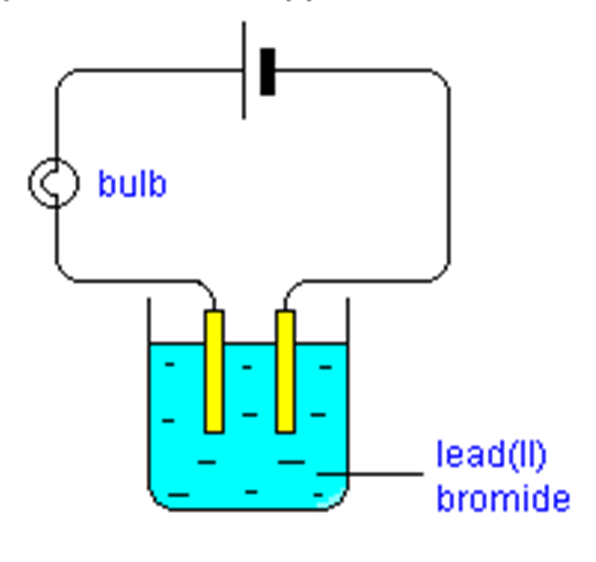
The diagram shows the electrolysis of lead(II) bromide using inert electrodes. Why does the bulb only light up  when the lead(II) bromide is melted?
a)
Bromine atoms in lead(II) bromide are converted to ions when it is melted
b)
Electrons flow through the lead(II) bromide when it is melted
c)
The ions in lead(II) bromide are acting as the mobile charge carriers when it is melted
d)
There are no ions in solid lead(II) bromide
100.
In electrolytic cell which its electrolyte is aqueous copper (II) sulfate, copper are used as electrodes. What is the product at the anode?
a)
Oxygen gas and water
b)
Copper metal
c)
Copper (II) ions
d)
Hydrogen gas
101.
Reduction occurs at the 
a)
anode
b)
cathode
102.
Anion loses electrons at the
a)
cathode
b)
anode
103.
What is the product formed at the anode during the electrolysis of concentrated copper(II) chloride?
a)
copper
b)
chlorine
c)
hydrogen
d)
oxygen
104.
What are the names of the products when you mix an equal strength acid and alkali together?
a)
Water and Sodium Hydroxide
b)
Water and Salt
c)
Water and Hydrochloric Acid
d)
Water and Hydrochloric Acid
105.
What is the name of the process where an equal strength acid and alkali cancel each other out?
a)
Cancelisation
b)
Neutralisation
c)
Neutralology
d)
Waterification
106.
Which acid was used to make the salt magnesium sulphate?
a)
hydrochloric acid
b)
sulphuric acid
c)
nitric acid
d)
formic acid
107.
What is the correct scale used for measuring the concentration of acids and alkalis?
a)
a) Acidity
b)
b) pH
c)
c) Litmus
d)
d) Stength
108.
Which of the following is the pH of a Weak acid?
a)
a) 1
b)
b) 5
c)
c) 7
d)
d) 9
109.
Which of the following is the pH of a Strong acid?
a)
a) 1
b)
b) 5
c)
c) 7
d)
d) 9
110.
Which of the following is the pH of neither an acid or alkali/base?
a)
a) 1
b)
b) 5
c)
c) 7
d)
d) 9
111.
Which of the following is the pH of a Weak alkali/base?
a)
a) 1
b)
b) 5
c)
c) 7
d)
d) 9
112.
What type of reaction occurs when an acid and alkali react together and 'cancel' each other out?
a)
a) COMBUSTION
b)
b) OXIDATION
c)
c) NEUTRALISATION
d)
d) REDUCTION
113.
If there is excess hydrogen ions, the solution will be...
a)
acidic
b)
basic
114.
A neutralisation reaction is a reaction between 
a)
Acid and a Base 
b)
Acid and water 
c)
Base and water 
d)
None of the above 
115.
Bleach is a strong base, what is the pH level of bleach?
a)
13
b)
14
c)
1
d)
2
116.
Which sentence below best describes how the pH changes when an alkali is neutralised by an acid?
a)
The pH stays the same
b)
The pH stays the same but then drops rapidly to pH 7.
c)
The pH drops gradually as more and more acid is added to the mixture.
d)
The pH goes straight to 7 as soon as any of the acid is added.
117.
Which statement is incorrect?
a)
a) All acids are harmful if ingested.
b)
b) An alkali is SOLUBLE in water and a base is INSOLUBLE.
c)
c) An acid is the OPPOSITE of an alkali
d)
d) An acid is the OPPOSITE of an base
118.
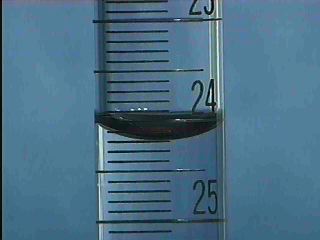
What is the volume in this burette?
a)
24.1mL
b)
24.3mL
c)
24.2L
d)
24.2mL
119.
pH less than 7.
a)
Acids
b)
Bases
c)
All
120.
KOH
a)
acid
b)
base
c)
neutral
121.
What is the long graduated piece of equipment called?
a)
Pipette
b)
Tube
c)
Burette
d)
Measuring Cylinder
122.
HCl + NaOH → 
a)
NaH + ClOH
b)
NaCl + H2
c)
NaCl + H2O
d)
NaCl + Cl2
123.
What indicator is commonly used in titrations?
a)
Phenolphthalein
b)
Bromothymol Blue 
c)
Litmus
d)
Universal 
124.
What is the endpoint of a titration
a)
Where the amount of acid and base are equal as shown by a colour change 
b)
Where there is no base
c)
When the volume of base in the burette is used up 
d)
When there is no acid
125.
How will I ensure I get an accurate final end point?
a)
Be slow and careful 
b)
Repeat until you have 3 very similar titre
c)
Rinse the Burette
d)
Always use the same Pipette filler
126.
What is the white tile for in titration?
a)
To help clearly see the colour change
b)
To protect the conical flask 
c)
To add extra height
d)
To assist the reaction
127.
Why do we use water to wash the solution from the burette into the flask
a)
To ensure accuracy (all solution reacts)
b)
To dilute the reagents
c)
To help the reaction go faster
d)
To see the colour of the indicator better
128.
Which of the following is not a use of the products from the fractional distillation of crude oil?
a)
a) Iron ore
b)
b) Petrol
c)
c) Asphalt
d)
d) Motor fuel
129.
Which key term is described as the attractive force BETWEEN molecules?
a)
a) Inner molecular forces
b)
b) Outer molecular forces
c)
c) Intermolecular forces
d)
d) Intramolecular forces
130.
What physical property allows Distillation to separate different molecules?
a)
a) Melting point
b)
b) Boiling point
c)
c) Diffusion rate
d)
d) Condensation rate
131.
Which letter in the diagram of Industrial Crude Oil Fractions identifies 'Petroleum Gas'?
a)
A
b)
B
c)
C
d)
D
132.
What happens to water at 0oC (32oF)?
a)
boils
b)
evaporates
c)
freezes
d)
condenses
133.
Which letter in the diagram of Industrial Crude Oil Fractions identifies 'Bitumen'?
a)
B
b)
D
c)
G
d)
H
134.
A process in which a liquid changes in to vapor or gas by boiling throughout is called
a)
Fractional distillation
b)
filtration
c)
distillation
d)
evaporation
135.
A separation technique which uses a fractionating column to separate different liquid components in a mixture with different boiling points by heating mixture is called
a)
Fractional distillation
b)
filtration
c)
crystallization
d)
evaporation
136.
What does the volatility of a hydrocarbon tell you?
a)
How smokey its flame is
b)
How easily it sets alight
c)
How easily it flows
d)
How easily it evaporates
137.
What are the products of combustion if there is plenty of oxygen available?
a)
carbon monoxide and hydrogen
b)
carbon dioxide and water
c)
carbon dioxide and hydrogen
d)
carbon monoxide and water
138.
What is the correct order for the fractions that come out of crude oil?
a)
fuel gases, petrol, kerosene, diesel, fuel oil, residue
b)
fuel gases, petrol, diesel, kerosene, fuel oil, residue
c)
fuel gases, kerosene, petrol, diesel, fuel oil, residue
d)
fuel gases, diesel, kerosene, petrol, fuel oil, residue
139.
What is kerosene used for?
a)
Fuel for ships
b)
Fuel for lorries
c)
Fuel for airplanes
d)
Making roads
140.
What does the viscosity of a hydrocarbon tell you?
a)
How easily it flows
b)
How easily it sets alight
c)
What its boiling point is
d)
How long the hydrocarbon is
141.
How long does it take crude oil to form?
a)
hundreds of years
b)
thousands of years
c)
millions of years
d)
billions of years
142.
What happens when crude oil is fractional distilled?
a)
Different fractions are mixed together to form oil.
b)
Sulfur is removed from the crude oil.
c)
The oil is separated into fractions of different boiling ranges by heating.
d)
Longer chain fractions are broken down into shorter chain fractions.
143.
Which of the following, when fossil fuels are burned, is formed when there is lack of oxygen?
a)
carbon monoxide
b)
sulphur dioxide
c)
nitrogen dioxide
d)
carbon dioxide
144.
A sample of gas from a car exhaust was tested with limewater and gave a white precipitate. The gas was most likely to be?
a)
partly burned petrol vapour
b)
unburned petrol vapour
c)
carbon monoxide
d)
carbon dioxide
145.
The process of separating the different length hydrocarbons from crude oil is known as...
a)
Distillation
b)
Cracking
c)
Fractional Distillation
d)
Filtering
146.
The longer the hydrocarbon, the _______ the boiling point
a)
Lower
b)
Higher
147.
The longer the hydrocarbon, the ________ the flammability?
a)
Lower
b)
Higher
148.
In fractional distillation, longer length hydrocarbons are found where in the distillation column?
a)
Top
b)
Bottom
149.
Cracking.....
a)
Breaks larger hydrocarbons into smaller hydrocarbons
b)
Separates hydrocarbons based on their length
c)
Detects alkenes
150.
What liquid detects the presence of an alkene?
a)
Alkene water
b)
Bromine water
c)
Water
d)
Limewater
151.
What colour does bromine water turn in the presence of an alkene
a)
Orange
b)
Blue
c)
Clear
152.
chemicals or products made from petroleum such as rubber, synthetic fibers, plastics, and cosmetics
a)
petrochemicals
b)
petroleum
c)
agribusiness
d)
diversification
153.

Oil has been around for millions of years. But where did it come from?

a)

Organisms that lived million of years ago

b)

Prehistoric plants

c)

Prehistoric aquatic life

d)

All of the above

154.
What are fossil fuels?
a)
Dinosaur bones
b)
Resources made from once living organisms 
c)
Combination of different rocks
d)
Gas Stations
155.

Crude oil must be refined before it can be used as fuel. What does "refined" mean?

a)

Taxed

b)

created

c)

purified

d)

burned

156.
Fossil fuels are classified as nonrenewable because they.......
a)
require expensive equipment
b)
take millions of years to replace
c)
can be found all over 
d)
provide all the energy we use
157.
What is a problem that is linked to the burning of fossil fuels?
a)
Global Warming
b)
geothermal energy
c)
solar power panels
d)
none of the above
158.
Drilling, refining, and using petroleum is responsible for which environmental hazard?
a)
air pollution
b)
water pollution
c)
groundwater pollution
d)
all 3 types of pollution
159.
Which is not an environmental impact of using fossil fuels.
a)
Global Warming
b)
Acid Rain
c)
Oil Spill
d)
Rapid Population Growth
160.
What term means "does not break down in the environment"
a)
biodegradeable
b)
non-degradeable
c)
corrosive
d)
biodegenerative
161.
Small molecules that make up larger molecules.
a)
monomer
b)
polymer
c)
synthetic
d)
plastic
162.
Once formed, it can be heated and reformed   Over and over again
a)
Thermoplastic
b)
Thermoset
c)
Linear
d)
Branched
163.
Large molecules made up of smaller molecules.
a)
monomer
b)
polymer
c)
hydrocarbon
d)
plastic
164.
Large molecules made of Hydrogen and Carbon
a)
plastic
b)
vulcanization
c)
hydrocarbon
d)
organic
165.
It cannot be re-melted. Once re-heated they will burn.
a)
Thermoplastic
b)
Thermoset
c)
Linear
d)
Branched
166.
Carbon tends to share its electrons.  What type of bond does carbon tend to form?
a)
Ionic
b)
Covalent
c)
Metallic
d)
James
167.
The process by which polymers and plastics are made 
a)
polymerization 
b)
vulcanization 
c)
PVA
d)
PMMA
168.
Which of these is an example of synthetic polymer?
a)
cotton fibers
b)
rubber
c)
wool
d)
polyvinyl chloride (PVC)
169.
What is an advantage of polymers
a)
Thermal and electrical insulators
b)
Easily affected by chemicals
c)
Heavy
d)
Can be processed only one way
170.
What materials are used to make plastics?
a)
oil and gas 
b)
oil and water
c)
trees and plants 
d)
rocks
171.
Bakelite is an example of
a)
thermosetting plastic
b)
thermoplastic
c)
synthetic fiber
d)
none of the above
172.
These materials react and change with a physical change in their environment e.g. heat, light, electrical current.
a)
Smart Materials
b)
Modern materials
c)
Nano materials
d)
New Materials
173.
Pigments react to changes in temperature
a)
Thermochromic
b)
Photochromic 
174.

Nitric Acid

a)

HN

b)

H2NO4

c)

HNO3

d)

H2NO3

175.

Hydrochloric Acid

a)

H2Cl4

b)

H2ClO4

c)

HClO

d)

HCl

176.

Sulfuric Acid

a)

H2S

b)

H2SO4

c)

HSO3

d)

H2SO3

177.

Potassium hydroxide

a)

K2O2H2

b)

K3OH

c)

KOH

d)

HOK

178.
what is cirrhosis 
a)
scaring of the liver
b)
stomach irritation
c)
mouth sores
d)
ulcers in stomach
179.
Fermentation is a process that uses yeast or bacteria to change the sugars in the food into alcohol
a)
True
b)
False
180.
Which of the following would have the highest melting point?
a)
C3H8
b)
C4H8
c)
C5H12
d)
C22H44
181.
Which one of the following is saturated?
a)
water
b)
C4H8
c)
C4H10
d)
C5H8
182.
Which of the following will react with Br2(l)
a)
hexene 
b)
cyclohexane
c)
hexane
d)
alkanes
183.
Which of the following undergoes addition reactions
a)
alkanes
b)
alkanes and alkenes
c)
alkanes and alkynes
d)
alkenes
184.
Which of the following does not contain only carbon and hydrogen
a)
alkanes 
b)
alkenes
c)
alkynes
d)
alkanols
185.
The following compounds belong to the homologous series
a)
alkanes
b)
alkenes
c)
alkynes
d)
haloalkanes
186.
The following compounds all have
a)
the same structure
b)
the same molecular formula
c)
the same semi-structural formula
d)
double bonds
187.
The following compounds have a molecular formula of
a)
CnH2n+2
b)
CH4
c)
C6H14
d)
CH3CH2CH2CH2CH2CH3
188.
Melting and boiling points of alkanes
a)
increase with the number of carbon atoms in the chain
b)
decrease with the number of carbon atoms in the chain
c)
increase with branching
d)
are determined by the bonding between the carbons and hydrogens
189.
What is the prefix for four carbons?
a)
meth-
b)
but-
c)
prop-
d)
eth-
190.
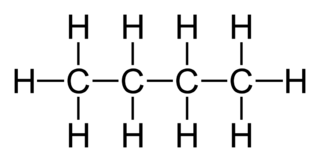
Name this alkane
a)
Methane
b)
Ethane
c)
Propane
d)
Butane
191.
The molecular formula for Heptane is
a)
C4H10
b)
C8H18
c)
C5H12
d)
C7H16
192.
What is the general formula of an alkane
a)
2n+2
b)
CnH2n+2
c)
CnH2n
d)
CnHn
193.
What is the general formula of an alkene
a)
2n+2
b)
CnH2n+2
c)
CnH2n
d)
CnHn
194.
Which functional group is present?
a)
hydroxyl
b)
alcohol
c)
carboxyl
d)
carboxylic acid
195.
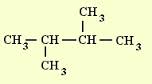
Name the compound
a)
hexane
b)
2,3-dimethylbutane
c)
ethylbutane
d)
2,2-dimethylbutane
196.
Name the compound
a)
3-methylpent-2-ene
b)
2-ethylbut-2-ene
c)
3-ethylbut-2-ene
d)
1,1-dimethyl-propene
197.
The name of the functional group found in alkanols is the …
a)
carboxyl group.
b)
carbonyl group.
c)
hydroxyl group.
d)
hydroxide group.
198.
Name this structure.
a)
3-chloropropane
b)
3-chloropentane
c)
1-chloropentane
d)
1-chloropropane
199.
Propane has no structural isomers
a)
True
b)
False
200.
Are the following molecules isomers?
a)
Yes
b)
No
201.
Are the following molecules isomers?
a)
Yes
b)
No
202.
Are the following molecules isomers?
a)
Yes
b)
No
203.
Are the following molecules isomers?
a)
Yes
b)
No
204.

What is the characteristic functional group of carboxylic acids?

a)

Carbonyl

b)

Hydroxyl

c)

Carbon

d)

Carboxyl

205.

What is the suffix for carboxylic acids?

a)

-ic acid

b)

-oic

c)

-oic acid

206.

Which of these contain a carboxylic acid?

a)

Coconut

b)

Butter

c)

Nutmeg

d)

Vinegar

e)

Citrus fruit