

wayground logo

Free Printable Worksheets

Font size

S
M
L
XL
Worksheets

RCP 110 Comprehensive Review

Total questions: 100

Worksheet time: 2hrs 47mins
Name
Class
Date
1.
Oxygen binds to hemoglobin in the blood to form
a)
bicarbonate ion
b)
carbonic acid
c)
carbon dioxide
d)
oxyhemoglobin
2.
Most of carbon dioxide is transported within blood in
a)
red blood cells
b)
plasma
c)
white blood cells
d)
in alveoli
3.
science word for "breathing"
a)
cellular respiration
b)
apnea
c)
eupnea
d)
pulmonary ventilation
4.
Which of the following is true?
a)
COconcentration is higher in the capillaries than the alveoli
b)
CO2 concentration is higher in the alveoli than the capillaries 
c)
O2 concentration is higher in the capillaries than the alveoli
d)
O2 concentration is lower in the alveoli than the capillaries
5.
Which of the following is true?
a)
Oxygen diffuses along the concentration gradient from the alveoli into the capillaries
b)
Oxygen diffuses against the concentration gradient from the alveoli into the capillaries
c)
Oxygen diffuses along a concentration gradient from the capillaries to the alveoli
d)
Oxygen diffuses against the concentration gradient from the capillaries to the alveoli
6.
Which is the correct order of structures that air passes through?
a)
Trachea --> bronchi --> bronchioles --> alveoli
b)
Bronchi ---> trachea--> bronchioles --> alveoli
c)
Bronchioles --> bronchi --> trachea --> alveoli
d)
Trachea --> bronchioles --? bronchi --> alveoli
7.
The two main branches from the trachea (one to each lung)
a)
bronchi
b)
alveoli
c)
capillaries
d)
bronchioles
8.
The air sacs that are covered with capillaries where gas exchange takes place
a)
bronchi
b)
lungs
c)
oxygen
d)
alveoli
9.
Location of gas exchange
a)
alveoli
b)
myocardium
c)
raveoli
d)
pulmonary vent
10.
What is the function of the bronchi?
a)
Transport air from nose to lungs
b)
Transport air from trachea to lungs
c)
Transport air from lungs to alveoli
d)
Transport air from alveoli to blood
11.
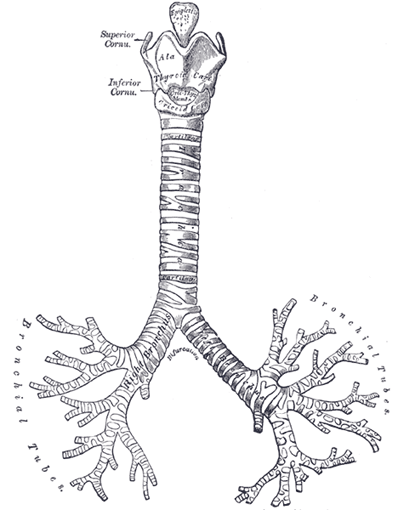
4?
a)
Sinusis
b)
Nasal cavity
c)
Pharynx
d)
Larynx
12.
B?
a)
larynx
b)
lung lobe
c)
pharynx
d)
trachea
13.
Given the following structures:
1. larynx
2. nasal cavity
3. pharynx
4. trachea
Which of the following is the correct order that air would flow during inhalation. 
a)
1,2,3,4
b)
2,3,1,4
c)
2,1,3,4
d)
4,2,3,1 
14.
Which of the following is not a characteristic of human lungs?
a)
Both right and left lungs are composed of three lobes. 
b)
Bronchi divide to form bronchioles.
c)
Capillary supply is abundant to facilitate gas exchange with the blood.
d)
The alveoli are tiny air sacs arranged in clusters.  
15.
Inhalation brings in fresh ________ and exhalation removes ________.
a)
cabon dioxide, oxygen
b)
oxygen, nitrogen
c)
oxygen, carbon dioxide
d)
nitrogen, carbon dioxide
16.
The upper section of the pharynx is called:
a)
oropharynx
b)
nasopharynx
c)
laryngopharynx
d)
hypopharynx
17.
This structure protects the superior opening of larynx.
a)
thyroid cartilage
b)
epiglottis
c)
vocal cords
d)
glottis
18.
COPD is mostly caused by
a)
heredity
b)
pollutants
c)
smoking
d)
plaque
19.
A fibrotic lung would exhibit which of the following characteristics?
a)
decreased airway resistance
b)
decreased lung compliance
c)
decreased PVR
d)
decreased surface tension
20.
Which of the following diseases or disorders is most likely to result in an increased VD/VT ratio?
a)
atelectasis
b)
pneumonia
c)
pulmonary embolus
d)
pulmonary fibrosis
21.
Hypoventilation is defined as:
a)
decreased tidal volume
b)
low blood oxygen level
c)
very slow respiratory rate
d)
elevated blood carbon dioxide level
22.
3. According to Boyle's law, at constant temperature, as the pressure of a given sample of gas is increased, the volume will –
a)
Increase
b)
Decrease
c)
Remains the same
23.
Boyle's law : When _______ is held constant, the pressure and volume of a gas are ________  proportional
a)
temperature,  equally
b)
mass, inversely
c)
temperature, inversely
d)
mass, equally
24.
If a balloon is cooled what will happen to the volume?
a)
Volume will increase
b)
Volume will decrease
c)
Volume will not change
25.
The muscular organ that holds the vocal chords is the ___.
a)
epiglottis
b)
pharynx
c)
larynx
d)
trachea
26.
The mucous membrane lining the nasal cavity 
a)
warms incoming air
b)
moistens incoming air
c)
entraps dust
d)
all of the above
27.
The volume of air that enters the lungs during forced maximal inspiration is the 
a)
inspiratory reserve volume
b)
expiratory reserve volume
c)
vital capacity
d)
tidal volume
28.
Of the respiratory air volumes listed, which one has the largest volume? 
a)
Expiratory reserve volume 
b)
Inspiratory reserve volume 
c)
Vital capacity 
d)
Tidal volume 
29.
A simple spirometer cannot measure which of the following air volumes? 
a)
Tidal volume 
b)
Vital capacity 
c)
Residual volume 
d)
Expiratory reserve volume 
30.
The volume of air that enters (or leaves) during a single respiratory cycle is the 
a)
inspiratory reserve volume
b)
vital capacity
c)
tidal volume
d)
expiratory reserve volume
31.
The hypoxia associated with high altitude can cause 
a)
vasodilation of the major arterial blood vessels. 
b)
vasoconstriction of the pulmonary blood vessels. 
c)
vasoconstriction of the coronary blood vessels. 
d)
vasodilation of the major venous blood vessels. 
32.
What do capillaries, the smallest blood vessels, do?
a)
Exchange O2 only
b)
Exchange CO2 only
c)
exchange nutrients and  oxygen for waste 
d)
break down foods
33.
Where does blood go after the right atrium?
a)
left atrium
b)
left ventricle
c)
right ventricle
d)
aorta
34.
Where does the blood go after it goes into the pulmonary arteries?
a)
lungs
b)
heart
c)
head
d)
hands
35.
Name of the kind of circulation that sends blood to the body and back to the heart:
a)
systemic
b)
pulmonary
c)
cardiovascular
36.
Which valve prevents blood from flowing back into the left atrium?
a)
Mitral
b)
tricuspid
c)
Aortic
d)
pulmonary
37.
Blood pressure is highest in  ___________ and lowest in ____________.
a)
arteries; veins
b)
veins; arteries
38.
Your patient is an 84-year-old male with difficulty breathing and peripheral edema. He tells you he has been suffering for many years with "heart failure" and his condition is worsening, especially with trouble breathing at night. Your knowledge of cardiovascular physiology suggests that his condition could have resulted from the failure of either the right or left side of his heart. Which chamber of the heart is the strongest, most muscular part of the heart and is primarily responsible for pumping oxygenated blood to the rest of the body?
a)
left ventricle
b)
right ventricle
c)
left atrium 
d)
right atrium 
39.
Normal blood pressure is...
a)
120/80 mmHg
b)
80/120 mmHg
c)
140/90 mmHg
d)
80/140 mmHg
40.
For a blood pressure reading, the number on top measures...
a)
Diastolic Pressure
b)
Systolic Pressure
c)
Diastemic Pressure
d)
Systemic Pressure
41.
Atherosclerosis is caused by 
a)
a buildup of fat in the arteries
b)
a buildup of protein in the arteries
c)
a buildup of calcium in the arteries
d)
a buildup of sodium in the arteries
42.
13) Which of the following are cells of the alveoli that produce surfactant?
a)
a) Type I alveolar cells
b)
b) Type II alveolar cells
c)
c) Type III alveolar cells
d)
d) Surface cells
43.
14) Which of the following is NOT a factor that affects pulmonary ventilation?
a)
b) Suface tension of alveolar fluid
b)
c) Elastic recoil of the chest wall and lungs
c)
d) Airway resistance
d)
e) All of these are factors that affect pulmonary ventilation
44.
15) Which of the following indicates the direction of diffusion of gases at the alveoli of the lungs?
a)
O2 into blood, CO2 out of blood
b)
O2 out of blood, CO2 into blood
c)
O2 out of blood, CO2 out of blood
d)
O2 into blood, CO2 into blood
45.
17) Which of the following is the sum of the residual and the expiratory reserve volume?
a)
Total lung capacity
b)
Vital capacity
c)
Inspiratory capacity
d)
Functional residual capacity
46.
19) Which of the following is the dominant method of carbon dioxide transport?
a)
Bound to oxygen
b)
Diffusion
c)
Dissolved in plasma as bicarbonate ions
d)
Dissolved in plasma as a gas
47.
Which vessels transport de-oxygenated blood from the heart to the lungs? 
a)
pulmonary veins
b)
pulmonary aorta
c)
pulmonary arteries
d)
pulmonary capillaries
48.
What are the two upper chambers of the heart called?
a)
Atria
b)
Ventricles
c)
Aortas
d)
Septums
49.
The walls of the alveoli are composed largely of:
a)
simple squamous epithelium
b)
stratified squamous epithelium
c)
simple cuboidal epithelium
d)
pseudostratified simple epithelium
50.
The bluish cast that results from inadequate oxygenation of the tissues is called:
a)
cyanosis
b)
cyanide
c)
cyanate
d)
cyanite
51.
Internal respiration is:
a)
the gas exchange between the blood and tissue cells
b)
the gas exchange between the pulmonary blood and the alveoli
c)
the gas exchange between the tissue cells and alveoli
d)
the gas exchange between outside air and the lungs
52.
Cessation of breathing is known as:
a)
apnea
b)
dyspnea
c)
eupnea
d)
hyperpnea
53.
According to the law of diffusion, movement of gases:
a)
move toward lower concentration
b)
move toward higher concentration
c)
move toward areas of lesser blood flow
d)
gases do not move
54.
Abnormally high number of red blood cells
a)
anemia
b)
leukemia
c)
polycythemia
d)
leukopenia
55.
A deficiency in hemoglobin or red blood cells.
a)
anemia
b)
polycythemia
c)
leukemia
d)
leukocytosis
56.
Which is NOT a formed element in blood?
a)
leukocyte
b)
thrombocyte
c)
plasma
d)
erythrocyte
57.
The scientific name of a white blood cell
a)
thrombocyte
b)
erythrocyte
c)
leukocyte
d)
osteocyte
58.
The scientific name of a red blood cell
a)
erythrocyte
b)
leukocyte
c)
thrombocyte
d)
plasmocyte
59.
The scientific name of a platelet.
a)
leukocyte
b)
hemocyte
c)
erythrocyte
d)
thrombocyte
60.
Most common WBC; serve as phagocytes
a)
neutrophils
b)
monocyte
c)
lymphocyte
d)
basophil
61.
B cells, T cells, and natural killer cells are ______.
a)
monocytes
b)
basophils
c)
eosinophils
d)
lymphocytes
62.
Which blood cells are the most numerous?
a)
RBC
b)
WBC
c)
platelets
63.
Blood is made up of __ % blood cells. 
a)
45
b)
55
64.
Plasma makes up about __ % of blood. 
a)
45
b)
55
65.
Red blood cells are also known as 
a)
leukocytes
b)
thrombocytes
c)
erthrocytes
66.
Hemoglobin is found in rbc's and carry oxygen and carbon dioxide.
a)
true
b)
false
67.

Which part of human blood carries hormones and nutrients?

a)

plasma

b)

platelets

c)

red blood cells

d)

white blood cells

68.

Platelets are a part of blood that help in the:

a)

formation of hemoglobin

b)

formation of a clot

c)

release of anitbodies

d)

absorption of amino acids

69.
What part of blood is responsible for fighting infections?
a)
Red Blood Cells
b)
White Blood Cells
c)
Platelets
d)
Plasma
70.
WBC that phagocytizes allergens and parasitic worms.
a)
lymphocyte
b)
eosinophil
c)
monocyte
d)
neutrophil
71.
Diffusion is the movement of molecules from an area of higher concentration to an area of lower concentration.
a)
True
b)
False
72.
What part of the brain is considered the Respiratory pacemaker?
a)
Dorsal Respiratory Group
b)
Frontal lobe
c)
Cerebellum
d)
Ventral Respiratory Group
73.
Central chemoreceptors are primarily stimulated by.....
a)
Hydrogen Ion Concentration
b)
Oxygen concentration
c)
Na+ concentration
d)
CSF Osmolarity
74.
Peripheral chemoreceptors respond to the following stimulus....
a)
Hydrogen ion concentration
b)
Oxygen concentration
c)
Sodium ion concentration
d)
CSF pH
75.
Anatomic Dead space consists of all of the following except.....
a)
Nose
b)
Trachea
c)
Terminal Bronchioles
d)
Respiratory Bronchioles
76.
Peripheral Chemoreceptors trigger ventilation when the PaO2 reach this general level.
a)
60 mmHg
b)
100 mmHg
c)
40 mmHg
d)
150 mmHg
77.
Lab values:  pH 7.56, PaCO2 20, HCO3 20
a)
Uncompensated Respiratory Alkalosis
b)
Partially Compensated Metabolic Acidosis
c)
Partially Compensated Respiratory Alkalosis
d)
Compensated Metabolic Acidosis
78.
Lab values:  pH 7.23, PaCO2 37, HCO3 18
a)
Partially Compensated Respiratory Acidosis
b)
Uncompensated Metabolic Acidosis
c)
Uncompensated Respiratory Alkalosis
d)
Partially Compensated Metabolic Alkalosis
79.
Lab values 7.52, PaCO2 48, HCO3 28
a)
Partially compensated respiratory alkalosis
b)
Uncompensated respiratory alkalosis
c)
Fully compensated metabolic acidosis
d)
Partially compensated metabolic alkalosis
80.
Lab values: 7.30, PaCO2 36, HCO3 16
a)
Uncompensated respiratory acidosis
b)
Partially compensated respiratory alkalosis
c)
Partially compensated metabolic alkalosis
d)
Uncompensated metabolic acidosis
81.
The patient whose blood that is most alkalotic would be the one with a pH of:
a)
 7.4
b)
6.9
c)
7.8
d)
7.6
82.
The normal pH range for blood is:
a)
7.0 - 7.25
b)
7.30 - 7.40
c)
7.35 - 7.45
d)
7.45 - 7.55
83.
The respiratory system compensates for changes in the pH level by responding to changes in the levels of:
a)
CO2
b)
 H2O
c)
H2CO3
d)
HCO3
84.
The kidneys compensate for acid-base imbalances by excreting or retaining:
a)
Hydrogen ions
b)
Carbonic acid
c)
Sodium bicarbonate
d)
Water
85.
Which of the following may be a reason to order an ABG on a patient?
a)
The patient suddenly develops shortness of breath
b)
An asthmatic is starting to show signs of tiring
c)
A diabetic has developed Kussmaul respirations
d)
All of the above
86.
You are reviewing the results of an ABG. When the pH and the PaCO2 values are moving in opposite directions, the primary problem is: 
a)
Respiratory
b)
Renal
c)
Metabolic
d)
Compensation
87.
When an acid-base imbalance is caused by a metabolic disturbance, the pH and the HCO3 will move:
a)
In opposite directions
b)
Totally independent of each other 
c)
In the same direction
88.
pH 7.38 pCO2 38 HCO3 24
a)
Respiratory alkalosis
b)
Normal
c)
Metabolic alkalosis
d)
None of the above
89.
pH: 7.35
PaCO2: 46
HCO3: 20
a)
respiratory acidosis
b)
metabolic acidosis
c)
metabolic acidosis with partial compensation
d)
respiratory acidosis with full compensation
90.
pH 7.44
PaCO2  33
HCO3  20
a)
Partial compensated respiratory alkalosis
b)
fully compensated metabolic alkalosis
c)
Fully compensated respiratory alkalosis
d)
metabolic acidosis
91.

The value of the pK in the Henderson-Hasselbalch equation is ________.

a)

1.0

b)

6.1

c)

7.4

d)

20.1

92.

Metabolic acidosis caused by fixed acids is present when the anion gap is greater than:

a)

9 mEq/L

b)

14 mEq/L

c)

20 mEq/L

d)

25 mEq/L

93.

Which of the following protects the lungs from excessive inflation?

a)

Hering-Breuer inflation reflex

b)

Deflation reflex

c)

Juxtapulmonary-capillary receptors

d)

Irritant reflex

94.

The advantages of polycythemia begin to be offset by the increased blood viscosity when the hematocrit reaches about:

a)

30-40%

b)

40-50%

c)

55-60%

d)

60-70%

95.

If the pressure in the pulmonary artery is 34 mm Hg and the pressure in the left atrium is 9 mm Hg, what is the driving pressure?

a)

9 mm Hg

b)

17 mm Hg

c)

25 mm Hg

d)

34 mm Hg

96.

The tricuspid valve lies between the

a)

right atrium and right ventricle

b)

left ventricle and aorta

c)

right ventricle and pulmonary artery

d)

left atrium and left ventricle

97.

An increase in the number of which of the following suggests a bacterial infection?

a)

Lymphocytes

b)

Monocytes

c)

Eosinophils

d)

Neutrophils

98.

At sea level, the normal percentage of carbon dioxide (CO2) in the atmosphere is which of the following?

a)

0.2 torr

b)

47 torr

c)

0.8 torr

d)

40 torr

99.

The difference between the alveolar pressure and the pleural pressure is called?

a)

Transrespiratory pressure

b)

Transthoracic pressure

c)

Transpulmonary pressure

d)

Driving pressure

100.

The canals of Lambert are located in the

a)

trachea

b)

terminal bronchioles

c)

alveoli

d)

main stem bronchi
