wayground logo

Free Printable Worksheets

NEW

Font size

S
M
L
XL
Worksheets

Anatomy Test

Total questions: 75

Worksheet time: 42mins

Name
Class
Date
1.
Which of the following provides support for the body, attachment of muscles, and protection for internal organs?
a)
skin
b)
spinal cord
c)
joints
d)
skeleton
2.
What is the correct order for food taken through the organs?
a)
mouth, esophagus, stomach, large intestine, small intestine, anus
b)
mouth, stomach, esophagus, large intestine, small intestine, anus
c)
mouth, esophagus, stomach, small intestine, large intestine, anus
d)
mouth, stomach, esophagus, small intestine, large intestine, anus
3.
How are infectious diseases spread?
a)
coughing, sneezing, physical contact
b)
infected animals
c)
contaminated water & food
d)
all of these ways
4.
How many bones are found in an adult human skeleton?
a)
212
b)
150
c)
206
d)
200
5.
Which sense relies on the largest sense organ in the body?
a)
taste
b)
touch
c)
smell
d)
hearing
6.
The main function of the skull is to
a)
produce blood cells
b)
act like a lever for muscle attachment
c)
protect the brain
d)
protect the heart and lungs
7.
The brain, lungs, testes, and small intestine are each examples of
a)
an organ system
b)
an organ
c)
a tissue
d)
a nerve
8.
The levels of organization in the body include
a)
lymphatic, respiratory, circulatory
b)
cells, tissues, organs, organ systems
c)
endocrine, respiratory, digestive, nervous
d)
cells, tissues, functions
9.
Where is cardiac muscle tissue located in the body?
a)
ribs
b)
skull
c)
heart
d)
bones
10.
Which system regulates and controls growth, development, and metabolism?
a)
integumentary
b)
endocrine
c)
skeletal
d)
lymphatic
11.
Which body system acts in a way similar to a transportation system?
a)
circulatory
b)
excretory
c)
respiratory
d)
nervous
12.
Each of the following is an infectious disease EXCEPT
a)
AIDS
b)
cancer
c)
chicken pox
d)
influenza
13.
Which are the components of the circulatory system?
a)
heart and lungs
b)
blood, blood vessels, and heart
c)
blood vessels, heart, and lungs
d)
heart and blood
14.
Where does the process of chemical digestion begin?
a)
stomach
b)
esophagus
c)
small intestine
d)
mouth
15.
A group of similar cells that perform a single function is called a(n)
a)
tissue
b)
organ
c)
organ system
d)
nerve
16.
What is the function of the central nervous system?
a)
relay messages
b)
analyze information
c)
process information
d)
all of these
17.
contains the brain
a)
spinal
b)
cranial
c)
buccal
d)
orbital
18.
contains the spinal cord
a)
spinal
b)
cranial
c)
buccal
d)
orbital
19.
Which system detects changes in the environment and sends electrical signals in response to these changes?
a)
Nervous
b)
Endocrine
c)
Lymphatic
d)
Reproductive
20.
The mouth, esophagus and gall bladder  belong to what system?
a)
Nervous System
b)
Digestive System 
c)
Integumentary System
d)
Lymphatic System 
21.
The study of the structure and shape of the body and body parts is called:
a)
Anatomy
b)
Physiology
c)
Homeostasis
d)
Irritability
22.
Includes bones, ligaments, joints and cartilage
a)
Muscular System
b)
Cartilage System
c)
Nervous System
d)
Skeletal System
23.
Muscle tissue that is involuntary:
a)
Cardiac muscle only.
b)
Smooth muscle only.
c)
Skeletal and cardiac muscle.
d)
Cardiac and smooth muscle.
24.
The primary function of skeletal muscle is:
a)
Movement of body extremities and locomotion.
b)
Movement of contents through the vessels.
c)
Production of heat.
d)
Ensuring the operation of the heart.
25.
The type of muscle tissue found in the walls of blood vessels:
a)
smooth
b)
cardiac
c)
skeletal
d)
smooth and cardiac
26.
Where is the Femur located
a)
The thigh 
b)
Lumbar region
c)
Orbital
d)
The chest
27.
Meaning of the root word osteo-
a)
muscle
b)
tissue
c)
bone
d)
fat
28.
Which of the following is a characteristic of ALL living things?
a)
moving around
b)
sweating
c)
thinking
d)
responding to stimulus
29.
What are the muscles over which you have complete control?
a)
smooth
b)
cardiac
c)
skeletal
d)
hartiac
30.
What is the main organ in your integumentary system?
a)
stomach
b)
skin
c)
hair
d)
small intestine
31.
What connects muscles to bones?
a)
cartilage
b)
bicep
c)
tendon
d)
ligament
32.
What connects to bones to each other?
a)
cartilage
b)
bicep
c)
tendon
d)
ligaments
33.
Which structure reduces friction between bones?
a)
cartilage
b)
tendons
c)
muscles
d)
bone marrow
34.
Which system does the muscular system NOT assist?
a)
Skeletal
b)
Respiratory
c)
Circulatory
d)
Answer not here
35.
What structure makes blood cells?
a)
Heart
b)
Liver
c)
Bone Marrow
d)
Skin
36.
Which blood vessels carry blood out of the heart?
a)
Capillaries
b)
Veins
c)
Arteries
d)
Nerves
37.
What is a skeleton?
a)
Tissues that contract to create movement
b)
Tissues that relax to create movement
c)
A framework that supports and protects an animal 
d)
Small tubes that help vertebrae support the spinal cord
38.
What is a muscle
a)
A hard outer covering of the body
b)
A skeleton without hard parts 
c)
Tissues that contract or relax to create movement 
d)
Large structures that are filled with fluids that help shape an animal
39.
majority of nutrients are absorbed here
a)
Small Intestine
b)
Stomach
c)
Pancreas
d)
Esophagus
40.
What is CNS?
a)
A vitamin store.
b)
continual nerve system
c)
central nervous system
d)
cardiac new syndrome
41.
The nerves networking through your whole body make up the
a)
central nervous system
b)
peripheral nervous system
c)
axillary nervous system
d)
afferent nervous system
42.
Sight is controlled by which nerve
a)
optic
b)
auditory
c)
trigeminal
d)
vagus
43.
When you stick your hand in hot water after a few minutes the water doesn't feel hot any more. this is caused by
a)
sensory adaptation
b)
damage to receptors
c)
sensory depravation
d)
neural death
44.
Name the bone in red
a)
Ulna
b)
Humerus
c)
Femur
d)
Clavicle
45.
Name the part of the spine in red
a)
Lumbar
b)
Cervical
c)
Thoracic
d)
Sacral
46.
Identify the bone.
a)
Humerus
b)
Ulna
c)
Radius
d)
Clavicle
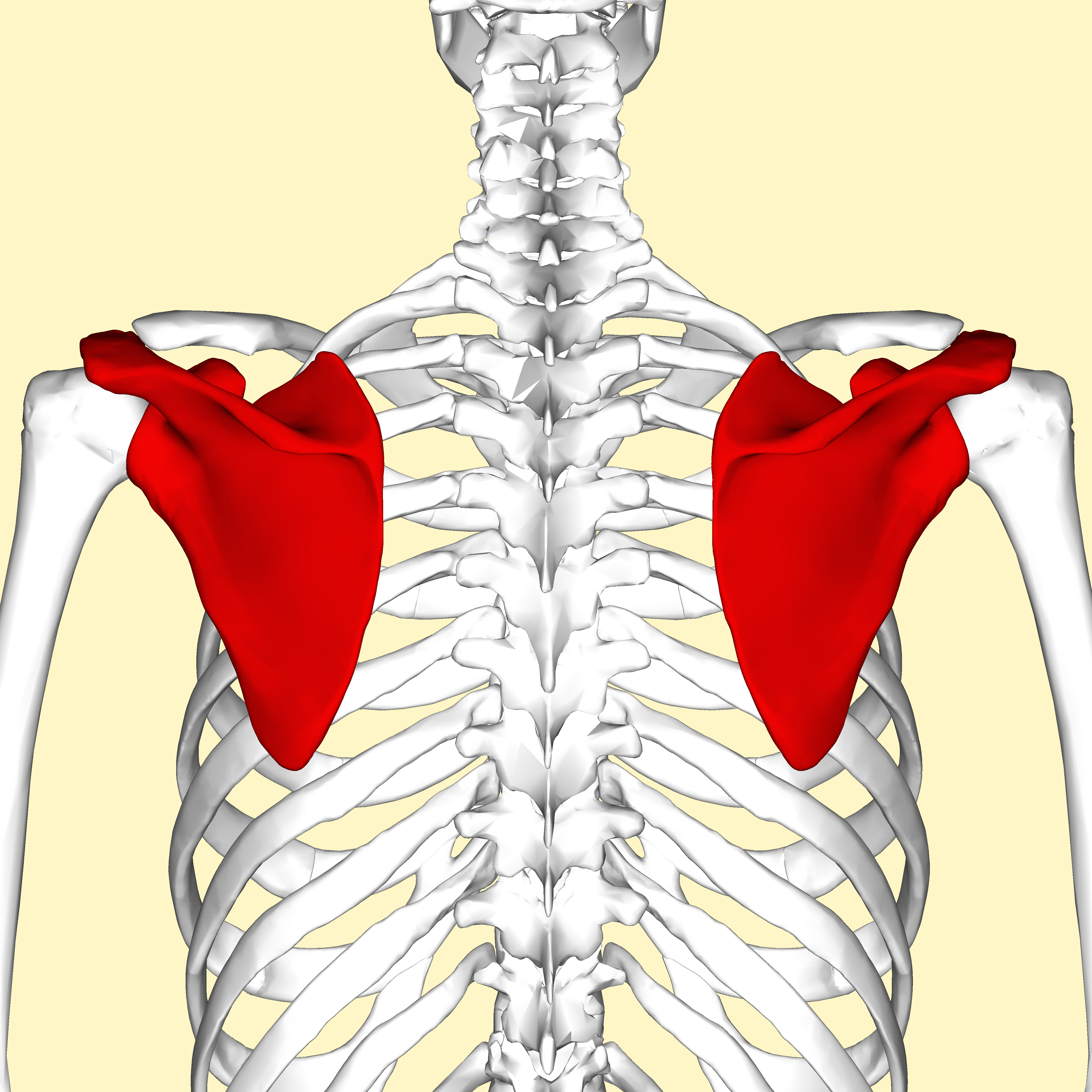
47.
What bones is represented in the  picture?
a)
Clavicle
b)
Scapula
c)
Sternum
d)
Carpals
48.
What are the 3 types of muscle tissue?
a)
Thigh, Calf, & Shoulder
b)
Traps, Forearm, & Abs
c)
Hamstring, Biceps, & Triceps
d)
Smooth Muscle, Cardiac Muscle, & Skeletal Muscle
49.
What is NOT a function of the stomach?
a)
Storing food
b)
Breaking down food (Chemically)
c)
Absorbing nutrients
d)
Breaking down food (Physically)
50.
a)
Endocrine System
b)
Nervous System
c)
Circulatory System
d)
Digestive System
51.
Chemical messengers that signal a change in the body
a)
hormone
b)
enzyme
c)
protein
d)
carbohydrate
52.
Hormones are considered what type of messenger?
a)
Electrical
b)
Chemical
53.
 What muscle is this?
a)
Triceps Brachii
b)
Biceps Brachii
c)
Biceps Femoris
d)
Rectus Femoris
54.
What is the name of this muscle?
a)
Trapezius
b)
Deltoid
c)
Abdominal
d)
Pectoralis
55.
What is the name of this muscle?
a)
Bicep
b)
Tricep
c)
Deltoid
d)
Trapezius
56.
_____ neurons carry messages to the central nervous system
a)
Motor
b)
Inter
c)
Sensory
d)
Fun
57.
_____ neurons carry  messages away from the central nervous system.
a)
Motor
b)
Inter
c)
Sensory
d)
Flower
58.
The part of the neuron that receives signals is the:
a)
Axon
b)
Dendrite
c)
Axon Terminal
d)
Cell Body
59.
Mad cow disease is caused by a
a)
prion
b)
virus
c)
bacteria
d)
toxin
60.
Which is NOT a part of the respiratory system?
a)
alveoli
b)
lungs
c)
trachea
d)
stomach
61.

Scientists working with pathogens posing mild danger such as easily treated E Coli and wearing face masks and gloves would be in a Biosafety Level____ Lab.

a)

1

b)

2

c)

3

d)

4

62.

Scientists working with incurable and highly deadly pathogens like Ebola, mad cow disease and airborne weaponized rabies wearing full suits, respirators, lab with emergency incinerator controls would be a Biosafety Level

a)

1

b)

2

c)

3

d)

4

63.

Number of people in the US who caught mad cow disease.

a)

33

b)

3000

c)

3

d)

10,000

64.

Mad cow disease in humans caused by cannibalism is called

a)

Marberg

b)

Hanta virus

c)

Kuru

65.

Pathogens transmitted from an animal to humans is called a

a)

disease

b)

virus

c)

zoonosis

d)

prion

66.

Mad cow disease in the US came from

a)

imported beef from Europe

b)

imported beef from China

c)

imported beef from South America

d)

mosquitos

67.

The most dangerous mode of pathogen transmission is

a)

blood borne

b)

direct transmission

c)

airborne

d)

droplets

68.

Girrafes have_________ vertebrae.

a)

14

b)

7

c)

12

d)

24

69.

Cattle , sheep, goats, deer and giraffes all have 4 stomach compartments that make them

a)

mono gastric.

b)

modified mono gastric.

c)

ruminants.

70.

Humans, pigs, chickens and dogs have___________ digestion.

a)

ruminant

b)

modified monogastric

c)

monogastric

71.

Horses and rabbits are examples of what type of digestion?

a)

modified monogastric

b)

monogastric

c)

ruminant

72.
a)
Latissmius Dorise
b)
Erectors
c)
Deltoids
d)
Abdominal
73.
a)
Latissimius Dorsi
b)
Trapezius
c)
Triceps
d)
Erectors
74.

A scary virus transmitted by saliva?

a)

ringworm

b)

rabies

c)

Mad Cow Disease

d)

cancer

75.

The brain can feel no pain.

a)

True

b)

False