
 Worksheets
Benchmark 3 - 7th Grade Science
Total questions: 92
Worksheet time: 10hrs 15mins
Name
Class
Date
1.

Look at the following plant cell on the white board. The organelle _____________ within a plant cell, and some other organisms, captures energy from sunlight and changes it to an energy form that cells can use in making food.
a)
chloroplast
b)
lysosomes
c)
mitochondria
d)
nucleus
2.

Look at the animal and plant cells above. The organelle ________________ within both plants and animal cells is a small grain-shaped organelle in the cytoplasm of a cell that produces protein.
a)
chloroplast
b)
ribosomes
c)
golgi apparatus
d)
endoplasmic reticulum
3.

Which of the following organelles is responsible for many of the cell's activities, and also contains the cell's genetic material (DNA).
a)
cell membrane
b)
mitochondria
c)
nucleus
d)
endoplasmic reticulum
4.
___________________ is the tendency of a cell to maintain the conditions necessary for survival. For example, ______________ helps a cell maintain a stable temperature and the proper amount of water. In turn, Cellular Respiration is the process that transforms chemical energy into other types of energy needed for life.
a)
Cellular Synthesis
b)
Cellular Respiration
c)
Homeostasis
d)
Protein Synthesis
5.
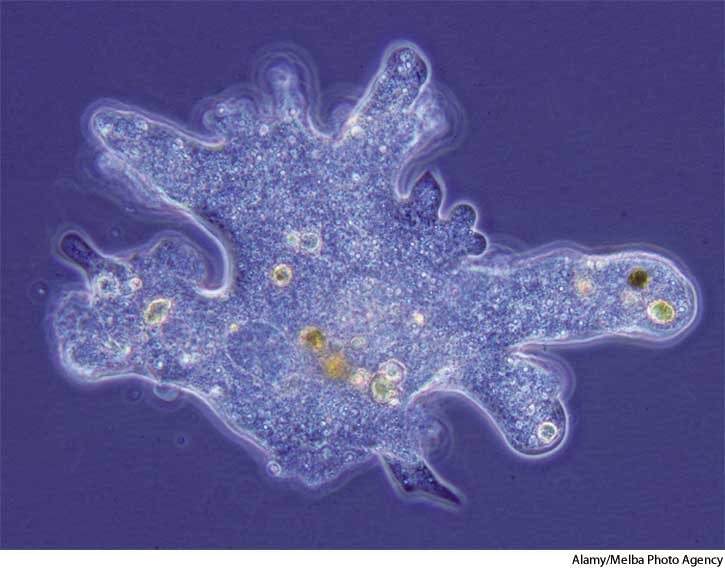
An Amoeba is a unicellular, animal-like protist that lives in ponds and streams. According to cell theory, where did this cell come from?
a)
another pre-existing amoeba cell.
b)
energy from sun that allowed the protist to reproduce.
c)
a multicellular organism.
d)
the nonliving environment.
6.
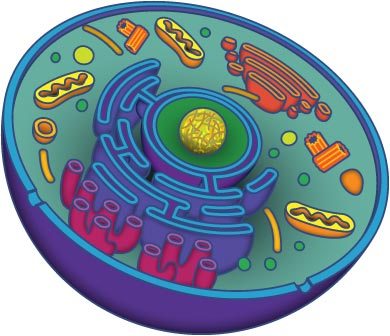
All living things are made up of...
a)
cells
b)
cell tissues
c)
organ
d)
organ systems
7.

Looking at the following roller coaster image, what form of energy does the roller coaster cart currently hold?
a)
Maximum Elastic Potential Energy
b)
Maximum Chemical Potential Energy
c)
Maximum Gravitational Energy
d)
Maximum electrical energy
8.
Suppose you were to to drop a tennis ball from a tall building. As the ball is falling, its kinetic energy:
a)
decreases
b)
remains constant
c)
disappears
d)
increases
9.

Looking at the image, where does the frog possess kinetic energy?
a)
at position P
b)
at position Q
c)
at position R
d)
at positions P, Q, and R
10.
A waterfall is an example of?
a)
energy being destroyed
b)
energy being created
c)
kinetic energy being converted into potential energy
d)
potential energy being converted to kinetic energy
11.
When riding a roller coaster, you go up and down many hills. When do you have the least amount of kinetic energy?
a)
at the top of the hill
b)
as you go down each hill
c)
at the bottom of the hill
d)
as you go up each hill
12.
Which one of the following is an example of the conversion of kinetic energy to potential energy?
a)
coasting downhill on your bicycle
b)
recharging your cell phone battery
c)
a burning match
d)
an acorn falling from a tree
13.

In order to get fresh oxygen, dispose of carbon dioxide, the circulatory system has to connect with this organ?
a)
heart
b)
vessels
c)
lungs
d)
veins
14.

The human heart is a ____-chambered organ.
a)
1
b)
2
c)
3
d)
4
15.

blood flows back to the heart in these
a)
cytoplasm
b)
lungs
c)
circulatory system
d)
vein
16.

What is a system of organs that transport blood throughout the body called?
a)
Lymphatic System
b)
Blood System
c)
Cardiovascular System
d)
Digestive System
17.

Which of the following is an organ of the nervous system?
a)
lungs
b)
the heart
c)
the spinal cord
d)
skin
18.

Which structure of the nervous system sends synapsing signals, aka electrical signals, to other body systems?
a)
Synapse
b)
Dendrite
c)
Axon
d)
Motor Neuron
19.

What are the ways within which microbiologists classify protists?
a)
Microbiologists classify protists by the way they look. Some of them are green in color, while others are clear.
b)
Microbiologist classify protists by observing their method of obtaining energy.
c)
Microbiologists classify protists by observing how they move. Some protists use cilia to move, while some other use cytoplasmic streaming or flagellum.
d)
Microbiologists classify protists by observing how they move, and the protists method of obtaining energy.
20.

As we already know, heterotrophic protists are animal-like in extracting energy for food. What does it mean when a protist is "heterotrophic"?
a)
Heterotrophic protists are protists that have to move to find their food, and eat smaller organisms to survive. Sometimes, these types of protists eat each other, or other protists.
b)
Heterotrophic protists are protists that do not have to move to fin their own food, rather, these protists can perform photosynthesis which allows for these types of protists to create their own food.
c)
Heterotrophic protists can find their own food, and create their own food.
d)
Heterotrophic protists feed off of decaying matter which can include dead trees.
21.

As we already know, autotrophic protists are plant-like in extracting food for energy. What does it mean when a protist is "autotrophic"?
a)
Autotrophic protists are protists that have to move to find their food, and eat smaller organisms to survive. Sometimes, these types of protists eat each other, or other protists.
b)
Autotrophic protists are protists that do not have to move to fin their own food, rather, these protists can perform photosynthesis which allows for these types of protists to create their own food.
c)
Autotrophic protists feed off of decaying matter which can include dead trees
d)
Autotrophic protists are protists that can move to find their own food, and eat smaller organisms to survive, can produce photosynthesis to create their own food, and feed off of decaying matter which can include dead trees.
22.

The euglena and volvox are part of the plant-like protists. Which of the following organelles is responsible for identifying this protists to be plant-like in nature?
a)
Cilia - Each volvox and euglena have cilia which are tiny hair-like structures that allow the euglena and volvox to move around its watery environment.
b)
chloroplasts - Each volvox and euglena contain the organelle chloroplast within which the chloroplast allows the plant-like protists to perform photosynthesis.
c)
Cell Membrane - Each volvox and euglena contain a cell membrane, within which the cell membrane allows the movement of organelles across its cell.
d)
Cilia & Chloroplasts are both found in the euglena and volvox which is responsible for identifying these protists to be plant-like in nature.
23.
What is the role of pseudopodia in the Amoeba?
a)
Store food until it is digested.
b)
Transcription
c)
Movement
d)
Regulates how much water goes into the cell.
24.
Which protists are autotrophic?
a)
Euglena and Volvox
b)
Amoeba and Euglena
c)
Volvox and Amoeba
d)
Paramecium Only
25.
Which protists are heterotrophic?
a)
Amoeba and Volvox
b)
Euglena and Paramecium
c)
Paramecium and Ameoba
d)
Euglena and Volvox
26.

When you breathe, your lungs take in ___ and remove ___.
a)
air/oxygen
b)
oxygen/carbon dioxide
c)
carbon dioxide/waste
d)
waste/air
27.
What are the main organs of gas exchange in the respiratory system?
a)
diapragm
b)
lungs
c)
trachea
d)
bronchi
28.

How is cartilage important in the skeletal system?
a)
cartilage provides the connection from one bone to another bone. For example, your knee has cartilage that connects the upper leg bone to the lower leg bone.
b)
cartilage provides the connection from muscle to bone. For example, the biceps brachii is attached to your radius lower arm bone.
c)
cartilage is found at the end of bones and is made of tough protein fibers, called collagen, within which cartilage provides smooth surfaces for bone to rub against.
d)
none of these answers are correct because cartilage is part of the muscular system.
29.
What is the main purpose of cartilage in the skeletal system?
a)
Cartilage allows you to turn your neck.
b)
Cartilage protects your soft organs.
c)
Cartilage prevents your bones from being broken.
d)
Cartilage cushions bones to keep them from grinding together
30.
Which of the following skeletal system parts is connective tissue that keeps your bones attached to each other?
a)
joints
b)
tendons
c)
cartilage
d)
ligaments
31.

How many parents does asexual reproduction involve?
a)
one
b)
two
c)
three
d)
four
32.

If two organisms reproduce sexually, then their offspring will exhibit a genetic makeup that is -
a)
identical to only one parent
b)
identical to all of its siblings
c)
a unique combination of traits
d)
the recessive traits of each parent
33.

All of the offspring of an organism have the same genetic material, which is identical to the parent organism. From this, we can conclude that this organism -
a)
makes its own food
b)
is unicellular
c)
live in a marine habitat
d)
reproduces asexually
34.

When comparing the offspring of sexually and asexually reproducing organisms, we would expect the genetic material (DNA) of the sexually reproducing organism to -
a)
contain fewer mutations
b)
be lesser in quantity
c)
be simpler overall
d)
show more variation
35.

The genetic material of an offspring of sexually reproducing organisms is best described as–
a)
identical to that of the other offspring
b)
a copy of the genetic material of the mother
c)
a copy of the genetic material of the father
d)
genes from both parents, in unique combinations
36.

A white cat had a litter of kittens that were orange, grey, and black and white spotted. Is this the result of sexual or asexual reproduction? And how would you characterize the offspring listed above?
a)
Sexual reproduction with uniform offspring
b)
Asexual reproduction with diverse offspring
c)
Sexual reproduction with diverse offspring
d)
Asexual reproduction with uniform offspring
37.
Asexual reproduction like mitosis produces
a)
Two offspring cells with the same genetic material as the parent cell.
b)
Two offspring cells with half genetic material as the parent cell.
c)
Four offspring cells with the same genetic material as the parent cell.
d)
Four offspring cells with half the genetic material as the parent cell.
38.
What are some of the facts about sexual reproduction?
a)
Takes two mates to reproduce and takes a longer time to reproduce
b)
Takes one mate to reproduce and takes a shorter amount of time to reproduce
c)
Takes two mates to reproduce and takes a shorter amount of time to reproduce
d)
Takes one mate to reproduce and takes a shorter amount of time to reproduce
39.
What are some of the facts about asexual reproduction?
a)
Takes only one mate to reproduce and takes a longer time to reproduce
b)
Takes a shorter amount of time to reproduce and it takes two mates to reproduce
c)
Reproduces diverse offspring and takes a longer time to reproduce
d)
Takes only one mate to reproduce and takes a shorter time to reproduce
40.
Which of the following is a genetic cross between two purebred pea plants?
a)
Tt x Tt
b)
Tt x tt
c)
TT x tt
d)
None of the answers are correct
41.
An example of a homozygous recessive allele pair can be:
a)
Rr
b)
rr
c)
RR
d)
none of the answers are correct
42.
An example of a heterozygous dominant allele pair can be:
a)
rr
b)
RR
c)
Rr
d)
none of the answers are correct
43.
An example of a homozygous dominant allele par can be:
a)
TT
b)
Tt
c)
tt
d)
none of the answers are correct
44.
How can a tall pea plant crossed with another tall pea plant produce four offspring, within which 3 of the offspring are are tall, but one of the pea plants is short?
a)
One of the pea plants is homozygous recessive, while the other pea plant is homozygous recessive. This cross of pea plants would produce 3 offspring that are tall, but one of the pea plants is short.
b)
One of the pea plants is heterozygous dominant, while the other pea plant is homozygous dominant. This cross of pea plants would produce 3 offspring that are tall, but one of the pea plants is short.
c)
One of the pea plants is heterozygous dominant, while the other pea plant is heterozygous dominant. This cross of pea plants would produce 3 offspring that are tall, but one of the pea plants is short.
d)
none of the answers are correct.
45.
An organism with two different alleles for a trait is said to be:
a)
recessive
b)
hybrid
c)
dominant
d)
purebred
46.
Homozygous Alleles are also considered to be
a)
Purebreds
b)
Hybrids
c)
Genotype
d)
Phenotype
47.
Mr. Lloyd has been breeding tulip flowers for Valentines day. For the parent generation, he decides to cross a heterozygous dominant allele pair (red phenotype) with a homozygous recessive allele pair (white phenotype). What is the probability that the F1 - Generation offspring will be the color white? Remember, you must use the same letter of the alphabet, but has to be capital or lower case!
a)
The probability that the F-1 Generation offspring will have recessive alleles (white phenotype) would be 25%
b)
The probability that the F-1 Generation offspring will have recessive alleles (white phenotype) would be 50%
c)
The probability that the F-1 Generation offspring will have recessive alleles (white phenotype) would be 75%
d)
The probability that the F-1 Generation offspring will have recessive alleles (white phenotype) would be 100%
48.

The diagram shows a box that is sliding down a ramp. Which arrow correctly indicates the direction of friction acting on the box?
a)
F1
b)
F2
c)
F3
d)
F4
49.
What is the purpose of using a pedigree?
a)
To determine the average age of a family
b)
To find out family histories and medical records
c)
To find out whether a couple can have a boy or a girl
d)
To trace the inheritance of a certain trait through generations
50.
How many PAIRS of chromosomes do humans have?
a)
23
b)
46
c)
1
d)
2
51.
I have 2 X chromosomes. What am I?
a)
Male
b)
Female
52.
I have 1 X chromosome and 1 Y chromosome. What am I?
a)
Male
b)
Female
53.

What percentage of the offspring will have this recessive disease?
a)
0%
b)
25%
c)
50%
d)
75%
54.

What percentage of the female offspring will be a carrier for this recessive disease?
a)
0%
b)
50%
c)
100%
d)
25%
55.

Looking at this pedigree, how many female family members are carriers?
a)
1
b)
3
c)
10
d)
7
56.
A man with type O blood is accused of being the father of a type B baby. The mother is type A. Could this man be the father?
a)
Yes
b)
No
57.
What are the blood types of the possible children that a woman (type O) and man (type AB) can have?
a)
O and AB
b)
O and A
c)
O and B
d)
A and B
58.
Shona cycles at an average speed of 8km/h. How far has she travelled if she cycles for 4 hours?
a)
55km
b)
32km
c)
43km
d)
32miles
59.
A plane flies due west for 4 1/2 hours. It travels a total of 5400 km. What was its velocity?
a)
1500 km/h
b)
1200 km/h, west
c)
400 km/h
d)
2000 km/h
60.

What is this graph showing?
a)
Constant Speed
b)
Acceleration (speeding up)
c)
Deceleration (slowing down)
d)
No motion
61.

In which of the following graphs (click the image) are both runners moving at the same speed (note that graph c is the bottom right graph, and graph d is the bottom left graph)?
a)
Graph A
b)
Graph B
c)
Graph C
d)
Graph D
62.

What is happening at D?
a)
Stationary
b)
Accelerating
c)
Fast steady speed; moving away from the starting position
d)
Slower steady speed; moving away from the starting position
63.

What does this graph represent?
a)
Constant Speed
b)
Acceleration
c)
Not moving
64.
An example of incomplete dominance can be:
a)
If a homozygous dominant red flower (RR) breeds with a homozygous dominant blue flower (BB), the F-1 offspring's phenotype will have red flowers with blue dots, or blue flowers with red dots.
b)
If a homozygous dominant red flower (RR) breeds with a homozygous dominant blue flower, the F-1 offsprings phenotype will have either blue flower, or red flower. This is dependent on which flower if more dominant.
c)
If a homozygous dominant red flower (RR) breeds with a homozygous dominant blue flower (BB), the F-1 offspring's phenotype will have all purple flowers. This is due to the incomplete dominance of both the blue and red flower's genotypes.
d)
none of the answers are correct.
65.

Which of the following gases is the most abundant in Earth's Troposphere?
a)
Nitrogen (N2)
b)
Oxygen (O2)
c)
Argon (Ar)
d)
Carbon Dioxide (CO2)
66.

As you increase altitude within the troposphere, temperature
a)
increases, this is due to that the Earth radiates the heat back to space
b)
decreases, this is due to that the Earth radiates the heat back towards space
c)
stays the same
d)
does not change
67.

The stratosphere is important due to that
a)
it has an ozone layer, within which it protects life from infrared radiation which would otherwise cause us to burn.
b)
it has an ozone layer, within which it protects life from ultra-violet radiation which would otherwise cause us to burn.
c)
it burns up meteors.
d)
contains the aurora borealis.
68.
As the altitude increases in the stratosphere, temperature tends to
a)
decrease
b)
increase
c)
stay the same
d)
none of these
69.
The process of convection transfers heat energy _____.
a)
from cold areas to warm areas
b)
from warm areas to cold areas
c)
from high altitudes to low altitudes
d)
from humid areas to dry areas
70.
What is the relationship between altitude and air density within Earth's atmosphere?
a)
As altitude increases, air density decreases.
b)
As altitude increases, air density increases.
c)
As altitude increases, air density remains the same.
d)
There is no relationship between altitude and air density within Earth's atmosphere.
71.
Why does air density decrease with increasing altitude within Earth's atmosphere?
a)
Air density decreases with increasing altitude because more atoms escape into outer space.
b)
Air density decreases with increasing altitude because temperature decreases with increasing altitude.
c)
Air density decreases with increasing altitude because the gravitational pull exerted by the Earth decreases with increasing altitude.
d)
Air density decreases with increasing altitude because energy from the sun pushes the air particles closer to Earth.
72.
List the layers of Earth's atmosphere in order of increasing altitude.
a)
exosphere, thermosphere, mesosphere, stratosphere, troposphere
b)
troposphere, stratosphere, mesosphere, thermosphere, exosphere
c)
troposphere, stratosphere, ozone layer, mesosphere, thermosphere, exosphere
d)
stratosphere, mesosphere, thermosphere, exosphere, troposphere
73.

1. This picture shows warm air rising and cool air falling in a cycle. This is an example of which process?
a)
Conduction
b)
Convection
c)
Radiation
74.

What happens to the air pressure (density) of air as you increase in altitude?
a)
density increases, this is due to the surface area of the atmosphere increasing as you increase altitude which allows for gas molecules to expand.
b)
density decreases, this is due to the surface area of the atmosphere increasing as you increase altitude which allows for gas molecules to expand.
c)
density stays the same
d)
density disappears
75.

Looking at the image provided by quizizz, when the ball is at position p...
a)
the ball has no energy
b)
all of the balls energy is kinetic
c)
it has both potential and kinetic energy
d)
all of the balls energy is potential energy
76.

Prokaryotic cells are simple cells, like bacteria, which do not contain a nucleus but, like all cells, have a cell membrane and are filled with a thick liquid known as ___________________________.
a)
chloroplast
b)
nucleoid
c)
cytoplasm
d)
chromatin
77.

Which of the following events would occur if plant cells could not perform the life process of cellular respiration?
a)
Plant cells make their own carbohydrates, in turn, plant cells would not be able to create their own carbohydrates. The cells would starve, and die if they could not perform the life process of cellular respiration.
b)
Plant cells reproduce by the nucleus, in turn, the plant cells would not be able to reproduce. The cells would eventually go extinct if they could not perform the life process of cellular respiration.
c)
Plant cells have cytoplasm that holds all the cells organelles in place, in turn, plant cells would not be able to hold the organelles together. The plant cells would eventually dry up, and die if they could not perform the life process of cellular respiration.
d)
none of the answers are correct
78.

The Earth radiates energy back towards space in the form of?
a)
Solar Radiation (UV)
b)
Infrared Radiation (heat)
c)
X-Ray Radiation
d)
Nuclear Radiation
79.

Why are greenhouse gases important to the Earth's atmosphere?
a)
Greenhouse Gases reflect infrared radiation (in the form of heat), within which the infrared radiation is re-radiated towards space
b)
Greenhouse Gases absorb infrared radiation (in the form of heat), within which the infrared radiation cools the planet.
c)
Greenhouse Gases reflect infrared radiation (in the form of heat), within which the greenhouse gases re-radiate the heat back towards Earth.
d)
Greenhouse Gases absorb infrared radiation (in the form of heat), within which greenhouse gases re-radiate the heat back towards space
80.
Natural processes that cause air pollution, and climate change, within the Earth's atmosphere can consist of:
a)
smokestacks and cars
b)
power plants and busses
c)
volcanoes and wildfires
d)
volcanoes and man-made-fires
81.
Unnatural processes that cause air pollution, and climate change, within the Earth's atmosphere can consist of:
a)
Oceans spraying sea water
b)
Volcanic Euruptions
c)
Industrial Smokestacks
d)
Pollinated Trees and Flowers
82.

Particulate matter, found within the atmosphere, can be defined as:
a)
a substance (such as hair spray or medicine) that is kept in a container under pressure and that is released as a fine spray when a button is pressed.
b)
the sum of all solid and liquid particles suspended in air, many of which are hazardous. This complex mixture contains for instance dust, pollen, soot, smoke, and liquid droplets.
c)
the matter that is only in the form of a solid which includes dust particles and pollen
d)
the matter that is only in the form of a liquid which includes water vapor and liquid water
83.

Aerosols are a substance (such as hair spray or medicine) that is kept in a container under pressure which is released as a fine spray when a button is pressed. The Environmental protection Agency banned the use of this gas to prevent stratospheric ozone layer depletion?
a)
Ground Level Ozone (O3)
b)
Nitric Oxides (NO2)
c)
Sulfor Dioxides (SO2)
d)
Chlorofluorocarbons
84.

As we already know, An erupting volcano can change the composition of the atmosphere locally and globally as winds carry particulate matter and greenhouse gases over large distances. If volcanic eruptions were constant, and 99% of volcanoes on Earth were erupting for a period of time, the atmosphere of the planet would?
a)
Warm, this is due to greenhouse gases absorbing the infrared (heat) radiation, and re-radiating that heat back towards Earth.
b)
Cool, this is due to particulate matter, aka ash and smoke plumes, blocking UV radiation, and re-radiating that heat back towards space.
c)
Cool, this is due to to absorbing the infrared (heat) radiation, cooling the air, and re-radiating that air back towards Earth.
d)
Warm, this is due to absorbing the infrared (heat), and re-radiating the heat back towards space.
85.
Which type of friction occurs when an object moves through a liquid or gas?
a)
sliding
b)
fluid
c)
static
d)
rolling
86.
Friction is a force that acts in an ___________ direction of movement.
a)
similar
b)
opposite
c)
parallel
d)
west
87.

Sally sliding down the slide would be an example of which type of friction?
a)
Rolling Friction
b)
Sliding Friction
c)
Fluid Friction
d)
Static Friction
88.

Wheels of a shopping cart would be an example of which type of friction?
a)
Rolling Friction
b)
Sliding Friction
c)
Fluid Friction
d)
Static Friction
89.
What is the difference between genotype and phenotype?
a)
genotype is detectable expression of the genotype. An expressed and observable trait. e.g. hair color. on the other hand, phenotype is The genetic makeup of an individual. Refers to the information contained on two alleles in the cell.
b)
Hair color, eye color, weight, and the ability to roll one's tongue are examples of genotype. Phenotype is a section of DNA that may be susceptible to disease.
c)
phenotype is the detectable expression of the genotype. It is also an expressed or an observable trait, e.g. hair color. Genotype is the genetic makeup of an individual. Refers to the information contained on two alleles in the cell, e.g. TT, tt, Tt
d)
none of the answers are correct.
90.
Mr. Lloyd has been breeding tulip flowers for Valentines day. For the parent generation, he decides to cross a heterozygous dominant allele pair (red phenotype) with a homozygous recessive allele pair (white phenotype). What is the probability that the F1 - Generation offspring will be the color red? Remember, you must use the same letter of the alphabet, but has to be capital or lower case!
a)
The probability that the F-1 Generation offspring will have a dominant allele (red phenotype) would be 25%
b)
The probability that the F-1 Generation offspring will have a dominant allele (red phenotype) would be 50%
c)
The probability that the F-1 Generation offspring will have a dominant allele (red phenotype) would be 75%
d)
The probability that the F-1 Generation offspring will have a dominant allele (red phenotype) would be 0%
91.

The genotype of the affected son and daughter at the bottom of this pedigree must be:
a)
homozygous dominant
b)
homozygous recessive
c)
heterozygous
d)
Can't tell
92.

The genotype of the affected son and daughter at the bottom of this pedigree...
a)
homozygous dominant
b)
homozygous recessive
c)
heterozygous
d)
Can't tell
100 %

