Wayground logo

Free Printable Worksheets

Font size

S
M
L
XL
Worksheets

EOC Review

Total questions: 128

Worksheet time: 2hrs 15mins

Name
Class
Date
1.
Members of which kingdom live in unusual conditions such as deep ocean trenches or volcanoes?
a)
Eubacteria
b)
Protista
c)
Fungi
d)
Archaebacteria
2.
A body part or behavior that helps a living thing survive
a)
camoflage
b)
adaptation
c)
extiction
d)
instinct 
3.
What reactants are there in cellular respiration?
a)
Water and Glucose
b)
Oxygen and Glucose
c)
Carbon Dioxide and Water
d)
Glucose  and Carbon Dioxide
4.

The ___________ record provides evidence for evolution by showing how species have changed over time.

a)

fossil

b)

time

c)

embryological

d)

analogous structure

5.

Similar fossils have been found in places separated by thousands of miles of ocean, but which would have been next to each other on Pangea.

a)

False

b)

True

6.

A ___________ structure in two different species has the same developmental and evolutionary history, but serves different functions in the two species.

a)

analogous

b)

embryology

c)

homologous

d)

fossil

7.

the word dormancy means:

a)

inactive/period of rest

b)

dead

c)

actively growing

d)

who cares

8.
An animal cell does not have a 
a)
nucleus
b)
cell wall
c)
mitochondria
d)
golgi apparatus
9.
In osmosis the water moves from____________ to __________.
a)
high to low
b)
low to high
10.
Does passive transport require energy?
a)
Yes
b)
No
11.
When does the duplication of DNA occur?
a)
Prophase
b)
Metaphase
c)
Interphase
d)
Telophase
12.
What happens during cytokinesis?
a)
DNA replicates
b)
Cytoplasm divides
c)
Spindle fibers appear
d)
Nothing
13.
How many daughter cells does mitosis produce?
a)
2
b)
4
c)
6
d)
8
14.
What is a codon?
a)
RNA
b)
Daughter cell
c)
chromosome
d)
group of 3 base codes
15.
Where does RNA translation take place?
a)
Nucleus
b)
Cytoplasm at the ribosome
c)
In the science lab
d)
Amherst
16.
What are the bases for DNA?
a)
A, U, C, G
b)
A, T, C, G
c)
T, D, I, U
d)
P, M, A, T
17.
In a genetics lab, two heterozygous tall plants are crossed. If tall is dominant over short what are the expected phenotypic results 
a)
23% tall, 72% short, 5% average
b)
75% Tall 25% short
c)
75% short 25% tall
d)
0% tall 100% short
18.
What are the genotypes of the parents that would produce 50% short and 50% tall pea plants? 
a)
Tt x tt
b)
tt X tt
c)
TT x Tt
d)
TT x TT
19.
What is an organism that breaks down & absorbs dead matter so nutrition can be recycled into the soil?
a)
Consumer
b)
Decomposer
c)
Producers
d)
Scavenger
20.
A producer is a (n) ______________.
a)
heterotroph
b)
omnitroph
c)
autotroph
d)
oscartroph
21.
The rabbit in this food web would be considered a:
a)
Decomposer
b)
Producer
c)
Secondary Consumer
d)
Primary Consumer
22.
What is Mutualism
a)
a relationship in which both species are benefited
b)
 a relationship in which neither is benefited
c)
a relationship in which one is benefited
d)
My Dog
23.
What kind of organic molecule is DNA?
a)
Protein
b)
Nucleic Acid
c)
Lipid 
d)
Carbohydrate
24.
Where is DNA found in eukaryotic cells?
a)
Cytoplasm
b)
Vacuole
c)
Cell Membrane
d)
Nucleus
25.
Amino acids are joined together in order to form
a)
DNA
b)
ribosomes
c)
proteins 
d)
RNA
26.
Any change in the sequence of DNA is...
a)
transgenic shift
b)
Single Genotype
c)
Monohybrid Trait
d)
Mutation
27.
RNA is different from DNA in ___
a)
RNA is single stranded
b)
RNA has uracil 
c)
RNA has the sugar ribos
d)
All of these
28.
what does tRNA do?
a)
carry info from genes to ribosomes
b)
carry amino acids to ribosomes
c)
help with RNA splicing
d)
make up ribosomes
29.
The process of making mRNA from DNA is called.
a)
Replication
b)
Transcription
c)
Translation
d)
Protein synthesis
30.
The building blocks of DNA  & RNA consisting of a five-carbon sugar, a phosphate group, and a nitrogen-containing base.
a)
Genetics
b)
Replication
c)
Nucleotides
31.
How do enzymes function?
a)
They increase the activation energy
b)
They increase the reaction rate
c)
They decrease the reaction rate
d)
They decrease the substrate binding complex
32.
Which of the following is NOT an element found in lipids?
a)
Carbon
b)
Nitrogen
c)
Hydrogen
d)
Oxygen
33.
What are the two major organ systems that work to defend the body from injury?
a)
Immune and Endocrine
b)
Integumentary and Nervous
c)
Excretory and Immune
d)
Integumentary and Immune
34.
Which of the following is NOT a characteristic of Meiosis?
a)
Produces diploid cells
b)
Produces unique cell
c)
Two rounds of cell division 
d)
Is associated with sexual reproduction
35.
Normal-
AGA-TTC-ATA-GCG
Mutant-
AGA-TTC-AAT-AGC-G
What is the type of mutation that has occurred?
a)
deletion frameshift
b)
insertion frameshift
c)
substitution
d)
nonsense
36.
What does NOT happen during interphase?
a)
growth
b)
DNA replication 
c)
obtaining nutrients
d)
cell divison
37.
This image represents a monomer of which macromolecule?
a)
protein
b)
carbohydrates
c)
lipids
d)
nucleic acids
38.
A group of different species that live together and interact in an environment are called a/an ________.
a)
community
b)
habitat
c)
population
d)
ecosystem
39.
6CO2 + 6H20 + light energy    -> C6H12O6 + 6O2
In this chemcial equation, the highlight red is called the ______. 
a)
product
b)
reactant
c)
yields
d)
production
40.
In the middle of the DNA strand, the bases (ATCG) are held together by what type of bond? 
a)
polar bonds
b)
ionic bonds
c)
covalent bonds
d)
hydrogen bonds
41.
When substances enter a cell by going against the gradient, it is called
a)
passive transport
b)
active transport
c)
facilitated diffusion
d)
isotonic interaction
42.
Which shows a cell in hypotonic solution?
a)
1
b)
2
c)
3
d)
It depends on the cell
43.
Which of the following is not a part of interphase?
a)
G2
b)
M
c)
G1
d)
S
44.
What is the basis for all variation among organisms?
a)
Mutation
b)
Genetic Drift
c)
Migration
d)
Inbreeding
45.
Lysosomes...
a)
store water and sugar
b)
make energy
c)
controls the cell
d)
cleans up waste
46.
Are viruses living or nonliving? 
a)
Nonliving because they cannot reproduce on their own
b)
living because they spread
c)
living because they contain genetic material
d)
nonliving because they do not have genetic material
47.
Which pair of structures best shows that plant cells have functions different from animal cells?
a)
Cytoplasm and mitochondria
b)
Chloroplasts and cell wall
c)
Ribosome and golgi
d)
Nucleus and cell membrane
48.
Which biomolecule is this a picture of?
a)
Protein
b)
Nucleic Acid
c)
Lipid
d)
Carbohydrate
49.
Which biomolecule is your main source of energy?
a)
Nucleic Acid
b)
Protein
c)
Lipid
d)
Carbohydrate
50.

The ability to maintain a stable internal environment is called ________________.

a)

Metabolism

b)

Mitosis

c)

Heterozygous

d)

Homeostasis

51.
What is the capsid of a virus?
a)
the disease it causes
b)
the receptors to which it binds
c)
the genetic material
d)
its protein coat
52.
What is one way that a lysogenic infection differs from a lytic infection?
a)
A lysogenic virus does not act on bacteria as a lytic virus does.
b)
A lysogenic virus can remain in the host DNA for a longer period without becoming active.
c)
A lysogenic virus contains RNA instead of DNA.
d)
A lysogenic virus directs the production of new viruses right away.
53.
Which of the following is a possible result of a disruption in the cell cycle?
a)
cancer
b)
photosynthesis
c)
cellular respiration
d)
protein synthesis
54.

Cell have several mechanisms for regulating their internal environments. Which of these mechanisms involved in maintaining homeostasis requires energy?

a)

osmosis

b)

diffusion

c)

active transport

d)

passive transport

55.
Which of the following is the only characteristic shared by living cells and viruses?
a)
the presence of carbohydrates
b)
the ability to reproduce
c)
the presence of the nucleic acid
d)
a cell membrane
56.
This cell is undergoing mitosis.  What stage of mitosis is shown?
a)
prophase
b)
metaphase
c)
anaphase
d)
telophase
57.
Which of the following macromolecules are a prominent part of animal tissues that function in insulation, helping animals conserve heat?
a)
Carbohydrates
b)
Lipids
c)
Proteins
d)
Nucleic acids
58.
a)

Prophase

b)

Anaphase

c)

Telophase

d)

Interphase

59.
The diffusion of water through a semi-permeable membrane is called?
a)
Osmosis
b)
Cell wall
c)
Diffusion
d)
Respiration
60.
An animal cell placed in a hypertonic (salty) solution will
a)
Shrink
b)
Swell
c)
Stay the same
61.
What gender has an X and a Y chromosome?
a)
male
b)
female
c)
transgender 
d)
all of the above
62.
Two brown eyed parents (Bb) have a baby. What is the chance the baby is blue eyed?
a)
0 %
b)
25%
c)
50%
d)
75%
63.
What is a phenotype?
a)
The expression of a trait; physical appearance.
b)
refers to the genetic makeup of an individual
c)
An organism that has the same genes for a trait (ex. TT or tt)
d)
the passing of traits from parent to offspring
64.
The process of making an mRNA strand from a DNA template is called
a)
Replication
b)
Transcription
c)
Translation
d)
Protein Synthesis
65.
The process of using an mRNA to make a protein is called
a)
Replication
b)
Transcription
c)
Translation
d)
Cell Division
66.
What amino acid is represented by the codon UUA?
a)
Phenylalanine
b)
Tyrosine
c)
Leucine
d)
Stop codon
67.
The process by which all organisms change slowly over time because of slight gene variations is called
a)
natural selection
b)
artificial selection
c)
evolution
d)
gene pool
68.
The role or function or job of a species in a community.
a)
habitat
b)
diet
c)
niche
d)
ecosystem
69.
Autotrophs make up the _______ level in all ecosystems.
a)
First
b)
Second
c)
Third
d)
Fourth
70.
Plant cells that are specialized for cell division are most likely found in what part of a plant?
a)
Root tips
b)
Bark
c)
Stem epidermis
d)
Vascular tissue
71.
A scientist treats a cell with a chemical that destroys the ribosomes. As a result, which cell process will be stopped?
a)
Osmosis
b)
Protein Synthesis
c)
Photosynthesis
d)
Cellular Respiration
72.
This diagram shows an enzyme-substrate complex.
Which is represented by Structure X?
a)
Substrate
b)
Enzyme
c)
Complex
d)
Product
73.
Which is the most likely function of a group of cells that contain a high number of chloroplasts?
a)
Respiration
b)
Transpiration
c)
Photosynthesis
d)
Fermentation
74.
What will most likely happen if an appropriate enzyme is added to a chemical reaction?
a)
The reaction rate will increase
b)
The reaction rate will decrease
c)
The reaction will stop
d)
It will explode
75.
Which process is an example of asexual reproduction?
a)
An amoeba divides in half to form two amoebas.
b)
A bee transfers pollen from one flower to another.
c)
A female fish deposits eggs on a rock, then a male fish releases sperm on them.
d)
Earthworms exchange sperm
76.
A researcher is studying a particular disease-causing agent. The agent has a protein coat, but it lacks a nucleus, contains no other organelles, and can reproduce only when it is inside an animal cell. The researcher should classify the agent as which of the following?
a)
A bacterium
b)
A fungus
c)
A virus
d)
A protist
77.
Energy for most chemical reactions in cells is supplied by which of the following molecules?
a)
DNA
b)
ATP
c)
RNA
d)
Hemoglobin 
78.
What is one way that a lysogenic infection differs from a lytic infection?
a)
A lysogenic virus does not act on bacteria as a lytic virus does.
b)
A lysogenic virus can remain in the host DNA for a longer period without becoming active.
c)
A lysogenic virus contains RNA instead of DNA.
d)
A lysogenic virus directs the production of new viruses right away.
79.
Which is the only structure you would expect to see when examining a prokaryotic cell with a compound microscope?
a)
nucleus
b)
chloroplast
c)
cell membrane
d)
mitochondria
80.
A compound is analyzed and found to have the chemical formula C6H12O6. What type of macro molecule is this substance?
a)
protein
b)
lipid
c)
carbohydrate
d)
nucleic acid
81.
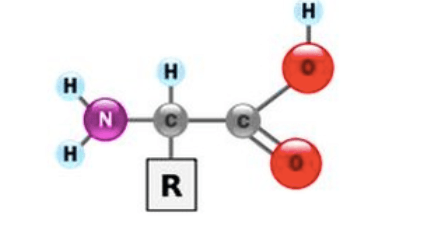
The diagram shows the base sequence of a strand of DNA.
From left to right, what is the sequence of the complementary strand of DNA in this molecule?
a)
T G A A C
b)
A C T  T G
c)
T G U U C
d)
U C T T G
82.
an organism has a nucleus, is multicellular but has no cell wall and no chloroplast?
a)
Fungi
b)
Plantae
c)
Animalia
d)
Eubacteria
83.
ATG is _____, while UAA is ____
a)
a ribosome - a protein
b)
an amino acid - an enzyme
c)
a DNA codon - an RNA codon
d)
transfer RNA - messenger RNA
84.
Biological systems are highly organized. The basic unit of all living things is the cell. Cells with a similar structure and function are organized into a(n)-
a)
tissue
b)
organ
c)
organ system
d)
organism
85.
scientists use similarities and differences to place organisms in categories. These categories make up a hierarchical classification system. Which category represents the level where organisms are most alike?
a)
species
b)
family
c)
kingdom
d)
domain
86.
Plants respond to stimuli such as light and gravity. What are these responses called?
a)
Tropisms
b)
Homeostasis
c)
Mutualism
d)
Decomposition
87.
In an experiment testing how plant water intake affects a plant's growth, what would be the independent variable?
a)
Glucose production
b)
Plant growth
c)
Amount of water
d)
Sunlight
88.
In an experiment testing how plant water intake affects a plant's growth, what would be the dependent variable?
a)
Glucose production
b)
Plant growth
c)
Amount of water
d)
Sunlight
89.
The specific location where a substrate binds on an enzyme is called the:
a)
Active site
b)
Catalyst region
c)
Connection site
d)
Reactant complex
90.
This type of process requires oxygen.
a)
Aerobic
b)
Anaerobic
c)
Cell transport
d)
None of the above
91.
How do fungi obtain nutrients?
a)
Photosynthesis
b)
Chemosynthesis
c)
Absorption
d)
Ingestion
92.
Which biomolecule is this a picture of?
a)
Protein
b)
Nucleic Acid
c)
Lipid
d)
Carbohydrate
93.

Where are proteins synthesized? These structures are found in the cells of plant and animals. Bacteria too!

a)

Golgi body

b)

Mitoichondrion

c)

Chromosomes

d)

Ribosomes

94.

Osmosis is the movement of water. What will be the direction of the water movement?

a)

From side A to side B

b)

From side B to side A

c)

The water will move in both direction at equal rates!

95.

What type of transport involves movement across a protein channel? No energy required!

a)

Facilitated Diffusion

b)

Active Transport

c)

Diffusion

d)

Osmosis

96.

Which of the following occurs after a virus attaches to a host cell in the viral reproduction process?

a)

The host cell immediately dies.

b)

The virus dies after attaching the the host cell.

c)

The virus inserts its genetic information into the host cell.

d)

Copies of the virus are immediately released from the host.

97.
DNA replication results in two DNA molecules,
a)
each one with two original strands
b)
each one with two new strands
c)
each one with one new strand and one original strand
d)
one with two new strands and the other with two original strands
98.
What determines the code, or information, of a DNA molecule?
a)
the shape (structure) of the nitrogen bases
b)
the order (sequence) of the nitrogen bases
c)
the color of the nitrogen bases
d)
the frequency (number) of nitrogen bases
99.
The main function of tRNA is to...
a)
carry a message that, when translated, forms proteins
b)
form a portion of ribosomes
c)
string together complementary RNA and DNA strands
d)
bring amino acids from the cytoplasm to the ribosomes
100.
DNA holds the code for
a)
lipids
b)
carbohydrates
c)
protein
d)
sugar
101.
If T=Tall & t=short, what is the genotypic ratio?
a)
1:3
b)
3:1
c)
1:2:1
d)
2:2
102.
An illustration and a dichotomous key are given. What is the correct classification for this organism?
a)
Class Insecta
b)
Order Amblygygi
c)
Order Araneae
d)
Order Scorpiones
103.
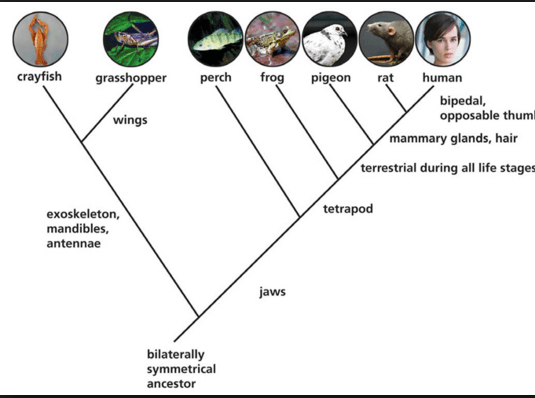
According to the cladogram, which organism is most distantly related to the human?
a)
crayfish
b)
grasshopper
c)
perch
d)
frog
104.
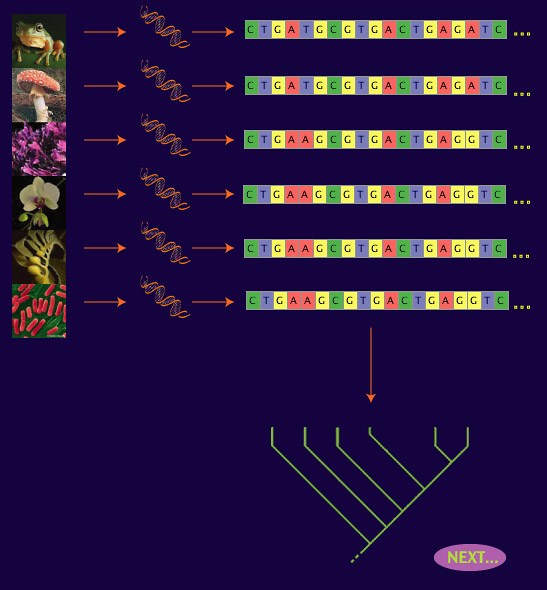
Two organisms that are closely related would have
a)
very similar DNA sequence
b)
exactly the same DNA sequences
c)
no proteins in common
d)
completely different DNA sequence
105.
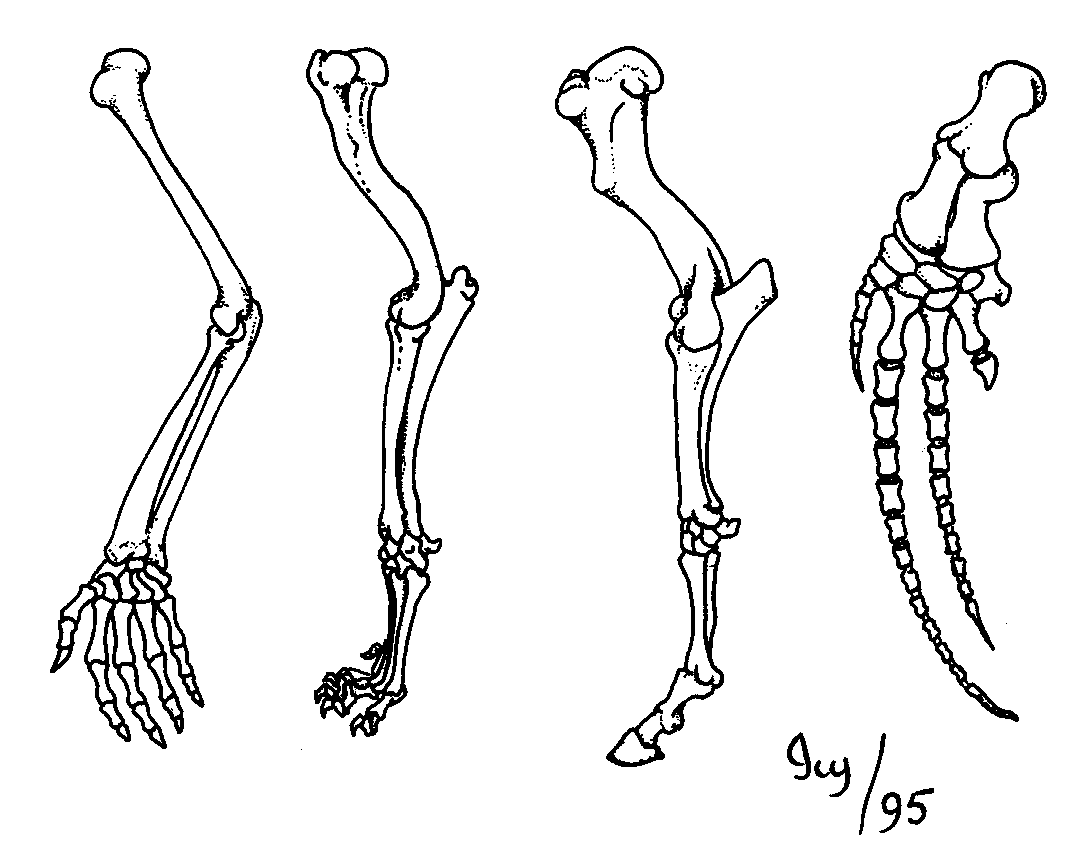
Structures with the same parts have different functions; suggests that organisms share a common ancestry
a)
vestigial structures
b)
homologous structures
c)
adaptive radiation
d)
fossil
106.
In humans, the pelvis and femur, or thigh bone, are involved in walking. In whales, the pelvis and femur shown in Figure
a)
examples of fossils.
b)
vestigial structures.
c)
acquired traits.
107.

Why did the yellow ants survive better in the desert?

a)

They could blend in/camouflage with the sand

b)

They could dig into the sand and hide

c)

They could kill the other ants

d)

It was random.

108.
A harmless scarlet king snake and a venomous eastern coral snake have similar band patterns, as shown. For the scarlet king snake, the adaptation of having a banding pattern like the eastern coral snake's is known as mimicry.
The outcome of this adaptation in the scarlet king snake is to -
a)
make it easier for the scarlet king snake to attract prey
b)
make it easier for the scarlet king snake to interbreed with the other snake
c)
allow the scarlet king snake to blend in with its environment
d)
protect the scarlet king snake from predators
109.
Organisms with the most beneficial traits will survive.  This is commonly known as
a)
DNA
b)
variations.
c)
survival of the fittest.
d)
ecosystems.
110.
The scientific name for an organism is made from the:
a)
class and family name
b)
genus and species name
c)
domain and kingdom name
d)
kingdom and phylum name
111.
I am prokaryotic and am found everywhere. What kingdom do I belong to?
a)
Eubacteria
b)
Archaebacteria
c)
Fungi
d)
Protista
112.
The diaphragm is a muscle that interacts with the _____ system because it expands and relaxes your chest which pull air in and out of your lungs. 
WHICH BODY SYSTEMS? 
a)
nervous and respiratory
b)
respiratory and muscle
c)
digestive and excretory
d)
endocrine and exocrine
113.
A student was playing with his little brother who had stayed home from school sick because he got infected with the flu. The student had his flu vaccine so he did not get sick because his antibodies and white blood cells were circulated through the blood to fight an infection. 
WHICH  BODY SYSTEMS?
a)
circulatory and immune
b)
excretory and digestive
c)
digestive and nervous
d)
nervous and endocrine
114.
Our brain interacts with our muscle to coordinate movements throughout our bodies.  WHICH BODY SYSTEMS?
a)
excretory and endocrine
b)
digestive and excretory
c)
eyes and lung
d)
nervous and muscular
115.
The muscular system interacts with the system that helps break down food and move the food we eat through our bodies.  
WHICH BODY SYSTEMS ?
a)
nervous and digestive
b)
digestive and muscle
c)
excretory and endocrine
d)
endocrine and nervous
116.
In order for humans to reproduce an egg must be fertilized by a sperm. For women ovulation is the time when an egg is released due to hormone stimulation. WHICH BODY SYSTEMS?
a)
excretory and endocrine
b)
endocrine and reproductive
c)
digestive and nervous
d)
circulatory and respiratory
117.
During cold weather our skin usually responds to the cold by developing goose bumps, which are muscle contraction.
WHICH BODY SYSTEMS?
a)
muscular and integument
b)
circulatory and excretory
c)
digestive and nervous
d)
respiratory and endocrine
118.
Specialized tissue within roots, stems and leaves that moves food downward.
a)
tissue
b)
xylem
c)
transipration
d)
phloem
119.
What kind of response is this?
a)
Gravitropism
b)
Photosynthesis
c)
Thigmotropism
d)
Hydrotropism
120.
What type of tropism response to touch? 
a)
Geotropism
b)
Phototropism
c)
Thigmotropism
d)
Hydrotropism
121.
This picture would represent which type of tropism?
a)
Phototropism
b)
Geotropism
c)
Hydrotropism
d)
Thigmotropism
122.

Which element is found in nucleic acids (DNA and RNA) but NOT in proteins?

a)

Nitrogen (N)

b)

Phosphate (P)

c)

Oxygen (O)

d)

Hydrogen (H)

123.

Which elements are found in carbohydrates and lipids (sources of energy)?

a)

C, H, O, N, P

b)

C, H, O, N

c)

C, H, O

124.
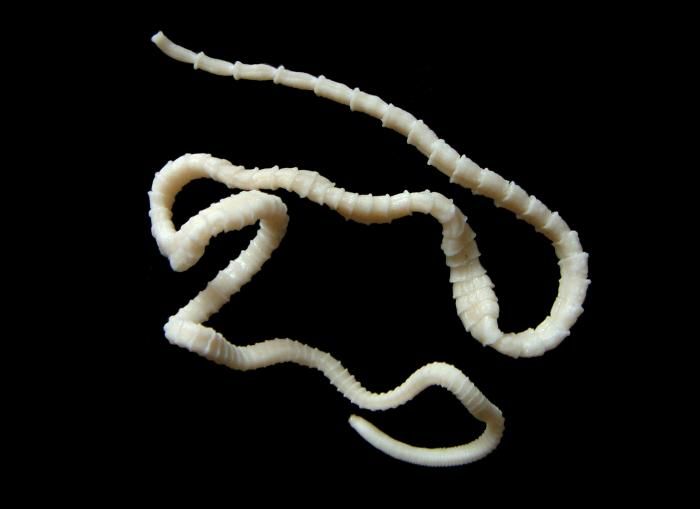
A tapeworm and a cat have this type of relationship.
a)
mutualism
b)
parasitism
c)
commensalism
d)
competition
125.
What type of symbiosis?  Hummingbirds feed on nectar from flowers.  The flowers are pollinated by hummingbirds as they move from flower to flower.
a)
commensalism
b)
mutualism
c)
parasitism
d)
predation
126.
Cattle egrets forage (feed) in fields among cattle. The egret gets easy access to flying insects stirred up by the cattle, and the cattle don't care if they are there or not.
a)
mutualism
b)
commensalism
c)
competition
d)
parasitism
127.
What might happen if you remove a primary consumer from the ecosystem?
a)
There would be more food for secondary consumers.
b)
The number of primary consumers would increase.
c)
The number of plants would increase.
d)
The number of secondary consumers would increase.
128.
Shivering is what type of feedback?
a)
negative
b)
positive
c)
bad
d)
good