wayground logo

Free Printable Worksheets

Font size

S
M
L
XL
Worksheets

7th Grade Life Science Study Guide

Total questions: 123

Worksheet time: 2hrs 42mins

Name
Class
Date
1.
What is the main difference between prokaryotic and eukaryotic cells?
a)
Prokaryotic cells have a nucleus and Eukaryotic cells do not
b)
Prokaryotic cells are unicellular and Eukaryotic cells are multicellular.
c)
Prokaryotic cells do not have a nucleus, Eukaryotic cells do have a nucleus.
d)
Prokaryotic cells are plant cells and Eukaryotic cells are animal cells.
2.
The site of photosynthesis
a)
ribosome
b)
mitochondria
c)
chloroplast
d)
nucleus
3.
This organelle takes food and turns it into ENERGY for plant and animal cells.
a)
Chloroplast
b)
Mitochondria
c)
Lysosome
d)
Ribosome
4.
What tool do you use to view the cells?
a)
metric ruler
b)
centrifuge
c)
microscope
d)
pipette
5.
Controls what enters and leaves the cell
a)
Mitochondria
b)
Cell Membrane
c)
Cell Wall
d)
Nucleus
6.
what is the control center in a cell
a)
mitochondria
b)
DNA
c)
nucleus
d)
movement
7.
What is the function of the cytoplasm?
a)
Stores water and mineral ions
b)
It holds all the organelles in place
c)
a.Controls what enters and leaves the cell
d)
Supports the cell
8.
Which is not a part of cell theory?
a)
All organisms are made of cells
b)
All existing cells come from preexisting cells
c)
All matter is composed of living cells
d)
The cell is the most basic unit of life
9.
cells that lack a true nuclues
a)
animal
b)
prokaryotes
c)
eukaryotes
d)
fungus
10.
an organelle in a cell that receives proteins and other newly formed materials from the endoplasmic retiulum packages them and distributes them to other parts of the cell
a)
vacuole
b)
chloroplast 
c)
ribosome
d)
golgi apparatus
11.
What is the name of the genetic material that is inside the nucleus?
a)
ER
b)
ATP
c)
YOLO
d)
DNA
12.
Who discovered and named cells? 
a)
Captain Hook
b)
Robert Hooke
c)
Zacharias Janssen
d)
Rudolf Virchow
13.
Where are proteins made?
a)
Golgi body
b)
Mitoichondria
c)
Chromosomes
d)
Ribosomes
14.
What organelle helps with cell digestion?
a)
Lysosomes
b)
Ribosomes
c)
Golgi Complex
d)
ER
15.
Main producer of ATP in all eukaryotes
a)
chloroplast
b)
mitochondria
c)
lysosome
d)
smooth er
16.
 A group of cells that have similar functions? Examples are nervous, epithelial, muscle and connective
a)
cells
b)
tissues
c)
organs
d)
atoms
17.
A group of tissues that work together to perform a similar function is called_____. (Examples include the heart, lungs or stomach)
a)
cells
b)
tissues
c)
organs
d)
organ system
18.
Organs that work together to perform a related function is called _____________?
a)
cells
b)
tissues 
c)
organ system
d)
organs
19.
Chloroplasts are organelles that convert light energy to sugars.  These organelles are found only in plants.  Which organelles are found only in animals?
a)
Golgi apparatus
b)
lysosomes
c)
mitochondria
d)
ribosomes
20.
 Starch and water molecules in potato cells are stored in what organelle?
a)
mitochondria
b)
nucleus
c)
cell wall
d)
vacuole
21.
Which structures are found in every living cell?
a)
cell membrane and cytoplasm
b)
chloroplasts and mitochondria
c)
a cell wall and nucleus
d)
chloroplasts and cell wall
22.
Which component of the cell membrane functions to isolate the cell from its environment?
a)
carbohydrates
b)
cholesterol
c)
phospholipids
d)
proteins
23.
The breaking down of sugar with oxygen to make energy is called ____.
a)
cellular respiration
b)
photosynthesis
c)
fermentation
d)
diffusion
24.
The movement of particles from regions of higher concentration to regions of lower concentration.
a)
permeable
b)
diffusion
c)
mitosis
d)
osmosis
25.
The process in which a cell membrane releases a particle by enclosing the particle in a vesicle that then moves to the cell's surface and fuses with the cell membrane forcing the particle from the cell.
a)
exocytosis
b)
endocytosis
c)
osmosis
d)
mitosis
26.
What is the chemical formula for cellular respiration?
a)
Carbon Dioxide + Water = Glucose + Oxygen + Energy (ATP)
b)
Glucose + Oxygen = Water + Carbon Dioxide + Energy (ATP)
c)
Water + Carbon Dioxide + Energy = Glucose + Oxygen 
d)
All the above
27.
Which process is this image an example of?
a)
Passive Transport
b)
Osmosis 
c)
Active Transport
d)
Diffusion
28.
The process by which some organisms use sunlight, carbon dioxide and water to make food.
a)
exocytosis
b)
endocytosis
c)
photosynthesis
d)
Cellular Respiration
29.
The diffusion of water through a semipermeable membrane.
a)
exocytosis
b)
osmosis
c)
endocytosis
d)
mitosis
30.
What is the chemical formula for cellular respiration?
a)
Carbon Dioxide + Water = Glucose + Oxygen + Energy (ATP)
b)
Glucose + Oxygen = Water + Carbon Dioxide + Energy (ATP)
c)
Water + Carbon Dioxide + Energy = Glucose + Oxygen 
d)
All the above
31.
Which cell structure allows molecules to enter and leave the cell? 
a)
Cell Membrane
b)
Nucleus
c)
Mitochondria
d)
Cytoplasm
32.
Which of these organelles is not found in animal cells?
a)
nucleus
b)
ribosomes
c)
cell membranes
d)
chloroplasts
33.
The movement of substances across a cell membrane without the use of energy by the cell.
a)
homeostasis
b)
active transport
c)
passive transport 
d)
photosynthesis
34.
Where in the cell does cellular respiration happen?
a)
chloroplast
b)
mitochondria
c)
nucleus
d)
cell membrane
35.
C6H12O6 is the chemical formula for
a)
glucose
b)
oxygen
c)
carbon dioxide
d)
ATP
36.
The process by which a cell membrane surrounds a particle and encloses the particle in a vesicle to bring the particle into the cell
a)
endocytosis
b)
osmosis
c)
exocytosis
d)
mitosis
37.
Active transport moves substances against a concentration gradient 
a)
true
b)
false 
38.
When comparing the offspring of sexually and asexually reproducing organisms, we would expect the genetic material (DNA) of the sexually reproducing organism to -
a)
contain fewer mutations
b)
be lesser in quantity
c)
be simpler overall
d)
show more variation
39.
Which is a type of Asexual Reproduction
a)
Sexual 
b)
Binary fission
c)
Cells 
d)
organism 
40.
What is an advantage of sexual reproduction?
a)
Allows genetic variation
b)
Only needs one parent
c)
Happens very quickly
d)
Offspring are exact copies of parent
41.
Sexual reproduction requires _____ parents and asexual reproduction requires ___ parents
a)
1,1
b)
2,2
c)
2,1
d)
1,2 
42.
Where does an offspring get its traits in asexual reproduction?
a)
From both parents
b)
From only one parent
c)
From neither parent
d)
There are no traits handed down
43.
Which of the following genotypes is heterozygous?
a)
Bb
b)
BB
c)
bb
d)
B
44.
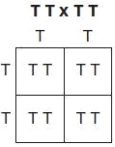
What ratio of the offspring from the cross shown will be homozygous recessive for the  trait of tallness
a)
0 in 4
b)
1 in 4
c)
2 in 4
d)
4 in 4
45.
aa always shows up as
a)
dominant
b)
recessive
46.
Which of the following is a phenotype?
a)
Aa
b)
red hair
c)
heterozygous
d)
DNA
47.
Aa, DD, bB, yy are all examples of
a)
genotypes
b)
phenotypes
48.
the passing of genetic traits from parent to offspring.
a)
heredity
b)
trait
c)
gene
d)
allele
49.
Mandy is a tall, 11 year old drummer. She has a scar on her right cheek. She is good at swimming. Which of her traits did Magda most likely inherit?
a)
height
b)
the scar
c)
ability to swim
d)
ability to play drums
50.
What are some of the facts about asexual reproduction?
a)
Takes only one mate to reproduce and takes a longer time to reproduce
b)
Takes a shorter amount of time to reproduce and it takes two mates to reproduce
c)
Reproduces diverse offspring and takes a longer time to reproduce
d)
Takes only one mate to reproduce and takes a shorter time to reproduce
51.
Is budding an example of asexual or sexual reproduction?
a)
sexual
b)
both
c)
asexual
d)
neither
52.
The scientific study of heredity
a)
Genetics
b)
Allele
c)
Dominant
d)
Biology
53.
What does heterozygous mean?
a)
An organism that has the same genes for a trait (TT or tt)
b)
An organism that has different genes for a trait (Tt)
c)
When neither gene is fully dominant; offspring is a mixture of both
d)
the different forms of a trait (hair color--> brown, blonde, red
54.
What is a gene?
a)
An entire chromosome that  codes for a trait
b)
a piece of clothing
c)
a piece of a DNA on chromosome that codes for a trait
d)
Chemical messengers in your brain that code for a trait
55.
What are the two genotypes that show the DOMINANT Phenotype
a)
GG, gg
b)
GG, Gg
c)
Gg, gg
56.
Dominant or recessive?
Dd
a)
Dominant
b)
recessive
c)
neither
d)
homozygous
57.
Dominant or recessive?
tt
a)
Dominant 
b)
Recessive
58.
A ________________________ is used to predict the possible genotype from certain parents
a)
Mendel Grid
b)
Genetic Tic Tac Toe
c)
Punnett Square
d)
Pedigree Plot
59.
Which characteristic would a child not inherit from one or both of its parents?
a)
freckles
b)
hair style
c)
eye color
d)
dimples
60.
He is known as the father of modern day genetics.
a)
Gregory Mendel
b)
Greg Mendel
c)
Gregor Mendel
d)
Grace Mendel
61.
Organisms that reproduce asexually generally have offspring that are 
a)
unicellular. 
b)
multicellular. 
c)
genetically varied. 
d)
genetically identical. 
62.
Why does sexual reproduction result in more genetic diversity than asexual reproduction? 
a)
Traits from two parents are combined. 
b)
More organisms reproduce this way. 
c)
Offspring grow in different environments. 
d)
Offspring come from identical parents. 
63.
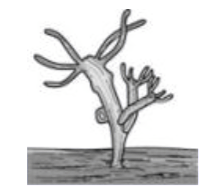
Many invertebrate animals, such as the hydra, reproduce asexually. What form of reproduction in this stage of the life cycle of the hydra is shown in the diagram? 
a)
binary fission
b)
budding
c)
fragmentation 
d)
vegetation propagation
64.
The muscle cells of an elephant contain 62 chromosomes. How many chromosomes are in an elephant egg cell? 
a)
31 
b)
62 
c)
122 
d)
244 
65.
Which is the greatest benefit of sexual reproduction? 
a)
capable of reproducing by meiosis 
b)
ability to reproduce without a mate 
c)
ability to produce genetically different offspring 
d)
capable of producing offspring genetically identical to parent 
66.
Which of the following is a fossil?
a)
a plant that has recently died
b)
a group of organisms that can reproduce
c)
a structure or organ that no longer functions
d)
a trace of an organisms that existed in the past
67.
Mutations are important because they bring about
a)
death of the organism in which they develop
b)
genetic variation needed for a population to evolve
c)
benefits for the individual, not for the population
d)
Hardey-Weinberg equilibrium within a population
68.
The Physical remains of a plant or animal preserved in rock or Earth's crust. 
a)
Adapt
b)
Fossil
69.
A remnant or trace of an organism from the past is called a _______.
a)
Ancestor
b)
Skeleton
c)
Fossil
d)
Imprints
70.
The diagram shows fossils in different rock layers. Which of these statements about the age of these fossils is most likely correct?
a)
Fossil A and C are the same age
b)
Fossil B is older than fossil C
c)
Fossils A is older than fossil B
d)
Fossil D is older than fossil C
71.
The opossum and kangaroo both incubate their young in a pouch. This provides evidence that they---
a)
are descended from a common ancestor
b)
Have very similar skeletal structures
c)
belong to the same species
d)
must range great distances to eat
72.
What is a Vestigial Structure?
a)
Structures that have a common function and suggest common ancestry
b)
The traits of organisms that result from sharing a common ancestor: such traits often have similar embryological origins
c)
genetically determined structures or attributes that have apparently lost most or all of their ancestral function in a given species
d)
I don't know :(
73.
Why is the fossil record most important to scientists?
a)
It's our only record of dinosaurs
b)
It tells us that very few animals have gone extinct
c)
It suggests that species have evolved over time
d)
It proves that humans have always dominated the earth
74.
If an organism has a vestigial structure, that structure likely once had a function in a(n)
a)
close relative
b)
early ancestor
c)
unrelated organism
d)
embryological stage
75.
What is a diagram that shows characteristic relationships among organisms called?
a)
Cladogram
b)
Karyotype chart
c)
Punnet square
d)
Biogeography
76.
Scientist find dinosaur fossils in the bottom of a cliff and mammals fossils in the middle layer, what can be inferred?
a)
dinosaurs ate plants
b)
dinosaurs were eaten by the mammals
c)
they lived at the same time
d)
dinosaurs lived before the mammals
77.
A fossil of an extinct dinosaur is found and the anatomy of the fossil shows similarities to that of a bird. What could this mean?
a)
This is purely by chance and isn't significant
b)
The extinct dinosaur and modern bird share a common ancestor
c)
All dinosaurs evolved into birds and that's why there aren't any dinosaurs alive today
d)
Dinosaurs choose to fly, and evolved into birds to escape predation and capture food
78.
Which two species are most related?
a)
B&C
b)
A&B
c)
A&C
d)
C&B
79.
What is this an example of?
a)
vestigial structures
b)
fossil record
c)
homologous structures
d)
embryology
80.
What is the advantage of having different shaped beaks?
a)
To look different from other species.
b)
To be able to eat the food readily available in the environment.
c)
To protect itself against predators.
d)
To protect itself against prey.
81.
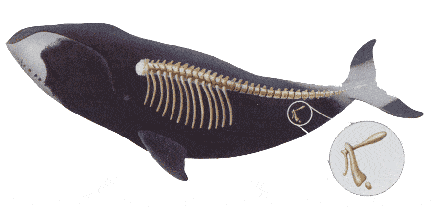
Whales are aquatic mammals that contain a pelvis bone.  Even though it does not aid in its movement, the function must have been used by a common ancestor of the whale.  Thus, the pelvis is referred to as a(n)...
a)
vestigial structure
b)
analogous structure
c)
homologous structure
82.
If an organism has a vestigial structure, that structure likely once had a function in a(n)...
a)
close relative
b)
early ancestor
c)
unrelated organism
d)
embryological stage
83.
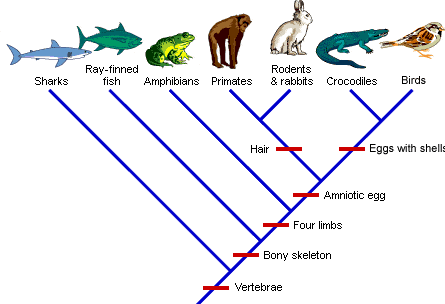
According to this cladogram, sharks are MOST closely related to which organism? 
a)
Amphibians
b)
Ray finned fish
c)
Crocodiles
d)
Birds
84.
How many animals have an amniotic egg?
a)
2
b)
3
c)
4
d)
5
85.
What traits do crocodiles and amphibians have in common?
a)
Vertebrae and hair
b)
Four limbs and amniotic eggs
c)
Bony skeleton and vertebrae
d)
Amniotic eggs and hair
86.
On the cladogram, which number represents the common ancestor of organisms B & D?
a)
1
b)
2
c)
3
d)
A
87.
A branching diagram that represents the proposed phylogeny or evolutionary history of a species or group 
a)
Cladogram 
b)
Cladistics
c)
Phylogeny
d)
Taxonomy
88.

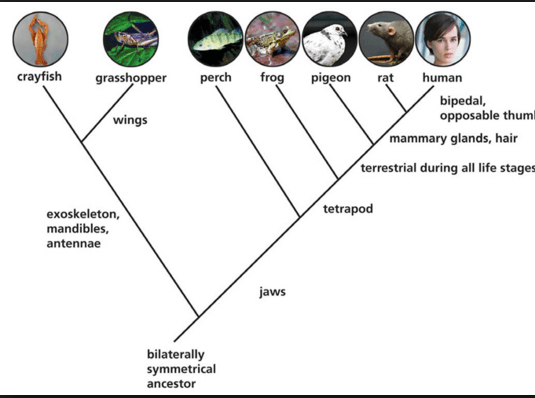
According to the cladogram, which organism is most distantly related to the human?

a)

crayfish

b)

grasshopper

c)

perch

d)

frog

89.
How old do Paleontologists believe the Earth is?
a)
2015 years old
b)
3.6 billion years old
c)
4.6 billion years old
d)
4.6 million years old
90.

Definition: Division of Earth's History into time units based on the types of life-forms that lived only during certain periods

a)

Fossil

b)

Geologic Time Scale

c)

Extincton

d)

Law of superposition

91.
The __________ tells the history of life, past environments on Earth, and how different organisms have changed over time.
a)
fossil record
b)
law of superposition
c)
absolute age
d)
relative dating
92.
Fossils are preserved most often in which of the following substances? 
a)
Ice
b)
Sedimentary Rock 
c)
Asphalt
d)
Amber
93.
The Geologic Time Scale is a record of what?
a)
old geologists
b)
sweet geology music
c)
the known history of rocks and fossils
d)
a list of every living thing ever
94.
Survival of the Fittest and Evolution were proposed by what scientist?
a)
Charles Darwin
b)
Albert Einstein
c)
Steven Hawking
d)
Isaac Newton
95.
Behavioral changes of individuals of a species that allow for better survival. (Acquired traits)
a)
Variation
b)
Adaptation
c)
Behavior
d)
Environment
96.
When every organism of a species has died.
a)
Evolution
b)
Natural Selection
c)
Extinction
d)
Artificial Selection
97.
Where the better adapted organisms survive to pass traits along to offspring.
a)
Evolution
b)
Natural Selection
c)
Extinction
d)
Artifical Selection
98.
What are the most studied animals in the galapagos?
a)
Finches
b)
Tortoises
c)
Turtles
d)
Lizards
99.
The theory of evolution by natural selection means that what is changing over time?
a)
The inherited traits of a population.
b)
The acquired traits of a population.
c)
Hair color and eye color
d)
Attractive features.
100.
Why are advantageous traits more likely to be passed onto offspring?
a)
Because they are more likely to survive and reproduce.
b)
Because they come from dominant alleles.
c)
Because they come from recessive alleles.
d)
Because the trait is an acquired phenotype.
101.
Mutations are a change in what?
a)
DNA
b)
tRNA
c)
genotype
d)
phenotype
102.
All mutations and adaptations usually lead to what process?
a)
selective breeding
b)
behavioral
c)
natural selection
d)
genetic engineering
103.
Why do frogs and other organism reproduce so many eggs or offspring?
a)
so that their babies can have friends to play with
b)
the more offspring the more likely the offspring will survive
c)
the more offspring the less likely offspring will survive 
d)
the more offspring the less competition
104.
Which organisms are most likely to survive?
a)
the best adapted
b)
the fastest
c)
the strongest
d)
the most domesticated (tamed)
105.
Almost all adaptations started off as?
a)
selective breeding
b)
physiological
c)
structural
d)
mutation
106.
Which of the following means "genetic change over time"
a)
natural selection
b)
speciation
c)
evolution
d)
fitness
107.
Do organisms "decide" to evolve and change?
a)
Yes, they know they need to change to survive 
b)
No, they change because of natural selection
108.
The differences among a species, like different bird beaks, are called
a)
genes.
b)
variations.
c)
traits.
d)
theories.
109.
Natural selection is when ____________ decides who survives and who doesn't
a)
nature
b)
humans
c)
animals
d)
years
110.
The preserved remains or traces of organisms that lived in the past are called...
a)
dinosaurs
b)
burrows
c)
predators
d)
fossils
111.
A group separated from the rest of the species is one of the main ways a __________ is formed.
a)
mutation
b)
migration
c)
competition
d)
new species
112.
A species is a group of similar organisms that
a)
Can mate with each other and produce fertile offspring
b)
can live together on an island
c)
can migrate to an island from the mainland
d)
all have exactly the same traits.
113.
how does natural selection lead to evolution?
a)
stronger offspring kill weaker members of the species.
b)
helpful variations accumulate among surviving members of the species.
c)
Overproduction provides food for stronger members of the species.
d)
environmental changes favor weaker members of the species
114.
What are fossils?
a)
molds and casts of organisms that live today
b)
drawings of ancient animals and other organisms
c)
footprints or burrows of small animals that live today
d)
the preserved remeins or traces of organisms that lived in the past
115.
Similarities in the early development of chickens and opossums suggest that these animals share a common _____
a)
behavioral
b)
embryo
c)
ancestor
d)
species
116.
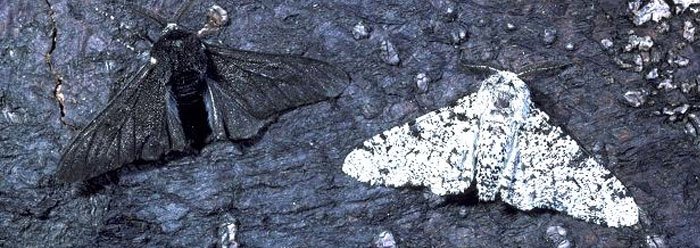
The trees these moths used to live on were white, but have been covered in soot from coal factories. Which moth will be more successful in this environment?
a)
Dark moth
b)
Light moth
c)
Both will be equally successful
d)
Neither will be successful
117.
What are the five principles of natural selection?
a)
adaptation, artificial selection, overproduction, descent with modification, variation
b)
variation, overproduction, adaptation, struggle to survive, and descent with modification
c)
homologous  overproduction, adaptation, struggle to survive, and descent with modification
d)
variation, overproduction, adaptation, struggle to survive, and gene flow
118.
A graph regarding the effect of agricultural bioengineering on insect pests is shown below How has natural selection affected species of insect pests?
a)
A.  Natural selection has not affected the number of species that are resistant to pesticides
b)
A.  Natural selection has rapidly increased the number of species that are resistant to pesticides
c)
A.  Natural selection has only affected the number of species that are resistant to pesticides
119.

What is a theory?

a)

A guess

b)

A hypothesis

c)

A scientific fact

d)

A well-supported explanation

120.

What was the theory proposed by Lamarck?

a)

The Theory of Survival of the Fittest

b)

The Theory of Acquired Characteristics

c)

The Theory of Evolution

d)

The Theory of Patagonia

121.

What does "survival of the fittest" mean?

a)

Only the strong survive

b)

The fastest organism will win

c)

The most attractive organism will reproduce more

d)

The organism that can camouflage best will survive

122.

Which of the following is not a part of natural selection?

a)

Competition

b)

The most attractive organism will reproduce more

c)

Overproduction

d)

Genetic Variation

123.

The pocket mouse evolved from having a sandy colored coat to a dark coat because....

a)

it's a recessive trait

b)

the habitat changed

c)

they morphed overnight they morphed overnight

d)

a mutation occurred