wayground logo

Free Printable Worksheets

Font size

S
M
L
XL
Worksheets

3rd Quarter Review

Total questions: 123

Worksheet time: 1hrs 12mins

Name
Class
Date
1.
What two things are found in the central nervous system?
a)
brain/spinal cord
b)
spinal cord/motor neurons
c)
motor/sensory neurons
d)
only brain
2.

Which part of a neuron RECEIVES information?

a)

axon

b)

dendrite

c)

cell body

d)

axon terminal

3.
Which part of the neuron is a long fiber that send information to other cells?
a)
dendrite
b)
terminal
c)
cell body
d)
axon
4.
Which of the TWO nervous systems contains motor and sensory neurons?
a)
central nervous system
b)
peripheral
c)
motor
d)
sensory
5.
Which part of your brain controls memory?
a)
cerebrum
b)
cerebellum
c)
medulla
d)
neurons
6.
Which part of the brain controls breathing?
a)
neurons
b)
medulla
c)
cerebellum
d)
cerebrum
7.
Which part of the brain controls balance and body position?
a)
cerebrum
b)
medulla
c)
cerebellum
d)
impluses
8.
In this picture, the red line represents a(n)
a)
motor neuron
b)
sensory neuron
c)
receptor
d)
interneuron
9.
In this picture, the blue line represents a(n)
a)
interneuron
b)
motor neuron
c)
sensory neuron
d)
effector
10.
This picture is an example of a
a)
Nerve Impulse
b)
Reflex Arc
c)
Neural Arc
d)
Cerebral Processing
11.

Does every cell respond to all hormones?

a)

Yes

b)

No

12.

Which of the following is the true statement?

a)

Target cells respond to all hormones because they carry receptors for every hormone

b)

Target cells do not respond to all hormones because they carry receptors for every hormone

c)

Target cells respond to all hormones because they do not carry receptors for every hormone

d)

Target cells do not respond to all hormones because they do not carry receptors for every hormone

13.
The gland labeled 4 in the diagram is?
a)
the thymus gland
b)
the thyroid gland
c)
the parathyroid glands
d)
the adrenal glands
14.
When levels go above or below a set point a hormone is released to return the body to set point. When the body is restored to set point no more hormone is released. This is an example of...
a)
a positive feedback loop
b)
a negative feedback loop
c)
a neutral feedback loop
15.
Endocrine glands produce __________ which maintain the body in homeostasis
a)
oils
b)
neurotransmitters 
c)
tears
d)
hormones
16.
Which of the following IS correctly paired
a)
Thyroid- promotes metabolism
b)
Parathyroid-promotes childbirth
c)
Pineal-promotes storage of calcium in bones
d)
Prolactin-promotes growth and development
17.
produces epinephrine and nor-epinephrine which promote the fight or flight response
a)
pancreas
b)
testes
c)
adrenal glands
d)
pineal gland
18.
together these two hormones produced by the pancreas control blood sugar levels
a)
epinephrine and nor-epinephrine
b)
T3 and T4
c)
estrogen and progesterone
d)
insulin and glucagon
19.
The correct order of the glands/organs shown in the diagram is 
a)
hypothalamus, thyroid, pancreas, kidneys, ovaries, testes
b)
pituitary, thyroid, adrenal, pancreas, ovaries, testes
c)
pituitary, parathyroid, pancreas, adrenal, testes, ovaries
d)
non are correctly ordered
20.
Bacteria reproduce this way.
a)
budding
b)
fragmentation
c)
binary fission
d)
vegetative propagation
21.
Which type(s) of reproduction involves only ONE parent?
a)
asexual 
b)
sexual
c)
both
22.
Which type(s) of reproduction involves offspring identical to the parent?
a)
asexual
b)
sexual
c)
both
23.
Which type(s) of reproduction involves NO genetic diversity?
a)
asexual
b)
sexual
c)
both
24.

Growing back a missing or lost body part

a)

binary fission

b)

budding

c)

sporulation

d)

regeneration

25.
When an offspring grows off the body of the parent
a)
regeneration 
b)
budding
c)
binary fusion 
d)
sporulation
26.

What type of asexual reproduction is taking place?

a)

Binary Fission

b)

Budding

c)

Fragmentation

d)

Regeneration

e)

Vegetative Reproduction

27.
In binary fission how does the DNA of the daughter cells compare to the DNA of the parent cell? 
a)
It is only half of the amount of DNA found in the parent.
b)
It is identical.
c)
It is a mix of the parent's DNA.
d)
It has some similarities and some differences.
28.
a)
budding
b)
sporulation
c)
vegetative propagation
d)
binary fission
29.

What is Sporulation?

a)

the organism produce its own spores. These spores are genetically identical to the parent

b)

Organisms can be produced from unfertilized eggs.

c)

during this type of reproduction the organism divides in half

d)

A new organism is created from the roots, stems or leaves.

30.
The stages of mitosis in order
a)
Metaphase, Anaphase, Prophase, Telophase
b)
Prophase, Anaphase, Metaphase, Telophase
c)
Prophase, Metaphase, Anaphase, Telophase
d)
Anaphase, Prophase, Telophase, Metaphase
31.
When a cell divides in mitosis, what do we call the 2 new cells?
a)
mother cells
b)
father cells
c)
daughter cells
d)
son cells
32.
In which type of cells will mitosis occur?
a)
egg cells
b)
sperm cells
c)
jail cells
d)
Body cells except the sperm and egg cells
33.
When you start with 1 cell, at the end of mitosis, how many identical cells will you have?
a)
1
b)
2
c)
3
d)
4
34.
Before cells can divide, what must be copied?
a)
mitochondria
b)
cytoplasm
c)
DNA
d)
Cell Wall
35.
The cells produced via meiosis are called:
a)
sex cells (gametes)
b)
somatic cells
c)
body cells
d)
skin cells
36.
What is the name of the process in which DNA (genetic information) is exchanged during meiosis?
a)
crossing under
b)
crossing over
c)
melding
d)
blending
37.
After meiosis is complete, the new cells:
a)
are all identical
b)
are all different
c)
are half identical and half different
d)
are all stretched out
38.
The process on the left is:
The process on the right is:
a)
Left: meiosis
Right: meiosis
b)
Left: meiosis
Right: cloning
c)
Left: mitosis
Right: meiosis
d)
Left: mitosis
Right: mitosis
39.
What is the function of the organ shown in the picture?
a)
Scrotum
b)
used to cool down the temperature in the testes
c)
testes
d)
produces sperm cells and semen
40.
The male gonad that produces sperm and the male hormone testosterone.
a)
Penis
b)
Epididymis
c)
Testes
d)
Cowper's Gland
41.
Male reproductive organ that stores mature sperm. 
a)
Epididymis
b)
Vas Deferens
c)
Prostate Gland
Prostate Gland
d)
Urethra
42.
This male organ is used for both excretion (going to the bathroom) and reproductive funtions.
a)
Urethra
b)
Endometrium
c)
Cowper's Gland
d)
Scrotum
43.
The two male reproductive organs that produce most of the fluids that make up semen are called
a)
Testes & Epididymis
b)
Seminal Vesicle & Prostate
c)
Vas Deferens and Urethra
d)
Scrotum and Penis
44.
once a sperm matures, it travels through this tube
a)
Vas deferens
b)
Fallopian tube
c)
Ovaries
d)
Epididymis
45.
the organ that removes urine from the male body   and that can deliver sperm to the female reproductive system
a)
Penis
b)
Vagina
c)
Urethra
d)
Testes
46.
The process of making new sperm is called:
a)
spermatogenesis
b)
spermatomaking
c)
spermatoreguvination
d)
spermatolysis
47.
What is the question mark pointing to?
a)
Prostate gland
b)
Seminal vesicles
c)
Vas deferens
d)
Scrotum
48.
sperm mixed with fluids from glands
a)
semen
b)
ejaculation
c)
vas deferens
d)
urethra
49.
What is structure #1
a)
Ovary
b)
Fundus
c)
Fallopian Tube
d)
I don't know
50.
What is structure #3
a)
Ovary
b)
Fundus
c)
Fallopian Tube
d)
I don't know
51.

What is structure #6

a)

Vagina

b)

Cervix

c)

Uterus

d)

Ovary

52.
What is structure #7
a)
Vagina
b)
Introitus
c)
Uterus
d)
I don't know
53.
What is structure #12
a)
Vagina
b)
Introitus
c)
Uterus
d)
I don't know
54.
This structure is where eggs are stored and matured.
a)
Fallopian Tubes
b)
Uterus
c)
Ovaries
d)
I don't know
55.
This structure is where the egg waits to be fertilized.
a)
Fallopian Tubes
b)
Uterus
c)
Ovaries
d)
I don't know
56.
This structure is where the egg grows during pregnancy.
a)
Fallopian Tubes
b)
Uterus
c)
Ovaries
d)
I don't know
57.
This structure the muscular canal that connects to the cervix.  It is important for sexual intercourse, birthing, and removal of blood during menstruation.
a)
Vagina
b)
Cervix
c)
Uterus
d)
I don't know
58.
Stage of human growth and development in which a person becomes physically mature is...
a)
Fertilization
b)
Menstruation
c)
Implantation
d)
Puberty
59.

The menstrual cycle repeats every?

a)

Month

b)

28 days

c)

Week

d)

Year

60.

Ovulation phase typically occurs on what day of the cycle?

a)

1

b)

14

c)

20

d)

7

61.

Which hormone causes the egg to ripen in the ovary?

a)

Progesterone

b)

FSH

c)

Oestrogen

d)

Testosterone

62.

Which hormone spikes and consequently causes the release of the ova into the uterus?

a)

LH

b)

FSH

c)

Oestrogen

d)

Progesterone

63.

Which phase involves the egg being released into the uterus?

a)

Menstruation

b)

Ovulation

c)

Follicular

d)

Luteal

64.

In what phase of the menstrual cycle does the uterus shed its lining?

a)

menstruation

b)

post menstruation

c)

ovulation

d)

premenstruation

65.

A period of time when a woman stops going through her menstrual cycle because her hormones no longer cycle is called?

a)

Puberty

b)

Ovulation

c)

Menopause

d)

Menstruation

66.

What hormone(s) is responsible for the development of the secondary sex characteristics in females, and plays a role in menstruation and pregnancy?

a)

estrogen

b)

progesterone

c)

FSH & LH

d)

FSH only

67.

What hormone(s) is responsible for thickening the lining of the uterus (endometrium)?

a)

estrogen

b)

progesterone

c)

FSH & LH

d)

LH only

68.
What hormones are releases by the Pituitary Gland?
a)
FSH, Oestrogen, LH and Progesterone
b)
FSH, Oestrogen, and Progesterone
c)
FSH, LH and Progesterone
d)
FSH and LH
69.
The joining of a sperm cell and an egg cell is called...
a)
Fertilization
b)
Labor
c)
Zygote
d)
STOP ASKING ME THESE IMPOSSIBLE QUETSIONS!!
70.
Repeated cell divisions during embryonic cell development is known as:___________.
a)
Fertilization
b)
Cleavage
c)
oogenesis
d)
spermatogensis
71.
Human reproduction usually involves
a)
internal fertilization and internal development
b)
external fertilization and external development
c)
internal fertilization and external development
d)
external fertilization and internal development
72.
Meiosis and fertilization are important processes because they may most immediately result in
a)
many body cells
b)
immune responses
c)
genetic variation
d)
natural selection
73.
The process that transforms developing cells into specialized cell with different structures and functions: ______________
a)
Differentiation
b)
Fertilization
c)
Cleavage
d)
Reproduction
74.

The diagram and chart represent some of the changes a zygote undergoes during its development.The processes that are most directly responsible for these changes are

a)

sorting and recombination of genetic information

b)

mitosis and differentiation

c)

meiosis and adaptation

d)

fertilization and cycling of materials

75.

The diagram below represents stages in the development of organisms The normal developmental sequence of the processes represented by the diagrams is

a)

4 – 1 – 2 – 3

b)

1 – 4 – 3 – 2

c)

4 – 1 – 3 – 2

d)

3 – 2 – 1 – 4

76.

The diagram represents some stages in the development of an embryo. Which stage represents a zygote?

a)

A

b)

B

c)

C

d)

D

77.

Which sequence represents the correct order of events in the development of sexually reproducing animals?

a)

fertilization → cleavage → differentiation → growth

b)

cleavage → fertilization → growth → differentiation

c)

growth → cleavage → fertilization → differentiation

d)

fertilization → differentiation → cleavage → growth

78.

Which sequence represents the correct order of events in the development of sexually reproducing animals?

a)

fertilization → cleavage → differentiation → growth

b)

cleavage → fertilization → growth → differentiation

c)

growth → cleavage → fertilization → differentiation

d)

fertilization → differentiation → cleavage → growth

79.

When a pregnant woman ingests toxins such as alcohol and nicotine, the embryo is put at risk because these toxins can

a)

diffuse from the mother’s blood into the embryo’s blood within the placenta

b)

enter the embryo when it eats

c)

transfer to the embryo since the mother’s blood normally mixes with the embryo’s blood in the placenta

d)

enter the uterus through the mother’s navel
80.
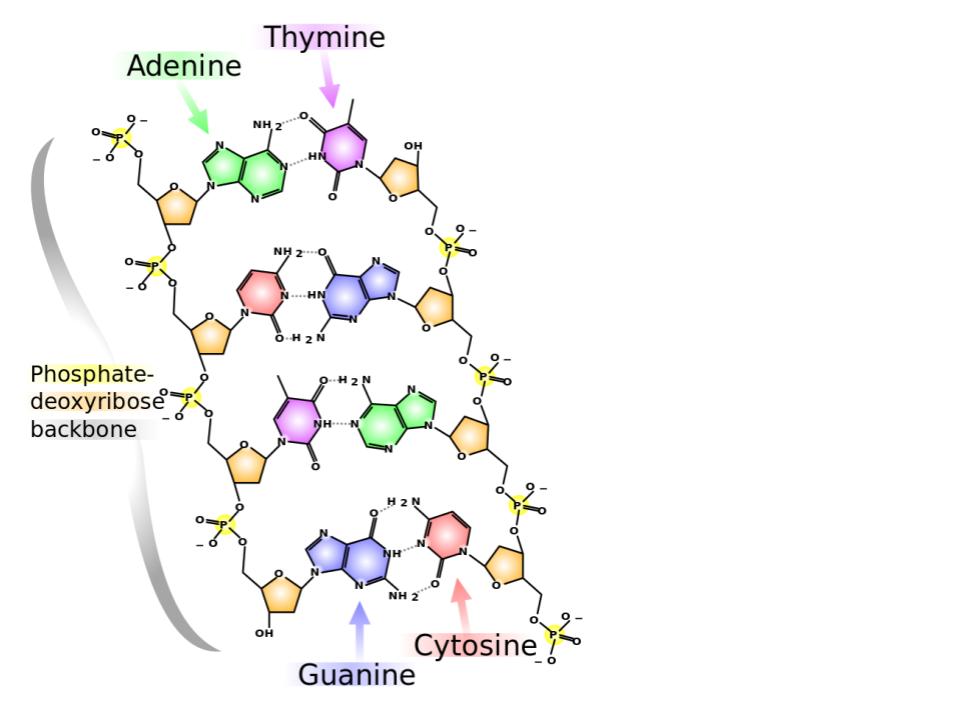
The two strands of DNA are held together by:
a)
Hydrogen Bonds
b)
Phosphodiester Bonds
c)
Glycolsyl Bonds
d)
Glycosidic Linkages
81.
DNA is a polymer made of:
a)
Nucleotides
b)
Ribosomes
c)
Purines
d)
Pyrimidines
82.
Which of the following best describes a DNA molecule?
a)
double helix
b)
contains ribose
c)
made of amino acids
d)
contains Uracil
83.
Which organelle is DNA usually found in?
a)
cell membrane
b)
vacuole
c)
ribosome
d)
nucleus
84.
In a molecule of double-stranded DNA, the amount of Adenine present is always equal to the amount of
a)
cytosine
b)
guanine
c)
thymine
d)
uracil
85.
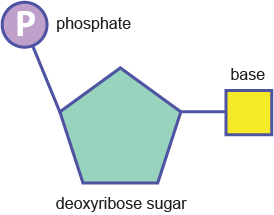
Nucleotides are made up of a sugar, phosphate, and..?
a)
nitrogenous base
b)
nucleic acid
c)
cholesterol
d)
fatty acid
86.
What determines the code, or information, of a DNA molecule?
a)
the shape (structure) of the nitrogen bases
b)
the order (sequence) of the nitrogen bases
c)
the color of the nitrogen bases
d)
the frequency (number) of nitrogen bases
87.
Which 2 molecules form the sides (backbone) of the DNA ladder?
a)
deoxyribose sugar and adenine
b)
deoxyribose sugar and a hydrogen bond
c)
deoxyribose sugar and the nucleus
d)
deoxyribose sugar and phosphate
88.
Which shows the correct complementary base pairing for DNA?
a)
C-A, T-G
b)
A-G, C-T
c)
C-G, U-A
d)
T-A, G-C
89.
Who is the monk known as the father of genetics?
a)
Mendel
b)
Rutherford
c)
Weltch
d)
Watson
90.
Phenotype is 
a)
what you can see about a trait 
b)
what genes a person or thing has 
c)
an alleles 
91.
What is a Heterozygous genotype?
a)
Hh
b)
HH
c)
hh 
d)
None of the above
92.
a genotype is 
a)
what you can see about a trait 
b)
alleles 
c)
what genes a person or thing has 
93.
The passing of traits from parents to offspring
a)
Genetics
b)
Heredity
c)
Genes
94.
parts of a chromosome that control all the inherited traits that show up in an organism
a)
Genetics
b)
Chromosomes
c)
Genes
95.
How many people in the pedigree are carriers for the disorder? 
a)
b)
8
c)
2
d)
9
96.
Weak and can be overpowered
a)
dominant
b)
recessive
c)
chromosome
d)
DNA
97.
A chart that shows all the possible combinations of alleles from parents
a)
T-square
b)
Gene Chart
c)
Punnett Square
d)
DNA organizer
98.
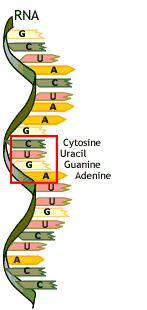
In RNA, Uracil pairs with ______. 
a)
cytosine
b)
adenine
c)
guanine
d)
thymine
99.
The process to go from DNA to mRNA is _______
a)
translation
b)
transcription
c)
replication
100.
The process to go from mRNA to a protein is called ____
a)
transcription
b)
rRNA
c)
replication
d)
translation
101.
Choose the nucleotide sequence of the RNA strand that would be complementary to the following strand: 
GTAGTCA
a)
UATUAGA
b)
ACGACTG
c)
CAUCAGU
d)
CATCAGT
102.
The main function of tRNA is to...
a)
carry a message that, when translated, forms proteins
b)
form a portion of ribosomes
c)
string together complementary RNA and DNA strands
d)
bring amino acids from the cytoplasm to the ribosomes
103.
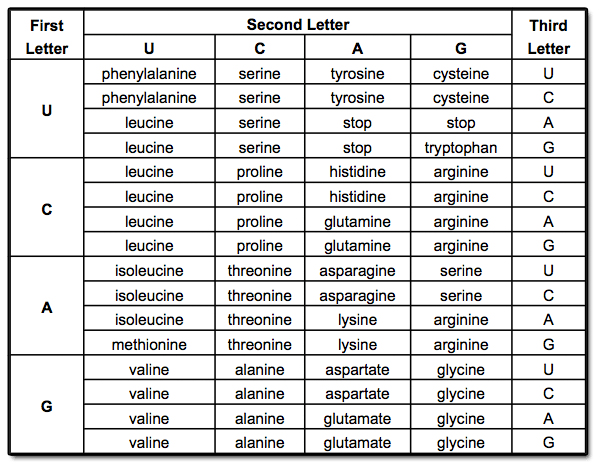
What amino acid is represented by the codon UUA?
a)
Phenylalanine
b)
Tyrosine
c)
Leucine
d)
Stop codon
104.
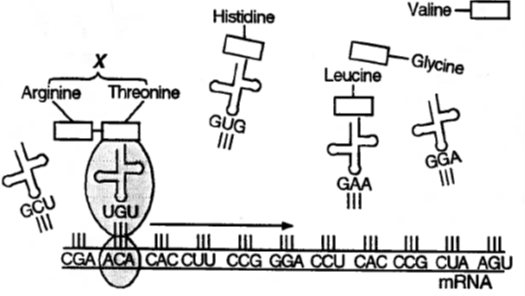
What process is going on in this photo? 
a)
Transcription 
b)
Translation 
c)
Replication 
d)
All the above 
105.
Does the order of amino acids in a protein matter?
a)
YES!
b)
NO!
106.
Mutations that occur at a single point in the DNA sequence are:
a)
frameshift
b)
point
c)
deletion
107.
original chromosome
ABC-DEF
mutated chromosome
AC-DEF
This is a _____________ mutation.
a)
frameshift
b)
point
c)
deletion
108.
original chromosome
ABC-DEF
mutated chromosome
AED-CBF
a)
duplication
b)
translocation
c)
inversion
109.
Why are insertion and deletion (frameshift) mutations so harmful?
a)
They change all of the codons from the mutation on down the line, which changes the amino acid sequence
b)
They insert things that an organism doesn't need.
c)
They often delete things that organisms need.
d)
Insertion and deletions are not any more harmful than substitution mutations.
110.

Which type of mutation occurs when there is an addition or removal of a base?

a)

missense mutation

b)

nonsense mutation

c)

frameshift mutation

d)

point mutation

111.

DOES THE DNA MUTATION ALWAYS ALTER THE AMINO ACID SEQUENCE?

a)

Yes

b)

No

112.
Which of the following is used to cut DNA so it can be studied?
a)
Gel Electrophoresis
b)
Restriction Enzymes
c)
Karyotypes
d)
Haplotypes
113.
Which piece of DNA would move faster in gel electrophoresis?
a)
100 Base Pairs Long
b)
1000 Base Pairs Long
c)
5000 Base Pairs Long
d)
100,000 Base Pairs Long
114.
The human genome project is an attempt to 
a)
Sequence everyones DNA
b)
Copy DNA
c)
Sequence the human genome
d)
Cure genetic disease
115.
The process of making changes in the DNA code of a living organism is called 
a)
Selective Breeding
b)
Inbreeding
c)
Genetic Engineering
d)
Di-hybrid Cross
116.
A DNA molecule produced by combining DNA from different sources is referred to as
a)
Mutant
b)
Polyploid
c)
Diploid
d)
Recombinant
117.
Which Suspect Committed the crime?
a)
Suspect #1
b)
Suspect #2
c)
Suspect #3
d)
Suspect #4
118.
In gel electrophoresis, DNA fragments move from 
a)
Positive to Negative
b)
Negative to Positive
c)
Positive to Positive
d)
Negative to Negative
119.
What was the first cloned animal?
a)
Dolly the Sheep
b)
Robby the Rat
c)
Milton the Mouse
d)
Beth the Goat
120.
The small ring of DNA found in a bacterial cell used as a biological vector
a)
Helix
b)
Plasmid
c)
Clone
d)
Nucleotide
121.
A scientist cloned a goat. Which of these is a true statement about the cloned goat?
a)
It has new genes and traits
b)
It lacks the genes for reproduction
c)
It has the genes that are identical to the original goat
d)
It looks the same but has different genes.
122.
The purpose of selective breeding is to 
a)
Get bigger animals
b)
get smaller animals
c)
create animals with desirable traits
d)
create animals with bad traits
123.
Problems with selective breeding include
a)
Better animals
b)
More Meat
c)
Animals can have bad health problems
d)
more diversity