
 Worksheets
Biology Semester 1 Final (Review)
Total questions: 125
Worksheet time: 2hrs 39mins
What is a compound?
The center of an atom that is formed by neutrons, protons, and electrons.
A tiny particle that makes up all matter.
A molecule that is formed from two or more different types atoms.
A molecules that is formed from the same type of atoms.


The hydrogen atoms in a water molecule are ________________ charged.
not
negatively
neutrally
positively

Water drops being attracted to each other is an example of ____________.
capillary action
adhesion
specific heat index
cohesion

A paperclip floating on water is an example of what property of water?
capillary action
surface tension
universal solvent
specific heat index

What molecule is this?
calcium
hydrogen
helium
water
Which term refers to water having a slightly positive and a slighty negative charge on its ends?
cohesion
surface tension
polar
adhesion
Why does ice float?
As water freezes, the molecules spread out decreasing its density.
As water freezes, it takes up more hydrogen from the atmosphere, causing it to have a greater buoyancy.
As water freezes, air gets trapped making it more dense
As water freezes, it takes up more oxygen from the atmosphere, causing it to be more dense
Water is a universal solvent because it...
It can be found anywhere
It freezes when it gets cold
Floats when frozen
Dissolves more substances than anything else
Which of the following is LEAST likely to dissolve in water?
nonpolar fats and oils
polar sugar molecules
salt made of a positive sodium ion and a negative chloride ion
all of the substances will dissolve easily in water

Why does water move from the roots to the leaves of plants?
Water is pushed by solutes
Capillary action pulls the water molecules up like a chain
Water is pulled by gravity
Water cannot move up roots to leaves
Water is considered to be_________________.
Polar
Non-Polar
Both A and B
None of the Above


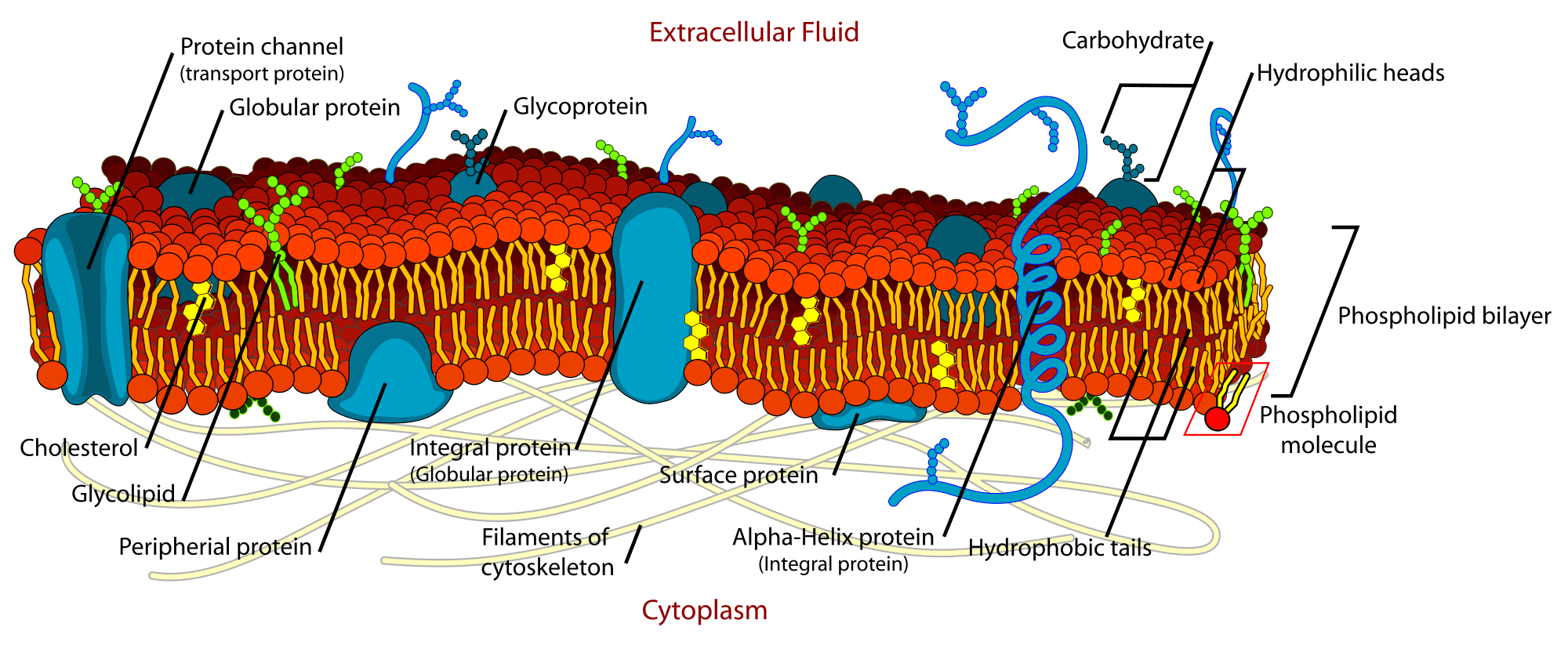
cell are called ____________________.

Which macromolecule is shown?
lipid
protein
nucleic acid
carbohydrate
when some molecules can cross the membrane while others cannot.



Using the figure, between which parts of the molecule must the bonds be broken to form an ADP molecule?
This is given off by plants during photosynthesis as a waste product.
Which plant structure transforms light into glucose?
Chromoplasts
Leukoplasts
Chloroplasts
Neuroplasts
What chemical pigment absorbs sunlight for photosynthesis?
basophyll
dynophyll
grassophyll

Which structure in the figure above represents a single thylakoid?
Structure A
Structure B
Structure C
Structure D
If carbon dioxide is completely removed from a plant's environment, what would you expect to happen to the plant's production of high-energy sugars?
More sugars will be produced.
The same number of sugars will be produced but without carbon dioxide.
No sugars will be produced.
Fewer sugars will be produced at first, but then the plant will recover.
Which chemical is an electron carrier molecule?
NADP+
H2O
carbon dioxide
oxygen
What two energy molecules are made by the light reaction? Select both answers.
NADPH
glucose
ATP
oxygen gas
Which molecule supplies chlorophyll with electrons
sun
water
oxygen gas
NADPH
What is the name of a stack of thylakoids?
stroma
chromoplast
granum
choloroplast
Chloroplasts and mitochondria are the same in that they both...
are green in color.
are found in plant and animal cells.
have a liquid stroma.
produce energy.
Which of the following is NOT a product of the light reactions?
Oxygen
NADPH
ATP
Glucose (Sugar)
The light reactions (those that need light to operate) are located in the...
Chloroplast double membrane.
Stroma
Stomata
Thylakoid membranes
The opening under a leave that allow CO2 to enter are called...
stroma
stages
spines
stomata
What is the name of an organism that is capable of making their own food?
Photosynthetic Autotroph
Photosynthetic Heterotroph
Eukaryotic Organism
Only Plants can make their own food from light energy
Plants need carbon dioxide from their environment to produce glucose during which stage of photosynthesis?
The light-dependent reaction
The light-independent reaction
The electron transport chain
ATP formation

What are the 2 products shown in this diagram? (select 2 correct)
production of carbon dioxide
production of oxygen gas
production of sugar
production of water
Which is the correct formula for photosynthesis?
6CO2 + 12H2O --->C6H12O6 + 6O2 + 6H2O
12CO2 + 12H2O --->C6H12O6 + 6O2 + 6H2O
6CO2 + 6H2O --->C6H12O6 + 6O2 + 6H2O
CO2 + H2O --->6C6H12O6 + O2 + H2O

This is the chemical formula for a molecule of...
Oxygen
Carbon dioxide
Glucose
Water
Which organelle performs Cellular Respiration AKA Aerobic Respiration?
Chloroplast
Mitochondria
Which of the following correctly sequences the events of Cellular Respiration?
Glycolysis, Fermentation, Krebs Cycle
Krebs Cycle, Electron transport, Glycolysis
Glycolysis, Krebs Cycle, Electron Transport
Krebs Cycle, Glycolysis, Electron Transport
What are the inputs, or reactants, that cells use in cellular respiration?
carbon dioxide and water
starch and protein
amino acids and glucose
glucose and oxygen
Which of the following is a reactant of cellular respiration
Carbon Dioxide
Water
Oxygen
ATP
Which of the following is a product of cellular respiration?
Glucose
Carbon Dioxide
Oxygen
Radiant Energy
Which statement is true regarding cellular respiration?
The reactants of cellular respiration are identical to the reactants of photosynthesis.
The reactants of cellular respiration are obtained from the products of photosynthesis.
The products of cellular respiration are the same as the products of photosynthesis
Cellular respiration only occurs in autotrophs, photosynthesis occurs only in heterotrophs.

