wayground logo

Free Printable Worksheets

Font size

S
M
L
XL
Worksheets

RC 4 Review

Total questions: 85

Worksheet time: 4hrs 11mins

Name
Class
Date
1.
          An earthworm farmer wanted to grow three species of earthworms, but earthworms can be very picky about the temperature, moisture, and pH balance of their soil. This graph shows the range of soil conditions preferred by three species of earthworms in an earthworm soil bed. 
          Which of these conditions would cause the most competition for the resources among the three species of earthworms?
a)
Very warm soil, ph of 6, and dry.
b)
Very cold soil, pH of 7, and high moisture.
c)
Moderate temperature, pH of 6.5, and moderate moisture.
d)
Moderate temperature, pH of 7.0, and high moisture.
2.
This diagram shows the variety of organisms that live in different tide zones. Mussels are common organisms that compete for space in intertidal (middle) tide zones. If all of the mussels were removed from zone A, which organisms would likely compete for the space in Zone A?
a)
Periwinkle and Limpets
b)
Sea lettuce and Chiton
c)
Sea urchins and Hermit crabs
d)
Rock louse and Periwinkle
3.
     The Black-banded Sea Krait is found in the warm waters of the Pacific Ocean. It is well adapted to the environment in which it lives.          Which of these resources is most likely limited in the Black-Banded Sea Krait's environment?
a)
Land
b)
Coral dwelling fish
c)
Water
d)
Coral
4.
(8.11B) The graph below shows the percent of seeds from two plant species that sprout when grown in water containing different amounts of salt.
Which of the following best summarizes the effect of saltwater on these plant species?
a)
Species 1 can only sprout in freshwater, and species 2 can sprout only in saltwater.
b)
Both species can sprout in freshwater and saltwater, but Species 2 can sprout in a higher salt concentration than Species 1.
c)
Both species need salt in their water, but Species 2 needs more salt than Species 1.
d)
Species 1 can sprout only in water with a low salt concentration, but Species 2 is not affected by the salt concentration.
5.
Which abiotic factor is phytoplankton most likely to compete for in a marine environment?
a)
Sunlight
b)
Fish
c)
Rocks
6.
The graph shows the change in the deer population on an island for one year. According to the graph, what is the carrying capacity of the deer?
a)
Zero
b)
10
c)
80
d)
100
7.
Wild Soay sheep live in a cold environment on a small Scottish island. The sheep used to be large because they gained extra weight during the summers in order to survive the harsh winters. A recent change in the island’s climate has caused grass to be available for a longer period each year, so survival conditions for the sheep have become less challenging.
a)
Size
b)
life expectancy
c)
reproduction rates
d)
body temperatureSelect
8.
Which of the following human activities can most negatively affect the oceans via sewer drains?
a)
Collecting and storing rainwater before it reaches drains.
b)
Spraying lawns with chemicals to kill weeds and insects.
c)
Sweeping dead leaves into the gutters along streets.
d)
Pouring salt on streets and sidewalks when it snows.Select
9.
Bromeliads are small plants that grow attached to the sides of large trees high above the ground in warm, damp and densely crowded tropical rainforests. Bromeliads do this because they are in competition with other plants for -
a)
soil.
b)
heat.
c)
light.
d)
water.
10.
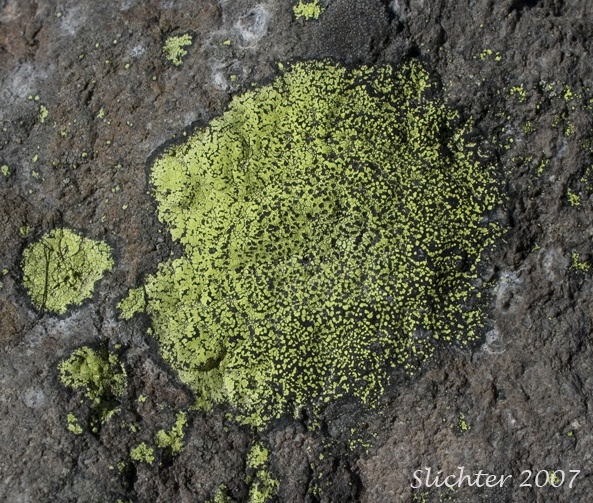
What is the goal of the pioneer species in Primary Succession?
a)
To kill the dead materials after a disaster
b)
To rebuild soil
c)
To feed Johnny
d)
To put fresh oxygen into the air
11.
What is the name given to lichen or algae after a primary succession?
a)
pioneer species
b)
volunteer species
c)
founder species
d)
conqueror species
12.
Reaches a climax community quicker because soil is already present
a)
primary succession 
b)
secondary succession
c)
both types of succession
13.
After a forest fire, an ecosystem would start regrowth through -
a)
primary succession
b)
secondary succession
c)
climax community
d)
limiting factors
14.
What is Ecological Succession?
a)
Competition between plants in a society
b)
A natural disaster such as a flood or fire
c)
The cycle of a tomato plant
d)
The change an ecosystem experiences over time
15.
a stable ecological community that has reached equilibrium
a)
ecological succession 
b)
climax community
c)
secondary succession
d)
pioneer speciles
16.
The most sustainable ecosystem would
a)
have low biodiversity.
b)
have high biodiversity.
c)
not experience change.
d)
have no predators.
17.
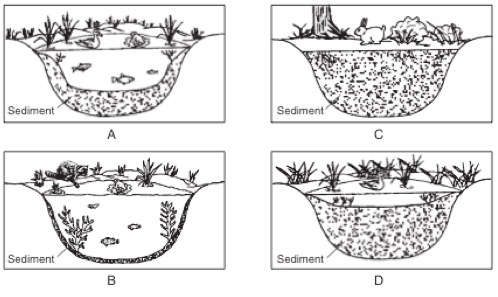
What is the correct order from oldest (happened first) to youngest (happened last) in this pond succession?
a)
A, B, C, D
b)
D, C, B, A
c)
B, A, D, C
d)
C, D, A, B
18.
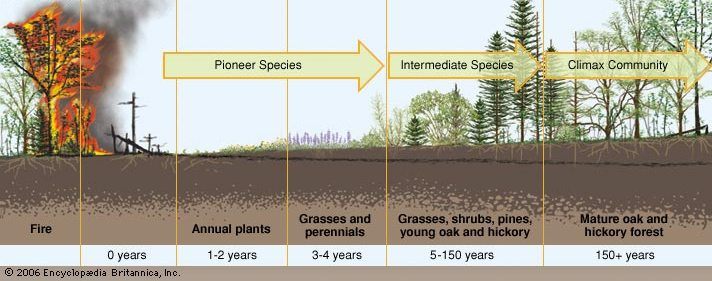
The picture shows what type of succession?
a)
primary
b)
secondary
c)
tertiary
d)
quadanary
19.
Which human activity has had a negative impact on ocean systems?
a)
Monitoring
b)
Over-fishing
c)
Creation of artificial reefs
d)
Reduction in coastal developments
20.
Which process is responsible for carrying fertilizers that have been applied to crops into bodies of water, such as a river?
a)
Runoff
b)
Evaporation
c)
Ocean Currents
d)
Tectonic Plate movement
21.
Based on the model, which consumers would receive the greatest amount of energy capturedby the producers in their food chains?
a)
Wedge-tailed eagles
b)
Chuditch
c)
Ring-tailed opossums
d)
Eucalyptus trees
22.
A Cross Timbers rancher is concerned about competition between the ranch animals and the deer. Based on the graph, which ranch animals compete for the most food with white-tailed deer?
a)
Cattle that eat grass and feed
b)
Goats that eat weeds and shrubs
c)
Turkeys that eat seeds and fruit
d)
Hogs that eat fruit, seeds, and feed
23.
A manatee is a water-dwelling herbivore on the list of endangered species. If manatees were to become extinct, what would be the most likely result in areas where they had lived?
a)
Certain producer organisms would become more abundant in the area.
b)
Other manatees would move into the area and restore balance.
c)
Predators in the area would have more food to eat.
d)
The area would not be affected.
24.
What does biodiversity mean?
a)
Only one species in an area.
b)
The different amount of species in an area
c)
All abiotic life
d)
Nitrogen fixation
25.
Which statement best explains how natural selection occurs?
a)
when adaptations help an organism reproduce and survive.
b)
when organisms are geographically isolated.
c)
when an organism’s offspring grow vestigial structures.
d)
when characteristics from the parent organism are inherited.
26.
(8.11C) Some scientists studying aquatic plants notice that flooding often leads to a decrease in the rate of photosynthesis among aquatic plants. Flooding causes more sediment to be suspended in the water. The increased sediment concentration decreases the amount of light that reaches the plants. Why does a decreased rate of photosynthesis lead to a decrease in a plant population?
a)
Less water is available for absorption.
b)
Less tissue is available for plant growth.
c)
Less energy is available for reproduction.
d)
Less soil is available for leave development.
27.
(7.11C) Some students collected leaf samples. The students used the leaf identification key shown below to identify a leaf sample.
Based on the identification key, which type of tree is this sample from?
a)
Ginkgo
b)
Honey locust
c)
Horse chestnut
d)
Black maple
28.
(7.12D) The diagram of a plant cell is shown below. 
The function of the plant cell structure shown in the enlargement is to-
a)
provide support for the cell
b)
direct all the cell's activities
c)
use energy from sunlight to make sugar
d)
regulate substances that enter and exit the cell
29.
(7.14B) The hydra is a very small, simple animal that lives in water. Hydras reproduce asexually by budding, a process in which a bud breaks off as adult hydra and floats away.
Which of the following describes a hydra bud?
a)
A hydra bud contains genetic material from its two parents.
b)
A hydra bud is genetically identical to the parent hydra.
c)
A hydra bud has different mutations than the parent hydra. 
d)
A hydra bud has half as much genetic material as the parent hydra.
30.
Certain species of whiptail lizards have only female individuals and no males. These lizards reproduce asexually. What is one disadvantage of asexual reproduction for these lizards?
a)
A new population can be established by a single individual in a relatively short period of time.
b)
All the members of a population are genetically very similar and less able to survive environmental changes.
c)
They are smaller than lizards that reproduce sexually.
d)
They are more likely to develop a variety of tail lengths.
31.
(6.12D) The characteristic of a particular organism are listed below.
In which kingdom should this organism be classified?
a)
Fungi
b)
Eubacteria
c)
Plantae
d)
Animalia
32.
Which organism do the owl and the weasel compete for in the food web?
a)
Hawk
b)
Spider
c)
Grasshopper
d)
Shrew
33.
An organism that cannot adapt to changes in the environment will most likely - 
a)
produce more offspring
b)
die
c)
change its traits to survive
d)
store more food
34.
Which of the following human activities can most negatively affect the oceans via sewer drains?
a)
Collecting and storing rainwater before it reaches drains.
b)
Spraying lawns with chemicals to kill weeds and insects.
c)
Sweeping dead leaves into the gutters along streets.
d)
Pouring salt on streets and sidewalks when it snows.Select
35.
If the grasshopper were to be removed completely from the food web, what organism would be most effected?
a)
The squirrel
b)
The shrew
c)
The deer
d)
The rabbit
36.
A fox is an example of...
a)
Biotic Factor
b)
Abiotic Factor
37.

Which type of cells contain a DNA in a nucleus and membrane bound organelles.

a)

eukaryotes

b)

prokaryotes

38.

Which type of cells do not possess a nucleus and do not have membrane bound organelles.

a)

eukaryotes

b)

prokaryotes

39.

Unicellular Organisms

a)

Organisms made up of only one cell

b)

Organisms made up of many cells.

40.

Multicellular Organisms

a)

Organisms made up of only one cell

b)

Organisms made up of many cells.

41.

Autotrophic Organisms

a)

Organisms that can make their own food through processes such as photosynthesis.

b)

Organisms that cannot make their own food and must consume other organism to obtain energy.

42.

Heterotrophic Organisms

a)

Organisms that can make their own food through processes such as photosynthesis.

b)

Organisms that cannot make their own food and must consume other organism to obtain energy.

43.

Requires only 2 parents to produce offspring

a)

Asexual Reproduction

b)

Sexual Reproduction

44.

Requires only 1 parent to produce offspring

a)

Asexual Reproduction

b)

Sexual Reproduction

45.
Which kingdom are mosses, ferns, conifers, and flowering plants a part of?
a)
Archaebacteria
b)
Plantae
c)
Animalia
d)
Protista
46.
True or False: I am an autotrophic organism, therefore, I cannot make my own food.
a)
True
b)
False
47.
Amoeba and paramecia are eukaryotic, single cellular, heterotrophic, and reproduces asexually. Which kingdom would best these organisms best be classified into?
a)
Plant
b)
Animal
c)
Protist
d)
Fungi
48.
A paramecium is a single celled organism with a nucleus that consumes other organisms for energy. The offspring are genetically different from its parents.
a)
Prokaryotic
b)
Eukaryotic
49.
A mushroom is composed of many cells that have a nucleus
In which domain does a mushroom belong?
a)
Archaea
b)
Eukarya
c)
Bacteria
50.
In which of the following domains would a lion cub belong?
a)
Protista
b)
Animalia
c)
Eukarya
d)
Archaea
51.
The skeletal system does all of the following EXCEPT
a)
produces red blood cells
b)
stores calcium and minerals
c)
protects organs
d)
excretes waste
52.
The nervous system is composed of the ___, ___, and ___.
a)
heart, brain, kidneys
b)
lungs, liver, stomach
c)
brain, spinal cord, nerves
d)
eyes, pancreas, veins
53.

What is the function of the nervous system?

a)

circulate blood through the body

b)

gas exchange

c)

Protect your body from UV rays, secrete waste, and regulate body temperature.

d)

Sense and interpret external and internal changes in the environment and then send a response.

54.

Which of the figures is in the nervous system?

a)

Figure #1

b)

Figure #2

c)

Figure #3

d)

Figure #4

55.
Muscles are responsible for?
a)
Movement of the body
b)
Framework of the body
c)
Elimination of body waste
d)
Circulation of blood
56.
What are the 3 types of muscle tissue?
a)
Thigh, Calf, & Shoulder
b)
Traps, Forearm, & Abs
c)
Hamstring, Biceps, & Triceps
d)
Smooth Muscle, Cardiac Muscle, & Skeletal Muscle
57.
What is skeletal muscle responsible for?
a)
Responsible for voluntary body movements.
b)
Carries out mostly involuntary processes like digestion and pumping blood through arteries.
c)
Prevents the actin from rubbing with the myosin.
d)
Rigor mortis
58.
One major function of the excretory system is to clean the what?
a)
urine
b)
blood
c)
kidneys
d)
bladder
59.
These organs are responsible for what?
a)
storing urine
b)
storing water
c)
filtering blood
d)
they don't have a particular job 
60.
Where is urine stored?
a)
kidneys
b)
urinary bladder
c)
urethra
d)
ureters
61.
What is the circulatory system made up of?
a)
Food, water
b)
Hands, Feet
c)
Heart, Blood Vessels, Veins, Blood
d)
Sunlight, Plants
62.

The job of the heart is to . . .

a)

pump blood around the body.

b)

send food to the small intestines.

c)

break down food.

d)

give energy to the body.

63.
The circulatory system works with the ___________ system to provide our body with oxygen.
a)
respiratory
b)
digestive
c)
muscular
d)
skeletal
64.
Which best describes the relationship between the muscular system and the circulatory system? 
a)
The circulatory system captures carbon dioxide from the air for muscle energy.
b)
The circulatory system produces red blood cells to bring oxygen to the muscles
c)
The circulatory system provides a framework for muscle movement
d)
The circulatory system delivers oxygen for muscle energy
65.
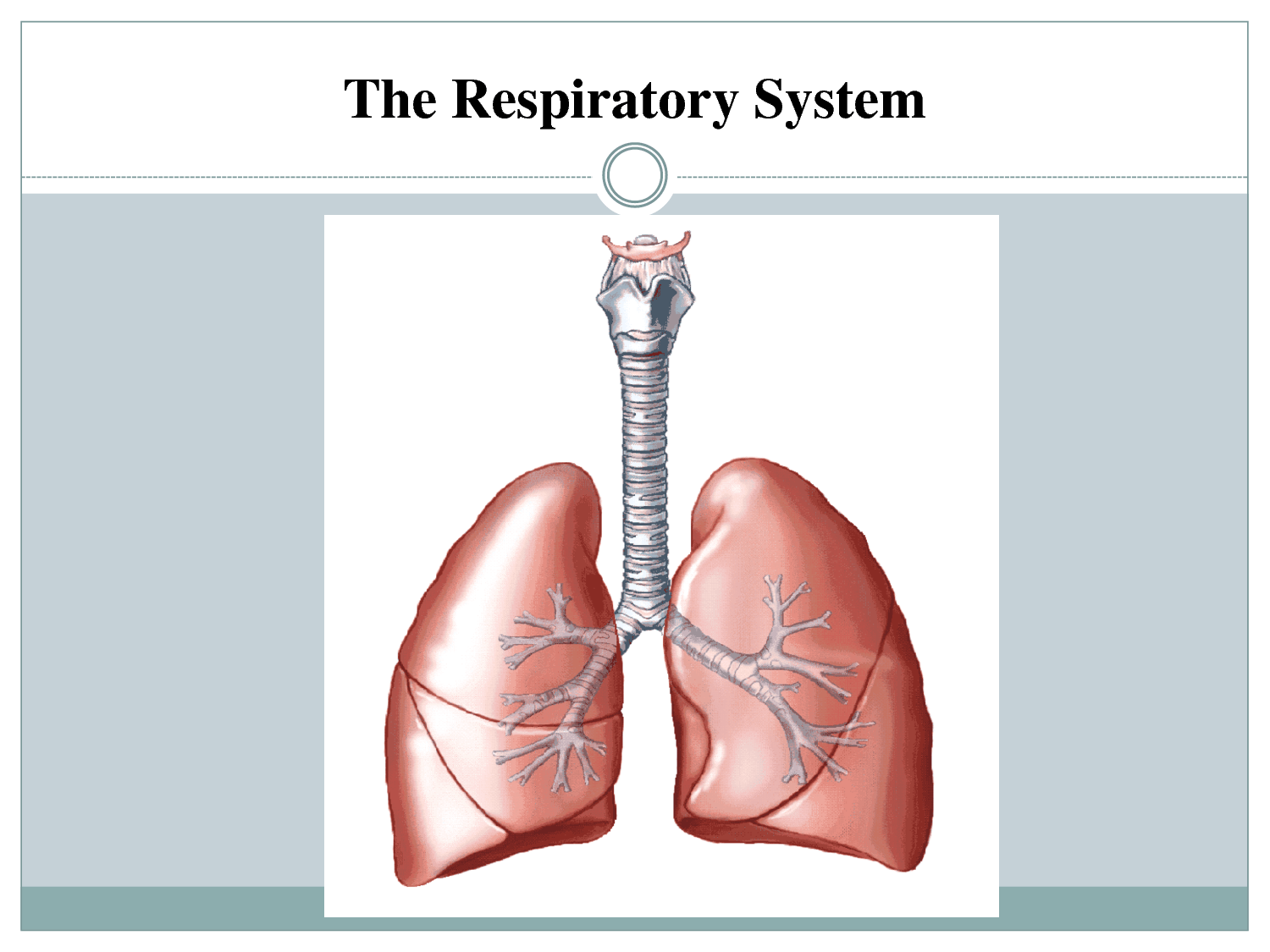
What is the main function of the respiratory system?
a)
to provide oxygen and remove carbon dioxide from the body
b)
to bring oxygen to the body
c)
to break down food and absorb nutrients
d)
to remove oxygen from the body and deliver carbon dioxide
66.
When you breathe, your lungs take in ___ and remove ___. 
a)
air/oxygen
b)
oxygen/carbon dioxide 
c)
carbon dioxide/waste 
d)
waste/air 
67.
Given the following structures:
1. larynx
2. nasal cavity
3. pharynx
4. trachea
Which of the following is the correct order that air would flow during inhalation. 
a)
1,2,3,4
b)
2,3,1,4
c)
2,1,3,4
d)
4,2,3,1 
68.
The integumentary system does not include.. 
a)
Hair 
b)
Skin 
c)
Nails 
d)
Liver
69.
A main function of the integumentary system is ____________________.
a)
To protect the body from infection
b)
To receive pressure, pain, heat, and cold stimuli
c)
To maintain an internal body temperature
d)
all of these
70.

Which of the following is NOT part of the cell theory?

a)

All animals are made up of cells

b)

cells can only arise from existing cells

c)

cells are the smallest form of life

d)

growth in animals is due to the cells getting bigger

71.

Which of the following organelles is most important in providing energy to the cell?

a)

centrosome

b)

mitochondrion

c)

nucleus

d)

cytoplasm

72.

Which of the following correctly matches an organelle with its function?

a)

mitochondrion…photosynthesis

b)

nucleus…cellular respiration

c)

vacuole…storage

d)

chloroplast…movement

73.

What organelle provides protection, shape, support, and rigidity to the cell?

a)

nucleus

b)

cell wall

c)

mitochondrion

d)

chromosome

74.

A cell has the following structures: nucleus, cell membrane, vacuole and mitochondria. It could be a cell from

a)

An animal, but not a plant

b)

A plant, but not an animal

c)

Either a plant or an animal

d)

Bacteria

75.

Which organelle holds genetic material and is nicknamed the “brain” of the cell?

a)

cytoplasm

b)

cell membrane

c)

vacuole

d)

nucleus

76.

What two organelles are found in plant cells but not animal cells?

a)

nucleus, chloroplasts

b)

cell wall, cell membrane

c)

nucleus, cell membrane

d)

cell wall, chloroplasts

77.

Stores food, water & waste

a)

cell membrane

b)

cytoplasm

c)

vacuole

d)

chloroplast

78.

The function of the cell parts labeled X are to __________.

a)

control the heredity of traits

b)

provide oxygen to the cell

c)

transform light energy into chemical energy through photosynthesis

d)

stores waste

79.

The cell part labeled Y contains _____________.

a)

genetic material

b)

cytoplasm

c)

chlorophyll

d)

water

80.

What is the function of structure W in the cell?

a)

To store water, waste, and nutrients for the cell

b)

To transport materials between parts of the cell

c)

To produce energy for the cell

d)

To control the activities of the cell

81.

Based on the characteristics in the chart provided, what are the names of Organelle A and Organelle B?

a)

Organelle A is a cell wall. Organelle B is chloroplast

b)

Organelle A is chloroplast. Organelle B is a cell wall

c)

Organelle A is a cell wall. Organelle B is a cell membrane

d)

Organelle A is a cell membrane. Organelle B is a cell wall

82.

Chromosomes are found inside which of the following structures of a eukaryotic cell?

a)

Gene

b)

DNA

c)

Nucleus

d)

Proteins

e)

Mitochondrion

83.
DNA is inside your cells. What part of the cell is the DNA inside of?
a)
cell membrane
b)
cytoplasm
c)
nucleus
84.

Heredity is the passage of what from parent to offspring?

a)

genetic material

b)

oxygen

c)

digestive enzymes

d)

connective tissue

85.

Bianca has blue eyes like her father. Where is the trait found?

a)

genes within chromosomes in nucleus

b)

chromosomes within genes in cytoplasm

c)

nucleus within a gene in the chromosome

d)

cytoplasm within a chromosome