wayground logo

Free Printable Worksheets

Font size

S
M
L
XL
Worksheets

Chapter 16 Part 2 Test Review

Total questions: 78

Worksheet time: 2hrs 31mins

Name
Class
Date
1.
What is voltage?
a)
The amount of electric potential energy per one coulomb of charge
b)
The amount of 1 coulomb of charge per unit of potential energy
c)
The number of volts per coulomb
d)
The amount of electric potential energy per volt
2.
Resistance is measured in ___. 
a)
watts. 
b)
amps.
c)
ohms.
3.
Voltage is measured in __.
a)
volts.
b)
watts.
c)
coulombs. 
4.
As the resistance of a circuit increases, the current will
a)
increase
b)
decrease
c)
stay the same
5.
The difference in electrical potential energy between two places is called
a)
resistance
b)
friction
c)
induction
d)
voltage
6.
The current passing through bulbs in series will be...
a)
...the same
b)
...different
7.
What 'flows' in a wire?
a)
Protons
b)
Neutrons
c)
Atoms
d)
Electrons
8.
Current is measured in....
a)
Amps 
b)
Volts
c)
Ohms
d)
Coulombs
9.
brass is a _____?
a)
insulator
b)
conductor
10.
How should you put in an Ammeter?
a)
In Parallel
b)
In Series
11.
A voltmeter should be placed ........... in a circuit
a)
in parallel
b)
in series
c)
in order
d)
upside down
12.
What would the voltmeter read
a)
1V
b)
2V
c)
3V
d)
6V
13.
Which Voltmeter will give the lowest reading?
a)
V1
b)
V2
c)
V3
14.
Resistance is a measure of....
a)
the energy per unit charge in a circuit
b)
how hard it is for electrons to move through the circuit
c)
how hard it is for electrons to move through the battery
d)
the number of charge carriers in a circuit
15.
A conductor is?
a)
material that current can pass through easily
b)
material that current cannot pass through easily
c)
magnet
d)
electric current
16.
Insulator is?
a)
material that current can pass through easily
b)
material that current cannot pass through easily
c)
magnet
d)
static electricity
17.
the tendency for a material to oppose the flow of electrons
a)
current
b)
circuit
c)
resistance
d)
difference
18.

Copper wire is a

a)

Insulator

b)

Conductor

19.

What moves electrons?

a)

Resistance

b)

Current

c)

Voltage

d)

Power

20.
What happens when you add a second bulb to a series circuit?
a)
The first bulb gets brighter
b)
The second bulb will be as bright as the first because they both get full power
c)
The circuit will no longer work
d)
Both bulbs will be half as bright because the voltage is divided by two now
21.
When you flip a light switch on and off you are closing and opening a circuit.
a)
true
b)
false
22.
water is a______?
a)
conductor
b)
insulator
23.
wood is a _____?
a)
conductor
b)
insulator
24.
In a Series circuit the more lightbulbs you add the brighter they get 
a)
False 
b)
True 
25.
A material in which electrons are able to move easily
a)
Circuit
b)
Insulator 
c)
Resistance 
d)
Conductor 
26.
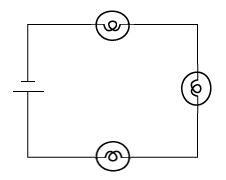
The picture shows an electrical circuit. This circuit is a series circuit because: 
a)
It has 3 light bulbs.
b)
The same current flows through all three light bulbs.
c)
It uses a single battery.
d)
The electrical current has more than one path to flow through
27.
Which of these objects is an insulator?
a)
Copper Wire
b)
Paper Clip
c)
Steel Pole
d)
Rubber Gloves
28.
What does the battery / cell provide?
a)
Voltage
b)
Current
c)
Resistance
29.
What does the voltage create?
a)
Power that runs through the whole circuit
b)
A current that runs through the whole circuit
c)
Resistance that runs through the whole circuit
30.
Comparing series vs parallel circuits:
a)
Series: voltage changes, current is constant
b)
Series: Current changes, voltage is constant
c)
Parallel: both voltage AND current change
d)
Parallel: neither voltage nor current change
31.
Changing from 1 bulb to 2 bulbs in series will ...
a)
... double the voltage
b)
... double the resistance
c)
... double the current
32.
Every time the number of components in a series circuit increases,
a)
... the current decreases more
b)
... the current increases more
c)
... the voltage increases more
33.

A material in which charge is not able to move easily

a)

Circuit

b)

Insulator

c)

Resistance

d)

Conductor

34.

The charge that moves through the wires of a circuit is _____.

a)

supplied by the battery; if it weren't there would be no current.

b)

already present in the wires; it simply takes a batter to force it to move.

c)

a fictional idea that originated when scientists gave up on the possibility of determining what was really happening.

d)

used up when the bulb lights.

35.

Adding more resistance to an series circuit will cause _____.

a)

charge flow to increase and bulb brightness to decrease

b)

charge flow to decrease and bulb brightness to increase

c)

charge flow to increase and bulb brightness to remain the same

d)

charge flow to decrease and bulb brightness to decrease

36.

The three circuits shown consist of a light bulb and varying numbers of resistors (small rectangle on wire at the bottom). In which circuit will the current (charge flow) be the greatest?

a)

Circuit A

b)

Circuit B

c)

Circuit C

d)

All will have the same current.

37.

The batteries and bulbs of the two circuits shown above are identical. In which circuit will there be the greatest resistance?

a)

Circuit A

b)

Circuit B

c)

Circuit A and B have the same resistance.

38.

The type of batteries and bulbs are identical in the circuits shown. Which circuit above would have the brightest bulbs?

a)

Circuit A

b)

Circuit B

c)

Circuit A and B bulbs would all have the same brightness.

39.
In a series circuit, the relationship between equivalent resistance and current is ___.
a)
direct
b)
inverse
c)
not relationship
40.
Two batteries in a circuit make the lights in the circuit brighter than one battery.
a)
true
b)
false
41.

How do you connect two 12-volt batteries to produce 24 volts?

a)

Parallel

b)

Series

c)

Series/Parallel

d)

Both A and C

42.
The type of electricity used in homes is called
a)
alternating current
b)
current
c)
direct current
d)
electromotive force
43.
A heat sensitive switch that protects branch circuits from overcurrents
a)
Circuit Breaker
b)
GFCI
c)
Service Panel
d)
Fuse
44.
Outlets that contain special protection that are used near water sources
a)
NEC
b)
GFCI
c)
Circuit Breaker
d)
Service Panel
45.
a switch that automatically opens if the current in the circuit is too high
a)
parallel circuit
b)
circuit breaker
c)
series circuit
d)
load
46.
a device that contains a thin strip of metal that melts easily if the current in the circuit is too high
a)
fuses
b)
circuit
c)
series circuit
d)
load
47.
a mini circuit breaker comparing the current in one side of an outlet with the other side and opens the circuit if there is a slight difference
a)
GFCI
b)
load
c)
fuse
d)
parallel circuit
48.
The type of current where charges flow in one direction
a)
Direct Current
b)
Alternating Current
c)
Electron Flow
d)
Voltage
49.
A(n) ______________ is a reusable safety switch that breaks the circuit when the current gets too high.
a)
Fuse
b)
Grounded wire
c)
Fuse box
d)
Circuit breaker
50.
The type of current where charges shake back and forth in a circuit
a)
Alternating Current
b)
Direct Current
c)
Voltage 
d)
Switchback Current
51.
DC stands for ____ and is used in batteries.
a)
Distant Current
b)
Don't Current
c)
Direct Current
52.
AC stands for ___.
a)
Alternating Current
b)
Attraction Connections
53.
Why are metals useful for making electrical wire?
a)
Metals do not bend.
b)
Metals hold much heat.
c)
Metals are insulators.
d)
Metals are conductors.
54.
Which one is an insulator? 
a)
Silver 
b)
Copper 
c)
Mechanical pencil
d)
plastic 
55.
The coiled wire inside the light bulb is called a _____.
a)
insulator
b)
filament 
c)
coiled wire
d)
connector
56.
A flow of electrons through a conductor is called:
a)
A river
b)
A spark
c)
An electron flow
d)
A current
57.
A tool that can be used to measure voltage, amperage and resistance is called a 
a)
ammeter
b)
ohmmeter
c)
multimeter
d)
voltmeter
58.
Choose the true statement below concerning DC currents:
a)
DC stands for Direct Computing and electrons flow in multiple pathways
b)
DC stands for direct current and electrons flow in multiple directions
c)
DC stands for direct current and the electrons do not flow
d)
DC stands for direct current and the electrons flow in only one direction
59.
In electrical terms, what does AC mean? 
a)
Amplified Current
b)
Amplitude Current
c)
Attenuating Current
d)
Alternating Current
60.
When electricity moves in only one direction (usually a current from batteries).
a)
Alternating current
b)
Direct current
c)
Ionic current
d)
Both Alternating and Direct
61.
When charges flow in alternating directions.
a)
Direct Current
b)
Alternating Current
c)
Semi Conductor
d)
Electrical Conductor
62.
How does alternating current differ from direct current?
a)
Alternating current produces more voltage than direct current
b)
 Alternating current always flows in the same direction; the direction of a direct current switches back and forth
c)
Direct current produces more voltage than alternating current
d)
 Direct current always flows in the same direction; the direction of an alternating current switches back and forth
63.
The flow of electricity in a circuit-
a)
current
b)
flow
c)
circuit
64.
The tendency for a material to oppose the flow of electrons, changing electrical energy into thermal energy and light.
a)
Voltage
b)
Current
c)
Resistance
d)
Circuit 
65.

On a multimeter which wire is used for what?

a)

the red probe is used for positive, and the black probe is used for negative

b)

the red probe is used for negative, and the black probe is used for positive

66.
If you have three 1.5V batteries in series, what would be total voltage be? 
a)
3.4 V
b)
4.5 V
c)
1.5 V
d)
3 V
67.
 An AA battery holder with 6 cells provides how many total volts?
a)
1.5V
b)
6V
c)
9V
d)
3V
68.
Where should the black test lead be connected on a multimeter when you are measuring resistance?
a)
To the COM input jack
b)
To the V•Ω or V•Ω•mA input jack
c)
To the 10A input jack
d)
To any input jack
69.
The SI unit of charge is
a)
the ampere
b)
the newton
c)
the coulomb
d)
the joule
70.
The Law of Conservation of Charge states that:
a)
all atoms have more protons than electrons.
b)
only protons can be rubbed off of an atom.
c)
charge cannot be created or destroyed.
d)
charge cannot be transferred.
71.
Batteries have
a)
two negative terminals
b)
two positive terminals
c)
one positive and one negative terminal
d)
no terminals
72.
A device that protects a circuit from current overload is a(n)
a)
conductor 
b)
fuse
c)
capacitor
d)
resistor
73.
A device that protects a circuit from current overload is a(n)
a)
insulator
b)
circuit breaker
c)
switch
d)
resistor
74.
Which is the unit for charge?
a)
ampere
b)
coulomb
c)
watt
d)
volt
75.
Which is the unit for potential difference?
a)
ampere
b)
coulomb
c)
ohm
d)
volt
76.
An example of a conductor is :
a)
a glass paperweight
b)
a plastic cap
c)
a metal screw
d)
a wooden handle
77.
What causes current to flow?
a)
potential difference
b)
energy
c)
electricity
d)
magnetism
78.
In a series circuit  with 4 bulbs:
a)
a switch is never used
b)
all of the bulbs become dimmer if another bulb is added
c)
There are many paths for electricity to take
d)
the remaining 3 bulbs stay lit if one burns out