wayground logo

Free Printable Worksheets

NEW

Font size

S
M
L
XL
Worksheets

Quarter 1 Keystone Review

Total questions: 53

Worksheet time: 31mins

Name
Class
Date
1.
What word describes when water is attracted to other substances?
a)
cohesion
b)
adhesion
c)
capillary action
d)
surface tension
2.
Attractions between water molecules are called
a)
Covalent bonds
b)
Ionic bonds
c)
Polar bonds
d)
Hydrogen bonds
3.
tendency of molecules of the same kind to stick to one another
a)
cohesion
b)
adhesion
c)
solution
d)
polar molecule
4.
Why does ice float?
a)
As water freezes, it expands and its density decreases.
b)
As water freezes, it takes up more hydrogen from the atmosphere, causing it to have a greater buoyancy.
c)
As water freezes, air becomes trapped between the hydrogen bonds of water molecules.
d)
As water freezes, it takes up more oxygen from the atmosphere, causing it to have a greater buoyancy.
5.
Which end of the water molecule has a slightly positive charge?
a)
the oxygen end
b)
the hydrogen end
c)
both ends are slightly positive
d)
neither end is positive
6.
Which types of compounds dissolve easily in water?
a)

Polar and Nonpolar

b)

Polar

c)

Nonpolar and Ionic

d)

Covalent and Nonpolar

7.

Water droplets take a spherical shape (as pictured) because they bond to one another. This process is called ____________

a)

adhesion

b)

cohesion

c)

capillary action

d)

solubility

8.

Water is a versatile solvent because it...

a)

It can be found anywhere

b)

It freezes when it gets cold

c)

floats when frozen

d)

is polar and dissolves many substances

9.

Pepper can rest on top of a cup of water because of

a)

Adhesion

b)

High Surface Tension

c)

Universal Solvent

d)

Changes in Density

10.

Most of water's properties occur because of its...

a)

polarity

b)

has no charge

c)

is nonpolar

d)

abundance on earth

11.
What is the reason why oil and water don't mix?
a)
Oil is too heavy to mix with water
b)
Water can only mix with polar molecules 
c)
Water can only mix with non-polar molecules
d)
Oil is too light to mix with water 
12.
Water molecules require a lot of energy to separate one from the others.  This gives water a high
a)
density
b)
polarity
c)
solvency
d)
specific heat
13.

Which biomolecule is this a picture of?

a)

Protein

b)

Nucleic Acid

c)

Lipid

d)

Carbohydrate

14.

Which biomolecule contains enzymes?

a)

Carbohydrate

b)

Lipid

c)

Nucleic Acid

d)

Protein

15.
Which biomolecule is responsible for insulation and LONG term energy storage?
a)
Proteins
b)
Nucleic Acids
c)
Lipids
d)
Carbohydrates
16.
Which biomolecule is made of amino acid monomers?
a)
Nucleic Acid
b)
Carbohydrate
c)
Protein
d)
Lipid
17.
Which biomolecule does your body (break down) for energy?
a)
Nucleic Acid
b)
Protein
c)
Lipid
d)
Carbohydrate
18.
Identify this polymer.
a)
Lipid
b)
DNA
c)
RNA
d)
Complex carbohydrate
19.

An important feature of lipid tails like the phospholipid tails is that they are ...

a)

Hydrophobic (hate water)

b)

Hydrophilic (love water)

c)

Long

d)

Short

20.
Which biomolecule is this a picture of?
a)

Protein

b)

Nucleic Acid

c)

Lipid

d)

Carbohydrate

21.
All polymers are made up of...
a)
monosaccharides
b)
monomers
c)
proteins
d)
None of these
22.

Which biomolecule is made up of repeating nucleotides

a)

lipids

b)

proteins

c)

carbohydrates

d)

nucleic acids

23.

All living things are made up of many types of organic compounds. This means living things contain a lot of which element?

a)

helium

b)

sodium

c)

copper

d)

carbon

24.
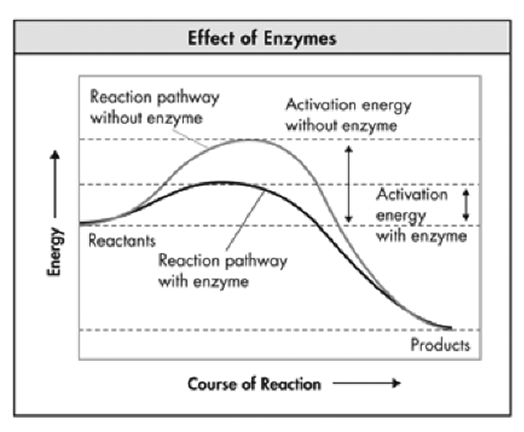
The graph shows how enzymes affect reactions in cells. Which statement best summarizes the information shown in the graph?
a)
Enzymes increase the energy of the reactants.
b)
Enzymes decrease the energy level of the products.
c)
Enzyme decrease the activation energy of the reaction.
d)
Enzymes reverse the direction of the reaction.
25.
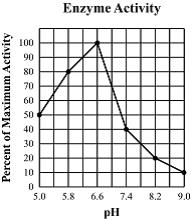
Which of the following conclusions can be drawn from this graph?
a)

The best pH for the enzyme is 6.6.

b)

The best pH for the enzyme is 5.0

c)

The enzyme’s activity increases as pH increases 5.0 to 9.0

d)

The enzyme’s activity is greater around pH of 8.0 .
26.
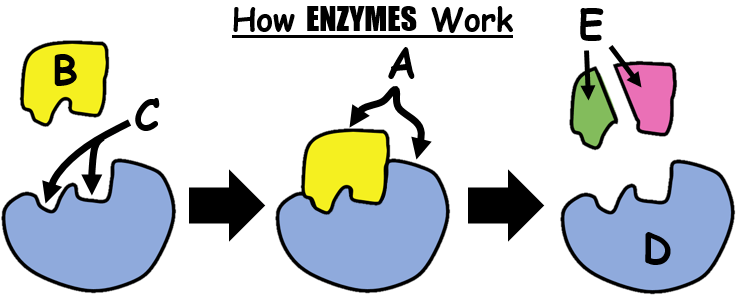
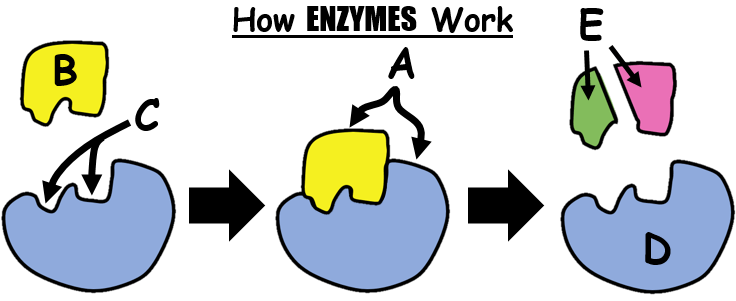
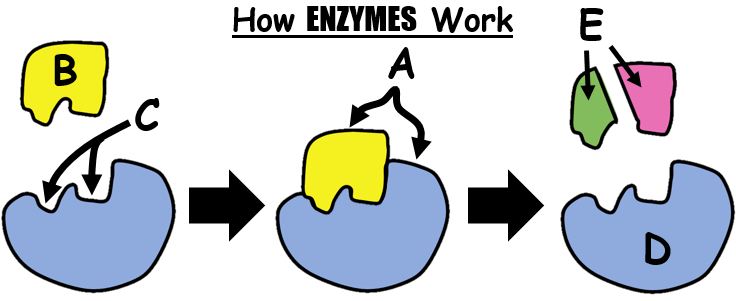
In the diagram, what is letter A? 
a)
product
b)
substrate
c)
enzyme-substrate complex
d)
active site
27.
An enzyme speeds up a chemical reaction in the cell but can only be used once.  True or False? 
a)
true
b)
false
28.
What is the function of an enzyme?
a)
enzymes break themselves into small pieces
b)
enzymes slow down chemical reactions
c)
enzymes speed up chemical reactions
d)
enzymes combine products to form reactants 
29.
What happens when enzymes are heated to a high temperature?
a)

The enzymes die.

b)

The folding of the enzymes unravel and they denature

c)

The enzymes' amino acid sequence changes.

d)

The enzymes remain the same

30.
Which of these is NOT true?
a)
Enzymes can denature (change shape) when the temperature gets too high.
b)
Enzymes can only be used once in a chemical reaction. 
c)
Extreme pH can denature enzymes.
d)
Enzymes speed up chemical reactions. 
31.
Letter D...
a)
active site
b)
enzyme
c)
substrate
d)
products
32.
Letter B...
a)
active site
b)
enzyme
c)
substrate
d)
products
33.
Which of the following is a characteristic of both Eukaryotic and Prokaryotic cells?
a)
ribosomes
b)
nucleus
c)
membrane bound organelles
d)
simple
34.
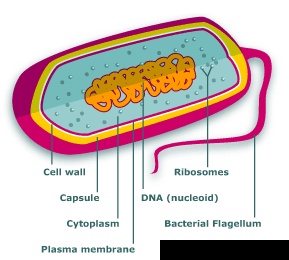
Which type of cell?
a)
Prokaryote
b)
Eukaryote
35.
Which of the following is found inside a prokaryote?
a)
cytoplasm
b)
DNA
c)
ribosomes
d)
all of these
36.
True or False:
cells can have different numbers or organelles because of the cell's function.
a)
True
b)
False
37.

These cells have DNA found in a nucleus..

a)

Eukaryotic

b)

Prokaryotic

c)

Neither

d)

Both prokaryotic and eukaryotic

38.
Animal, fungi, plant, and protista cells are all examples of which type of cell?
a)
Eukaryotic
b)
Prokaryotic
c)
Both prokaryotic and eukaryotic
39.

Which domain has bacteria that is capable of living in extreme environments like hot springs, geysers, or very salty waters?

a)

Bacteria

b)

Archaea

c)

Eukarya

40.
Which domain includes all animals and plants?
a)
Archaea
b)
Eukarya
c)
Bacteria
41.
To say that an organism is heterotrophic means...
a)
it cannot reproduce asexually
b)
it cannot make its own food
c)
it cannot breathe oxygen gas
42.
Which kingdoms have some organisms that can make their own food (autotrophic)?
a)
Plantae and Animalia
b)
Fungi and Plantae
c)
Protista and Plantae
43.
True or False: All living things are made of one or more cells.
a)
True
b)
False
44.
Fungi are a type of...
a)
decomposer
b)
producer
45.
What is the genus name here:
Canis lupus
a)
Canis
b)
lupus
46.
Which kingdom is autotrophic AND has a cell wall?
a)
Bacteria
b)
Fungi
c)
Plantae
d)
Protista
47.
The 8 levels of classification, most broad to most specific.
a)
Domain, Genus, Family, Order, Class, Phylum, Kingdom, Species
b)
Domain, Species, Kingdom, Genus, Phylum, Family, Class, Order
c)
Domain, Kingdom, Phylum, Class, Order, Family, Genus, Species
d)
Order, Kingdom, Species, Domain, Phylum, Family, Class, Genus
48.
Which of the following organisms are MOST closely related?
a)
organisms that share a domain
b)
organisms that share a family 
c)
organisms that share a genus 
d)
organisms that share an order  
49.
Which of the following is the correct order of organization in living things from most basic (simple) to most complex?
a)
a.  Organism, cell, tissue, organ, organ system
b)
a.  Organ system, organ, tissue, cell, organism
c)
a.  Cell, tissue, organ, organ system, organism
d)
a.  Cell, organ, tissue, organ, organism, organ system
50.
The smallest level of organization of life in an organism
a)
tissue
b)
cell
c)
organ
d)
organ system
51.
What is the difference between a cell and a tissue?
a)
cell is basic unit of life; tissue is group of cells that work as one
b)
cell is group of tissues; tissue is basic unit of life
c)
cell is basic unit of life; tissue is groups of different cells
d)
cell is group of organs; tissue is group of different cells
52.
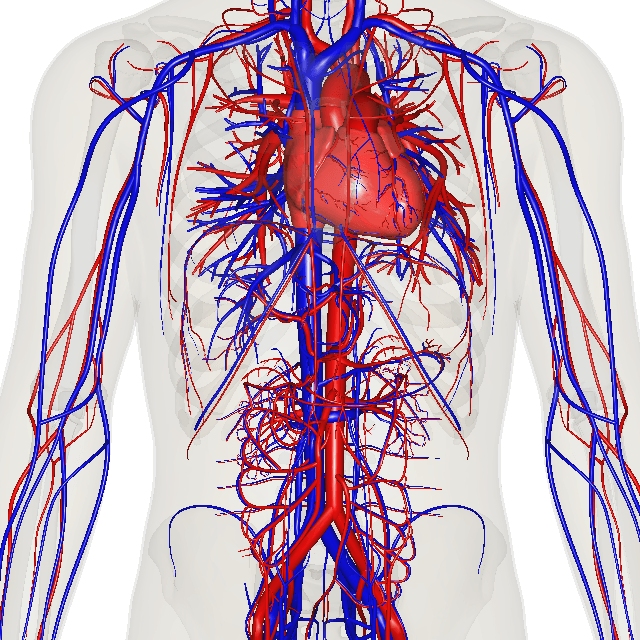
This is a example of ........
a)
organ
b)
organ system
c)
tissue
d)
cell
53.

What process is used to bond monomers together to make polymers by removing water?

a)

hydrolysis

b)

dehydration synthesis

c)

transpiration

d)

evaporation