wayground logo

Free Printable Worksheets

Font size

S
M
L
XL
Worksheets

Earth Space Science EOC Review Part 2

Total questions: 102

Worksheet time: 1hrs 26mins

Name
Class
Date
1.
Justin blows his nose, but mucus seems to leak through the tissue.  He decides to test which tissue holds up the best while sneezing.  What is the independent variable?
a)
sneezing
b)
Justin
c)
amount of tissue
d)
type of tissue
2.
Mr. McNeice wanted to know if different types of music affected people's heart rates, so he played different music and checked their pulses.  What is the dependent variable?
a)
type of music
b)
heart rate
c)
how long they listend to music
d)
Mr. McNeice
3.
Why should an experiment be repeated?
a)
to form a hypothesis
b)
to reduce the chance of error
c)
to change controls
d)
to identify the problem
4.
This is the outcome of the experiment. We get data and results from this.
a)
Independent Variable
b)
Dependent Variable
c)
Control
d)
Constant
5.
Which is the dependent variable in Amelia's experiment?
a)
the number of bean plants in each group 
b)
the amount of water given daily to each plant 
c)
the height of each bean plant 
d)
the amount of fertilizer given to each group of bean plants
6.
In the paper airplane experiment, changing the size of the airplane would be which variable?
a)
Dependent
b)
Independent
c)
Control
d)
Conclusion
7.
Squidward found new reeds to tryout for his clarinet.  He used an APPLAUSOMETER to measure clapping/applause after playing  Under the Sea with each reed.  The results were put in the table.
What was the dependent variable?
a)
The Song
b)
The Reed
c)
The Applause
d)
The clarinet
8.
Which of these hypotheses is testable?
a)
If I put a bow in my hair, it will look better
b)
If you put some cheese on the burger, it will taste better
c)
If the room is quieter, scores on tests will increase
d)
If I bake these cookies, they will smell delicious.
9.
A scientist set up an experiment to see how vinegar affects plant growth. Five seed pots received a small amount of vinegar in the soil and were placed in the sunlight. Another five pots received no vinegar and were placed in the shade. The scientist grew the seedlings for two months. Which explains why her experiment was not set up properly?
a)
More than one variable was changed.
b)
She did not have a control.
c)
She did not grow the plants long enough.
d)
Vinegar should not be used on plants.
10.
What two factors give stars their brightness?
a)
Distance and actual luminosity
b)
Temperature and color
c)
Color and distance
d)
Brightness and temperature
11.

What answer does not effect Earth's seasons?

a)

The 23.5 degree tilt on the axis

b)

The axis pointed toward Polaris

c)

The revolution around the sun

d)

The Earth's rotation

12.

What causes the tides during the day?

a)

The Earth's rotation on its axis

b)

The Earth's revolution around the sun

c)

Energy from the sun

d)

The moon's rotation around the earth

13.

Most sedimentary rocks are formed by ____________

a)

uplifting and melting

b)

compaction and cementation

c)

eruption of volcanoes

d)

changes deep within Earth

14.

Which city will get warmer in the next couple days?

a)

Billings

b)

Denver

c)

Minneapolis

d)

Atlanta

15.

Which city will get colder in the next 24 hours?

a)

Billings

b)

Denver

c)

Minneapolis

d)

Atlanta

16.

Why does Venus travel in a curved path instead of a straight line?

a)

electromagnetic attraction between the Sun and Venus

b)

gravitational attraction between the Sun and Venus

c)

electromagnetic attraction between Mercury and Venus

d)

gravitational attraction between Mercury and Venus

17.

Which plate boundary would form a mid-ocean ridge?

a)

A

b)

B

c)

C

d)

D

18.

Which plate boundary would form volcanoes and a deep-ocean trench?

a)

A

b)

B

c)

C

d)

D

19.

Which plate boundary would form folded mountains?

a)

A

b)

B

c)

C

d)

D

20.

Which plate boundary would cause surface earthquakes?

a)

A

b)

B

c)

C

d)

D

21.

What is a collection of a dust and gases that forms stars or results from dying stars?

a)

galaxy

b)

planet

c)

moon

d)

nebula

22.
What kind of plate boundary is shown here?
a)
divergent
b)
convergent
c)
transform
d)
strike slip
23.
If we compare the temperature and pressure of the Earth’s mantle to the core, what differences can we expect as we move downward into the Earth?
a)
Both the temperature and pressure increase.
b)
Both the temperature and pressure decrease.
c)
The temperature increases and the pressure decrease.
d)
The temperature decreases and the pressure increases.
24.
Which statement is true about why the Earth’s inner core is solid?
a)
It is not very dense.
b)
It is composed of molten (melted) metal.
c)
It is under extreme pressure.     
d)
 It is made of granite and basalt.
25.
Name this moon phase.
a)
waxing crescent
b)
waxing gibbous
c)
waning gibbous
d)
waning crescent
26.

Use the table to answer the following questions. In astronomical units, about how much farther is Saturn from the Sun than Jupiter is?

a)

2 AU

b)

655,000,000 AU

c)

4.38 AU

d)

5.2 AU

27.

What is solar wind?

a)

charged particles streaming toward the Sun

b)

a wind pattern in Earth’s atmosphere caused by the air being warmed by the Sun

c)

charged particles streaming away from the Sun

d)

huge bubbles of gas ejected from the corona of the Sun

28.
If the moon is in the waxing crescent phase now, what phase would it be in 2 weeks?
a)
full moon
b)
new moon
c)
waxing gibbous
d)
waning gibbous
29.
What are the two main factors that determine the climate of an area?
a)
precipitation and humidity
b)
temperature and air pressure
c)
wind conditions and humidity
d)
temperature and precipitation
30.
What causes winds to form on Earth?
a)
solar energy
b)
ocean currents
c)
elevation differences
d)
uneven heating of the Earth by the sun
31.
What are the surface features of an area called?
a)
latitude
b)
longitude
c)
topography
d)
elevation
32.
What are the 3 major climate zones in order from equator to the poles?
a)
polar, temperate, tropical
b)
tropical, temperate, polar
c)
temperate, polar, tropical
33.
Which BEST describes why latitudes closest to the equator have warmer climates?
a)
they are at lower elevations
b)
they receive more solar energy
c)
they are nearer to ocean currents
d)
they get more winds that carry energy in the form of heat
34.
What is the measure of distance in degrees north and south from the equator?
a)
latitude
b)
longitude
c)
elevation
d)
topography
35.
What is the height of an area above sea level?
a)
elevation
b)
topography
c)
latitude
d)
longitude
36.
Which sentence best describes how latitude and temperature are related?
a)
LOWER latitude = COLDER air temperature
b)
HIGHER latitude = COLDER air temperature
c)
HIGHER latitude = WARMER temperatures
37.
What is the weather conditions in an area over a long period of time?
a)
climate
b)
temperature
c)
elevation
d)
precipitation
38.
What causes some areas of Earth to receive less intense solar energy than others?
a)
the mass of earth
b)
the curve of earth
c)
the density of earth
d)
the elevation of earth
39.
What is weather?
a)
What's happening in space at a time and place.
b)
What's happening in our atmosphere at a time and place.
c)
The average weather over many years
d)
The average temperature over many years.
40.
In which position is it Spring in the Northern Hemisphere?
a)
1
b)
2
c)
3
d)
4
41.
In which position is it summer in the Northern Hemisphere?
a)
1
b)
2
c)
3
d)
4
42.
Which of the following does NOT have an affect on a region's climate?
a)
Large bodies of water
b)
Latitude
c)
Mountains
d)
Longitude
43.
What does this symbol on a weather map indicate? 
a)
High pressure system
b)
Low pressure system
c)
Cold front
d)
Warm front
44.
What does this symbol indicate on a weather map? 
a)
High pressure system
b)
Low pressure system
c)
Cold front
d)
Warm front
45.
What kind of weather is usually associated with a high pressure system?
a)
Sunny weather
b)
Precipitation (rain, snow, etc.)
46.
Which condition usually means cloudy, stormy weather?
a)
high pressure
b)
low pressure
47.
name this front
a)
warm front
b)
cold front
c)
stationary front
d)
occluded front
48.
A _____ is a large, swirling, low-pressure system that forms over the Atlantic Ocean.
a)
blizzard
b)
cold front
c)
tornado 
d)
hurricane
49.
A violently rotating column of air called a _____ when it comes in contact with the ground.
a)
hurrican
b)
tornado
c)
trade wind
d)
local wind
50.
Rain, snow, sleet, and hail are all forms of _____.
a)
precipitation
b)
condensation
c)
evaporation
d)
climate
51.
What type of storm front is this? 
a)
warm front
b)
cold front
c)
stationary front
d)
occluded front
52.
When a warm air mass gently slides on top of a cold air mass, and you have drizzly rain and then warmer weather, what type of front is it?
a)
warm front
b)
cold front
c)
occluded front
d)
stationary front
53.
What causes wind to blow?
a)
Differences in longitude 
b)
Shock waves from clouds 
c)
Differences in air temperature and pressure 
d)
The rotation of the earth
54.
Which term best describes how the earth's atmosphere is heated?
a)
Spirally
b)
Unevenly
c)
Circularly
d)
Kinetically
55.
How are the winds in the northern hemisphere different from winds in the southern hemisphere? 
a)
Winds int he northern hemisphere are deflected right; winds int eh southern hemisphere are deflected left
b)
winds in the northern hemisphere are deflected south; winds in the southern hemisphere are deflected north 
c)
winds in the northern hemisphere are deflected eart; winds in the southern hemisphere are deflected west
d)
winds in the northern hemisphere are deflected left; einds in the southern hemisphere are deflected right 
56.
if you wanted to find the jet steam, where would you go? 
a)
the area around the poles 
b)
the area around the equator 
c)
10 km above the earth's surface 
d)
1 km above the earth's surface 
57.
If you wanted to visit an area with very little wind, where might you go? 
a)
The doldrums around the equator
b)
the jet streams in the northern and southern hemisphere 
c)
the North or South Pole 
d)
the area around the Mediterranean Sea 
58.
How do jet streams influence the weather? 
a)
by creating clouds 
b)
by increasing the moisture in the atmosphere 
c)
by moving weather from one area to another very quickly 
d)
by drying out the atmosphere 
59.
When Earth's rotation causes the wind to curve 
a)
cloudy 
b)
Coriolis effect
c)
high pressure
d)
low pressure 
60.
What creates the air pressure difference between the equator and the poles?
a)
The length of the seasons
b)
The shape of the earth 
c)
the duration of the solar year
d)
The amount of direct sunlight each area receives 
61.
Which illustrates an energy transfer between the atmosphere and the hydrosphere?
a)
Polar ice reflecting the Sun's light back toward space
b)
Loss of heat from a geothermal vent to the surrounding cooler water
c)
Convection currents in the ocean mixing warmer and cooler water together
d)
Plant roots absorbing water from the soil
62.
Which of the following statements about air pressure is true?
a)
Air pressure increases as altitude increases.
b)
Air pressure decreases as altitude increases.
c)
The atmosphere's air pressure does not vary
d)
Warm air tends to have higher air pressure than cold air
63.
Which correctly shows the 4 most abundant gasses in order from most abundant to least abundant?
a)
Nitrogen, Oxygen Argon, Carbon Dioxide
b)
Oxygen, Nitrogen, Carbon Dioxide, Argon
c)
Nitrogen, Oxygen, Carbon Dioxide, Argon
d)
Oxygen, Nitrogen, Argon, Carbon Dioxide
64.
The graph shows how temperature changes with altitude in the Earth's atmosphere. In the troposphere...
a)
Temperature decreases as altitude increases
b)
Temperature increases as altitude increases
c)
Temperature alternately increases and decreases as altitude increases
d)
Temperature stays the same as altitude increases
65.
Most of the water vapor and carbon dioxide in Earth's atmosphere is found:
a)
In the upper part of the atmosphere.
b)
In a thin layer right in the middle of the atmosphere.
c)
In a thick layer right in the middle of the atmosphere.
d)
In the lower part of the atmosphere.
66.
During the latest ice age huge frozen glaciers of snow and ice slowly crept along the surface of the planet. These glaciers crushed and flattened many solid, rock features on the land. This is an example of the _____ interacting with the _______.
a)
biosphere; cryosphere
b)
cryosphere; geosphere
c)
hydrosphere; cryosphere
d)
geosphere, biosphere
67.
If carbon dioxide, methane and water vapor were not in the atmosphere, then
a)
The Earth's surface would be much warmer than it is.
b)
The weather and climate of planet Earth would not be affected.
c)
The organisms currently living on Earth's surface would find it easier to survive.
d)
The Earth's surface would be much colder than it is.
68.
Water evaporating from the surface of a lake moves from the...
a)
Atmosphere to the geosphere 
b)
Geosphere to the hydrosphere 
c)
Hydrosphere to the atmosphere 
d)
Atmosphere to the hydrosphere 
69.
Which statement explains one way the cryosphere and the hydrosphere interact?
a)
When the Sun’s energy melts the ice in the cryosphere, the water flows and joins the hydrosphere.
b)
When the Sun’s energy melts the ice in the hydrosphere, the water flows and joins the cryosphere.
c)
Plants and animals in the cryosphere send out water into the hydrosphere through the process of transpiration
d)
The clouds high up in the cryosphere constantly send water to the hydrosphere through the process of precipitation.
70.
The Sun provides energy for the circulation of air and water in our atmosphere. Which statement BEST describes the cause of this movement of air and water? 
a)
Heat from the center of the Earth warms the surface of Earth which in turn warms the air and causes it to condense.
b)
The Sun warms the Earth’s surface equally, causing air to rise.
c)
The Earth absorbs the Sun's energy, which then warms the air at the surface of the planet. The cooler molecules rise as the warmer molecules sink.
d)
The Earth absorbs the Sun's energy, which then warms the air at the surface of the planet. The warmer molecules rise as the cooler molecules sink.
71.
Within a given region, the mean air temperature over a forested area is significantly cooler than the mean air temperature over a land area without trees. 
What would be the MOST LIKELY cause for the difference in mean air temperature between the forested and non-forested areas?
 
a)
The shading from the trees decreased the surface temperature.
b)
The humidity in the air increased the surface temperatures.
c)
The shading from the trees increased the surface. temperature
d)
The humidity in the air decreased the surface temperature.
72.
Which of the following is one way that the subtropical jet stream can impact weather in Florida?
a)
The jet stream can decrease the severity of a thunderstorms in its path.
b)
The jet stream can increase the severity of thunderstorms in its path.
c)
The jet stream stops fronts from moving.
d)
The jet stream does not have an impact on Florida’s weather.
73.
The process by which water, ice, wind, or gravity moves weathered rock and soil from one place to another.
a)
Weathering
b)
Erosion
c)
Deposition
d)
Crop Rotation
74.
Rain washing away soil from a hillside
a)
Weathering
b)
Erosion
c)
Deposition
75.
Waves dropping sand on the beach
a)
Weathering 
b)
Erosion
c)
Deposition
76.
Glaciers, giant rivers of ice, form in high places and move downhill.  As they travel the glaciers pick up dirt and rocks.  They carve away mountains and leave deep valleys in their paths.  As the ice melts, the loose soil and rocks get dumped on the land.  The unloading of rocks and soil by the glacier is called...
a)
weathering
b)
erosion
c)
deposition
d)
runoff
77.
This type of weathering occurs when rocks weaken then break down due to chemical changes in the composition of the rock.
a)
mechanical weathering
b)
chemical weathering
c)
erosion weathering
d)
deposition
78.
A metal statue slowly turning green after years of being outside is an example of:
a)
mechanical weathering
b)
chemical weathering
79.
A box was filled with sand. Spongebob took a straw and blew all of the sand across the box and into a pile on the other side of the box. What 2 processes did he observe happening? 
a)
Weathering and Erosion
b)
Weathering and Deposition
c)
Erosion and Deposition
d)
Erosion and Cementation
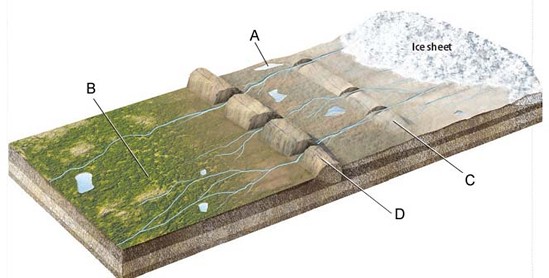
80.
What glacial features are indicated by the labels C and D on the figure?
a)
moraines
b)
outwash plains
c)
kettle lakes
d)
ice sheets
81.
Poorly graded (unsorted) rock material deposited directly by a glacier.
a)
glacial drift
b)
stratified drift
c)
till
d)
glacier
82.
The statement that the oldest layer will be at the bottom in an undisturbed sequence of rock layers is called the Principle of ....
a)
Inclusions
b)
Unconformities
c)
Cross-Cutting Relationships
d)
Superposition
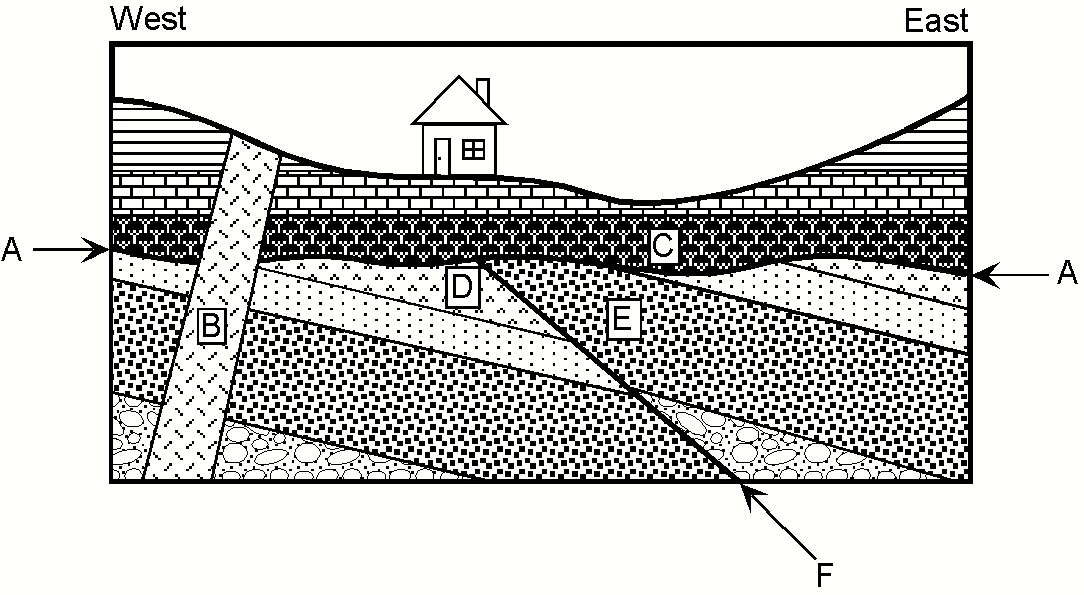
83.
Which of the following correctly lists the layers in order from oldest to youngest?
a)
A, B, C, D, E
b)
E, B, C, D, A
c)
E, D, C, B, A
d)
C, B, A, D, E
84.
Letter "A" is an....
a)
inclusion
b)
intrusion
c)
fault
d)
unconformity 
85.
Letter "F" is a....
a)
inclusion
b)
intrusion
c)
fault
d)
unconformity 
86.
The number of years that have passed since the rock formed is the rock's
a)
relative age
b)
law of superposition
c)
absolute age
d)
index fossil
87.
The ________ states that layers of sediment were originally deposited horizontally under the action of gravity.
a)
law of superposition
b)
law of horizontality 
c)
uniformitarianism 
d)
unconformities
88.
Which of the following is the oldest?
a)
Layer L
b)
Intrusion D
c)
Intrusion H
d)
Layer E
89.
Which fold has younger rock found in the core of the fold?
a)
Syncline
b)
Anticline
90.
A normal fault forms from what kind of forces?
a)
Compression
b)
Tension
c)
Shear Stress
d)
Deformation
91.
Which fault forms from compression forces?
a)
Normal Faults
b)
Reverse Faults
c)
Strike Slip Faults
d)
Transform Fault
92.
Which mountains are commonly formed along continent-continent convergent boundaries?
a)
Volcanic Mountains
b)
Folded Mountains
c)
Fault Block Mountains
93.
What is pyroclastic material?
a)
Lava ejected from volcano during eruption
b)
Hot ash and bits of rock
c)
Hardened pieces of cinders 
d)
Gas escaping active volcano
94.
Volcano with broad base and low slopes
a)
Shield volcano
b)
Cinder Cone volcano
c)
Composite Volcano
95.
Volcano type that tends to eject pyroclastic material during large eruptions
a)
Shield
b)
Cinder Cone
c)
Composite
96.
Hawaii sits atop a
a)
Divergent Boundary
b)
Convergent Boundary
c)
Transform Boundary
d)
Hot Spot
97.
Depression formed when magma chamber drains
a)
Volcanic Crater
b)
Lava plateau
c)
Caldera
d)
Lava Fissure
98.
The tallest mountains on Earth are formed by _______________.
a)
oceanic to continental convergence
b)
ocean to ocean convergence
c)
continental to continental convergence
d)
hot spots
99.
S Waves can move through which of the following?
a)
Gas
b)
Liquid
c)
Solid
d)
All of these
100.
P Waves can move through which of the following?
a)
Gas
b)
Liquid
c)
Solid
d)
All of these
101.
Where is the epicenter located?
a)
A
b)
B
c)
C
d)
There is no epicenter
102.
Where is the focus located?
a)
A
b)
B
c)
C
d)
There is no focus