wayground logo

Free Printable Worksheets

Font size

S
M
L
XL
Worksheets

Semester 2 Review

Total questions: 92

Worksheet time: 1hrs 8mins

Name
Class
Date
1.
Genotype refers to the ...
a)
physical expression of the genes
b)
the possible combination of alleles in a gene
c)
whether an allele is dominant or recessive
d)
how an organism will appear
2.
Squidward has light blue skin, and his genotype for this trait is Bb. Would Squidward be considered a purebred or hybrid for light blue skin?
a)
Purebred
b)
Hybrid
3.
Which of the following is a phenotype?
a)
BB
b)
Bb
c)
bb
d)
Blue eyes
4.
the passing of genetic traits from parent to offspring.
a)
heredity
b)
trait
c)
gene
d)
allele
5.
having two of the same genes for the trait (sometimes called purebred).
a)
homozygous
b)
hetrozygous
c)
protein
d)
chromosome
6.
having two different genes for a trait (sometimes called hybrid).
a)
protein
b)
homozygous
c)
heterozygous
d)
genotype
7.
G = green, g = yellow
The genotype for a yellow plant is...
a)
GG
b)
Gg
c)
gg
d)
all of the choices result in yellow
8.
An allele whose trait only shows up when no dominant allele is present.
a)
hidden allele
b)
dominant allele
c)
recessive allele
d)
present allele
9.
 which is heterozygous ?  
a)
Tt
b)
TT
10.
Which is homozygous ?
a)
Zz
b)
SS
11.
Traits that hide other traits when passed on to offspring are called ____________.
a)
recessive
b)
protectant
c)
powerful
d)
dominant
12.
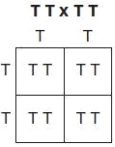
What ratio of the offspring from the cross shown will be homozygous recessive for the  trait of tallness? 
a)
0 in 4
b)
1 in 4
c)
2 in 4
d)
4 in 4
13.
Dominant alleles are represented by a:
a)
Male gene
b)
lowercase letter
c)
recessive trait
d)
capital letter
14.
If a pea plant were homozygous recessive for height, how would its alleles be represented?
a)
TT
b)
Tt
c)
tt
d)
tT
15.
If a trait is recessive, it needs to be inherited from ___ parents to be 'expressed'.
a)
one
b)
both
16.
An organism that needs to eat other organisms to obtain energy is known as a:
a)
Autotroph
b)
Producer
c)
Consumer
d)
Mutualist
17.

What does a food web represent?

a)

All connections of energy flow throughout all organisms in a habitat.

b)

The specific ways that mutualism is carried out.

c)

A single pathway of energy flow between organisms.

d)

How carnivores get their food.

18.
Consumer that eats plants
a)
heterotroph
b)
herbivore
c)
producer
d)
community
19.
What does every food chain start with? (Even if it's not drawn or written there!)
a)
producers
b)
sun
c)
consumer
d)
decomposers
20.
What is the term for each step in the transfer of energy and matter within a biological community?
a)
energy path
b)
food web
c)
trophic level
d)
food pyramid
21.
The amount of energy that usually transfers from one trophic level to the next...
a)
10%
b)
20%
c)
80%
d)
50%
22.
An illustration that uses arrows to show the MANY possible directions in which matter and energy can pass through the organisms in an ecosystem.
a)
Food chain
b)
Food web
c)
Energy Pyramid
d)
Succession Map
23.
The living portions of the ecosystem.
a)
Biotic factors
b)
Abiotic factors
24.
The nonliving aspects of an ecosystem.
a)
Abiotic factors
b)
Biotic factors
25.
A collection of organisms that make up a community as well as all of the nonliving aspects of the environment.
a)
Population
b)
Community
c)
Habitat
d)
Ecosystem
26.
As you move upward, from level to level, in an energy pyramid, energy _____.
a)
increases
b)
decreases
c)
stays the same
d)
increases exponentially
27.
 plants that convert energy from the sun
a)
decomposer
b)
primary consumer
c)
secondary consumer
d)
producer
28.
The science of the environment, its components, and the interactions between these components is called
a)
geology
b)
ecology
c)
biology
d)
physiology
29.
What is made up of all populations in an area?
a)
niche
b)
habitat
c)
community
d)
ecosystem
30.

A close interaction between two or more different species is known as

a)

symbiosis

b)

commensalism

c)

mutualism

d)

botulism

31.
Which of the following organisms are typical decomposers?
a)
grasses and ferns
b)
bacteria and mushrooms
c)
mice and deer
d)
lions and snakes
32.

What is the symbiotic relationship called which one organism is helped and the other organism is neither harmed nor helped?

a)

mutualism

b)

parasitism

c)

commensalism

d)

consumer

33.
What is the symbiotic relationship called in which the organism is helped and the other organism is harmed?
a)
mutualism
b)
parasitism
c)
commensalism
d)
consumer
34.

An organism's specific role in its habitat is called its

a)

consumer

b)

niche

c)

birth right

d)

mutualism

35.

What is an heterotroph?

a)

An organism that can produce its own form of energy (via the Sun)

b)

An organism that consumes only plants for energy

c)

An organism that consumes other organisms for energy

d)

An organism that decomposes other organisms

36.
symbiotic relationship in which both organisms benefit
a)
competition
b)
Mutualism
c)
nitrogen fixation
d)
energy pyramid
37.

Which of the following breaks down organic matter and returns nutrients back to the soil?

a)

Scavengers

b)

Decomposers

c)

Herbivores

d)

Omnivores

38.

An organism that eats both plants and animals is called

a)

herbivore

b)

carnivore

c)

omnivore

d)

cannibal

39.
What is the lowest (most specific) level of the Linnaean system?
a)
Kingdom 
b)
Class
c)
Phylum
d)
Species
40.
A tree is called Quercus alba. Quercus is the...
a)
Kingdom
b)
Phylum
c)
Genus
d)
Species
41.
A tree is called Quercus alba. alba is the...
a)
Kingdom 
b)
Phylum
c)
Genus
d)
Species
42.
The 8 levels of classification, most broad to most specific.
a)
Domain, Genus, Family, Order, Class, Phylum, Kingdom, Species
b)
Domain, Species, Kingdom, Genus, Phylum, Family, Class, Order
c)
Domain, Kingdom, Phylum, Class, Order, Family, Genus, Species
d)
Order, Kingdom, Species, Domain, Phylum, Family, Class, Genus
43.
Scientific names are written using which two levels of classification?
a)
Kingdom phylum
b)
Kingdom class
c)
Species genus
d)
Genus species
44.
What is a species?
a)
A group of organisms that can mate with each other and produce fertile offspring. 
b)
A group of organisms that genetically are very different from each other. 
c)
A group of organisms that can mate, but do not produce offspring.
d)
Indivual organisms that live in the same environment. 
45.
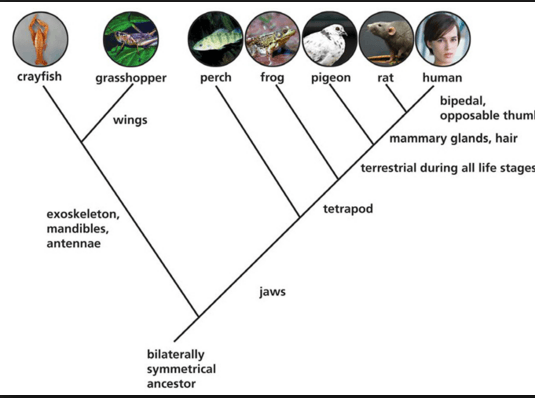
Which trait do only humans have, according to the cladogram?
a)
jaws
b)
mammary glands & hair
c)
terrestrial during all life stages
d)
bipedal & opposable thumbs
46.

Which characteristic separates the animal kingdom into 2 broad categories?

a)

DNA

b)

Backbone

c)

Notochord

d)

Symmetry

47.

What type of symmetry describes an animal that CANNOT be divided into mirror images in any way?

a)

asymmetry

b)

bilateral symmetry

c)

radial symmetry

d)

perfect symmetry

48.

What type of symmetry describes an animal that can be divided into 2 near-mirror images through its central axis in any direction?

a)

asymmetry

b)

bilateral symmetry

c)

radial symmetry

d)

perfect symmetry

49.

What type of symmetry describes an animal that can be divided into two near-mirror images in only one way.

a)

asymmetry

b)

bilateral symmetry

c)

radial symmetry

d)

perfect symmetry

50.

What Phylum has animals with a soft-body, bilateral symmetry, no backbone and a shell? (ex:Oyster)

a)

Porifera

b)

Mollusca

c)

Annelida

d)

Chordata

51.

What Phylum has animals that are asymmetrical with no tissues, organs or organ systems? (ex:sponge)

a)

Cnidaria

b)

Annelida

c)

Porifera

d)

Chordata

52.

What Phylum has animals with no organs, radial symmetry, and nematocysts (stinging cells) for capturing food? (ex:sea anemone)

a)

Nematoda

b)

Platyhelminthes

c)

Arthropoda

d)

Cnidaria

53.

What Phylum has animals with bilateral symmetry, a soft, flattened body, and one digestive opening? (ex:flatworm)

a)

Platyhelminthes

b)

Annelida

c)

Echinodermata

d)

Mollusca

54.

What Phylum has animals with bilateral symmetry, round bodies covered with a cuticle and 2 digestive openings? (ex:round worm)

a)

Annelida

b)

Nematoda

c)

Echinodermata

d)

Cnidaria

55.

What Phylum has bilateral symmetry, a body with segments and 2 digestive openings? (ex:earthworm)

a)

Arthropoda

b)

Mollusca

c)

Annelida

d)

Chordata

56.

What Phylum has bilateral symmetry with segmented bodies, exoskeletons and jointed appendages? (ex:insects)

a)

Arthropoda

b)

Porifera

c)

Cnidaria

d)

Echinodermata

57.

What Phylum has animals with radial symmetry, hard plates in the skin, tube feet and 2 digestive openings? (ex:sea stars)

a)

Echinodermata

b)

Chordata

c)

Mollusca

d)

Arthropoda

58.

What do scientists use to compare animals at the molecular level?

a)

DNA

b)

symmetry

c)

Tissues

d)

Skeletons

59.

What type of animals make up about 95% of all living species on earth?

a)

Vertebrates

b)

Invertebrates

c)

Lizards

d)

Humans

60.

Why isn't it common to see very large land invertebrates?

a)

Lack of support makes it hard for animals to move

b)

They need the vertebrae to breathe

c)

Invertebrates are only found in the ocean

d)

They are there, but are so camouflaged we cannot see them

61.

What is NOT a characteristic of all birds?

a)

hollow bones

b)

skin with feathers and scales

c)

4 chambered heart and beaks

d)

the ability to fly

62.

What is NOT a characteristic that all reptiles have?

a)

Waterproof, scaly skin

b)

Three chambered heart and lungs

c)

Leathery shells on eggs

d)

Arms

63.

What is NOT a characteristic that all fish have?

a)

Gills

b)

Paired fins

c)

Bones

d)

Live in water

64.
2) To which phylum do vertebrates belong?
a)
Arthropoda
b)
Chordata
c)
Porifera
d)
Echinodermata
65.

5) Amphibians are especially sensitive to changes in the environment because

a)

few amphibians have camouflage.

b)

their eggs are tough and leathery.

c)

they do well only in sunny areas.

d)

their skin is delicate and absorbs toxins.

66.

3) How is a reptile egg different from an amphibian egg?

a)

It is covered with protective jelly.

b)

It has a shell and internal membranes.

c)

It must be kept in shallow water.

d)

It does not release carbon dioxide.

67.
Pairs with adenine
a)
thymine
b)
guanine
c)
cytosine
68.
Pairs with cytosine
a)
adenine
b)
thymine
c)
uracil 
d)
guanine
69.
What would the complementary DNA strand to AGCT be....
a)
TTCA
b)
TCGA
c)
AGCT
d)
GTCA
70.
What does DNA stand for?
a)
Ribonucleic Acid
b)
Deoxyribonucleic Acid
c)
Both of these
d)
None of these
71.
What is the structure of DNA?
a)
A single helix
b)
Nitrogen bases
c)
A double helix
d)
It has no structure
72.
Fill in the complementary bases according to the base-pair rule in DNA: A T C C A G
a)
T U G G T C
b)
T A G G T C
c)
T A C G T G
d)
T A C C A C
73.
What holds the two sister chromatids together as they prepare for cell division?
a)
Centromeres
b)
Chromosomes
c)
Centrosomes
d)
Chromatids
74.
What  anchor plants to the ground and absorb water and nutrients?
a)
Roots
b)
Stem
c)
Xylem
d)
Leaves
75.
What is the tissue that is used to transport necessary materials throughout the plant?
a)
Circulatory tissue
b)
Transport tissue
c)
Vascular tissue
d)
Pathway tissue
76.
What is the part of the flower that is brightly colored to attract pollinators?
a)
Petals
b)
Stamen
c)
Pistil
d)
Sepals
77.
What is the male part of the flower?
a)
Petals
b)
Stamen
c)
Pistil
d)
Sepals
78.
What is the female part of the flower?
a)
Petals
b)
Stamen
c)
Pistil
d)
Sepals
79.
What part of the male part of the flower makes pollen?
a)
Ovary
b)
Anther
c)
Filament
d)
Stigma
80.
What part of the female part of the flower gathers pollen?
a)
Ovary
b)
Style
c)
Filament
d)
Stigma
81.
What part of the female part of the flower is a tube that pollen travels through?
a)
Ovary
b)
Style
c)
Filament
d)
Stigma
82.
What part of the female part of the flower is the place that holds the eggs?
a)
Ovary
b)
Style
c)
Filament
d)
Stigma
83.
What is the male reproductive material of plants?
a)
Seeds
b)
Pollen
c)
Fruit
d)
Sepals
84.
What part of the flower turns into the fruit?
a)
Seeds
b)
Ovary
c)
Stamen
d)
Sepals
85.
What organelle in the leaves of plants capture light energy from the sun to complete photosynthesis?
a)
Chloroplasts
b)
Mitochondria
c)
Nucleus
d)
Ribosomes
86.
What is the waxy layer on leaves?
a)
Chloroplasts
b)
Plastic
c)
Wax
d)
Cuticle
87.
What is the function of the cuticle on a leaf?
a)
to keep water from entering the leaf
b)
to keep water from leaving the leaf
c)
to keep bacteria out of the leaf
d)
to keep oxygen in the leaf
88.
What are the openings on the underside of leaves that let carbon dioxide into the leaf and let oxygen out?
a)
Chloroplasts
b)
Stomata
c)
Stomach
d)
Cuticle
89.
What is pollination?
a)
the transfer of pollen from the anther to the stigma
b)
the union of pollen and egg cells in the ovary of the flower
c)
the dispersal of seeds to a new location
d)
the transfer of cash in a business transaction between plants
90.
What is fertilization?
a)
the transfer of pollen from the anther to the stigma
b)
the union of pollen and egg cells in the ovary of the flower
c)
the dispersal of seeds to a new location
d)
the transfer of cash in a business transaction between plants
91.
What helps plants pollinate by carrying pollen from one plant to another?
a)
Mailman
b)
Pollinator
c)
Terminator
d)
Commentator
92.
What is the depositing of seeds in new areas called?
a)
Scattering
b)
Dispersal
c)
Disposal
d)
Pollination