
 Worksheets
Biology STAAR review
Total questions: 91
Worksheet time: 50mins
Name
Class
Date
1.
During the cell cycle, DNA is copied. What type of biomolecule is DNA
a)
nucleic acid
b)
nucleotides
c)
proteins
d)
oxygen
2.
What part of Interphase is DNA copied
a)
The D phase
b)
The S phase
c)
The beginning and the end phase
d)
The inside phase
3.
The cell cycle includes mitosis. What happens during mitosis
a)
Google Chromosomes
b)
chromosomes die
c)
chromosomes multiply
d)
chromosomes divide
4.
What is the name of the process that takes a cell and cuts the number of chromosomes in half
a)
mitosis
b)
osmosis
c)
meiosis
d)
halitosis
5.
Which genotype represents an individual that is heterozygous for two traits?
a)
BB
b)
Aa
c)
AaBb and AaBB
d)
Abcde
6.
What is recombinant DNA?
a)
DNA that is a mix between three types of ogranisms
b)
DNA that has been recombined
c)
DNA that is a mix between two types of organisms
d)
DNA that is locked until you find the combination again
7.
What two things can a karyotype reveal about an individual
a)
Gender and genetic disorders
b)
Gender and hair color
c)
Hair color and genetic disorders
d)
If they like karaoke and gender
8.
What provides the strongest evidence to suggest that all species share a common ancestor?
a)
CSI Miami
b)
cellular evidence
c)
DNA evidence
d)
fossil evidence
9.
What is a fossil?
a)
a preserved specimen from any time
b)
a watch
c)
a dinosaur bone
d)
a preserved specimen from an earlier time
10.
What is an adaptation?
a)
a change in order to better suit the environment
b)
a movie based on a book
c)
a mutation of a body part
d)
a change caused by the environment
11.
Which is not one of the seven levels of classification?
a)
family
b)
race
c)
species
d)
class
12.
Assume that the DNA of an organism contains 20% adenine. What percentage of guanine would be in this DNA?
a)
30%
b)
20%
c)
110%
d)
80%
13.
The making of RNA based on information in the DNA is called?
a)
Transylvania
b)
transcontinental
c)
tranlation
d)
transcription
14.
What is natural selection?
a)
survival of the fastest
b)
survival of the strongest
c)
survival of the fittest
d)
survival of natural disasters
15.
What is the difference between recessive and dominant genes?
a)
recessive causes a recessive hair line
b)
recessive is always hidden
c)
dominant always wins
d)
dominant is always expressed, recessive can be hidden
16.
What type of cells go through meiosis?
a)
sex cells
b)
prison cells
c)
blood cells
d)
cancer cells
17.
Which is not one of the four organic compounds?
a)
lipids
b)
proteins
c)
carbs
d)
calories
18.
What is the function of a carbohydrate?
a)
To provide energy
b)
To provide food
c)
To provide shelter
d)
To provide strength
19.
What is the most commonly used type of carbohydrate?
a)
glucose
b)
sucrose
c)
fructose
d)
high fructose corn syrup
20.
What do enzymes do?
a)
speed up chemical reactions
b)
slow down chemical reactions
c)
create chemical reactions
d)
they don't do anything, they're lazy
21.
What are the two types of transport into a cell?
a)
Passive and Active
b)
Passive and Rectroactive
c)
Deactive and Active
d)
Passive and Aggressive
22.
What structure is selectively permeable in the cell?
a)
the cell membrane
b)
the cell nucleus
c)
the cell wall
d)
the cell tower
23.
What specific type of transport does oxygen and carbon dioxide use to move across the membrane?
a)
diffusion
b)
fission
c)
fusion
d)
refusion
24.
What is the movement of water called?
a)
osmosis
b)
mitosis
c)
meiosis
d)
waves
25.
What is the only group of organisms that is totally single celled?
a)
bacteria
b)
mononucleosis
c)
algea
d)
virus
26.
What is the organelle that produces energy?
a)
mitochondria
b)
midichlorian
c)
The Force
d)
proteins
27.
What is the function of the nucleus?
a)
to control the cell's life activities
b)
to do the thinking
c)
to create nuclear energy
d)
to make nucleic acid
28.
What controls a cell's packaging and shipping?
a)
the golgi apparatus
b)
FedEx
c)
the nucleus
d)
the mail room
29.
Which group of organic compounds do the steroids belong to?
a)
the lipids
b)
the illegal group
c)
the proteins
d)
the carbs
30.
An animal cell does not have a
a)
nucleus
b)
cell wall
c)
mitochondria
d)
golgi apparatus
31.
In osmosis the water moves from____________ to __________.
a)
high to low
b)
low to high
32.
Does passive transport require energy?
a)
Yes
b)
No
33.
What happens during cytokinesis?
a)
DNA replicates
b)
Cytoplasm divides
c)
Spindle fibers appear
d)
Nothing
34.
How many daughter cells does mitosis produce?
a)
2
b)
4
c)
6
d)
8
35.
What is a codon?
a)
RNA
b)
Daughter cell
c)
chromosome
d)
group of 3 base codes
36.
Where does RNA translation take place?
a)
Nucleus
b)
Cytoplasm at the ribosome
c)
In the science lab
d)
Amherst
37.
What are the bases for DNA?
a)
A, U, C, G
b)
A, T, C, G
c)
T, D, I, U
d)
P, M, A, T
38.
In a genetics lab, two heterozygous tall plants are crossed. If tall is dominant over short what are the expected phenotypic results
a)
23% tall, 72% short, 5% average
b)
75% Tall 25% short
c)
75% short 25% tall
d)
0% tall 100% short
39.
What are the genotypes of the parents that would produce 50% short and 50% tall pea plants?
a)
Tt x tt
b)
tt X tt
c)
TT x Tt
d)
TT x TT
40.
What is an organism that breaks down & absorbs dead matter so nutrition can be recycled into the soil?
a)
Consumer
b)
Decomposer
c)
Producers
d)
Scavenger
41.

The rabbit in this food web would be considered a:
a)
Decomposer
b)
Producer
c)
Secondary Consumer
d)
Primary Consumer
42.
What is Mutualism
a)
a relationship in which both species are benefited
b)
a relationship in which neither is benefited
c)
a relationship in which one is benefited
d)
My Dog
43.
Amino acids are joined together in order to form
a)
DNA
b)
ribosomes
c)
proteins
d)
RNA
44.
Any change in the sequence of DNA is...
a)
transgenic shift
b)
Single Genotype
c)
Monohybrid Trait
d)
Mutation
45.
RNA is different from DNA in ___
a)
RNA is single stranded
b)
RNA has uracil
c)
RNA has the sugar ribos
d)
All of these
46.
what does tRNA do?
a)
carry info from genes to ribosomes
b)
carry amino acids to ribosomes
c)
help with RNA splicing
d)
make up ribosomes
47.
The building blocks of DNA & RNA consisting of a five-carbon sugar, a phosphate group, and a nitrogen-containing base.
a)
Genetics
b)
Replication
c)
Nucleotides
48.
How do enzymes function?
a)
They increase the activation energy
b)
They increase the reaction rate
c)
They decrease the reaction rate
d)
They decrease the substrate binding complex
49.
What are the two major organ systems that work to defend the body from injury?
a)
Immune and Endocrine
b)
Integumentary and Nervous
c)
Excretory and Immune
d)
Integumentary and Immune
50.
Which of the following is NOT a characteristic of Meiosis?
a)
Produces diploid cells
b)
Produces unique cell
c)
Two rounds of cell division
d)
Is associated with sexual reproduction
51.
Normal-
AGA-TTC-ATA-GCG
Mutant-
AGA-TTC-AAT-AGC-G
What is the type of mutation that has occurred?
AGA-TTC-ATA-GCG
Mutant-
AGA-TTC-AAT-AGC-G
What is the type of mutation that has occurred?
a)
deletion frameshift
b)
insertion frameshift
c)
substitution
d)
nonsense
52.

This image represents a monomer of which macromolecule?
a)
protein
b)
carbohydrates
c)
lipids
d)
nucleic acids
53.
Members of which kingdom live in unusual conditions such as deep ocean trenches or volcanoes?
a)
Eubacteria
b)
Protista
c)
Fungi
d)
Archaebacteria
54.
6CO2 + 6H20 + light energy -> C6H12O6 + 6O2
In this chemcial equation, the highlight red is called the ______.
In this chemcial equation, the highlight red is called the ______.
a)
product
b)
reactant
c)
yields
d)
production
55.

In the middle of the DNA strand, the bases (ATCG) are held together by what type of bond?
a)
polar bonds
b)
ionic bonds
c)
covalent bonds
d)
hydrogen bonds
56.
When substances enter a cell by going against the gradient, it is called
a)
passive transport
b)
active transport
c)
facilitated diffusion
d)
isotonic interaction
57.
What is the basis for all variation among organisms?
a)
Mutation
b)
Genetic Drift
c)
Migration
d)
Inbreeding
58.
Meiosis has _______ daughter cells.
a)
4
b)
2
c)
1
d)
3
59.
Are viruses living or nonliving?
a)
Nonliving because they cannot reproduce on their own
b)
living because they spread
c)
living because they contain genetic material
d)
nonliving because they do not have genetic material
60.

Which biomolecule is this a picture of?
a)
Protein
b)
Nucleic Acid
c)
Lipid
d)
Carbohydrate
61.

What amino acid is represented by the codon UUA?
a)
Phenylalanine
b)
Tyrosine
c)
Leucine
d)
Stop codon
62.
The process by which all organisms change slowly over time because of slight gene variations is called
a)
natural selection
b)
artificial selection
c)
evolution
d)
gene pool
63.

This diagram shows the cell cycle.
Which of the following activities occur in the S phase?
Which of the following activities occur in the S phase?
a)
Replication of the DNA
b)
Growth of the cell
c)
Formation of the mitotic spindle
d)
Breakdown of the nuclear membrane
64.
A scientist treats a cell with a chemical that destroys the ribosomes. As a result, which cell process will be stopped?
a)
Osmosis
b)
Protein Synthesis
c)
Photosynthesis
d)
Cellular Respiration
65.
Which is the most likely function of a group of cells that contain a high number of chloroplasts?
a)
Respiration
b)
Transpiration
c)
Photosynthesis
d)
Fermentation
66.
What will most likely happen if an appropriate enzyme is added to a chemical reaction?
a)
The reaction rate will increase
b)
The reaction rate will decrease
c)
The reaction will stop
d)
It will explode
67.
Which process is an example of asexual reproduction?
a)
An amoeba divides in half to form two amoebas.
b)
A bee transfers pollen from one flower to another.
c)
A female fish deposits eggs on a rock, then a male fish releases sperm on them.
d)
Earthworms exchange sperm
68.
A researcher is studying a particular disease-causing agent. The agent has a protein coat, but it lacks a nucleus, contains no other organelles, and can reproduce only when it is inside an animal cell. The researcher should classify the agent as which of the following?
a)
A bacterium
b)
A fungus
c)
A virus
d)
A protist
69.

symbiotic relationship in which both organisms benefit
a)
competition
b)
Mutualism
c)
nitrogen fixation
d)
energy pyramid
70.

Some organisms that share a common ancestor have features that have different functions, but similar structures. These are known as
a)
vestigial structures
b)
analogous structures
c)
homologous structures
d)
fossil structures
71.
A father and a son would have identical...
a)
Y chromosomes
b)
X chromosomes
c)
mitochondrial DNA
d)
chromosomal DNA
72.

The DNA codon TAC codes for which amino acid?
a)
Stop
b)
Ile
c)
Met
d)
Val
73.

Place these cells in order of mitosis.
a)
A, B, C, D, E
b)
B, E, D, A, C
c)
C, E, A, D, B
d)
B, D, A, E, C
74.
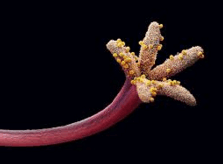
The sticky part of the female flower that catches pollen
a)
pistil
b)
ovary
c)
style
d)
stigma
75.
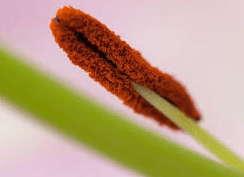
The male part of the flower that produces pollen
a)
Stamen
b)
Ovary
c)
Pedal
d)
Pistil
76.
Stomata
a)
tiny holes in the leaves of a plant that allow gases to enter or leave the plant
b)
living things
c)
a plant part that carries out photosynthesis to make food for the plant
d)
the process in which plants use energy from the sun to make their own food
77.
The Xylem in plants transport what throughout the plant?
a)
Sunlight
b)
Oxygen
c)
Blood
d)
Water
78.
An organism that produces its own food supply from inorganic compounds is called a(an)
a)
heterotroph
b)
consumer
c)
detritivore
d)
autotroph
79.
What is the term for each step in the transfer of energy and matter within a biological community?
a)
energy path
b)
food web
c)
trophic level
d)
food pyramid
80.
Which of the following would be the definition of a detritivore?
a)
Animals that eat insects.
b)
Organisms that feed on rocks, recycling the nutrients back into the ground.
c)
Organisms that eat only pants
d)
Things that feed on dead organisms, recycling the nutrients back into the ground.
81.
An illustration that uses arrows to show the many possible directions in which matter and energy can pass through the organisms in an ecosystem.
a)
Food chain
b)
Food web
c)
Energy Pyramid
d)
Succession Map
82.
The nonliving aspects of an ecosystem.
a)
Abiotic factors
b)
Biotic factors
83.
The living portions of the ecosystem.
a)
Biotic factors
b)
Abiotic factors
84.
The general name for organisms like animals and fungi that get their energy from eating other organisms.
a)
Producers
b)
Consumers
c)
Detritivores
d)
Carnivores
85.
Cellular Respiration occurs in which organelle?
a)
Nucleus
b)
Vacuole
c)
Chloroplast
d)
Mitochondria
86.
Which is product of photosynthesis?
a)
carbon dioxide
b)
water
c)
glucose
d)
sunlight
87.
When the same amount of energy that goes into a reaction is the same amount of energy that comes out, this is called?
a)
The Law of Conservation of Energy
b)
The Law of Conservation of Mass
c)
Law of Motion
d)
Law of Gravity
88.
Are plant cells able to carry out cellular respiration?
a)
Yes
b)
No
89.
Which is NOT a product of cellular respiration?
a)
water
b)
carbon dioxide
c)
oxygen
d)
chemical energy
90.
Photosynthesis occurs in which organelle?
a)
Nucleus
b)
Vacuole
c)
Chloroplast
d)
Mitochondria
91.
Mitosis has _______ daughter cells.
a)
4
b)
2
c)
1
d)
3
100 %

