wayground logo

Free Printable Worksheets

NEW

Font size

S
M
L
XL
Worksheets

Anatomy- Nervous system

Total questions: 73

Worksheet time: 3615secs

Name
Class
Date
1.
What two things are found in the central nervous system?
a)
brain/spinal cord
b)
spinal cord/motor neurons
c)
motor/sensory neurons
d)
only brain
2.
Which part of a neuron RECIEVES information?
a)
axon
b)
dendrite
c)
cell body
d)
axon terminal
3.
Which part of the neuron is a long fiber that send information to other cells?
a)
dendrite
b)
terminal
c)
cell body
d)
axon
4.
What are specialized nerve endings that detect change inside and outside the body?
a)
interneurons
b)
receptors
c)
motor neurons
d)
reflex arc
5.
Which of the TWO nervous systems contains motor and sensory neurons?
a)
central nervous system
b)
peripheral
c)
motor
d)
sensory
6.
The impulse changes to _______________ as it moves ACROSS the synapse to other neurons.
a)
electrical
b)
chemical
c)
it stays the same
d)
liquid
7.
If I step on a nail...what type of neuron take that signal TO the CENTRAL NERVOUS SYSTEM?
a)
interneurons
b)
motor
c)
sensory 
d)
receptors
8.
If I step on a nail...what type of neurons take the response to my muscles?
a)
motor
b)
interneurons
c)
sensory
d)
not neurons, muscle tissue sends the response
9.
Where in your body can you find nerve cells?
a)
brain
b)
spinal cord
c)
neurons
d)
everywhere
10.
Which process is goverened by the autonomic nervous system?
a)
writing
b)
chewing
c)
running
d)
digesting food
11.
The nervous system is composed of the ___, ___, and ___.
a)
heart, brain, kidneys
b)
lungs, liver, stomach
c)
brain, spinal cord, nerves
d)
eyes, pancreas, veins
12.
Major function of the nervous system
a)
movement
b)
sensation
c)
thought
d)
all of these
13.
The nerves in your fingertips are part of the ___ nervous system
a)
central
b)
peripheral
c)
internal
d)
cardiovascular
14.
Neurons send signals in the brain and body via...
a)
neurotransmitters only
b)
electrical impulses only
c)
wifi
d)
neurotransmitters AND electrical signals
15.
This portion of a neuron allows the electrical signal to move very quickly
a)
Dendrites
b)
myelin sheath
c)
nucleus
d)
axon terminals
16.
Motor neurons are involved with
a)
all 5 senses
b)
all movement
c)
involuntary movement only
d)
voluntary movement only
17.
Involuntary motor neurons have these two responses:
a)
Sympathetic and parasympathetic
b)
Fast and slow
c)
automatic and manual
d)
Sympathetic and sleeping
18.
This involuntary response is also known as "fight or flight"
a)
Sympathetic
b)
Parasympathetic
c)
Slow
d)
Sensory
19.
This involuntary response occurs during high stress and usually begins with a surge of adrenaline.
a)
Sympathetic
b)
Parasympathetic
c)
Slow
d)
Sensory
20.
This involuntary response occurs AFTER a period high stress and causes body to calm down
a)
Sympathetic
b)
Parasympathetic
c)
Slow
d)
Sensory
21.
Which of the following would be part of the parasympathetic response?
a)
Increased heart rate
b)
Decreased heart rate
c)
Energy diverted to muscles
d)
Dilated pupils
22.
The long, fiber like part of a neuron which the cell sends information to receiving neurons
a)
axon 
b)
dendrite
c)
axon terminal
d)
gene
23.
This releases neurotransmitters which are sent into the synaptic cleft for receptors on the dendrite to taste
a)
axon
b)
axon terminal
c)
gene
d)
neuron
24.
A network of branches coming from individual cells.  They carry information and electrical signals in the brain and nervous system
a)
axon
b)
axon terminal
c)
dendrite
d)
neuron
25.
A nerve cell that is the basic working unit of the brain and nervous system which processes and transmits information
a)
axon
b)
neuron
c)
dendrite
d)
neurotransmitter
26.
This insulating material forms a layer, around the axon of a neuron.  It enables electrical signals to travel down the axon at higher speeds.
a)
neuron
b)
myelin sheath
c)
dendrite
d)
neurotransmitter
27.
A chemical produced by neurons that carries messages to other neurons
a)
myelin sheath
b)
neurotransmitter
c)
axon
d)
axon terminal
28.
The tiny gap between neurons where nerve impulses are sent from one neuron to another.  It is where communication occurs between an axon and dendrite
a)
synapse
b)
axon terminal
c)
impulse
d)
myelin
29.

At resting potential, the ion distribution inside and outside of a neuron is such that __________ ions are most abundant on the outside of the cell, while __________ ions are most abundant on the inside of the cell.

a)

Potassium; sodium

b)

Sodium; potassium

c)

Calcium; potassium

d)

Calcium; sodium

30.

In the figure above, what is occurring at step #4?

a)

Neuron receives enough stimulation (15 mV), threshold is reached (-55mV)

b)

Na+ voltage channels open allowing Na+ to diffuse inward, depolarizing the membrane

c)

K+ voltage channels open and Na+ voltage channels open

d)

K+ voltage channels open allowing K+ to diffuse out, repolarizing the membrane.

e)

Hamsters. Massive amounts of hamsters

31.
These connect Sensory and Motor Neurons to each other and are located in the brain and spinal cord
a)
Sensory Neurons
b)
Motor Neurons
c)
Interneurons
d)
Afferent Neurons
32.
What is structure labeled C in the picture?
a)
Dendrite
b)
Axon
c)
Cell Body
d)
Axon Terminal
33.
What is structure labeled B in the picture?
a)
Dendrite
b)
Axon
c)
Cell Body
d)
Axon Terminal
34.
What is structure labeled D in the picture?
a)
Dendrite
b)
Axon
c)
Cell Body
d)
Axon Terminal
35.

what process do neurons use to communicate

a)

text messenger

b)

electrochemical

c)

skype

d)

mechanical

36.

What are the 4 main parts of the neuron?

a)

synapse, dendrites, nucleus, axon

b)

soma, nucleus, axon, dendrites

c)

axon terminal, synapse, nucleus, dendrites

d)

dendrites, synapses, myelin, nucleus
37.
nerve impulse
a)
action potential
b)
resting potential
c)
membrane potential
d)
synapse
38.
What number(s) on the graph represents the Resting Potential?
a)
1 and 2
b)
1 and 5
c)
2 and 3
d)
3 and 4
39.
When a neuron is depolarized, what are the first channels to open?
a)
Sodium
b)
Potassium
c)
Calcium
d)
ACTH
40.
what initiates the action potential?
a)
A neurotransmitter sends the signal to the cell
b)
A chemical message reaches the cell
41.
When a membrane potential reaches +30mV, ________ channels open, ________ occurs, and ________ channels close.
a)
Sodium, depolarization, potassium
b)
Potassium, depoloarization, sodium
c)
sodium, repolarization, potassium
d)
postassium, repolarization, sodium
42.
a signal molecule that transmits nerve impulses across synapses
a)
neuron
b)
neurotransmitter
c)
nerve
d)
action potential
43.
a junction at which a neuron meets another cell
a)
axon
b)
dendrites
c)
myelin sheath
d)
synapse
44.
Neural transmission across a synaptic cleft is accomplished by: 
a)
the movement of sodium & potassium from the presynaptic neuron to the postsynaptic neuron.
b)
impulses traveling as electrical currents across the gap. 
c)
impulses causing the release  of a neurotransmitter signal and its diffusion across the gap.
d)
impulses ricocheting back and forth across the gap.
45.
Heroin mimics the effects of this neurotransmitter.
a)
Dopamine
b)
Serotonin 
c)
Endorphin
d)
Norepinephrine 
46.
The reward center of the brain is most closely associated with this neurotransmitter's pathways.
a)
Dopamine
b)
Serotonin
c)
GABA
d)
Ach
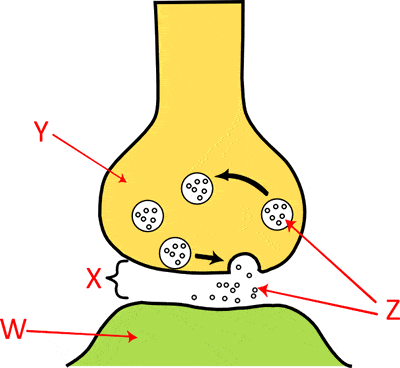
47.
W
a)
Axon Terminal Button
b)
Neurotransmitters
c)
Dendrite
d)
Synapse
48.
X
a)
Axon Terminal Button
b)
Neurotransmitters
c)
Dendrite
d)
Synapse
49.
Y
a)
Axon Terminal Button
b)
Neurotransmitters
c)
Dendrite
d)
Synapse
50.
Multiple sclerosis is an autoimmune disease in which the body's own immune system destroys the _____________ of the nerve axons. 
a)
Myelin
b)
Dendrites
c)
Axon Terminal
d)
Nodes of Ranvier
51.
The brain's supporting cells are called: 
a)
glial cells
b)
mitochondria
c)
neurons
d)
nuclei
52.
Neurotransmitters can have an excitatory or inhibitory effect on the receiving cell.
a)
True
b)
False
53.
The final step in communication between nerves at a synapse is:
a)
Release of the neurotransmitter
b)
Removal of the neurotransmitter
c)
Influx of calcium
d)
Removal of endorphins
54.
Cocaine and Amphetamines elevate activity at WHICH synapses?
a)
Serotonin and Dopamine
b)
Dopamine and Norepinephrine
c)
GABA and Serotonin
d)
GABA and Dopamine
55.
An oversupply with opiate drugs can suppress the body's natural supply of this neurotransmitter.
a)
Acetylcholine
b)
GABA
c)
Endorphins
d)
Glutamate
56.
This neurotransmitter is similar to cocaine.
a)
Serotonin
b)
Dopamine
c)
Acetylcholine
d)
Glutamate
57.
This neurotransmitter is similar to LSD and ecstasy.
a)
Serotonin
b)
Dopamine
c)
Acetylcholine
d)
GABA
58.
Which neurotransmitter is responsible for  mood and well-being (low levels linked to depression)? 
a)
serotonin
b)
dopamine
c)
Gamma  Aminobutyric Acid (GABA)
d)
glutamate
59.
Which of these is most closely related to metabolism, stress and excitement? 
a)
epinephrine 
b)
norepinepherine
c)
acetylcholine (ACh)
d)
glutamate
60.
Neurotransmitters are released from the
a)
Dendrites
b)
Post-synaptic neuron
c)
Presynaptic neuron
d)
Axon
61.
Excess neurotransmitters in the synapse that goes back into the presynaptic neuron.
a)
Resting potential
b)
Reuptake
c)
Retroactivity
d)
Repolarization
62.
What do you call it when two neurons communicate through neurotransmitters?
a)
Hormones
b)
Synapse
c)
Cholesterol
d)
Monty
63.
Thinking, problem solving, "executive functioning," happen here. 
a)
cerebellum
b)
cerebrum
c)
amygdala
d)
hypothalamus
64.
Carries messages between the body and the brain:
a)
cerebellum
b)
corpus callosum
c)
spinal cord
d)
special thalamus
65.
Known as the "Little brain" and is in charge of balance and coordinating movements:
a)
Thalamus
b)
Reticular Formation
c)
Hypothalamus
d)
Cerebellum
66.
Which letter on the illustration represents the frontal lobe
a)
A
b)
B
c)
C
d)
D
67.
Which letter on the illustration represents the temporal lobe
a)
A
b)
B
c)
C
d)
D
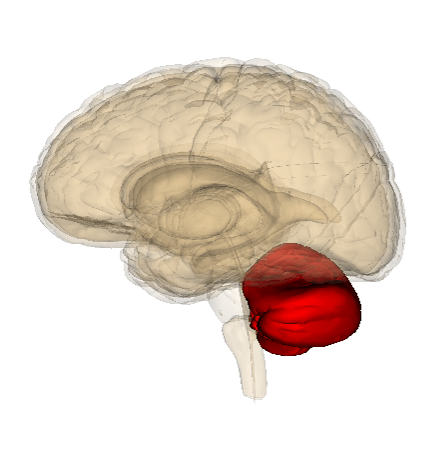
68.
The red portion is the ________
a)
Cerebrum
b)
Cerebellum
c)
Brain Stem
d)
Diencephalon
69.
Controls motivational behaviors, including: feeding, fight-flight response
a)
Hippocampus
b)
Amygdala
c)
Reticular Formation
d)
Hypothalamus
70.
The cerebellum is labeled
a)
1
b)
4
c)
5
d)
7
71.
Lobe of cerebrum that processes vision
a)
Occipital
b)
Frontal
c)
Temporal
d)
Parietal
72.
Lobe that deals with learning and movement
a)
Frontal
b)
Parietal
c)
Occipital
d)
Temporal
73.
Controls vital functions such as breathing and heart rate
a)
Diencephalon
b)
Frontal Lobe
c)
Brain Stem
d)
Cerebellum