

wayground logo

Free Printable Worksheets

Font size

S
M
L
XL
Worksheets

FINAL Exam Review - Corson

Total questions: 96

Worksheet time: 2hrs 31mins

Name
Class
Date
1.
This organelle takes food and turns it into ENERGY for plant and animal cells.
Este orgánulo toma alimento y lo convierte en ENERGÍA para células plantas y animales.
a)
Chloroplast 
b)
Mitochondria
c)
Lysosome
d)
Ribosome
2.
Where photosynthesis takes place inside the cell
Donde la fotosíntesis tiene lugar en la célula
a)
ribosome
b)
mitochondria
c)
chloroplast
d)
nucleus
3.
The ___________ is the basic unit of life
El ____________es la unidad basica de la vida
a)
organ
b)
cell
c)
atom
d)
tissue
4.
When many organ systems work together it can form...
Cuando muchos sistemas de órganos trabajan juntos, puede formar ...
a)
organ
b)
cells
c)
organ system
d)
organism 
5.
This is a example of ........ 
Este es un ejemplo de ........
a)
cell
b)
organ system
c)
organ
d)
tissue
6.
Which organelle is only found in a plant cell?
¿Qué organelo solo se encuentra en una célula vegetal?
a)
nucleus
b)
chloroplast
c)
mitochondria
d)
cell membrane
7.
Directs all cell activities through the DNA located there. 
Dirige todas las actividades celulares a través del ADN ubicado allí.
a)
Lysosomes
b)
Nucleus
c)
ribosomes
d)
Mitochondria
8.
Which part of the cell is often called "the brain of the cell"?
¿Qué parte de la célula a menudo se llama "el cerebro de la célula"?
a)
nuclear membrane
b)
endoplasmic reticulum
c)
nucleus
d)
mitochondria
9.
Where are proteins made? 
¿Dónde se hacen las proteínas?
a)
Golgi body
b)
Mitoichondria
c)
Chromosomes
d)
Ribosomes
10.
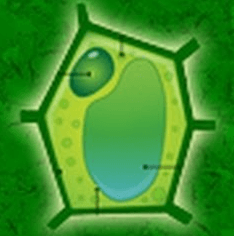
What is found in both plant and animal cells but is much larger in plant cells? 
¿Qué se encuentra en las células plantas y animales, pero es mucho más grande en las células v?
a)
Nucleus
b)
Mitochondria
c)
Chloroplast
d)
Vacuole
11.
A rigid layer that lies outside the cell's  membrane is... 
Una capa rígida que se encuentra fuera de la membrana de la célula es ...
a)
Cytoskeleton
b)
Cilia
c)
Cell Wall
d)
Flagella
12.
 A group of cells that have similar functions? 
¿Un grupo de celdas que tienen funciones similares?
a)
cells
b)
tissues
c)
organs
d)
atoms
13.
Organs that work together to perform a related function is called _____________?
a)
cells
b)
tissues 
c)
organ system
d)
organs
14.
B = brown fur  b = white fur
In the punnett square, what is the probability for white fur? 
a)
0%
b)
25%
c)
50%
d)
75%
15.
In the punnett square shown, what must the genotype of the missing parent be?
a)
BB
b)
Bb
c)
bb
d)
Tt
16.
T - tall and t = short
In the punnett square below, what belongs in the missing square
a)
tt
b)
Tt
c)
Bb
d)
TT
17.
Which is an example of a GENOTYPE?
a)
BB
b)
Blonde Hair
c)
Trait
d)
Adaptation
18.
HH crossed with Hh. What is the probability of hh?
a)
0%
b)
25%
c)
50%
d)
100%
19.
Purple (P) is dominant to the white (p).
According to the Punnett Square, what is the probability of an offspring being purple?
a)
25%
b)
0%
c)
100%
d)
50%
20.
What stays the same in an investigation?
a)
Control
b)
Constant
c)
Independent
d)
Dependent
21.
The variable that you measure is the -
a)
Independent Variable
b)
Dependent Variable
c)
Controlled Variable
d)
Repeated Trial
22.
A cell WITH a nucleus
a)
Eukaryote
b)
Prokaryote
23.
What does the genotype rr mean?
a)
2 recessive alleles
b)
1 recessive allele, 1 dominant allele
c)
2 dominant alleles
d)
1 recessive allele
24.

Where does gas exchange in the lungs occur?

a)

Heart

b)

Alveoli

c)

Stomach

d)

In the air

25.

Which systems are part of the excretory system?

a)

Respiratory, Circulatory, Urinary

b)

Respiratory, Circulatory, Integumentary

c)

Respiratory, Integumentary, Urinary

d)

Respiratory, Integumentary, Nervous

26.

What is the function of the respiratory system?

a)

Take in O2 and remove CO2

b)

Take in CO2 and remove O2

c)

Transfer of urine

d)

Circulate blood throughout body

27.

What is the function of the kidneys?

a)

Filter food to remove waste

b)

Filter blood to remove waste

c)

Produce bile

d)

Store waste until ready to be removed

28.

What does the model represent?

a)

Pumping of blood

b)

Flow of urine

c)

Taking in O2 and release CO2

d)

Movement of bones

29.

When pulling down on the elastic membrane this represents...

a)

Exhaling

b)

Inhaling

30.

What does the elastic membrane represent?

a)

Diaphragm

b)

Stomach

c)

Lungs

d)

Heart

31.

A group of tissues that work together are called?

a)

Cells

b)

Organ system

c)

Organ

d)

Organism

32.

What is one function of the integumentary system?

a)

Remove urine

b)

Take in O2

c)

Maintain body temperature

d)

Pump blood

33.

What is an organ that is included in the circulatory system?

a)

Liver

b)

Kidneys

c)

Heart

d)

Stomach

34.

What bone is highlighted?

a)

Skull (Cranium)

b)

Mandible

c)

Clavicle

d)

Scapula

35.
attaches bone to bone
a)
tendon
b)
ligament 
36.
attaches muscle to bone 
a)
tendon
b)
ligament 
37.
our hip joint would be considered which type of joint?
a)
hinge
b)
ball and socket
c)
ball 
d)
fixed 
38.
What is the place where two bones meet?
a)
hinge
b)
bone
c)
spot
d)
joint
39.
What is the name for the connector that attaches muscle to bone?
a)
ligament
b)
tendon
c)
patella
d)
string
40.
What do the bones create?
a)
white blood cells
b)
platlets
c)
red blood cells
d)
flying turkeys
41.
Which muscle type is found in your stomach, bladder, and intestines?
a)
Skeletal
b)
Smooth
c)
Cardiac
d)
Straight
42.
Which muscle type is found in your stomach, bladder, and intestines?
a)
Skeletal
b)
Smooth
c)
Cardiac
d)
Straight
43.
Which type of muscle is found in your heart?
a)
Skeletal
b)
Smooth
c)
Cardiac
d)
Straight
44.
Which muscles are involuntary?
a)
skeletal
b)
cardiac
c)
smooth
d)
smooth and cardiac
45.
When a muscle contracts, it _______
a)
gets longer
b)
gets shorter
c)
gets thinner
d)
grows hair
46.
Which types of muscle tissue are voluntary?
a)
Cardiac
b)
Skeletal
c)
Smooth
d)
Cardiac and Smooth
47.
Skeletal muscles are attached to the _________.
a)
Stomach
b)
Lungs
c)
Bones
d)
Involuntary Muscles
48.
Muscles always work in _____
a)
pairs
b)
groups of 3
c)
bones
d)
joints
49.
attaches bone to bone
a)
tendon
b)
ligament 
50.
The Skeletal System does what?
a)
Support your body
b)
Help your body move with muscles
c)
all of the above
d)
protect your organs
51.
The chewing and grinding of food into smaller pieces is an example of...
a)
Mechanical Digestion
b)
Chemical Digestion
52.
Bile is made by which digestive organ?
a)
Gallbladder
b)
Stomach
c)
Rectum
d)
Liver
53.
Nutrients from digested food are absorbed in which digestive organ?
a)
Small Intestine
b)
Stomach
c)
Large Intestine
d)
Gallbladder
54.
Number 4 is pointing to the....
a)
Anus
b)
Rectum
c)
Large Intestine
d)
Small intestine
55.
Which organ pushes food down to the stomach?
a)
Mouth
b)
Esophagus
c)
Rectum
d)
Large intestine
56.
As waste moves through the digestive system, the ______ absorbs water before storing waste in the rectum.
a)
Small intestine
b)
Stomach
c)
Esophagus
d)
Large intestine
57.
A short tube at the end of the large intestine that stores solid waste is the...
a)
Anus
b)
Rectum
58.
Which is NOT a function of the Digestive System?
a)
To rid the body of solid waste
b)
Absorb nutrients for energy & growth
c)
Break down nutrients from food
d)
Pump blood around the body
59.
The opening at the end of the digestive system where solid waste comes out is the...
a)
rectum
b)
anus
c)
mouth
d)
large intestine
60.
Most chemical digestion takes place in which organ?
a)
Stomach
b)
Small intestine
c)
Rectum
d)
Esophagus
61.
Number 7 is pointing to...
a)
Mouth
b)
Esophagus
c)
Small intestine
d)
rectum
62.
Number 8 is pointing to the...
a)
small intestine
b)
stomach
c)
anus
d)
rectum
63.
The body system that breaks down food into tiny pieces so that the body’s cells can use it for energy.
a)
Digestive System
b)
Skeletal System
c)
Nervous System
d)
Circulatory System
64.
A muscular tube that helps move food from the mouth to the stomach.
a)
esophagus
b)
mouth
c)
intestine
d)
anus
65.
A muscular organ in the body where chemical and mechanical digestion take place.
a)
Esophagus 
b)
Anus
c)
Stomach
d)
Intestine 
66.
What is the path of the digestive system?
a)
Mouth, Esophagus, Stomach, Small Intestines, Large Intestines, Anus
b)
Anus, Esophagus, Stomach, Large Intestine, Small Intestine, Mouth
c)
Mouth, Esophagus, Small Intestine, Stomach, Large Intestine, Anus
d)
Mouth, Esophagus, Stomach, Large Intestine, Small Intestine, Anus
67.

The circulatory system works with the digestive system by carrying large chunks of food to each cell.

a)

True

b)

False

68.
The brain is part of the ____ nervous system.
a)
central
b)
peripheral
c)
motor
d)
internal
69.
Two major branches of the nervous system
a)
central and peripheral
b)
peripheral and motor
c)
motor and sensory
d)
central and motor
70.
Motor neurons are involved with
a)
all 5 senses
b)
all movement
c)
involuntary movement only
d)
voluntary movement only
71.
An example of involuntary movement would be:
a)
heart beating
b)
walking
c)
talking
d)
wiggling toes
72.
An example of voluntary movement would be:
a)
smiling
b)
heart beat
c)
digestion
d)
breathing 
73.
The ________ is a rope-like bundle of nerves. It is also the main pathway for information.
a)
Nerves
b)
Spinal Cord
c)
Brain
74.
The nervous system is composed of the ___, ___, and ___.
a)
heart, brain, kidneys
b)
lungs, liver, stomach
c)
brain, spinal cord, nerves
d)
eyes, pancreas, veins
75.
The bony structure that protects the brain.
a)
Back bone 
b)
Teeth 
c)
Skull
d)
Helmet 
76.
What is the function of the nervous system?
a)
Transport nutrients around the body
b)
Send and receive messages to respond to a change in an organisms environment
c)
Brings oxygen into the body
d)
Moves body parts
77.
Which part of the body is like a highway for sending messages?
a)
Blood
b)
Spinal Cord
c)
Atrium
d)
Ventricle
78.
The cerebrum is part of the nervous system.
a)
True
b)
False
79.
The trachea is part of the nervous system.
a)
True
b)
False
80.
The manager of the body systems. Communicates bodily functions.
a)
integumentary
b)
resperatory
c)
circulatory
d)
nervous
81.
Which of the following describes the relationship between sensory neurons and motor neurons?
a)
Motor neurons bring a stimulus input to the brain and sensory neurons carry a movement output. 
b)
Sensory neurons tell motor neurons what to do.
c)
Sensory neurons bring a stimulius input to the spinal cord or brain and the brain or spinal cord sends a motor neuron  response.
d)
Sensory neurons do more than motor neurons
82.
Brain cells are called
a)
hemoglobin
b)
neurons
c)
brainpoppers
d)
alveoli
83.

Your brain is like a muscle, the more you exercise it, the better it performs.

a)

True

b)

False

84.
I am the father of Genetics
a)
Arnold
b)
Gregor Mendel
c)
Albert Einstein
d)
Regional Punnett
85.
Trait that helps an organism survive in its environment.
a)
Adaptation
b)
Survival
c)
Misery
d)
No way
86.
In a pair of alleles, the one that, if present determines the trait.
a)
Dominant
b)
Recessive
c)
Minimal
d)
Display
87.
The set of alleles an organism has for a trait. (Gg)
a)
Genetics
b)
Heredity
c)
Allele
d)
Phenotype
88.
Any single feature of an organism.
a)
Genetics
b)
Dominant
c)
Recessive
d)
Trait
89.
The hiding or disguising of something by changing the way it looks.
a)
Adaptation
b)
Camouflage
c)
Natural Selection
d)
Dissappear
90.
A continuation of life despite difficult conditions.
a)
Survival
b)
Natural Selection
c)
Continuity
d)
Salvation
91.
In a pair of alleles, the one that is masked/hidden when a dominant allele is present.
a)
Dominant
b)
Homozygous
c)
Recessive
d)
Heterozygous
92.
The physical appearance the trait takes on. (green eyes)
a)
Genotype
b)
Phenotype
c)
Heredity
d)
Genetics
93.
One of a pair of genes that determine a specific trait.
a)
Genotype
b)
Allele
c)
Phenotype
d)
Trait
94.

Reproduction involving one parent.

a)

Sexual

b)

Asexual

c)

Homozygous

d)

Heterozygous

95.
The transfer of pollen from the male part of a plant to the female part of a plant.
a)
Abdication
b)
Domination
c)
Justification
d)
Pollination
96.
Describes an organism with two different alleles for a trait. (Bb)
a)
Homozygous
b)
Heterozygous
c)
Sexual
d)
Asexual
