
 Worksheets
Entry-Level Survey: Chemical Interactions
Total questions: 93
Worksheet time: 47hrs 30mins
If you keep cutting a bar of pure gold in half, you cannot divide it forever and still have a piece of gold. Why?
Because eventually you will reach atoms, which cannot be divided further and still be gold.
Because gold will turn into another element after many cuts.
Because the gold will disappear after a certain number of cuts.
Because the gold will become liquid after many cuts.
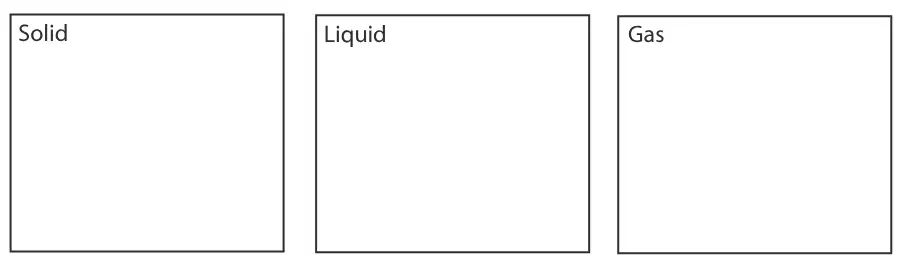
How do particles in a sample of matter interact when the sample is in a different state (solid, liquid, and gas)? Add drawings to help explain your answer.
In solids, particles are tightly packed and vibrate in place; in liquids, they are close but can move past each other; in gases, they are far apart and move freely.
In solids, particles are far apart and move freely; in liquids, they are tightly packed and vibrate in place; in gases, they are close but can move past each other.
In all states, particles are equally spaced and do not move.
In solids, particles are close but can move past each other; in liquids, they are far apart and move freely; in gases, they are tightly packed and vibrate in place.
Energy is transferred through the system to heat the water in the pot on the stove by:
Conduction from the stove to the pot, then to the water
Radiation directly from the stove to the water
Convection from the air to the water
Evaporation from the pot to the stove
As the temperature increased, what happened to the water particles?
The water particles moved faster and spread further apart.
The water particles moved slower and came closer together.
The water particles stopped moving completely.
The water particles changed into solid form.
When water in a pot begins to bubble and steam rises, does this indicate a chemical reaction has occurred?
No, bubbling and steam indicate a physical change, not a chemical reaction.
Yes, bubbling always means a chemical reaction is happening.
Yes, because water is turning into a new substance.
No, because water cannot change at all.
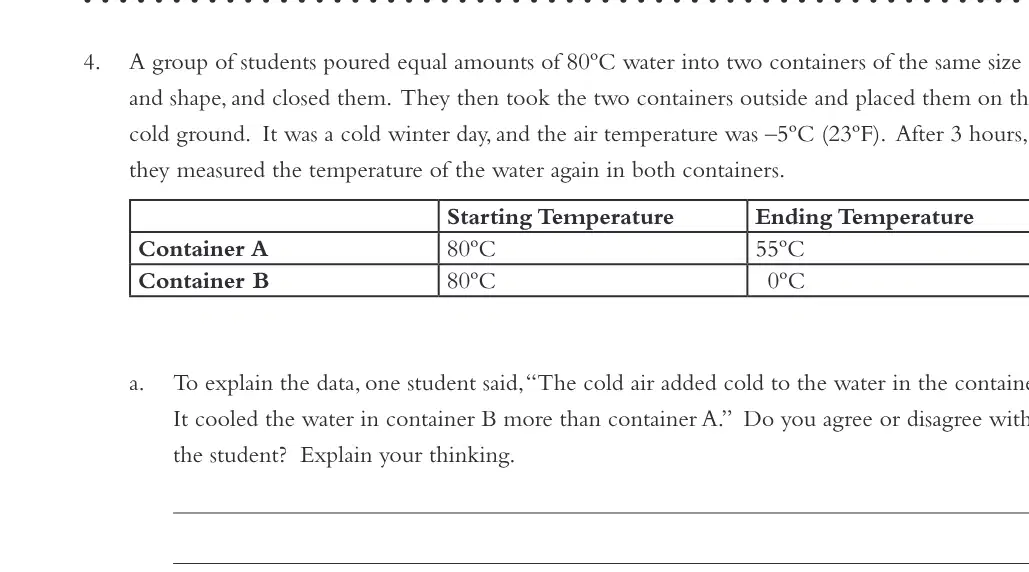
A group of students poured equal amounts of 80°C water into two containers of the same size and shape, and closed them. They then took the two containers outside and placed them on the cold ground. It was a cold winter day, and the air temperature was –5°C (23°F). After 3 hours, they measured the temperature of the water again in both containers.
Starting Temperature | Ending Temperature
Container A: 80°C | 55°C
Container B: 80°C | 0°C
Do you agree or disagree with the statement: “The cold air added cold to the water in the containers. It cooled the water in container B more than container A.”?
I disagree, because cold is not added; heat is lost from the water to the surroundings.
I agree, because cold air can add cold to water and cool it faster.
I agree, because container B was exposed to more cold air than container A.
I disagree, because the containers were not closed properly.
What could explain why the final water temperatures were different in the two containers?
The containers were made of different materials.
The containers had the same insulation.
Both containers were exposed to the same amount of heat.
The initial water temperatures were identical.
Identify which scenarios are chemical reactions. Write Y (yes) next to each statement that describes a chemical reaction; write N (no) next to each statement that does not describe a chemical reaction. A student mixes a clear liquid and a pink solid. The solid disappears, and the solution becomes pink. There is no temperature change.
N
Y
Y (yes)
N (no)
Two room-temperature substances are mixed together, and the mixture becomes cold.
Y
N
Maybe
Cannot be determined
Identify which scenarios are chemical reactions. Write Y (yes) next to each statement that describes a chemical reaction; write N (no) next to each statement that does not describe a chemical reaction. A student leaves a clear liquid substance out on the counter. In the morning, only a white solid remains.
Y
N
Maybe
Cannot be determined
Identify which scenarios are chemical reactions. Write Y (yes) next to each statement that describes a chemical reaction; write N (no) next to each statement that does not describe a chemical reaction. When pressure is released by opening a soda can, the liquid inside begins to bubble.
N
Y
Y (yes)
N (no)
Identify which scenarios are chemical reactions. Write Y (yes) next to each statement that describes a chemical reaction; write N (no) next to each statement that does not describe a chemical reaction. A student bends a glow stick to mix materials, and it produces light.
Y
N
Maybe
Cannot tell
Identify which scenarios are chemical reactions. Write Y (yes) next to each statement that describes a chemical reaction; write N (no) next to each statement that does not describe a chemical reaction. Thermal energy is added to a liquid substance until it bubbles and turns into a gas.
N
Y
Y (yes)
N (no)
The diagrams below show possible chemical reactions. The different-shaded circles represent different kinds of atoms. When circles are touching, that indicates that those atoms form a molecule. Write Y (yes) next to each representation of a possible chemical reaction; write N (no) next to each representation that is NOT a possible chemical reaction. ●● + ○○ → ○○ + ●●
N
Y
Both Y and N
None of the above
The diagrams below show possible chemical reactions. The different-shaded circles represent different kinds of atoms. When circles are touching, that indicates that those atoms form a molecule. Write Y (yes) next to each representation of a possible chemical reaction; write N (no) next to each representation that is NOT a possible chemical reaction. ●● + ○○ → ○○ + ○○ + ●● What should be written next to this representation?
N
Y
Both Y and N
Cannot be determined
The diagrams below show possible chemical reactions. The different-shaded circles represent different kinds of atoms. When circles are touching, that indicates that those atoms form a molecule. Write Y (yes) next to each representation of a possible chemical reaction; write N (no) next to each representation that is NOT a possible chemical reaction. ●● + ○○ → ●●○○
Y
N
Maybe
Cannot determine
The diagrams below show possible chemical reactions. The different-shaded circles represent different kinds of atoms. When circles are touching, that indicates that those atoms form a molecule. Write Y (yes) next to each representation of a possible chemical reaction; write N (no) next to each representation that is NOT a possible chemical reaction. ●● + ○○ → ○○ + ●● + ●●
N
Y
Both Y and N
None of these
The diagrams below show possible chemical reactions. The different-shaded circles represent different kinds of atoms. When circles are touching, that indicates that those atoms form a molecule. Write Y (yes) next to each representation of a possible chemical reaction; write N (no) next to each representation that is NOT a possible chemical reaction. ○●○ + ○○○ → ○○ + ○○ + ○●○
Y
N
Maybe
Cannot determine
The diagrams below show possible chemical reactions. The different-shaded circles represent different kinds of atoms. When circles are touching, that indicates that those atoms form a molecule. Write Y (yes) next to each representation of a possible chemical reaction; write N (no) next to each representation that is NOT a possible chemical reaction.
Y, N, Y
N, Y, Y
Y, Y, N
N, N, Y
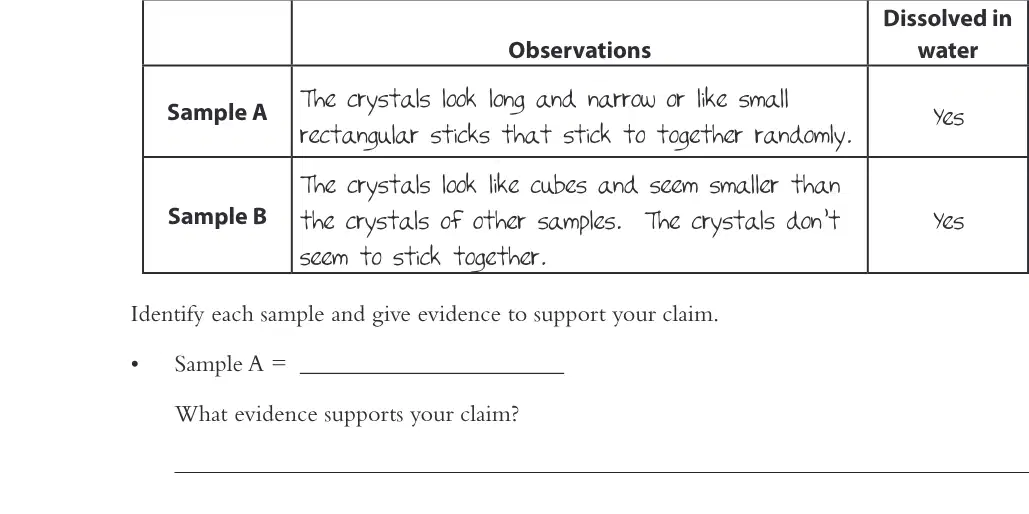
Sample A is identified as ________________. What evidence supports your claim?
Sample A is salt; it dissolves in water.
Sample A is sand; it does not dissolve in water.
Sample A is sugar; it turns brown when heated.
Sample A is iron; it is attracted to a magnet.
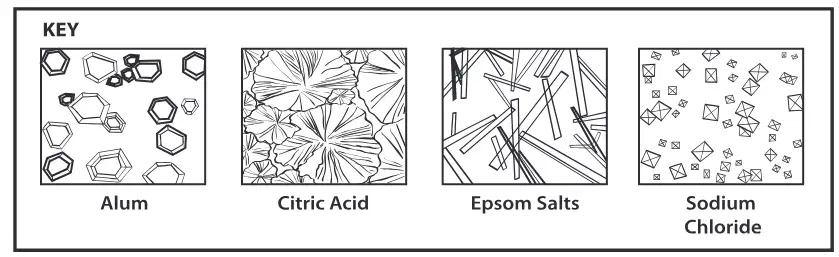
Sample B is identified as ________________. What evidence supports your claim?
Limestone; it reacts with acid to produce bubbles.
Sandstone; it is made of sand-sized particles.
Granite; it has visible crystals of quartz and feldspar.
Shale; it splits easily into thin layers.
What is the difference between the substances represented by the symbols Co and CO?
They are two different ways to represent the element cobalt.
One is the symbol for an element, and one is a formula for a compound.
Co represents the element cobalt, and CO represents the element copper.
They represent two substances, each made up of two elements.
Complete the table by naming the elements represented in each chemical formula. Substance: Water Chemical formula: H2O Names of the elements: _______
Hydrogen and Oxygen
Hydrogen and Nitrogen
Oxygen and Carbon
Carbon and Nitrogen
Substance: Sodium chloride Chemical formula: NaCl Names of the elements: _______
Sodium and Chlorine
Sodium and Carbon
Nitrogen and Chlorine
Sodium and Calcium
Complete the table by naming the elements represented in each chemical formula. Substance: Carbon dioxide Chemical formula: CO2 Names of the elements: _______
Carbon and Oxygen
Carbon and Hydrogen
Oxygen and Nitrogen
Hydrogen and Nitrogen
A student mixes a white solid and a clear liquid together. Which observations are evidence that a chemical reaction occurred? Write Y (yes) next to each piece of evidence that supports the claim that a chemical reaction occurred; write N (no) next to each piece of evidence that does not support this claim. The mixture begins to bubble or fizz.
Y
N
Maybe
Not sure
A student mixes a white solid and a clear liquid together. Which observations are evidence that a chemical reaction occurred? Write Y (yes) next to each piece of evidence that supports the claim that a chemical reaction occurred; write N (no) next to each piece of evidence that does not support this claim. The mixture becomes orange.
N
Y
Sometimes
Cannot be determined
A student mixes a white solid and a clear liquid together. Which observations are evidence that a chemical reaction occurred? Write Y (yes) next to each piece of evidence that supports the claim that a chemical reaction occurred; write N (no) next to each piece of evidence that does not support this claim. The solid disappears into the liquid.
N
Y
Y (yes)
Cannot be determined
A student mixes a white solid and a clear liquid together. Which observations are evidence that a chemical reaction occurred? Write Y (yes) next to each piece of evidence that supports the claim that a chemical reaction occurred; write N (no) next to each piece of evidence that does not support this claim. The mixture begins to smoke.
Y
N
Maybe
Not sure
A student mixes a white solid and a clear liquid together. Which observations are evidence that a chemical reaction occurred? Write Y (yes) next to each piece of evidence that supports the claim that a chemical reaction occurred; write N (no) next to each piece of evidence that does not support this claim. The mixture gets warm.
Y
N
Maybe
Cannot tell
What was Mendeleyev’s purpose for reorganizing the periodic table?
He wanted to fit all the elements on one page instead of in a long line.
He wanted to put elements with similar characteristics in the same column.
He wanted to order the elements from the lightest to the heaviest.
He wanted to put all the metals on one side of the table and gases on the other.
When Mendeleyev changed the layout, there were gaps where no known element fit. How did the gaps help scientists look for undiscovered elements? Write T if the sentence is true; write F if the sentence is false.
F, T, T, T
T, F, F, F
F, F, T, F
T, T, F, T
There are only 90 naturally occurring elements on Earth, but there are millions of different substances. What explains this phenomenon?
Elements combine in different ways to form compounds and mixtures, creating millions of substances.
Each element exists only as itself, so there are millions of elements.
All substances are made from only one element each.
New elements are constantly being created on Earth.
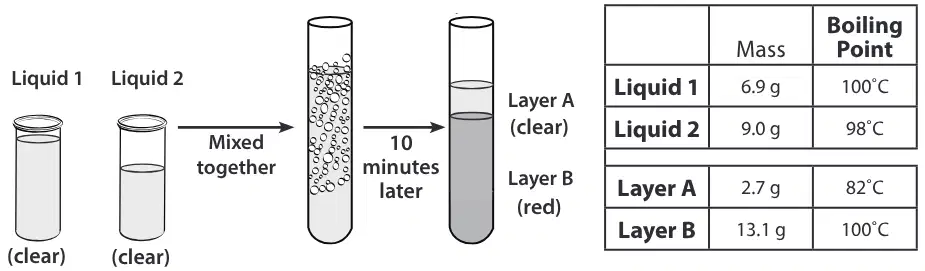
A group of students mixed two liquids together. After leaving the mixture alone for ten minutes, two separate layers formed. They recorded information about each substance in a table. Based on the properties of the substances before and after mixing, what can be claimed about whether a chemical reaction occurred?
No chemical reaction occurred because the substances formed separate layers, indicating a physical change.
A chemical reaction occurred because new substances were formed.
A chemical reaction occurred because the liquids mixed completely.
No chemical reaction occurred because the temperature increased.
A student trapped air inside a syringe. She pushed the plunger down and then pulled the plunger up. Record the number of particles in each syringe.
Syringe B: 10, Syringe C: 10
Syringe B: 8, Syringe C: 12
Syringe B: 12, Syringe C: 8
Syringe B: 15, Syringe C: 5
Which illustration shows air particles closer together inside the syringe after the plunger is pushed down?
Illustration B
Illustration A
Illustration C
Illustration D
A student trapped air inside a syringe (illustration A). She pushed the plunger down (illustration B) and then pulled the plunger up (illustration C). What happens to the particles when you push the plunger down (B)?
The air particles move closer together.
The air particles move farther apart.
There are more air particles in the syringe.
There are fewer air particles in the syringe.
A student trapped air inside a syringe. She pushed the plunger down and then pulled the plunger up. What happens to the particles when you pull the plunger up? (Mark the one best answer.)
The air particles move closer together.
The air particles move farther apart.
The air particles become smaller.
The air particles become larger.
A student was wondering about what is inside a helium balloon. Which of the following describes what is between the helium particles in the balloon? Write Y (yes) next to each term that describes what is between the helium particles; write N (no) next to each term that does not describe what is between the helium particles.
Y
N
Maybe
Not sure
A student was wondering about what is inside a helium balloon. Which of the following describes what is between the helium particles in the balloon?
Nothing
Air
Water vapor
Dust
A student was wondering about what is inside a helium balloon. Which of the following describes what is between the helium particles in the balloon? Write Y (yes) next to each term that describes what is between the helium particles; write N (no) next to each term that does not describe what is between the helium particles. Air: ______
N
Y
Maybe
Sometimes
A student was wondering about what is inside a helium balloon. Which of the following describes what is between the helium particles in the balloon? Write Y (yes) next to each term that describes what is between the helium particles; write N (no) next to each term that does not describe what is between the helium particles. Nothing: ______
N
Y
Maybe
Sometimes
A student was wondering about what is inside a helium balloon. Which of the following describes what is between the helium particles in the balloon? Write Y (yes) next to each term that describes what is between the helium particles; write N (no) next to each term that does not describe what is between the helium particles.
N
Y: Air
Y: Water vapor
Y: Solid particles
The particle model explains that the air inside a fully pumped soccer ball is different from the air outside the ball because:
The air particles inside are closer together than the air particles outside.
The air particles inside are larger than those outside.
The air particles inside move slower than those outside.
The air particles inside are fewer than those outside.
A soccer player pumps air into a soccer ball until no more air can be pushed inside. Use the particle model to predict what will happen if a sharp object creates a hole in the soccer ball. (Mark the one best answer.)
Particles will rush into the ball until the pressure is equal inside and outside the ball.
Particles inside the ball will speed up because the pressure inside the ball decreases.
Particles will rush out of the ball until the pressure is equal inside and outside the ball.
Particles outside the ball will speed up as the pressure increases.
Which of the following always results from a chemical reaction? (Mark the one best answer.)
Bubbles
Fire or smoke
Temperature change
A new substance

A group of students put 5 mL of a white solid substance into a bottle. They poured 10 mL of a clear liquid into the bottle and quickly sealed the system with a stopper with a balloon on top. They swirled the liquid to mix the two substances together and set the closed bottle-balloon system on the table. The mixture bubbled at the bottom of the bottle and the balloon slowly began to inflate. Has a chemical reaction occurred? What evidence supports your claim?
No new substances formed.
The mixture bubbled.
The substances mixed together.
The white substance disappeared.

At the particle level, the balloon inflated because:
air particles moved into the balloon, increasing the number of particles inside and causing it to expand.
the particles inside the balloon disappeared, making space for more air.
the particles inside the balloon shrank, allowing more air to enter.
the air particles outside the balloon pushed all the air out of the balloon.
At the particle level, the reason the plunger in a closed syringe returns to its original position after being compressed is because:
The air particles push back due to increased pressure when compressed.
The air particles disappear when compressed.
The plunger is magnetically attracted to its original position.
The air particles become solid when compressed.
A group of students investigated air in a closed syringe. They compressed the air by pushing the plunger in as far as they could and then let go. The plunger returned to its original position. Once the plunger returned to its original position, it did not move again. The teacher explained, “The system is stable or at equilibrium.” What does that mean at the particle level? Write Y (yes) next to each statement that describes the system at equilibrium; write N (no) next to each statement that does not describe the system at equilibrium.
The pressure inside and outside the syringe is the same.
The number of particles inside and outside the syringe are the same.
The system is open to the outside air.
The air particles inside the syringe push the plunger up with the same force that the particles outside the syringe push the plunger down.
The number of particle collisions against the inside and outside of the plunger are the same.
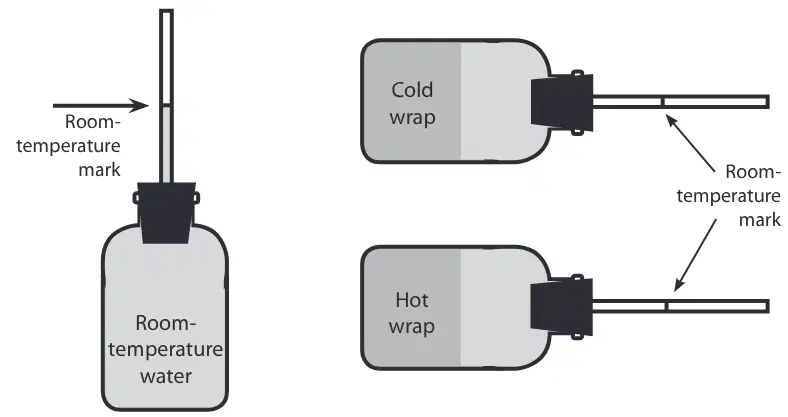
What happens to the water level in the tube when a cold wrap is placed around the bottle, followed by a hot wrap?
The water level goes down with the cold wrap and rises with the hot wrap.
The water level rises with the cold wrap and goes down with the hot wrap.
The water level stays the same with both wraps.
The water level rises with both wraps.
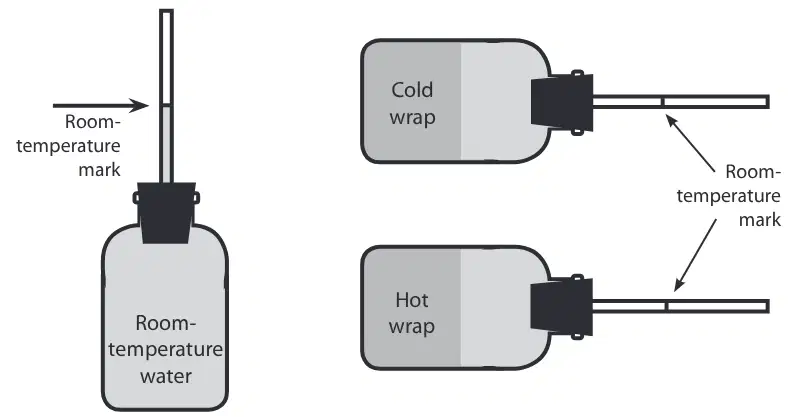
The water level in the tube changed when the student put the hot wrap on the bottle because:
the air inside the bottle expanded when heated, pushing water up the tube
the water evaporated quickly and filled the tube
the bottle shrank, forcing water into the tube
the hot wrap melted the tube, causing water to rise
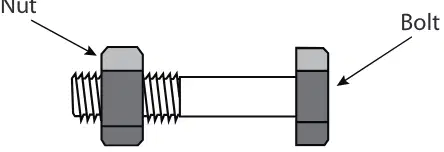
To loosen a stuck metal nut from a bolt using a flame and ice, which method best explains how kinetic energy helps in the process?
Heat the nut so it expands, then cool the bolt so it contracts, making it easier to loosen.
Cool both the nut and bolt so they contract together, making it easier to loosen.
Heat both the nut and bolt so they expand together, making it easier to loosen.
Cool the nut so it contracts, then heat the bolt so it expands, making it easier to loosen.
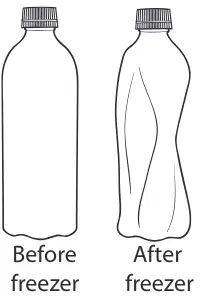
A student put a cap on a bottle, trapping room-temperature air inside. He put the bottle in the freezer for 15 minutes, then took it out and saw that the bottle looked different. What caused the bottle to change shape?
Some of the air particles got out of the bottle.
The air particles in the bottle got closer together.
The air particles settled to the bottom of the bottle.
The air particles cooled and became smaller.
A jeweler heats a silver strip and bends it into a bracelet. The jeweler then cools the bracelet. What happens to the silver particles as the bracelet cools? The kinetic energy of the particles _____.
increases and the particles move farther apart
decreases and the particles move more slowly
decreases until the particles stop moving
does not change
The difference between compression and contraction is:
Compression refers to a decrease in volume due to applied pressure, while contraction refers to a decrease in size due to temperature change.
Compression and contraction both refer to the same process.
Compression is only related to gases, while contraction is only related to solids.
Compression increases the temperature, while contraction decreases the temperature.
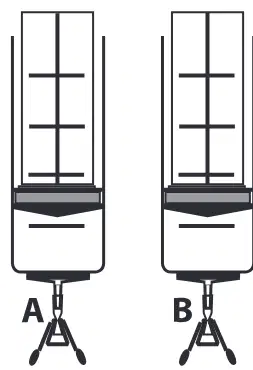
Which illustration correctly shows the arrangement of particles inside syringes A (with gas) and B (with liquid) when both are filled to the same level and clamped?
Particles in syringe A are far apart and randomly arranged; particles in syringe B are close together and orderly arranged.
Particles in both syringes are close together and orderly arranged.
Particles in syringe A are close together and orderly arranged; particles in syringe B are far apart and randomly arranged.
Particles in both syringes are far apart and randomly arranged.
A student filled syringe A with a gas to the marked level and clamped the tube. The student then filled syringe B with a liquid to the same level and clamped the tube. What happens to the particles when you push the plunger in each syringe?
The particles in syringe A move closer together.
The particles in syringe B move closer together.
The particles in both syringe A and B move closer together.
The particles in both syringe A and B do not change.
What happens to the particles when you pull the plunger up in each syringe?
The particles in syringe A are not affected.
The particles in syringe B are not affected.
The particles in both syringe A and B are not affected.
The particles in both syringe A and B move farther apart.
A student filled syringe A with a gas to the marked level and clamped the tube. The student then filled syringe B with a liquid to the same level and clamped the tube. Which syringe has the most matter in it?
Syringe B has the most matter because liquids are denser than gases.
Syringe A has the most matter because gases are heavier than liquids.
Both syringes have the same amount of matter because they are filled to the same level.
Neither syringe has any matter because they are both clamped.
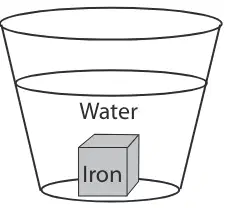
The iron cube and water in this system are at the same temperature. (Refer to the diagram of a beaker with water and an iron cube labeled 'Water' and 'Iron'.) Which particles have higher average kinetic energy?
The water particles
The iron particles
They both have the same.
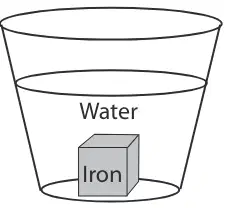
The iron cube and water in this system are at the same temperature. (Refer to the diagram of a beaker with water and an iron cube labeled 'Water' and 'Iron'.) b. Describe the energy transfer between the water and the iron. (Mark the one best answer.)
Energy transfers from the water to the iron.
Energy transfers from the iron to the water.
Energy transfers back and forth between the iron and water.
No energy is transferring between the iron and water.
A student heated 50 mL of water from 0°C to 60°C. How much energy did she use to heat the water?
12,540 J
3,000 J
6,000 J
30,000 J
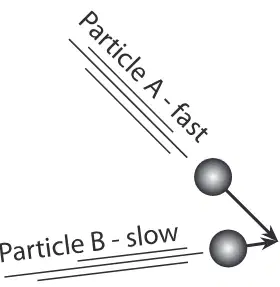
A fast-moving particle (A) and a slow-moving particle (B) collide. Which particle has more kinetic energy before the collision? (Mark the one best answer.)
Particle A
Particle B
A and B have the same kinetic energy.
A fast-moving particle (A) and a slow-moving particle (B) collide. What happens to the kinetic energy when the particles collide?
Energy transfers to particle A.
Energy transfers to particle B.
Energy transfers to both particles.
A fast-moving particle (A) and a slow-moving particle (B) collide. Which particle has more kinetic energy after the collision?
Particle A
Particle B
A and B have the same kinetic energy.
A student places a warm can of fruit juice in a bucket of ice water. What happens to the particles of juice?
The number of juice particles decreases as energy transfers to the ice water.
Energy flow decreases the size of the juice particles.
Cold energy decreases the motion of the juice particles.
Energy flow decreases the space between the juice particles.
A student pours cold milk into a mug filled with hot chocolate. Energy flows from the cold milk to the hot chocolate.
True
False
A student pours cold milk into a mug filled with hot chocolate. Energy flows from the hot chocolate to the cold milk.
True
False
A student pours cold milk into a mug filled with hot chocolate. The kinetic energy of the milk particles increases.
True
False
A student pours cold milk into a mug filled with hot chocolate. The kinetic energy of the hot chocolate particles increases.
True
False
Adding kinetic energy and energy transfer to the explanation, what happens when cold milk is poured into hot chocolate?
Kinetic energy is transferred from the hot chocolate to the cold milk, causing the hot chocolate to cool down.
Kinetic energy is transferred from the cold milk to the hot chocolate, causing the milk to heat up.
No energy is transferred between the milk and the hot chocolate.
Both the milk and hot chocolate lose kinetic energy to the air.
Particles in a solid table and in the air of a classroom are at the same temperature. The particles in the table and the air have the same average kinetic energy.
True
False
Particles in a solid table and in the air of a classroom are at the same temperature. The particles in the table are not moving, and the air particles are moving.
True
False
Particles in a solid table and in the air of a classroom are at the same temperature. The air particles interact with each other differently than how the table particles interact with each other.
True
False
Particles in a solid table and in the air of a classroom are at the same temperature. Particles interacting as a gas always have more average kinetic energy than particles interacting as a solid.
True
False
A baker has two identical cakes except that one cake is hot (40°C), and the other cake is at room temperature (20°C). He places both cakes next to each other on the same cold plate (10°C). Choose the claim that best explains what happens to the energy in the cakes.
Only the hot cake transfers energy to the plate.
The plate transfers energy to the room-temperature cake.
Both cakes transfer energy to the plate.
Neither cake transfers energy to the plate.
A baker has two identical cakes except that one cake is hot (40°C), and the other cake is at room temperature (20°C). He places both cakes next to each other on the same cold plate (10°C). What reasoning supports your claim?
The hot cake will cool faster because it has more energy.
The room-temperature cake doesn’t transfer energy, because it is already at room temperature.
Both cakes will cool at the same time because they are the same size.
The plate has less energy than the cakes.
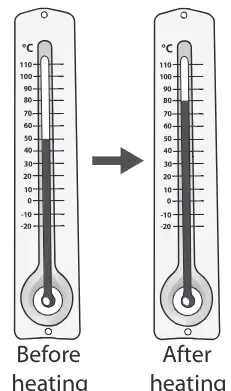
A thermometer measures temperature by:
detecting the expansion or contraction of a liquid inside it
counting the number of particles in the air
measuring the color of an object
using sound waves to sense heat
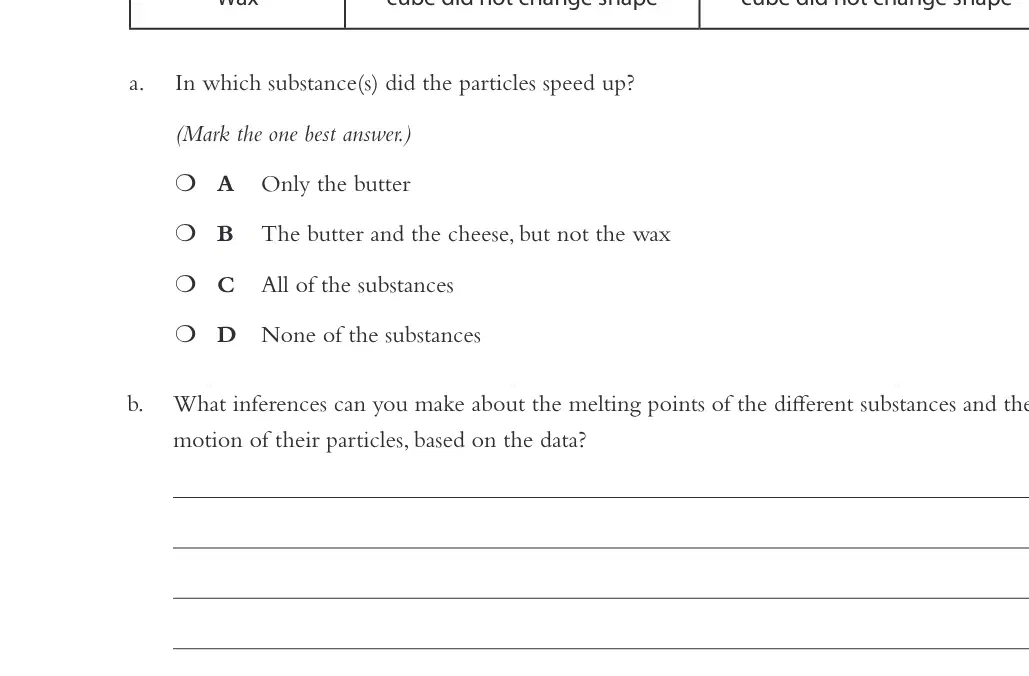
A group of students placed three equal-sized cubes of butter, cheese, and wax on a plate. They tested the hardness of each cube by gently pressing down on the top of each cube and recorded their observations. They left the cubes under a warm lamp for 1 hour. They returned and tested the hardness again and recorded their results. Below is their data table. Substance | At beginning of experiment | After sitting for 1 hour Butter | cube did not change shape | cube had become puddle Cheese | cube did not change shape | cube was easily flattened Wax | cube did not change shape | cube did not change shape a. In which substance(s) did the particles speed up?
Only the butter
The butter and the cheese, but not the wax
All of the substances
None of the substances
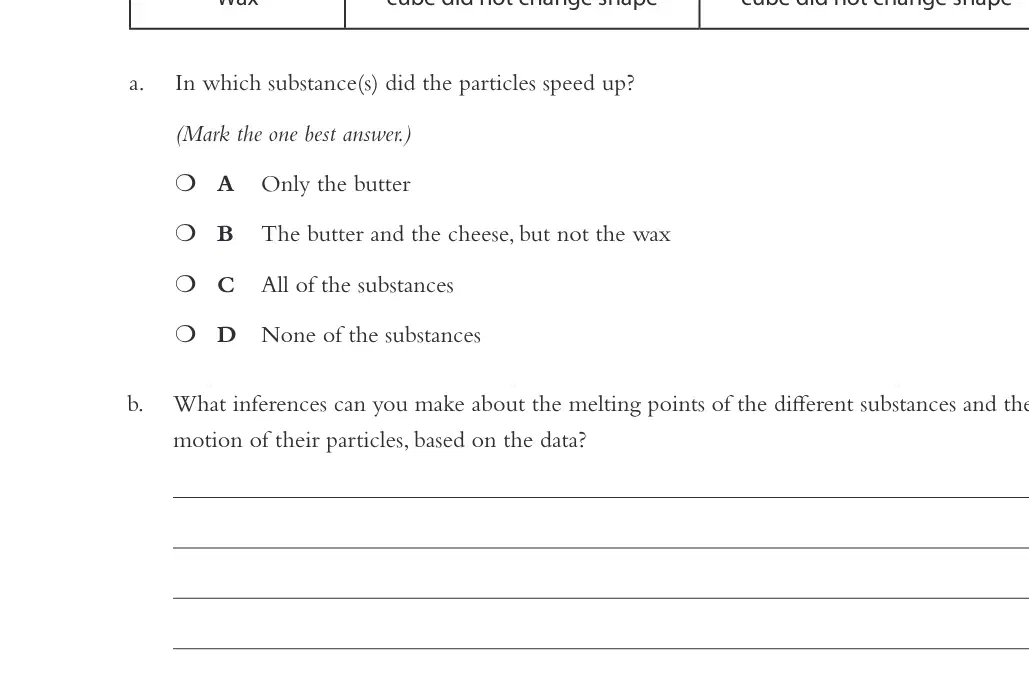
Based on the data, what inference can be made about the melting points of different substances and the motion of their particles?
Substances with higher melting points have particles that move less at the melting point.
All substances have the same particle motion at their melting points.
Substances with lower melting points have particles that move less at the melting point.
The motion of particles is unrelated to the melting point of a substance.
The melting/freezing point of mercury is –39°C. A scientist put liquid mercury into a freezer that is kept at a constant temperature of –35°C. Will the liquid mercury freeze?
Yes, because the freezer is cold enough to freeze mercury.
No, because the freezer isn’t cold enough to freeze mercury.
Yes, because the particles will slow down enough for the mercury to freeze.
No, because there is not enough energy in the freezer to freeze the mercury.
A student dissolved 20 g of salt in a cup of water. She left the cup uncovered in an area where nobody could touch it. When she returned to the cup 10 days later, she found that all the water was gone, and there were crystals in the bottom of the cup. What is the best conclusion, based on her observations?
The water evaporated, and there is 20 g of salt in the cup.
The water and some salt evaporated, but some salt is left in the cup.
There was a chemical reaction, and a new solid was left behind.
The water and salt separated and then the water evaporated, but there is no way to know what is left in the cup.
Write Y (yes) next to each action that happens to the particles when a substance changes from a liquid to a solid; write N (no) next to each action that is not possible. _____ The particles change shape. _____ The particles change from soft to hard. _____ The particles are held more strongly to one another. _____ The kinetic energy of the particles changes. _____ The particles change into a new substance. Which of the following is the correct way to label each action?
The particles change shape. - N The particles change from soft to hard. - Y The particles are held more strongly to one another. - Y The kinetic energy of the particles changes. - Y The particles change into a new substance. - N
The particles change shape. - Y The particles change from soft to hard. - N The particles are held more strongly to one another. - N The kinetic energy of the particles changes. - N The particles change into a new substance. - Y
The particles change shape. - Y The particles change from soft to hard. - Y The particles are held more strongly to one another. - N The kinetic energy of the particles changes. - Y The particles change into a new substance. - N
The particles change shape. - N The particles change from soft to hard. - N The particles are held more strongly to one another. - Y The kinetic energy of the particles changes. - N The particles change into a new substance. - Y
A student hangs a wet T-shirt on a clothesline. A few hours later, the T-shirt is dry. What happens to the water particles as the T-shirt dries?
The water particles are absorbed by the T-shirt.
The water particles evaporate, forming a cloud.
The water particles disappear and no longer exist.
The water particles move faster and become part of the air.
The shirt would dry faster on a sunny, hot day than on a cloudy, cool day because:
the heat and sunlight increase the rate of evaporation
the shirt absorbs more water on sunny days
cloudy days have more wind to dry the shirt
the shirt is protected from dust on sunny days
A student mixed together two substances that were at room temperature. The container quickly began to feel colder in the student’s hand. The hand-and-container system is at equilibrium.
T
F
A student mixed together two substances that were at room temperature. The container quickly began to feel colder in the student’s hand. Cold was released from the mixture.
T
F
A student mixed together two substances that were at room temperature. The container quickly began to feel colder in the student’s hand. Energy was absorbed by the mixture.
T
F
A student mixed together two substances that were at room temperature. The container quickly began to feel colder in the student’s hand. Energy transferred from the student’s hand to the container.
T
F
The sugar in hot tea dissolves faster than in cold tea because:
the molecules in hot tea have more kinetic energy and move faster, helping the sugar dissolve more quickly.
the sugar is sweeter in hot tea than in cold tea.
the color of the tea affects how fast sugar dissolves.
the cup size changes the dissolving rate.

1. The model representing the chemical reaction between sodium bicarbonate (NaHCO₃) and hydrochloric acid (HCl) shows that in a chemical reaction:
New substances are formed as reactants are converted to products.
The reactants remain unchanged after mixing.
No energy is involved in the process.
Only physical changes occur, not chemical changes.
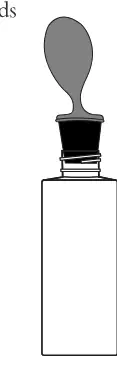
A scientist prepared a closed container for a chemical reaction. She poured two liquids into the bottle and quickly closed the bottle with the balloon stopper. The mixture bubbled and the balloon began to inflate. Explain why the balloon inflated.
New substances formed particles that are bigger than the ones before.
The scientist did not seal the system fast enough and more air got in.
A new gas was created and the gas took up more space.
The liquids reacted together and created more matter.

