wayground logo

Free Printable Worksheets

Font size

S
M
L
XL
Worksheets

Semester 2 Review -- 7th Grade

Total questions: 112

Worksheet time: 2hrs 36mins

Name
Class
Date
1.
Electricity that flows in a closed path is called a
a)
path
b)
current
c)
circuit
2.
The flow of electricity in a circuit-
a)
current
b)
flow
c)
circuit
3.
____________ allows electricity to flow.
a)
A conductor
b)
An insulator
c)
A magnet
4.
____________ stops the flow of electricity.
a)
A conductor
b)
An insulator
c)
A magnet
5.
To complete a circuit the switch must be
a)
unattached
b)
open
c)
closed
6.
The plastic around the wire is
a)
conductor
b)
insulator
c)
decoration
7.
In a parallel circuit the current
a)
makes one circle
b)
stays in one path
c)
splits and goes through two components
8.
Two types of circuits are
a)
parallel and magnetic
b)
electromagnetic and series
c)
series and parallel
9.
An example of a parallel circuit is
a)
the wiring in a house
b)
a flashlight
c)
a single circular path
10.
The ____________ is the energy that flows from the battery, through the wire in it’s path through the circuit.
a)
Electric Current
b)
Conductor
c)
Electromagnet
d)
Insulator
11.
Is the circuit pictured complete or incomplete? 
a)
Complete
b)
Incomplete
12.
What can we do to make this circuit pictured complete?
a)
connect wire to the terminal
b)
disconnect the wire from the lightbulb
c)
screw in the lightbulb
d)
replace the battery
13.
What is the power source for this circuit?
a)
Battery
b)
Electric socket
c)
Wires
d)
Magic
14.
) What would happen if an extra battery cell is added?
a)
A)The lights will glow dim
b)
The wire will glow
c)
The lights will glow brighter
d)
None of the above
15.
Which of the following does not conduct electricity?
a)
gloves
b)
penny
c)
paper clip
d)
key
16.
What kind of circuit is this?
a)
series
b)
parallel
17.
What kind of circuit is this?
a)
Series
b)
Consecutive
c)
Parallel
d)
Training
18.
What type of circuit is this?
a)
series
b)
parallel
19.
What type of circuit is this?
a)
series
b)
parallel
20.

Rain, snow, sleet, hail

a)

precipitation

b)

condensation

c)

evaporation

d)

ground water

21.

What is ground water?

a)

Water that fills the cracks and spaces in underground soil and rock layers.

b)

Water that fills the oceans and lakes.

c)

What that evaporates from rivers, lakes, and oceans.

d)

Water that flows.

22.

An underground layer of rock or sediment that holds water is a(n) _____________________.

a)

artisian well

b)

geyser

c)

aquifer

d)

lake

23.

The image is showing what process?

a)

condensation

b)

transpiration

c)

precipitation

d)

liquification

24.
The Coriolis Effect is caused by
a)
Earth rotating around the sun
b)
Earth rotating on its axis
c)
The tides
d)
Gravity
25.
Warm ocean currents generally come from
a)
The North Pole
b)
The South Pole
c)
The Equator
d)
Both A and B
26.
Cold ocean currents generally come from
a)
The North Pole 
b)
The South Pole
c)
The Equator
d)
Either Pole
27.
A horizontal movement of ocean water that is caused by wind and that occurs at or near the ocean's surface.
a)
Gulf Stream
b)
Global Conveyor Belt
c)
Surface Current
d)
Gyre
28.
Surface currents are a result of
a)
Global Wind Patterns
b)
Earth's Rotation
c)
Density
d)
All of the above
29.
Deep Ocean currents are a result of
a)
Global Wind Patterns
b)
Earth's Rotation
c)
Density
d)
All of the above
30.
Two types of water currents are
a)
local and global
b)
sea and land
c)
surface and deep
d)
warm and cold
31.
When surface currents meet continents they ___?
a)
Stop moving
b)
Are deflected (change paths)
c)
Continue in the direction they were going
32.
The Coriolis effect is...
a)
The curvature of things as they move across the Earth's surface.
b)
The reflection of the Sun's light on the moon.
c)
The heating of the earth by greenhouse gasses.
d)
What determines the speed at which the Earth spins.
33.
If the Earth did not rotate on its axis, there would be no
a)
Greenhouse effect
b)
Coriolis effect
c)
Global warming
d)
Convection
34.

Rivers, streams, lakes, ponds, and oceans are all examples of-

a)

Groundwater

b)

Aquifers

c)

Surface water

d)

Recharge zones

35.
How does water get into the ground?
a)
evaporation
b)
infiltration
c)
precipitation
d)
condensation
36.
What is the water cycle?
a)
the 3 forms of water
b)
the movement of water on, above, or below the surface of the Earth
c)
when water melts
d)
when clouds form
37.
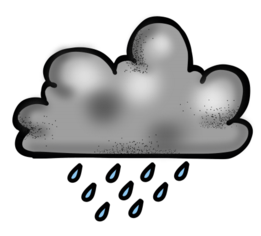
What part of the water cycle does this picture show?
a)
condensation
b)
precipitation
c)
evaporation
38.
Which of these is an example of precipitation?
a)
snow
b)
air
c)
clouds
d)
vapor
39.
Which is the opposite of condensation?
a)
runoff
b)
evaporation
c)
precipitation
d)
transpiration
40.
What is the energy source for the water cycle?
a)
the sun
b)
the earth
c)
water
d)
the moon
41.
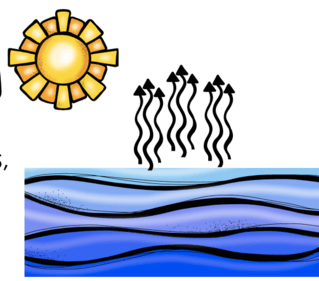
What part of the water cycle does this picture show?
a)
condensation
b)
precipitation
c)
evaporation
42.
What part of the water cycle does this picture show?
a)
condensation
b)
precipitation
c)
evaporation
43.
Which gas in our atmosphere is most abundant?
a)
Argon
b)
Oxygen
c)
Nitrogen
d)
Carbon Dioxide
44.
The air in the troposphere has a greater density than the air in any other layer of the atmosphere,
a)
True
b)
False
45.
Temperature in the stratosphere warms as altitude increases.
a)
True
b)
False
46.
Temperature decreases as altitude increases in the Thermosphere.
a)
True
b)
False
47.
What percentage of our atmosphere is made up of other gases such as argon, water vapor, and carbon dioxide?
a)
1%
b)
21%
c)
78%
d)
90%
48.
What is the percentage of oxygen in Earth's atmosphere?
a)
1%
b)
21%
c)
78%
d)
90%
49.
What is the percentage of nitrogen in Earth's atmosphere?
a)
1%
b)
21%
c)
78%
d)
90%
50.
In which layer of the atmosphere does weather occur?
a)
Mesosphere
b)
Thermosphere
c)
Stratosphere
d)
Troposphere
51.
What causes the temperature to increase in the stratosphere?
a)
Nitrogen
b)
Ozone
c)
Water Vapor
d)
carbon dioxide
52.
What decreases as you go up in the atmosphere?
a)
Altitude
b)
Atmosphere
c)
Meteors
d)
Air Pressure
53.
What is the lowest main layer of Earth's atmosphere?
a)
Thermosphere
b)
Troposphere
c)
Stratosphere
d)
Mesosphere
54.
What is the outer most main layer of Earth's atmosphere?
a)
Thermosphere
b)
Troposphere
c)
Stratosphere
d)
Mesosphere
55.
What is the second lowest main layer of Earth's atmosphere?
a)
Thermosphere
b)
Troposphere
c)
Stratosphere
d)
Mesosphere
56.
Where is the temperature the highest?
a)
1
b)
2
c)
3
d)
4
57.
Where is the air pressure the greatest?
a)
1
b)
2
c)
3
d)
4
58.
Where is the altitude the greatest?
a)
1
b)
2
c)
3
d)
4
59.
The layers of the atmosphere are classified according to changes in _________.
a)
altitude
b)
density
c)
composition
d)
temperature
60.
What are the 2 most abundant gases in Earth's atmosphere?
a)
carbon dioxide and oxygen
b)
carbon dioxide and nitrogen
c)
nitrogen and oxygen
d)
nitrogen and hydrogen 
61.
Which of the following is NOT a reason why the atmosphere is important?
a)
It is made of many layers.
b)
It provides gases living things need.
c)
It provides warm temperatures.
d)
It protects us from UV rays and meteors.
62.
Which of the following is the correct order of the atmosphere layers from Earth to space?
a)
troposphere, stratosphere, mesosphere, thermosphere, exosphere
b)
troposphere, mesosphere, thermosphere, exosphere, stratosphere
c)
thermosphere, stratosphere, mesosphere, troposphere, exosphere
d)
troposphere, stratosphere, mesosphere, exosphere, thermosphere
63.
The flow of energy from an object at a higher temperature to an object at a lower temperature.
a)
heat
b)
temperature
c)
radiation
d)
conduction
64.
The energy an object has due to the motion of its particles; the total amount of kinetic energy of particles in an object.
a)
heat
b)
thermal energy
c)
conduction
d)
convection
65.
A measure of the average amount of kinetic energy of the particles in the object.
a)
energy
b)
expansion
c)
temperature
d)
heat
66.
The process by which energy is transferred from a warmer object to a cooler object by means of physical contact
a)
Thermal Energy
b)
Convection
c)
Radiation
d)
Conduction
67.
The process by which energy is transferred in gases and liquids occurring when a warmer, less dense area of gas or liquid is pushed up by a cooler, more dense area of gas or liquid.
a)
Thermal Energy
b)
Radiation
c)
Convection
d)
Expansion
68.
Energy that travels across distances in the form of electromagnetic waves. 
a)
Convection
b)
Radiation
c)
Conduction
d)
Induction
69.
A response by molecules in a substance when heat is added
a)
Radiation
b)
Contraction
c)
Expansion
d)
Thermometer
70.

The heat from a hot burner to a pot is transferred by ______.

a)

convection

b)

insulation

c)

radiation

d)

conduction

71.
The way the heat is moving from the hot coffee is called...
a)
convection
b)
radiation
c)
insulation
d)
conduction
72.
When holding a cup of ice water, your warm hand becomes cold. How does the heat transfer?
a)
From the cold cup to your hand
b)
From the cold cup to the warm air
c)
From the ice to your hand
d)
From your warm hand to the cold cup.
73.
This is a lava lamp. When the light bulb heats the wax, the wax rises. When the wax cools, it falls. This cycle of rising/falling is an example of:
a)
Conduction.
b)
Convection.
c)
Radiation.
74.
Warm air rises and the cool air sinks demonstrates this type of heat transfer. 
a)
conduction
b)
convection
c)
radiation
d)
Insolation 
75.
The baby chickens are kept warm from the heat lamps demonstrates this type of heat transfer. 
a)
conduction
b)
convection
c)
radiation
76.

Heat transfers from an area of ____temperature to an area of ___ temperature.

a)

high to low

b)

low to high

c)

high to high

d)

It can travel high to low and low to high.

77.
What causes warm air to rise?
a)
the fact that it's less dense than cold air 
b)
The fact that it weighs more than cold air 
c)
The fact that it has higher pressure than cold
d)
the fact that its more dense than cold air 
78.
What causes wind to blow?
a)
Differences in longitude 
b)
Shock waves from clouds 
c)
Differences in air temperature and pressure 
d)
The rotation of the earth
79.
Which term best describes how the earth's atmosphere is heated?
a)
Spirally
b)
Unevenly
c)
Circularly
d)
Kinetically
80.
What creates the air pressure difference between the equator and the poles?
a)
The length of the seasons
b)
The shape of the earth 
c)
the duration of the solar year
d)
The amount of direct sunlight each area receives 
81.
if you wanted to find the jet steam, where would you go? 
a)
the area around the poles 
b)
the area around the equator 
c)
10 km above the earth's surface 
d)
1 km above the earth's surface 
82.
If you wanted to visit an area with very little wind, where might you go? 
a)
The doldrums around the equator
b)
the jet streams in the northern and southern hemisphere 
c)
the North or South Pole 
d)
the area around the Mediterranean Sea 
83.
The reason why global winds flow from east to west and west to east, but not north to south, or south to north.
a)
Bernoulli's principle 
b)
Coriolis effect 
c)
high pressure 
d)
low pressure 
84.
When Earth's rotation causes the wind to curve 
a)
cloudy 
b)
Coriolis effect
c)
high pressure
d)
low pressure 
85.
When heat rises cools then sinks 
a)
high pressure 
b)
convection current 
c)
low pressure 
d)
stratospheric pressure  
86.
What type of winds blow constantly, predictably, and over long distances?
a)
land breezes
b)
mountain breezes
c)
global winds
d)
land breezes
87.
What is the name of the steady winds that flow from west to east between latitudes 30*N and 60*N and 30*S and 60*S?
a)
trade winds
b)
land breeze
c)
westerlies
d)
jet stream
88.
Steady winds that flow from east to west between 30*N latitude and 30*S latitude?
a)
jet stream
b)
breeze
c)
westerlies
d)
trade winds
89.

The curving of air to the right in the Northern hemisphere is caused by ___________ and is called the _________ effect.

a)

Earth's rotation...Coriolis

b)

Earth's revolution...Coriolis

c)

Earth's rotation...Doppler

d)

Earth's revolution...Doppler

90.
What is located at 0 degrees on Earth?
a)
Pole
b)
Doldrums
c)
Horse Latitude
d)
Polar Easterlies
91.
What global wind is located from 0 to 30 degrees North and South of the Equator?
a)
Trade Winds
b)
Prevailing Westerlies
c)
Polar Easterlies 
d)
Doldrum
92.
Land and water absorb and release the sun’s heat in different ways. One result of this is a sea breeze. Which statement is true of sea breezes?
a)
They originate in the day and blow toward the land.
b)
They originate in the day and blow toward the water.
c)
They originate in the evening and blow toward the land.
d)
They originate in the evening and blow toward the water.
93.
Which statement correctly describes the properties of cold air?
a)
less dense and less pressure than warm air
b)
more dense and more pressure than warm air
c)
more dense and less pressure than warm air
d)
less dense and more pressure than warm air
94.
What characteristic do global winds and local winds share?
a)
They are both wind.
b)
They are both created by unequal heating of the Earth’s surface.
c)
They both occur in small areas.
d)
They both occur in small areas.
95.
At night, warm air rises over water then cools and falls over the land in a continuous cycle.
a)
Land breeze
b)
Sea breeze
96.
During the day, warm air rises over the land then cools and falls over water in a continuous cycle.
a)
Land breeze
b)
Sea breeze
97.
Which weather tool measures air pressure?
a)
thermometer
b)
barometer
c)
anemometer
d)
psychrometer
98.
This weather tool measures wind speed and direction
a)
thermometer
b)
barometer
c)
anemometer
d)
psychrometer
99.
Which weather tool measures temperature?
a)
thermometer
b)
barometer
c)
psychrometer
d)
anememeter
100.
The boundary  between two air masses is known as:
a)
front
b)
storm
c)
climate
d)
flood
101.

The amount of water vapor present in the air is called ________________.

a)

weather

b)

humidity

c)

air mass

d)

dew point

102.
Which measures the force of molecules pushing on a surface?
a)
air pressure
b)
temperature
c)
precipitation
d)
wind
103.

The distance at which large objects can be seen clearly...

a)

wind speed

b)

temperature

c)

visibility

104.
Which instrument is used to measure wind speed?
a)
barometer
b)
psychrometer
c)
anemometer
105.

This is used to measure relative humidity:

a)

barometer

b)

psychrometer

c)

anemometer

106.
What are the two main factors that determine the climate of an area?
a)
precipitation and humidity
b)
temperature and air pressure
c)
wind conditions and humidity
d)
temperature and precipitation
107.
What are the surface features of an area called?
a)
latitude
b)
longitude
c)
topography
d)
elevation
108.
What are the 3 major climate zones in order from equator to the poles?
a)
polar, temperate, tropical
b)
tropical, temperate, polar
c)
temperate, polar, tropical
109.
What is the condition of the Earth's atmosphere at a certain time and place?
a)
climate
b)
temperature
c)
weather
d)
air pressure
110.
What is the measure of distance in degrees north and south from the equator?
a)
latitude
b)
longitude
c)
elevation
d)
topography
111.
What is the weather conditions in an area over a long period of time?
a)
climate
b)
temperature
c)
elevation
d)
precipitation
112.
What causes some areas of Earth to receive less intense solar energy than others?
a)
the mass of earth
b)
the curve of earth
c)
the density of earth
d)
the elevation of earth