wayground logo

Free Printable Worksheets

Font size

S
M
L
XL
Worksheets

Wave Review

Total questions: 111

Worksheet time: 3hrs 59mins

Name
Class
Date
1.
A wave carries...?
a)
energy only
b)
matter only
c)
the matter carries the energy
d)
neither
2.
The lowest part of the wave is?
a)
trough
b)
crest
c)
point of origin
d)
compression point
3.
The highest point of a wave is?
a)
crest
b)
trough
c)
point of origin
d)
comppression point
4.
What is the measure of how many waves pass a point in a certain amount of time?
a)
frequency
b)
wavelength
c)
midpoint
d)
crest and trough
5.
What is the measure of how many waves pass a point in a certain amount of time?
a)
frequency
b)
wavelength
c)
midpoint
d)
crest and trough
6.
Which wave has a greater frequency?
a)
A
b)
B
7.
Sound is caused by? 
a)
force
b)
vibrations
c)
instruments
d)
medium
8.
What is vibration?
a)
how loud a sound is
b)
the back and forth movement of matter
c)
how high or low a sound is
d)
the loudness or softness of a sound
9.
Sound is a form of? 
a)
energy
b)
pitch
c)
volume
d)
matter
10.
This is what you get when sound waves are reflected, or bounce back, off of a hard surface.
a)
Amplitude
b)
Pitch
c)
Volume
d)
Echo
11.
How does a sound wave interact with a human ear?
a)
vibrates the ear drum
b)
bounces off the ear canal
c)
rotates the ear drum
d)
vibrates the ear canal
12.

A wave that can only travel through matter is called:

a)

solid waves

b)

longitudinal waves

c)

transverse waves

d)

mechanical waves

13.

True or false: In Longitudinal (or Compression) waves particles move back and forth in a wave.

a)

true

b)

false

14.

True or false: In Transverse waves particles travel side to side in a wave.

a)

true

b)

false

15.
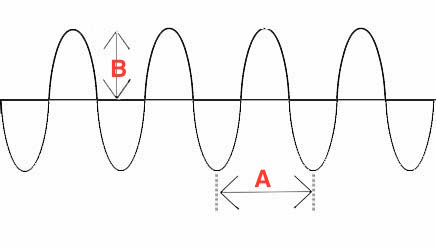
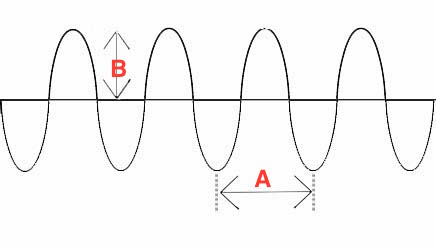
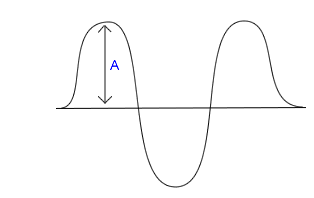
What property of this wave is represented by the letter "A"
a)
amplitude
b)
crest
c)
trough
d)
wavelength
16.
What property of the wave is represented by the letter "B"?
a)
amplitude
b)
crest
c)
trough
d)
wavelength
17.
The highest point on a wave is:
a)
the crest
b)
the trough
c)
the top
d)
the coast 
18.
The number of wavelengths that pass a point each per second is:
a)
frequency
b)
period
c)
longitudinal 
d)
transverse wave 
19.
Which is the correct equation for calculating the speed of a wave?
a)
T = 1/f
b)
Speed= Wavelength x Period
c)
Speed = Wavelength/Frequency
d)
Speed= Wavelength x Frequency
20.
When the frequency of a wave increases, what happens to the wavelength?
a)
The wavelength is not directly affected by the frequency of a wave.
b)
The wavelength increases.
c)
The wavelength decreases.
d)
More specific information is needed to form a conclusion about the wavelength.
21.
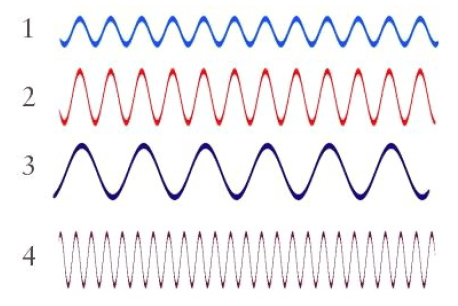
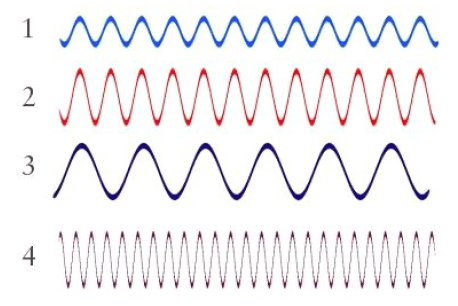
Which wave in the diagram has the greatest frequency?
a)
1
b)
2
c)
3
d)
4
22.
Which wave in the diagram has the greatest wavelength?
a)
1
b)
2
c)
3
d)
4
23.
1.  A wave has frequency of 50 Hz and a wavelength of 10 m. What is the speed of the wave?
a)
500 m/s
b)
50 m/s
c)
5 m/s
d)
0.5 m/s
24.
1.  A wave has frequency of 5 Hz and a speed of 25 m/s. What is the wavelength of the wave?
a)
25 m
b)
125 m
c)
5 m
d)
25 m/s
25.
A wave has wavelength of 10 m and a speed of 340 m/s. What is the frequency of the wave?
a)
34 m/s
b)
3400 Hz
c)
3.4 Hz 
d)
34 Hz
26.
What type of waves have compressions and rarefactions?
a)
longitudinal
b)
transverse
27.
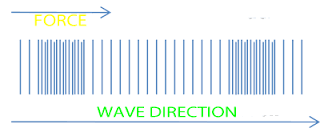
What type of wave is this?
a)
Longitudinal
b)
Transverse
28.
Which part of a longitudinal wave is where particles are packed closely together?
a)
compression
b)
rarefaction
c)
crest 
d)
amplitude
29.
The type of waves that require medium to pass:
a)
Mechanical Waves
b)
Electromagnetic Waves
30.
When the frequency of a wave increases, what happens to the wavelength?
a)
The wavelength is not directly affected by the frequency of a wave.
b)
The wavelength increases.
c)
The wavelength decreases.
d)
More specific information is needed to form a conclusion about the wavelength.
31.
A mechanical wave cannot travel through...
a)
a vacuum(empty space).
b)
water.
c)
air. 
d)
glass.
32.

Electromagnetic waves include the following except

a)

radio waves

b)

X-rays

c)

ocean waves

d)

microwaves

33.
The number of wavelengths that pass a point each per second is:
a)
frequency
b)
period
c)
longitudinal 
d)
transverse wave 
34.
All waves carry
a)
energy
b)
light 
c)
matter
d)
particles
35.
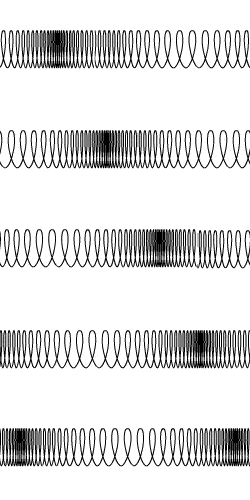
What kind of wave is pictured below?
a)
compressional wave
b)
transverse wave
c)
sound wave
d)
mechanical wave
36.
If you want to change the pitch of a sound, you have to change the ___
a)
frequency
b)
amplitude
c)
speed
d)
volume
37.
This is the unit used to measure the volume of a sound. 
a)
Decibel
b)
Medium
c)
Vibration
d)
Oscilloscope
38.
This is what you get when sound waves are reflected, or bounce back, off of a hard surface.
a)
Amplitude
b)
Pitch
c)
Volume
d)
Echo
39.
The speed of a sound wave depends on
a)
the frequency
b)
the medium
c)
both air temperature and medium
d)
the air temperature
40.
What is a pitch?
a)
highness or lowness of a sound
b)
the intensity of a vibration
c)
the amplitude of the sound wave
d)
volume of sound
41.

Bats use ________ to locate mosquitoes in the air.

a)

solar

b)

ecology

c)

echolocation

d)

refraction

42.
The number of wavelengths that pass a point each second
a)
frequency
b)
wavelength
c)
pitch
d)
amplitude
43.
A part in a longitudinal wave where the particles are spread apart
a)
compression
b)
rarefaction
c)
crest
d)
trough
44.
The part of a longitudinal wave where the particles of the medium are close together.
a)
rarefaction
b)
compression
c)
crest
d)
trough
45.
The number of wavelengths that pass a point each second
a)
frequency
b)
wavelength
c)
pitch
d)
amplitude
46.
Material (matter) through which a wave travels
a)
medium
b)
Doppler Effect
c)
sound
d)
pitch
47.
When a sound is louder what measurement gets bigger?
a)
Frequency 
b)
Amplitude 
c)
Wavelength 
d)
Crest
48.
Why is the school library covered with carpet?
a)
So everyone can make a lot of noise
b)
to help absorb sounds to keep it quiet
c)
because it looks good
d)
to help absorb sounds so it can stay noisy
49.

Sound is made when a source of energy forces the matter to _________.

a)

shake

b)

vibrate

c)

move

d)

stay still

50.

A back-and-forth motion causing particles to move close together generates a _________.

a)

rarefaction

b)

surface wave

c)

transverse wave

d)

compression

51.

A rarefaction is generated when particles move _______.

a)

together

b)

apart

c)

closer

d)

under

52.

Sound waves cannot travel through _________.

a)

paper

b)

milk

c)

hydrogen

d)

empty space

53.

In which of these types of media will sound travel fastest?

a)

solid

b)

liquid

c)

gas

d)

vacuum

54.

Which physical property of a medium is defined by how close the particles of the substance are to each other?

a)

elasticity

b)

temperature

c)

density

d)

amplitude

55.

Which temperature causes sound to travel more slowly?

a)

hot

b)

cold

56.

Which of these is not a property of a sound wave?

a)

intensity

b)

elasticity

c)

loudness

d)

pitch

57.

The amount of energy a sound wave carries per second through a unit of area is its ______________.

a)

pitch

b)

intensity

c)

loudness

d)

frequency

58.

The ____________ of a wave increases with increased energy.

a)

wave length

b)

amplitude

59.

Loudness of waves is measured in ______________.

a)

hertz

b)

decibels

c)

watts

d)

meters/second

60.

The maximum safe level for loudness is __________.

a)

0 dB

b)

60 dB

c)

85 dB

d)

130 dB

61.

Frequency of waves is measured in __________.

a)

hertz

b)

decibels

c)

watts

d)

meters/second

62.

High frequency sounds have ___________ pitch.

a)

high

b)

low

63.

______________ is produced by vibrations.

a)

Sound

b)

Light

c)

Smell

d)

Feeling

64.

Sound waves CANNOT travel through which of these:

a)

Paper

b)

Milk

c)

Outer space

65.
High Amplitude =__________________
a)
Louder sounds
b)
Quieter Sounds
66.
Low Amplitude = ______________
a)
Quieter Sounds
b)
Louder sounds
67.
Sound is produced when something ______________
a)
Vibrates
b)
Moves through empty space
68.
Low frequency = _______ Pitch
a)
Low
b)
High
69.
High frequency = _______ Pitch
a)
High
b)
Low
70.
In General Sound waves travel the fastest in __________
a)
solid
b)
liquid
c)
Gas
d)
plasma
71.
In General Sound waves travel the slowest in __________
a)
solid
b)
liquid
c)
Gas
d)
Plasma
72.
Which wavelength would have the highest pitch like a flute or whistle?
a)
High Frequency Wavelength
b)
Low frequency Wavelength
73.

Which wave produced the loudest sound?

a)

high Amplitude

b)

low Amplitude

74.
A sound is loud or soft depending on its ____________
a)
Amplitude
b)
Frequency
75.

Way in which sound waves are used by animals such as dolphins and bats.

a)

Echolocation

b)

Transverse

c)

Doppler Effect

d)

Longitudinal

76.

How many waves are in this wave train?

a)

10

b)

5

c)

20

d)

1

77.

What is the frequency of this wave?

a)

10 Hz

b)

5 Hz

c)

20 Hz

d)

1 Hz

78.

What is the speed of the wave?

a)

10 cm/s

b)

5 cm/s

c)

20 cm/s

d)

1 cm/s

79.

What is the frequency of this wave?

a)

8 Hz

b)

0.25 Hz

c)

0.125 Hz

d)

4 Hz

80.

What is the speed of this wave?

a)

8 cm/s

b)

32 cm/s

c)

1 cm/s

d)

3 cm/s

81.

What is the speed of the wave? The wavelength is 10 meters.

a)

60 m/s

b)

15 m/s

c)

10 m/s

d)

26.6 m/s

82.

A wave has a frequency of 5 hz and a wave length of 5 m. What is the wave speed (velocity)?

a)

25 m/s

b)

1 m/s

c)

10 m/s

d)

0 m/s

83.

A wave has a frequency of 4 hz and a wave length of 3 m. What is the wave speed (velocity)?

a)

25 m/s

b)

1 m/s

c)

7 m/s

d)

12 m/s

84.

A wave has a frequency of 6 hz and a wave length of 5 m. What is the wave speed (velocity)?

a)

25 m/s

b)

1 m/s

c)

30 m/s

d)

12 m/s

85.

A wave has a frequency of 6 hz and a wave length of 6 m. What is the wave speed (velocity)?

a)

25 m/s

b)

36 m/s

c)

30 m/s

d)

12 m/s

86.

A wave has a frequency of 7 hz and a wave length of 3 m. What is the wave speed (velocity)?

a)

25 m/s

b)

36 m/s

c)

21 m/s

d)

12 m/s

87.

A wave has a frequency of 5 hz and a wave length of 3 m. What is the wave speed (velocity)?

a)

25 m/s

b)

36 m/s

c)

21 m/s

d)

15 m/s

88.
A disturbance that travels through a medium as a longitudinal wave
a)
sound
b)
wavelength
c)
pitch
d)
frequency
89.
A wave that requires a medium through which to travel
a)
mechanical wave
b)
chemical wave
c)
electromagnetic wave
d)
pitch
90.
Cletus wants to make ear protectors for people who work around loud jet engines at Hartsfield Airport in Atlanta. Which of the following materials should he experiment with for the best results?
a)
a material that produces sound
b)
a material that absorbs sound
c)
a material that transmits sound
d)
a material that amplifies sound
91.
Which of the following would you hear as a low pitched sound? 
a)
sound wave with a frequency of 50 Hz
b)
sound wave with frequency of 10,000 Hz
c)
sound wave with an intensity of 10 dB
d)
sound wave with an intensity of 100 dB
92.
If a wave is traveling at 260 m/s and has a wavelength of 0.8 m/s, what is its frequency?
a)
208 Hz
b)
325 Hz
c)
430 Hz
d)
160 Hz
93.
The term for how high or low a sound is:
a)
pitch
b)
volume
c)
sound
d)
medium
94.
The term for how loud or soft a sound is:
a)
pitch
b)
volume
c)
sound
d)
medium
95.
Which feature of sound is determined by amplitude?
a)
Pitch
b)
Smoothness
c)
Loudness
96.
If the distance represented by the letter A (the amplitude) were increased, how would it change the sound?
a)
The sound would be higher. 
b)
The sound would be lower. 
c)
The sound would be softer. 
d)
The sound would be louder. 
97.
When a sound is louder what measurement gets bigger?
a)
Frequency 
b)
Amplitude 
c)
Wavelength 
d)
Crest
98.
What is something natural that Sound cannot travel through?
a)
Water
b)
Air
c)
Liquids
d)
outer Space
99.
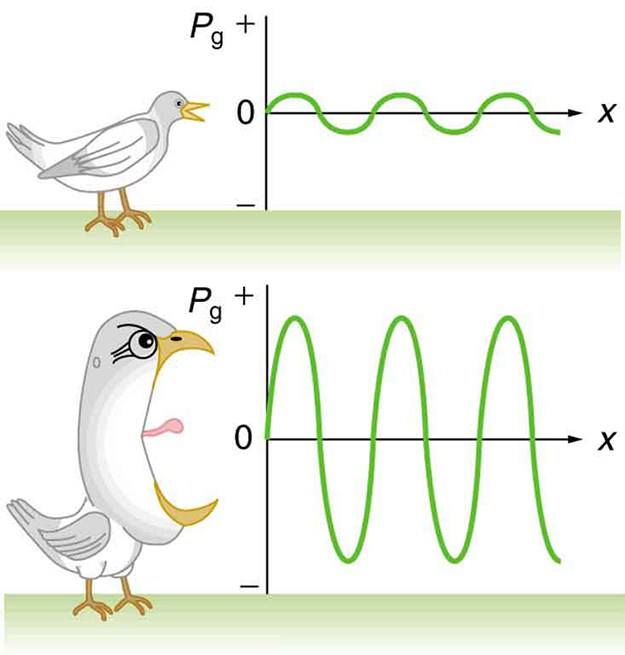
What is changed in the second picture?
a)
Someone is talking louder in picture 2
b)
Someone is talking softer in picture 2
c)
Someone is talking lower pitch in picture 2
d)
Someone is talking higher pitch in picture 2
100.
What is changed in the second picture?
a)
Someone is talking louder in picture 2
b)
Someone is talking softer in picture 2
c)
Someone is talking lower pitch in picture 2
d)
Someone is talking higher pitch in picture 2
101.
What is changed in the second picture?
a)
Someone is talking louder in picture 2
b)
Someone is talking softer in picture 2
c)
Someone is talking lower pitch in picture 2
d)
Someone is talking higher pitch in picture 2
102.
What is changed in the second picture?
a)
Someone is talking louder in picture 2
b)
Someone is talking softer in picture 2
c)
Someone is talking lower pitch in picture 2
d)
Someone is talking higher pitch in picture 2
103.

Review: What type of wave needs a medium to travel through?

a)

Electromagnetic

b)

Mechanical

104.

Review: if you hold a rope attached to a wall and move your hand up and down, then you will create waves in the rope. What's the medium the waves are traveling through in this example?

a)

The rope

b)

The person holding the rope

c)

The wall

d)

The air

105.

Which number on the diagram represents a crest?

a)

1

b)

2

c)

3

d)

4

106.

Which number represents a trough on the diagram?

a)

1

b)

2

c)

3

d)

4

107.

If B is the start of 1 wavelength, then where would it end?

a)

C

b)

E

c)

F

d)

D

108.

What does number 2 represent?

a)

Crest

b)

Trough

c)

Amplitude

d)

Wavelength

109.

What choice best describes the frequency of a wave?

a)

How many waves occur in 1 second

b)

The time it takes for 1 wave to occur

110.

Which wave has the highest frequency?

a)

1

b)

2

c)

3

d)

4

111.

If the period of a wave is 2 seconds, then what is the frequency?

a)

1 Hz

b)

1/2 Hz

c)

2 Hz