wayground logo

Free Printable Worksheets

Font size

S
M
L
XL
Worksheets

8th Grade Review

Total questions: 112

Worksheet time: 3hrs 31mins

Name
Class
Date
1.

The moon seems to change shape from day to day in a cycle that lasts about a month as it goes through ______.

a)
revolutions
b)
phases
c)
rotations
d)
eclipses
2.

Where does the moon get its light?

a)

It makes its own light

b)

The Stars

c)

The Sun

3.

During the phases of the Moon, the Moon appears to change shape. This change in appearance is due to the Moon...

a)

physically changing size and shape.

b)

moving closer and then farther away from Earth.

c)

reflecting a different amount of light due to alignment with Earth and the Sun.

d)

having craters on its surface.

4.
About how long does it take the moon to make one complete cycle around the earth?
a)
65 days
b)
8 days
c)
365 days
d)
28 days
5.

Select the correct moon phase

a)

Crescent Moon

b)

New Moon

c)

Full Moon

6.

Select the correct moon phase

a)

Crescent Moon

b)

New Moon

c)

Half Moon

7.

Select the correct moon phase

a)

Full Moon

b)

Half Moon

c)

Crescent Moon

8.

When the Earth blocks the sun from reaching the Moon, it is called?

a)

Lunar eclipse

b)

Solar eclipse

c)

Total eclipse

9.

A ___________ ______________ is when the Moon blocks the Sun.

a)

Lunar eclipse

b)

Total eclipse

c)

Solar eclipse

10.

What is an eclipse?

a)

When one object covers the other

b)

When the moon rotates around Earth

c)

When you can't see the moon at night

11.

What is correct order for a LUNAR eclipse?

a)

Sun-Earth-Moon

b)

Earth-Sun-Moon

c)

Sun-Moon-Earth

12.

What is correct order for a SOLAR eclipse?

a)

Sun-Earth-Moon

b)

Earth-Sun-Moon

c)

Sun-Moon-Earth

13.

The very darkest part of the shadow where the light from the sun is completely blocked, is called?

a)

Umbra

b)

Penumbra

14.

The area of the shadow where the sun is only partially blocked is called?

a)

Umbra

b)

Penumbra

15.
Nuclear fusion produces _______________.  
a)
Heat
b)
Light
c)
Energy
d)
All of these
16.
________________ is the closest star to Earth.  
a)
The Sun
b)
The Moon
c)
The Red Giant
d)
The Blue Dwarf
17.

Constellations appear to move across the night sky because of _________________

a)

Earth's rotation & revolution

b)

Earth's magnetic field

c)

Gravity

d)

the movement of the stars

18.
The color a star shines is determined by its _________________.
a)
Temperature
b)
Distance From Earth
c)
Position in the Solar System
d)
Brightness
19.
Label letter D
a)
White Dwarf
b)
Supernova
c)
Black Hole
d)
Neutron Star
20.
Label letter B
a)
Red Giant
b)
Supernova
c)
Red Supergiant
d)
Planetary Nebula
21.
Label letter A
a)
Stellar Nebula
b)
Supernova
c)
Black Hole
d)
Planetary Nebula
22.
Label letter F
a)
Stellar Nebula
b)
Supernova
c)
Black Hole
d)
Planetary Nebula
23.
Label letter G
a)
Stellar Nebula
b)
Supernova
c)
Black Hole
d)
Nuclear Fusion
24.
Which letter would show a bright, hot star?
a)
A
b)
B
c)
C
d)
D
25.
Which letter would show a dim, hot star?
a)
A
b)
B
c)
C
d)
D
26.
Which letter would show a dim, cool star?
a)
A
b)
B
c)
C
d)
D
27.
Which letter would show a cool, bright star?
a)
A
b)
B
c)
C
d)
D
28.
The stars going through the middle of an HR diagram are called ___________
a)
main sequence
b)
white dwarfs
c)
supergiants
d)
gas giants
29.
The brightness a star appears from Earth is its ___________________.
a)
Apparent Magnitude
b)
Absolute Magnitude
c)
Alphabetical Magnitude
d)
Brightness Index
30.
The true brightness of a star is its ___________________.
a)
Apparent Magnitude
b)
Absolute Magnitude
c)
Alphabetical Magnitude
d)
Brightness Index
31.
Absolute magnitude of a star does not depend on its _________________.  
a)
Distance from Earth
b)
Size
c)
Temperature
d)
Galaxy
32.
An average sized star like the Sun will eventually become a _________________ before becoming a planetary nebula.  
a)
Red Giant
b)
Blue Giant
c)
Jolly Green Giant
d)
Red Supergiant
33.
Which of the following best describes the tilt of the earth when it is summer in the southern hemisphere?
a)
The northern hemisphere is tilted toward the sun
b)
The northern hemisphere is tilted away from the sun
c)
The norther hemisphere is tilted neither toward or away from the sun
d)
Why are you talking about the northern hemisphere when you asked about the southern hemisphere?
34.
What does the earth's tilt cause?
a)
The seasons
b)
Day and Night
c)
Tsunamis
d)
Earthquakes
35.
What is the shape of the earth's orbit around the sun?
a)
Circular
b)
Elliptical (slightly oval)
c)
Square to rectangular
d)
Variable and changes with the seasons (no particular shape)
36.
Each day past the summer solstice, the days get longer and longer until the fall equinox.
a)
True
b)
False
37.
What effect does the tilt of the earth have?
a)
It changes the angle that the sun strikes the earth in different land areas
b)
It causes the earth to be farther away from the sun at different times of the year
c)
When the earth is tilted away from the sun we have night
d)
When the earth is tilted away from the sun we have day
38.
What season is it in the Southern Hemisphere when it is fall in the Northern Hemisphere?
a)
winter
b)
spring
c)
summer
d)
fall
39.
Why does the area around the equator stay the same temperature all year?
a)
The equator rotates slower than the poles.
b)
The equator remains the same distance from the sun.
c)
The equator always receives direct sunlight.
d)
The equator has 18 hour days.
40.
One rotation of Earth is equal to
a)
a day.
b)
a year.
41.
The amount of time it takes Earth to revolve around the sun is a 
a)
day
b)
24 hrs
c)
month
d)
year
42.
The rotation of Earth is responsible for day and night
a)
true
b)
false
43.
Waves that require a medium are called 
a)
mechanical waves
b)
transverse waves
c)
light waves
d)
gamma rays
44.
What happens when you increase the amplitude of a sound?
a)
it makes the sound louder
b)
it makes the sound travel faster
c)
it increases the wavelength of the sound
d)
it increases the frequency of the sound
45.

What kind of wave is pictured below?

a)

compressional wave

b)

transverse wave

c)

sound wave

d)

mechanical wave

46.
What can electromagnetic waves travel through?
a)
mediums
b)
empty space
c)
solely solids
d)
both mediums and empty space
47.
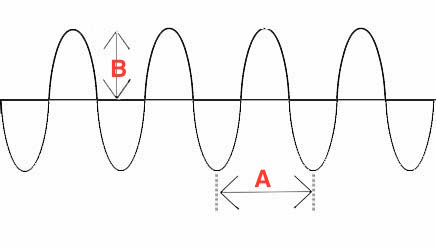
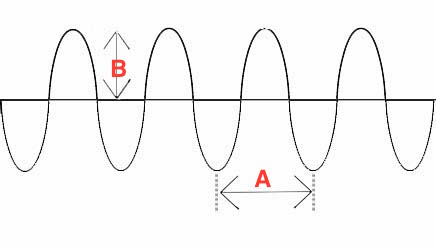
What property of this wave is represented by the letter "A"
a)
amplitude
b)
crest
c)
trough
d)
wavelength
48.
What property of the wave is represented by the letter "B"?
a)
amplitude
b)
crest
c)
trough
d)
wavelength
49.
Which wave is pictured?
a)
Transverse
b)
Longitudinal
c)
Both
d)
Neither
50.
A wave carries...?
a)
energy only
b)
matter only
c)
energy and matter
d)
neither
51.
What type of wave move a slinky back and forth?
a)
longitudinal
b)
transverse
52.
Which vocabulary term is used to identify the distance between points C & G?
a)
Amplitude
b)
Crest
c)
Frequency
d)
Wavelength
53.
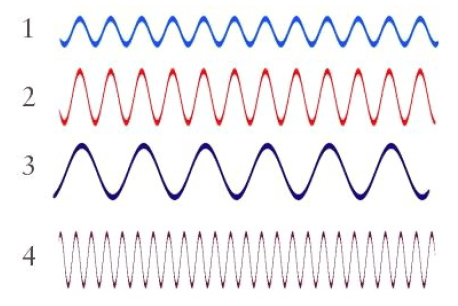
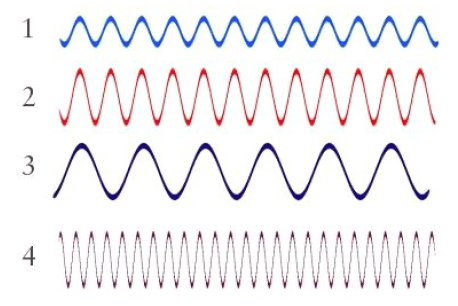
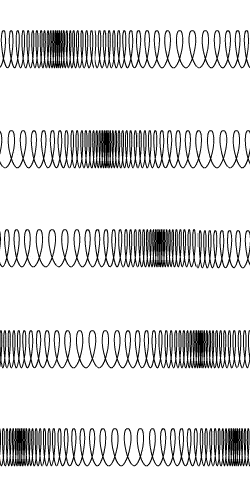
Which wave in the diagram has the greatest frequency?
a)
1
b)
2
c)
3
d)
4
54.
Which wave in the diagram has the greatest wavelength?
a)
1
b)
2
c)
3
d)
4
55.
Which of the following can sound travel through?
a)
solid
b)
liquid
c)
gas
d)
all of the above
56.
What type of wave is this?
a)
Longitudinal
b)
Transverse
57.
Define force
a)
a push or a pull
b)
he total amount of energy within an object
c)
when an object converts energy into a different form
d)
he amount of work done
58.
What is acceleration?
a)
the direction that the object is traveling
b)
taking place when the object remains motionless
c)
when the speed and/or direction is changing
d)
the same as an object's speed
59.
What is Inertia?
a)
the amount of matter an object contains
b)
the total amount of energy within an object
c)
the tendency of an object to resist motion
d)
momentum
60.
What is the difference between speed and velocity?
a)
velocity tells time
b)
velocity identifies the type of motion
c)
velocity includes the strength of the force involved
d)
velocity includes the direction of the motion
61.
Which is going to collide with the truck with the LEAST force?
a)
All will collide with the same force
b)
car
c)
bug
d)
mouse
62.
A runner runs from the starting line & accelerates to 15m/s in 5s. What is their acceleration?
a)
45 m/s/s
b)
3 m/s/s
c)
17 m/s/s
d)
60 m/s/s
63.
Which of the following will increase the acceleration of an object that is pushed by a force?
a)
Increasing the mass of the object
b)
Increasing the gravity on the object
c)
Increasing the friction on the object
d)
Increasing the force pushing the object
64.
On a distance vs time graph, a flat horizontal lines means the object
a)
is traveling at a constant speed.
b)
has stopped.
c)
is traveling at a constant velocity.
d)
Unable to determine 
65.
What is the net force of a 10kg watermelon being pushed with an acceleration of 5m/s2? (F=ma)
a)
50N
b)
2.5 N
c)
1 N
d)
75 N
66.
What 2 factors affect the amount of gravitational force between two objects?
a)
distance & time
b)
mass & distance
c)
mass & weight
d)
direction & speed
67.
What can the train passengers use as a frame of reference to indicate they are in motion?
a)
the mountains and trees 
b)
the grass
c)
the clouds
d)
the bug on the window
68.
What force opposes motion? 
a)
friction
b)
gravity
c)
electrical 
d)
magnetic
69.
Newton's 1st Law of Motion deals with the action and reaction forces
a)
True
b)
False
70.
The second Law of Motion relates force, mass, and acceleration.
a)
True
b)
False
71.
Newton's third Law of Motion states... 
a)
For every action, there is an equal and opposite reaction
b)
F= m x a
c)
An object at rest stays at rest
d)
an object in motion stays in motion
72.
Which Newton's Law explains the image?
a)
1st Law (Inertia)
b)
2nd Law (F=ma)
c)
3rd Law (Action-Reaction)
d)
Universal Law of Gravitation
73.
Which Newton's Law explains the image above?
a)
1st Law (Inertia)
b)
2nd Law (F=ma)
c)
3rd Law (Action-Reaction)
d)
Universal Law of Gravitation
74.
Which of Newton's laws explains why a driver's head snaps forward when making a sudden stop?
a)
1st Law (Inertia)
b)
2nd Law (F=ma)
c)
3rd Law (Action-Reaction)
d)
Universal Law of Gravitation
75.
Which of Newton's Laws explains the image?
a)
1st Law (Inertia)
b)
2nd Law (F=ma)
c)
3rd Law (Action-Reaction)
d)
Universal Law of Gravitation
76.
Velocity describes the _______ of a moving body.
a)
friction and force
b)
gravity and acceleration
c)
inertia and mass
d)
speed and direction
77.
A __________ is needed to detect motion.
a)
balanced force
b)
gravitational force
c)
net force
d)
frame of reference
78.
What two measurements are needed to determine speed?
a)
acceleration & time
b)
direction & time
c)
distance & time
d)
velocity & time
79.
During which point was Mabel farthest from home and stationary?
a)
Point A
b)
Point B
c)
Point C
d)
Point D
80.
Which of the following would NOT be considered a type of acceleration?
a)
Slowing down
b)
Speeding up
c)
Standing still
d)
Turning a corner
81.
Forces that cancel each other are called __________ forces.
a)
unbalanced
b)
balanced
c)
neutral
d)
moving
82.
What is wrong with this free body diagram?
a)
The arrows are the wrong size.
b)
Applied force always goes to the left.
c)
Gravity should be pointing down and normal force up.
d)
Normal force should be buoyant force.
83.
What is the net force?
a)
40 N to the right
b)
5 N to the left
c)
45 N to the right
d)
45 N to the left
84.
Which of the following statements about the fossil record is true?
a)
all organisms become fossils
b)
organisms having soft body parts make up most of the fossils
c)
all organisms that have shells become fossils
d)
the fossil record is incomplete
85.
The Law of Superposition helps scientists to determine what?
a)
The absolute age of rock layers
b)
The age of fossils
c)
The relative age of rock layers
d)
the super powers of rocks
86.
How old do Paleontologists believe the Earth is?
a)
2015 years old
b)
3.6 billion years old
c)
4.6 billion years old
d)
4.6 million years old
87.
According to the law of superposition, which layer is the youngest?
a)
A
b)
B
c)
C
88.
Why is the fossil record incomplete?
a)
fossils get eroded away over time
b)
most organisms never became fossils
c)
scavengers and decomposers eat them too quickly
d)
all of the above
89.
Paleozoic, Mesozoic & Cenozoic are all
a)
Epochs
b)
Eras
c)
Periods
d)
Eons
90.
Which is the most recent era of time- the one that we are currently in?
a)
Mesozoic 
b)
Paleozoic 
c)
Cenozoic 
d)
Precambrian 
91.
Scientists chose where units of geologic time began and ended based on major changes in life forms at certain times.
a)
true
b)
false
92.
The dinosaurs and reptiles were dominant in which Era?
a)
Precambrian
b)
Mesozoic
c)
Paleozoic
d)
Cenozoic
93.
Known as the age of the mammals?
a)
Mesozoic Era
b)
Holocene Epoch
c)
Cenozoic Era
d)
Cambrian
94.
The disappearance of a species.
a)
Evolution
b)
Extinction
c)
Migration
d)
Mutation
95.
This provides information about the history of life on earth and how organisms lived and evolved over time.
a)
fossil data
b)
fossil evidence
c)
fossil  record
d)
remains of fossil
96.

A group of DNA that makes up a small section of a chromosome and provides information for specific traits.

a)

nucleus

b)

gene

c)

nucleotide

d)

heredity

97.

The hereditary material that directs all cell activities, including the making of new cells.

a)

Protein

b)

DNA

c)

RNA

d)

Glucose nucleic acid (GNA)

98.
The passing of physical characteristics from parent to offspring 
a)
Heredity
b)
Chromosome
c)
Genes
d)
Chemistry
99.

An allele is ...

a)

the different versions of a phenotype

b)

a set of DNA

c)

The different versions (or forms) of a gene inherited from each parent.

d)

a pair of organisms with similar traits
100.
Dominant alleles are represented by a:
a)
Male gene
b)
lowercase letter
c)
recessive trait
d)
capital letter
101.
Aa, DD, bB, yy are all examples of
a)
genotypes
b)
phenotypes
102.
In a heterozygous genotype, the ___________ allele takes over in the phenotype.
a)
recessive
b)
dominant
c)
lower case letter
d)
both 
103.
What you see, or the physical appearance.
a)
Genotype
b)
Phenotype
c)
Homozygous
d)
Heterozygous
104.

B = brown eyes

b = blue eyes

One brother has genotype BB and the other brother has genotype Bb.

Which statement is true about these two brothers?

a)

They have same phenotype and genotype

b)

They have different phenotypes and genotypes

c)

They have same phenotype, but different genotypes

d)

They have different phenotypes, but the same genotype

105.

Which of the following would be a phenotype?

a)

Aa

b)

red hair

c)

heterozygous

d)

DNA

106.

Which of the following genotypes is homozygous dominant?

a)

Yy

b)

yY

c)

yy

d)

YY

107.

Which of the following genotypes is homozygous recessive?

a)

Tt

b)

tt

c)

TT

d)

tT

108.

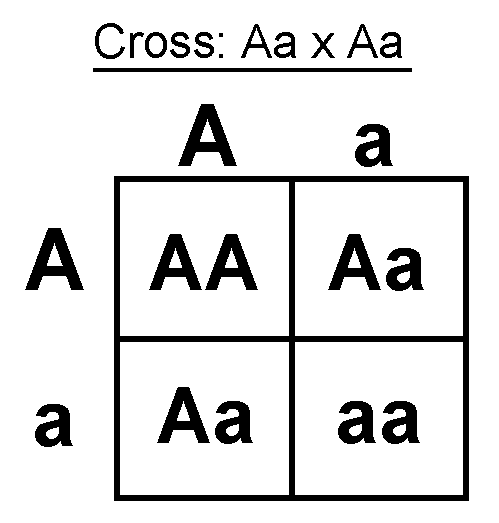
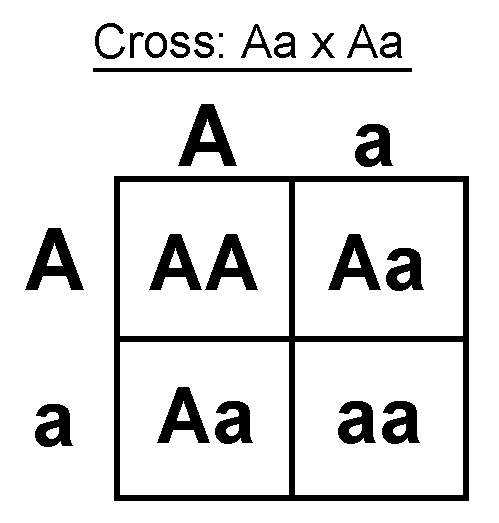
What is the genotypic ratio of the offspring?

a)

AA=1/4, Aa=1/2, aa=1/4

b)

AA=1/4, Aa=1/4, aa=1/4

c)

AA=1/2, Aa=1/2, aa=1/4

d)

AA=1/4, Aa=1/2, aa=1/2

109.

How many alleles (letters) does a child get from EACH parent for each trait?

a)

1

b)

2

c)

3

d)

4

110.

What are the phenotype percentages of the offspring?

(A-Brown fur color; a-white fur color)

a)

50 % Brown fur and 50% White fur

b)

25 % Brown fur and 75% White fur

c)

75 % Brown fur and 25% White fur

d)

0% Brown fur and 100% White fur

111.

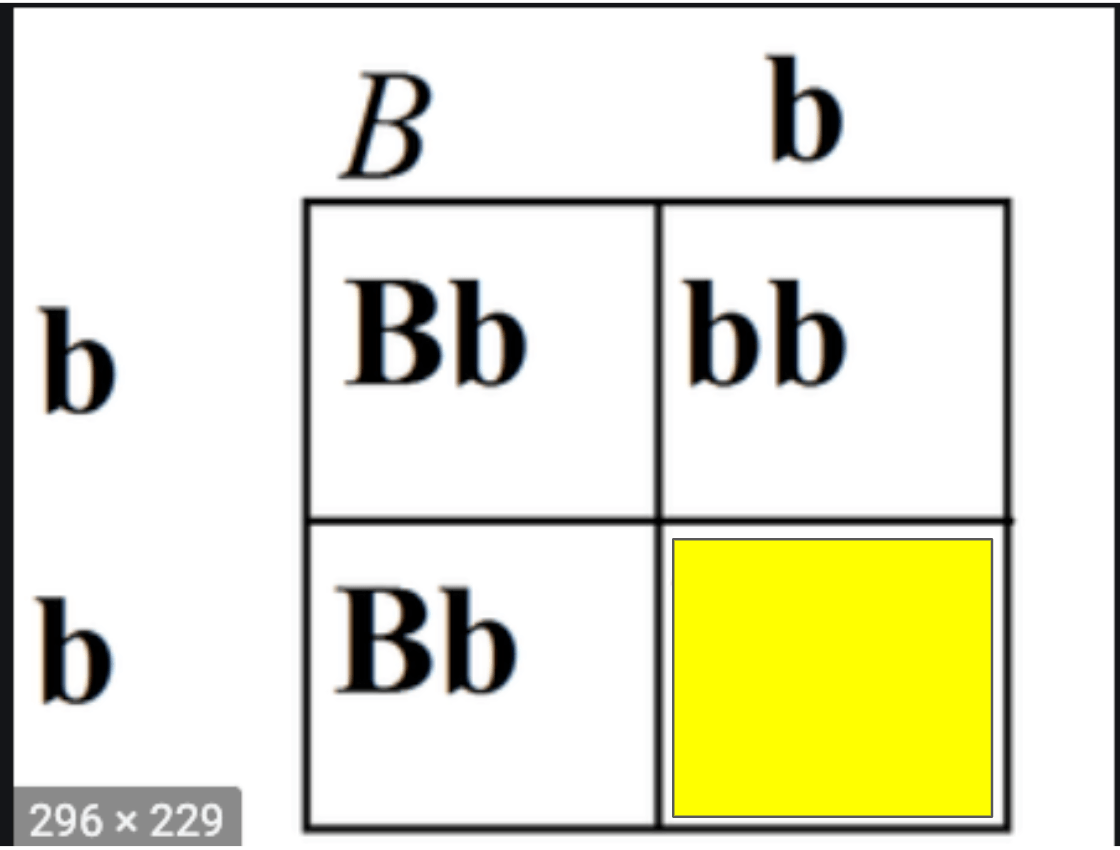
Fill in the Yellow Box

a)

Bb

b)

BB

c)

bb

112.

What is the chance the offspring born from this cross will have a homozygous dominant genotype?

a)

25%

b)

50%

c)

75%

d)

100%