
 Worksheets
NSCAS 8th Grade Science Review
Total questions: 110
Worksheet time: 3hrs 26mins



Insulators
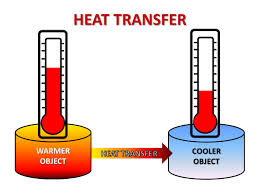
Materials that do not conduct heat well.
A material that conducts heat well,
The amount of energy required to raise the temperature of 1 kilogram of a material by 1 kelvin.
The expansion of matter when it is heated.

Conductor
Materials that do not conduct heat well.
A material that conducts heat well,
The amount of energy required to raise the temperature of 1 kilogram of a material by 1 kelvin.
The expansion of matter when it is heated.
Part of the plant that absorbs water.
Roots
Flowers
Petals
Leaves
Part of the plant that has chlorophyll
Roots
Flowers
Petals
Leaves
The flowers from plants turn into _________.
Fruits
Trees
Leaves
Vegtables

What is one job of the stem?
To pollinate the plant
To make food for the plant
To carry food and water to the plant
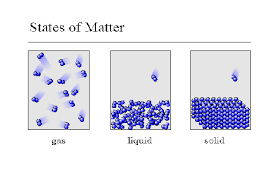
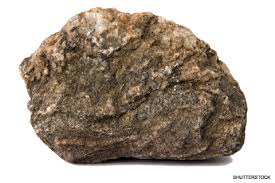
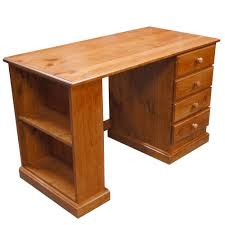
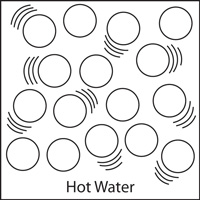
A ___ change causes the substance to change to a new substance with different properties.
Physical
Chemical
A ____ change only changes the look of the substance but NOT the chemical make-up.
Physical
Chemical

Is it a physical or chemical change?
physical
chemical

Is it a physical or chemical change?
Physical
Chemical
A green powder is heated & a gas is given off while it turns to a black solid. This describes
Physical Change
Chemical Change
Change in State
Change in Temperature

Identify what type of change happening in the picture below...
Chemical Change
Physical Change
Endothermic Reaction
Exothermic Reaction

Identify what type of change happening in the picture below...
Chemical Change
Physical Change
Endothermic Reaction
Exothermic Reaction
How many Hydrogen atoms are present?
How many Oxygen atoms are present?


A cactus
Biotic factor
Abiotic factor

Air
Biotic factor
Abiotic factor

A zebra skeleton
Biotic factor
Abiotic factor

Soil or dirt
Biotic factor
Abiotic factor

A pinecone
Biotic factor
Abiotic factor

Weather (sunny, rainy, windy, snowy)
Biotic factor
Abiotic factor

Lions only eat buffalo, antelopes, zebras and crocodiles. They are called __________.
Omnivore
Herbivore
Carnivore
Delivore

Bears eat fish, insects, plants, seeds, nuts and young elk. They are called __________.
Franivore
Carnivore
Herbivore
Omnivore

An animal that only eats plants is a...
carnivore
omnivore
herbivore
decomposer

Click on the imgae to make it larger-- Choose the herbivores in the food web....
hawk
mouse
rabbit
snake

Click on the image to make it larger--The rabbit gets energy from the ....
hawk
mouse
wildflowers
grass

Click on the image to make it larger-- Choose the living things that are producers...
wildflowers
rabbit
snake
grass

Choose the living things in the food web that are consumers --click on the image to make it larger
wildflowers
hawk
rabbit
snake
mouse
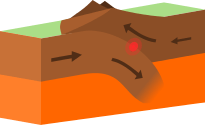


Which adaptation gives the Bony Fish the best advantage of changing directions quickly when being chased by a predator?
Fin with 2 lobes
Flexible fin
Thin bony spine
Control of fin by muscles

What does the shape of the Giant Water Lilly leaves do to help the plant survive in its environment?
Helps catch rainwater
Helps is stay on the waters surface
Helps attract small fish
Helps attract aquatic birds
What does the shape of the Mequite leaves do to help the plant survive in its environment?
The slim shape helps them avoid sunlight
Slim shape helps attract pollinators
Slim shape helps prevent water loss
Slim shape helps them avoid herbivores

Which bird is best adapted for catching fish and frogs?
F
G
H
J
Which bird is best adapted for shredding meat?
F
G
H
J
Which bird is best adapted for drinking nectar?
F
G
H
J

T - tall and t = short
In the Punnett square, what belongs in the missing square?
tt
Tt
TT
G = green, g = yellow
The genotype for a yellow plant is...
GG
Gg
gg
all of the choices result in yellow

Brown eyes are dominant over blue eyes. What is the probability that the offspring will have brown eyes in this cross?
25%
50%
75%
100%


G = dominant green and g = recessive yellow
A fish has a Gg genotype, what will its phenotype be?
yellow
green
greenish-yellow
red

Use the diagram to answer: which rock layer is the newest?
A
B
C
D
Use the diagram to answer: which fossil is older than the fish fossil?
A
B
C
D

Which of the fossils is the oldest?
Trilobite
Fish
Plant
Mammal
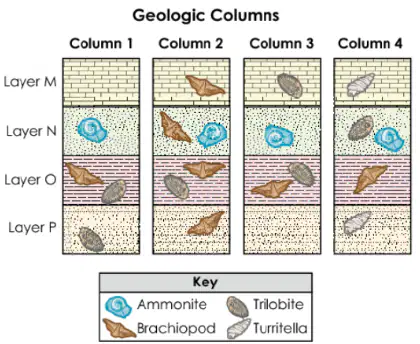
Which fossil would be most useful in determining the relative age for the rocks in these geologic columns?
(Hint: Which would serve as an index fossil?)
Ammonite
Branchiopod
Trilobite
Turritella

What does point C represent?
Amplitude
Trough
Crest
Wavelength

What does point A represent?
Amplitude
Wavelength
Crest
Trough

What is the number of complete waves passing a fixed point in a given amount of time?
Amplitude
Intensity
Wavelength
Frequency

What is the frequency of this wave? You must count the number of complete waves.
1 Hz
5 Hz
10 Hz

Which type of waves have the longest wavelength?
Visible light
Radio waves
X-rays
Gamma-Rays

Wavelengths are usually measured in ....
seconds
Hz
inches
meters

Shorter wave lengths can carry more energy. Which of these probably carries the MOST energy:
Infrared light
Visible light
X-rays
UV light

What is the distance between the calm sea and the highest wave called?
Wave
Frequency
Amplitude
Magnitude

Which refers to the passing of a wave through an object?
sound
interference
transmission
frequency
When light waves hit ice, most of them bounce off and radiate back into space. Because of this, ice is best described as which kind of surface?
reflective
absorbent
dense
rough

A wave hits an object as shown.
Which kind of wave interaction is shown?
absorption
diffraction
refraction
reflection

A wave hits an object as shown.
Which kind of wave interaction is shown?
absorption
diffraction
refraction
reflection

A wave hits a wall as shown.
As the wave interacts with a wall, which kind of wave interaction is shown?
absorption
diffraction
refraction
reflection

Hans observed properties of four different waves and recorded observations about each one in his chart.
Which statement is best supported by the table?
Wave W is being reflected, Wave X is being refracted, and waves Y and Z are being diffracted.
Wave X is being diffracted, Wave Z is being reflected, and waves Y and W are being refracted.
Wave X is being reflected, Wave Z is being refracted, and waves Y and W are being diffracted.
Wave W is being diffracted, Wave X is being reflected, and waves Y and Z are being refracted.

Which one of the following diagrams represents the highest FREQUENCY wave?
A
B
C
D

Which one of the following diagrams represents the
longest WAVELENGTH wave?
A
B
C
D

Which one of the following diagrams represents the highest amplitude of wave?
A
B
C
D


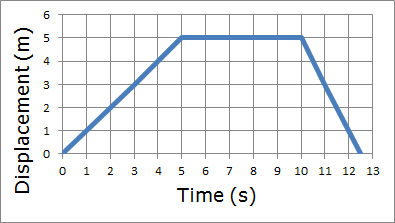
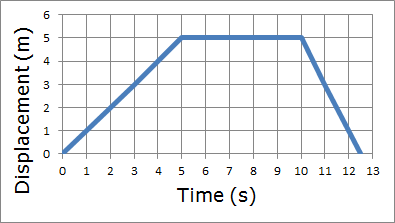

What is mass?
the amount of pounds something weighs
the amount of particles in an object
how far an object moves
You get tackled while playing football. Which player would cause you to move the greatest distance once they collide with you?
Billy Bob: 20 kg
Jim Bob: 50 kg
Bobby Bill: 70 kg
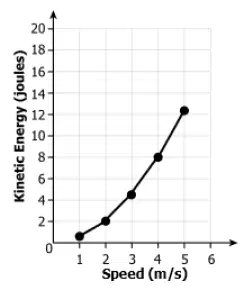
The graph shows the change in kinetic energy of a 1 kg object as the speed of the object increases from 1 m/s to 5 m/s.
Which graph correctly shows the change in kinetic energy of the object if the speed is further increased to 6 m/s?


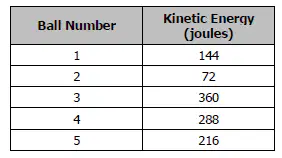
The table shows the kinetic energy of five balls of equal mass moving with different speeds.
Which two balls have the greatest speeds?
Ball 1
Ball 2
Ball 3
Ball 4
Ball 5

The table shows the masses, speeds, and measured values of the kinetic energy of four objects. Based on the table, what can be concluded about kinetic energy?
Kinetic energy of an object increases with an increase in mass of the object.
Kinetic energy of an object increases with a decrease in speed of the object.
Kinetic energy of an object does not vary with a change in mass of the object.
Kinetic energy of an object does not vary with a change in speed of the object.

What is the net force
10 N to the right
30 N to the right
10 N to the left
30 N to the left

What is the net force?
15 N
5 N to the left
5 N to the right
15 N left

What is the net force?
38 N to the left
38 N to the right
2 N to the left
2N to the right

What is the net force?
6 N to the right
9 N to the right
9 N to the left
15 N to the left

What is the net force?
19 N to the right
4 N to the left
7 N to the right
3 N to the right

What is the net force?
25 N
10 N down
5 N up
10 N up


