
 Worksheets
Final Exam Algebra 2, May 2018
Total questions: 113
Worksheet time: 8hrs 16mins
Name
Class
Date
1.
Factor
k2+7x+10
k2+7x+10
a)
(k+2)(k+5)
b)
(k-2)(k-5)
c)
(k+10)(k+4)
d)
(k+2)(k-5)
2.
Factor
k2 -2k - 24
k2 -2k - 24
a)
(k+4)(k-6)
b)
(k+4)(k+6)
c)
(k+6)(k-1)
d)
(k-4)(k+6)
3.
Factor
3v2 - 4v - 7
3v2 - 4v - 7
a)
(3v-7)(v+1)
b)
3(v-7)(v-1)
c)
(3v+1)(v-9)
d)
(3v+1)(v-10)
4.
Factor
3a2 + 4a + 1
3a2 + 4a + 1
a)
(7a-10)(a-8)
b)
Not factorable
c)
(3a+1)(a+1)
d)
(3a-1)(a-1)
5.
What is the term classification of the following polynomial?
x³-7x²+3
x³-7x²+3
a)
monomial
b)
binomial
c)
trinomial
d)
polynomial
6.
Which is an example of a linear polynomial?
a)
x²-5
b)
6x+4
c)
5x⁵
d)
2x³-9x²
7.
What is the leading coefficient of the following polynomial?
5x²-3x+6
5x²-3x+6
a)
2
b)
-3
c)
5
d)
6
8.
Which of these has a negative leading coefficient?
a)
x²+9x-4
b)
6x-9
c)
-8x+8
d)
9x
9.
What is the classification of the following polynomial?
x²-8x+10
x²-8x+10
a)
quadratic binomial
b)
cubic trinomial
c)
linear binomial
d)
quadratic trinomial
10.
Add the following polynomials:
(x³-2x²+3)+(2x³+3x²-1)
(x³-2x²+3)+(2x³+3x²-1)
a)
3x³-2x²+3x+2
b)
3x³+x²+2
c)
3x³-5x²-2
d)
3x³-x²+1
11.
Add the following polynomials
(x³-6x²+3)+(3x³+4x-1)
(x³-6x²+3)+(3x³+4x-1)
a)
4x³-2x²+2
b)
4x³-6x²+4x+2
c)
-2x³+2x+2
d)
4x³-2x²-2
12.
Subtract the following polynomials:
(3x²-3x+2)-(x²-2x+1)
(3x²-3x+2)-(x²-2x+1)
a)
2x²+x+1
b)
2x²-5x+3
c)
2x²-x+1
d)
4x²-5x+3
13.
What is the GCF in this polynomial?
3x²+6x-18
3x²+6x-18
a)
2
b)
3
c)
6
d)
18
14.
What is the GCF of the following polynomial?
2x³+4x²-12x?
2x³+4x²-12x?
a)
2
b)
4x
c)
x
d)
2x
15.
find f(0) if f(x) = -3x2 + 5x + 1
a)
1
b)
-2
c)
3
d)
5
16.
(x+3)(x+1) = ?
a)
x2+3x+3
b)
2x+4x+3
c)
x2+4x+3
d)
5x + 3
17.
5x(2x + 3) = ?
a)
10x2 + 15x
b)
7x + 15x
c)
7x2 + 8x
d)
25x2
18.

a)
The function has an Odd degree
b)
The function has an Even degree
c)
The function has 5 real zeros
d)
The function has a Positive coefficient
19.

a)
The function has an Even degree
b)
The function has a Negative coefficient
c)
The function has an Odd degree
d)
The function has 3 real zeros
20.

a)
The function is Positive and Even
b)
The function is Negative and Even
c)
The function is Negative and Odd
d)
The function is Positive and Odd
21.

What is the relative max?
a)
(0, 36)
b)
(-2.55, -6.55), (2.55, -6.55)
c)
(-∞, ∞)
d)
None
22.
The polynomial
f(x) = 5x4 + 2x3 + 2x − 7 can have, at most, how many solutions?
f(x) = 5x4 + 2x3 + 2x − 7 can have, at most, how many solutions?
a)
5
b)
4
c)
3
d)
2
23.
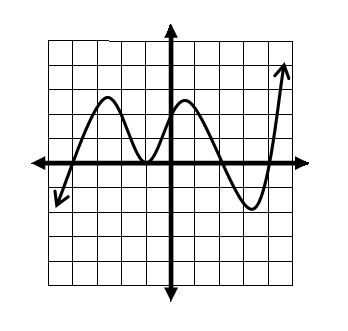
What is the equation in factored form of this graph?
a)
f(x) = (x-4)(x-1)2(x+2)(x+4)
b)
f(x) = (x-4)(x+1)2(x+2)(x+4)
c)
f(x) = (x-4)(x-1)2(x-2)(x+4)
d)
f(x) = (x+4)(x+1)2(x-2)(x-4)
24.
Determine the y-intercept
f(x) = x3 - 5x2 - 25x + 125
f(x) = x3 - 5x2 - 25x + 125
a)
(0,0)
b)
(0,25)
c)
(0,125)
d)
(0,5)
25.
Write a cubic polynomial in factored form that has zeros at x = 1, x = -1, and x = 0.
a)
(x - 1)(x + 1)
b)
x(x - 1)(x + 1)
c)
x2(x - 1)(x + 1)
d)
x(x - 1)(x - 1)
26.
What are the zeros of the polynomial and state their multiplicity at each.
y = (x - 5)(x + 2)2
y = (x - 5)(x + 2)2
a)
x = 5 multi 1, x = 2 multi 2
b)
x = -5 multi 2, x = -2 multi 1
c)
x = 5 multi 1, x = -2 multi 2
d)
x = 5 multi 2, x = -2 multi 1
27.
Translations, reflections and rotations are all known as ________________________.
a)
Geometry
b)
Transformations
c)
Congruent
28.

Name the transformation.
a)
Translation
b)
Reflection
c)
Rotation
29.
When you translate, you ______ a number to x and y.
a)
Add or subtract
b)
Multiply or divide
c)
Add or multiply
d)
Subtract or divide
30.
When you reflect a shape, you ______ over an axis or line.
a)
Flip
b)
Rotate
c)
Slide
d)
Expand
31.

Write a rule for the translation.
a)
(x -1, y + 2)
b)
(x -2, y + 1)
c)
(x +2, y - 1)
d)
(x +1, y - 2)
32.

Identify the transformation from ABC to A'B'C'.
a)
90o clockwise rotation
b)
90o counter clockwise rotation
c)
Reflection across the y-axis
d)
Reflection across the x-axis
33.
The point at which the X and Y axis intersect on the coordinate plane is called _______________.
a)
Graph
b)
Axis
c)
Quadrant
d)
Origin
34.

Which equation is shown?
a)
y = (x-2)2
b)
y = (x+2)2
35.
Which equation shows a function that is translated left 4 and 7 up?
a)
y = |x + 4| + 7
b)
y = (x - 4)2 + 7
c)
y = (x + 7)2 - 4
d)
y = |x + 4| - 7
36.

.
The blue graphs is the parent function f(x)=|x|, the red must be
The blue graphs is the parent function f(x)=|x|, the red must be
a)
g(x)=|x+2|
b)
g(x)=|x|+2
c)
g(x)=|x-2|
d)
g(x)=|x|-2
37.

If the blue graph is the parent function, what is the equation of the red (transformed) function?
a)
g(x)=x3+1
b)
g(x)=x3-1
c)
g(x)=(x-1)3
d)
g(x)=(x+1)3
38.
Which equation below is a quadratic function translated up 5 units?
a)
y = x2 + 5
b)
y = (x + 5)2
c)
y = 5x2
d)
y = -x2 - 5
39.

The graph shows the function f(x)=x2 in blue and another function g(x) in red. Which could be the equation for g(x)?
a)
A. g(x)=3x2
b)
B. g(x)=1/3x2
c)
C. g(x) = x2 - 3
d)
D. g(x) = (x-3)2
40.
Which transformation will occur if f(x) = x is replaced with f(x) + 2?
a)
Translation left 2 units
b)
Translation right 2 units
c)
Vertical translation up by 2 units.
d)
Reflection across the x-axis.
41.
How did the equation shift from the parent function? y = f(x - 4)
a)
Shift right by 4
b)
Shift left by 4
c)
Horizontal Stretch by 4
d)
Vertical Stretch by 4
42.
Describe the transformation that occurred.
w(x) = f(x - 7)
w(x) = f(x - 7)
a)
Down 7
b)
Up 7
c)
Right 7
d)
Less Steep
43.
The original graph is f(x). The new graph has been reflected across the x axis. The equation for the new graph in f(x) notation is:
a)
-f(x)
b)
f(-x)
44.
The original graph is f(x). The new graph has been moved up 3 and to the right 4. The new graph is:
a)
f(x + 3) - 4
b)
f(x - 4) + 3
c)
f(x + 4) + 3
d)
f(x + 3) + 4
45.
Which vocabulary word refers to changing the position on the x-axis or y-axis? (i.e. moving up, down, left, and right)
a)
Translations
b)
Dilations
c)
Reflections
d)
Transformations
46.
What are the following transformations?
- f(x+2)
- f(x+2)
a)
reflection over the y axis and 2 units to the right
b)
reflection over the x axis and 2 units right
c)
reflection over the y axis and 2 units left
d)
reflection over the x axis and 2 units left
47.
How many zeros does the polynomial function
P(x) = 3x4+4x-8 have?
P(x) = 3x4+4x-8 have?
a)
1
b)
2
c)
3
d)
4
48.
How many (total number of) solutions does the polynomial function
P(x) = x3+2x2+9x+18 have?
a)
0
b)
1
c)
2
d)
3
49.

Use the graph to determine the solutions.
a)
-1 and -3
b)
1 and -3
c)
1 and 3
d)
-1 and 3
50.

Use the graph of f(x) to find the real solutions of f(x)=0.
a)
0, 5
b)
-2
c)
0, -4
d)
no real solution
51.
f(x)=(x+4)(x-3)(x-2)
List the zeros for this function.
List the zeros for this function.
a)
x=-4, x=3, x=-2
b)
x=-4, x=3, x=2
c)
x=-4, x=3, x=2
d)
x=4, x=3, x=2
52.
True or false:
The solution, root, x-intercept, and zero of a problem are all the same thing.
The solution, root, x-intercept, and zero of a problem are all the same thing.
a)
True
b)
False, because the solution and root are the same but the x-intercept and zero are different
c)
False, because the x-intercept and root are the same but the zero and solution are different
d)
False, they are all different
53.
Which of the following is a 5th degree trinomial with a leading coefficient of -2?
a)
-2x5 + 3x - 1
b)
5x-2 +3x - 1
c)
-2x5 + 3x4 + 2x3 + x2 - 10
d)
2x + 5
54.
The polynomial
f(x) = 5x4 + 2x3 + 2x − 7 can have, at most, how many solutions?
f(x) = 5x4 + 2x3 + 2x − 7 can have, at most, how many solutions?
a)
5
b)
4
c)
3
d)
2
55.

The end behavior of a polynomial function is determined by the degree and the sign of the leading coefficient.
Identify the degree of the polynomial and the sign of the leading coefficient
Identify the degree of the polynomial and the sign of the leading coefficient
a)
Leading Coefficient Positive
Degree - Even
Degree - Even
b)
Leading Coefficient Positive
Degree - Odd
Degree - Odd
c)
Leading Coefficient Negative
Degree - Even
Degree - Even
d)
Leading Coefficient Negative
Degree - Odd
Degree - Odd
56.

The end behavior of a polynomial function is determined by the degree and the sign of the leading coefficient.
Identify the degree of the polynomial and the sign of the leading coefficient
Identify the degree of the polynomial and the sign of the leading coefficient
a)
Leading Coefficient Positive
Degree - Even
Degree - Even
b)
Leading Coefficient Positive
Degree - Odd
Degree - Odd
c)
Leading Coefficient Negative
Degree - Even
Degree - Even
d)
Leading Coefficient Negative
Degree - Odd
Degree - Odd
57.

The end behavior of a polynomial function is determined by the degree and the sign of the leading coefficient.
Identify the degree of the polynomial and the sign of the leading coefficient
Identify the degree of the polynomial and the sign of the leading coefficient
a)
Leading Coefficient Positive
Degree - Even
Degree - Even
b)
Leading Coefficient Positive
Degree - Odd
Degree - Odd
c)
Leading Coefficient Negative
Degree - Even
Degree - Even
d)
Leading Coefficient Negative
Degree - Odd
Degree - Odd
58.
What is the constant in the polynomial x2-2x+5?
a)
1
b)
2
c)
5
d)
0
59.
What is the leading coefficient in the polynomial 3x2-2x+5?
a)
3
b)
2
c)
5
d)
0
60.
What id the Degree of the Polynomial?
5x3 - 6x + 1
5x3 - 6x + 1
a)
Linear
b)
Quadratic
c)
Cubic
d)
Quartic
61.

a)
Even Degree
- Leading Coeff.
- Leading Coeff.
b)
Even Degree
+ Leading Coeff.
+ Leading Coeff.
c)
Odd Degree
- Leading Coeff.
- Leading Coeff.
d)
Odd Degree
+ Leading Coeff.
+ Leading Coeff.
62.

Lesly graphed two lines in order to find the solution to a given system of equations.
What is the solution?
What is the solution?
a)
(-3,-8)
b)
(-8,-3)
c)
(3,-8)
d)
(8,3)
63.
The solution (x, y) to a system of equations is the point where they...?
a)
Run off the graph
b)
Don't touch
c)
Intersect
d)
Exist
64.
Solve for x and y
3x + 2y = 16
7x + y = 19
3x + 2y = 16
7x + y = 19
a)
(-2,5)
b)
(-2,-5)
c)
(2,-5)
d)
(2,5)
65.
In a pasture are horses and chickens if there are a total of 28 animals and 80 legs how many chickens and horses?
a)
10 horses, 18 chickens
b)
16 horses, 12 chickens
c)
12 horses, 16 chickens
d)
18 horses, 10 chickens
66.

What is the solution?
a)
One Solution
b)
No solution
c)
Infinitely Many Solutions
67.
Solve for x and y
5x + 3y = 7
y = 4
5x + 3y = 7
y = 4
a)
(4,1)
b)
(4,-1)
c)
(1,4)
d)
(-1,4)
68.

How many solutions will this system have?
a)
No solution
b)
One Solution
c)
I Don't Know
d)
Infinitely Many Solutions
69.

a)
1
b)
2
c)
3
d)
4
70.
Given the system of equations:
y = x2 + 3x - 5
y = x + 3
When x = -4, what is the value of y?
y = x2 + 3x - 5
y = x + 3
When x = -4, what is the value of y?
a)
-1
b)
1
c)
7
d)
-33
71.

Determine the number of solutions to the given linear-quadratic system.
a)
0 solutions
b)
1 solution
c)
2 solutions
d)
3 solutions
72.

Determine the solution to the given linear-quadratic function.
a)
(0, 0)
b)
(3, 0)
c)
(2, -3)
d)
(-3, 2)
73.
Write logb(xy) as two logs
a)
logbx+logby
b)
logbx-logby
c)
logbx*logby
d)
logbx/logby
74.
Write logb(x/y) as two logs
a)
logbx-logby
b)
logbx+logby
c)
logbx*logby
d)
logbx/logby
75.
Evaluate logb(1)
a)
0
b)
1
c)
-1
d)
b
76.
Evaluate logb(b)
a)
-1
b)
0
c)
1
d)
b
77.
Evaluate blogb(x)
a)
x
b)
b
c)
1
d)
0
78.
Evaluate logb(bx)
a)
1
b)
0
c)
x
d)
b
79.
Expand log6(5x3/y).
a)
log65x3-log6y
b)
log65+log6x3-log6y
c)
log65+3log6x-log6y
80.
Write the expression as a single logarithm. Then simplify if possible.
log53 + log56 + log59
log53 + log56 + log59
a)
log569
b)
log556
c)
log5162
d)
log598
81.
Write the expression as a single logarithm. Then simplify if possible.
log 6 - log 3 + 2 log 7
log 6 - log 3 + 2 log 7
a)
log 98
b)
log 78
c)
log 56
d)
log 45
82.
The common logarithm has what base?
a)
10
b)
a
c)
e
d)
b
83.
The natural logarithm has what base?
a)
10
b)
a
c)
e
d)
b
84.
Rewrite 34 = 81 in logarithmic form.
a)
log34 = 81
b)
log813 = 4
c)
log381 = 4
d)
log481 = 3
85.
Simplify 8log8x
a)
0
b)
1
c)
x
d)
8
86.
Simplify 7log7(2x)
a)
0
b)
2x
c)
2
d)
1
87.
Simplify log443x
a)
3x
b)
3
c)
4
d)
43x
88.
Simplify eln(x)
a)
0
b)
1
c)
x
d)
8
89.
(34)(37)
a)
328
b)
33
c)
3-3
d)
311
90.
(x8)(x-5)
a)
x-40
b)
x-13
c)
x13
d)
x3
91.
(58) / (53)
a)
55
b)
15
c)
511
d)
111
92.
(v-5) / (v-9)
a)
v-14
b)
v4
c)
1/v4
d)
1/v14
93.
(85)3
a)
88
b)
815
c)
82
d)
1/82
94.
4-8
a)
18/4
b)
48/1
c)
4/18
d)
1/48
95.
(3x)0
a)
(3x)1
b)
01
c)
1
d)
3x
96.
Simplify
(2a2b4z)(6a3b2z5)
(2a2b4z)(6a3b2z5)
a)
8a5b6z6
b)
12a6b8z5
c)
12a5b6z6
d)
8a6b8z5
97.
(5x2y2)3
a)
125x6y6
b)
15x6y6
c)
8x5y5
d)
15x5y5
98.
4y6/3y2
a)
4y4/3
b)
7y8
c)
4y3/3
d)
2y3
99.
15x2y3z4/5z2
a)
3x2y3z2
b)
5x2y3z2
c)
45x2y3z6
d)
20yz-2
100.
Determine the values of
a, b, and c for
the quadratic equation:
4x2 – 8x = 3
a, b, and c for
the quadratic equation:
4x2 – 8x = 3
a)
a = 4, b = -8, c = 3
b)
a = 4, b =-8, c =-3
c)
a = 4, b = 8, c = 3
d)
a = 4, b = 8, c = -3
101.

What is this formula?
a)
This is the speed of light formula.
b)
This is the quadratic formula.
c)
This is the zero product property.
d)
This is scary.
102.

What is the name of the imaginary line that cuts a parabola in half and goes through the vertex?
a)
the middle
b)
axis of symmetry
c)
minimum
d)
standard form
103.
If the graph of a quadratic does not intercept the x-axis at any point, then it has:
a)
1 Real Solution
b)
2 Real Solutions
c)
Half a Solution
d)
No Real Solution
104.
Does the equation open or or down?
Y = -3x2 +7x - 2
Y = -3x2 +7x - 2
a)
up
b)
down
105.
Identify the 'b' value: y = 16x2 -8x -24
a)
16
b)
-8
c)
8
d)
-24
106.
Identify the 'a' value: y = 16x2 -8x -24
a)
16
b)
8
c)
-8
d)
-24
107.
Use the quadratic formula to solve 2x2 + 2x - 12?
a)
-2, 3
b)
2, 3
c)
2, -3
d)
-2, -3
108.
If the discriminant is zero you will have
a)
no real solutions
b)
two real solutions
c)
1 real solution
d)
1 imaginary solution
109.
If the discriminant is a perfect square you will have.....
a)
two real solutions
b)
two irrational solutions
c)
one solution
d)
two imaginary solutions
110.
If the discriminant is negative, you will have....
a)
two real solutions
b)
two irrational solutions
c)
two imaginary solutions
d)
one solution
111.
The discriminant is
a)
ax2 + bx + c
b)
b - 4ac
c)
b2 - 4ac
d)
b2 + 4ac
112.

How many zeros does this parabola have?
a)
3
b)
2
c)
0
d)
1
113.

a)
±81
b)
±9
c)
±3
d)
No real solution
100 %

